The elevator doors closed, sealing the four of us into a claustrophobic box of mirrored glass and brushed steel.
Dennis Hale didn’t notice the shift in the air.
He was too busy adjusting his cuffs, his face an impenetrable mask of corporate authority.
“Nora, when we step out, I’m having security escort Mr. Morrow to the lobby.
This charade ends now.”
I didn’t say a word.
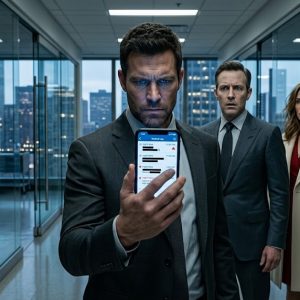
I simply turned the glowing screen of my phone toward Nora.
The text message was stark, but the attached PDF was damning.
It was an internal, unedited log from the automated medication dispensing system on the ICU floor.
PATIENT: Ashby, Richard
TIMESTAMP: 02:14 AM
OVERRIDE USER: D.
Hale (Legal Counsel/Proxy Auth)ACTION: Increased continuous infusion of Dexmedetomidine (Precedex) by 300%.
Cancelled scheduled morning neurological assessment protocol.
Nora gasped, the color draining from her face so fast she looked like a ghost in cashmere.
She looked from the phone to Dennis, her voice dropping to a dangerous, freezing whisper.
“Dennis… what is this?”
Dennis glanced at the screen.
For a fraction of a second, his left eye twitched.
The polished corporate lawyer vanished, replaced by a cornered predator.
“It’s a fabrication.
Nora, you’re letting a desperate handyman manipulate you with a doctored screenshot.
Anyone can fake a text.”
“The server logs don’t lie, Dennis,” I said, my voice carrying the weight of a man who had navigated hospital politics long before I ever picked up a toolbelt.
“You’re running a classic chemical cover-up.
The high-dose sedatives don’t just keep him quiet; they mimic the advanced staging of a glioblastoma.
They induce bradycardia, slurred speech, and acute cognitive decline.
You aren’t letting him die of a tumor.
You’re suffocating his brain so he signs over the final board voting rights before he passes.”
“You washed-up piece of garbage,” Dennis hissed, stepping into my space.
“You have no standing here.”
“I have two eyes and a medical degree you can’t erase,” I replied, standing my ground.
The elevator chimed, the doors sliding open to the sterile, quiet luxury of the VIP Intensive Care Unit.
Two burly security guards stood waiting, flanked by Dr. Weber, the elite German neurosurgeon Dennis had hired.
“Dennis, clear this up,” Dr. Weber said, his accent thick and impatient.
“The patient’s intracranial pressure is spiking.
We are preparing for palliative comfort care.”
“Perfect timing,” Dennis said, recovering his swagger.
“Guards, remove this trespasser from the building immediately.”
The guards stepped forward.
“Touch him,” Nora roared, her voice echoing through the pristine glass hallway, “and I will dismantle your entire security firm by sunrise.” She turned to the hospital administrators who had followed us up.
“As of this exact second, Dennis Hale is stripped of all legal proxies, medical power of attorney, and corporate standing at Ashby Capital.
He is a trespasser.
Remove him from my sight.”
Dennis laughed, a harsh, ugly sound.
“You can’t do that, Nora.
The board approved my temporary emergency proxy while your father is incapacitated.”
“The board approved it based on the medical reports you falsified,” I interrupted, flipping the tablet toward Dr. Weber.
“Doctor, look at the real EEG readings before the sedation override.
The tumor isn’t causing the flatline.
The drugs are.”
Dr. Weber grabbed the tablet, his eyes scanning the raw data.
His jaw dropped.
“Das ist… this cannot be.
These dosages are lethal for a patient with increased intracranial mass.
Who authorized this?”
Dennis backed away toward the exit, his phone already in his hand, frantically typing.
“This is a circus.
I’m calling a board meeting.”
“Call whoever you want from the back of a police cruiser,” Nora said, her eyes burning with a lifetime of betrayed trust.
“Security, hold Mr. Hale for the Chicago Police Department.
He is being charged with corporate fraud and attempted murder.”
The very guards Dennis had brought to remove me pinned his arms behind his back.
The Tom Ford suit crinkled as they pushed him against the wall.
He glared at me, his face twisted in venom.
“It doesn’t matter, Nora! Your father is a vegetable anyway! No one can cut into that brain and save him! He’s dead by midnight!”
The Anatomy of a Crisis
We burst into Richard Ashby’s room.
The room was a palace of medical technology, but the man in the bed looked incredibly small.
Vital signs blinked in frantic red.
-
Heart Rate: 42 bpm (Bradycardia)
-
Intracranial Pressure (ICP): 28 mmHg (Critically High)
-
Oxygen Saturation: 88%
“He’s herniating,” I said, the instincts of a decade of trauma surgeries taking over.
Eight years of building houses vanished.
I wasn’t Caleb the handyman anymore.
I was Dr. Morrow.
“Dr. Weber, we need to administer 20% Mannitol immediately to reduce the brain swelling, and we need to prep an emergency operating room.”
Weber looked at the monitors, completely paralyzed.
“The tumor wraps around the deep sylvian veins.
An approach from the lateral corridor is suicide.
It is inoperable.”
“It’s inoperable using your traditional approach,” I said, grabbing a sterile gown and tearing it open.
“We use a trans-sulcal contralateral approach.
We bypass the main vascular bundle by entering through the natural folds of the cortex.
It’s the exact mapping theory I presented in Boston twelve years ago.”
“That theory was never clinically validated!” Weber protested.

“Because hospitals like yours thought it took too long,” I snapped, looking him dead in the eye.
“It takes four hours longer, but it saves the patient.
Now, either get out of my way or start scrubbing in, because I am going into that OR.”
Nora stood by her father’s bedside, holding his cold hand.
She looked up at me, tears finally breaking through her fierce exterior.
“Caleb… your license.
If you do this and fail, they will put you in prison.
You have Eli to think about.”
I thought about my son in his dinosaur pajamas, waiting for a video call.
I thought about Sarah, whose face I couldn’t save because I had trusted a broken system.
And then I looked at Richard Ashby, the only man who had ever truly believed in my vision.
“If I walk away, he dies,” I said softly.
“Eli wouldn’t want a dad who let a man die out of fear.
Sign the emergency family consent form, Nora.
Let’s go to work.”
Five Hours in the Dark
The operating room was a theater of intense, heavy silence, broken only by the rhythmic, mechanical hiss of the ventilator.
My hands, scarred from years of handling rough lumber and heavy tools, felt strangely light inside the latex surgical gloves.
When I picked up the scalpel, my fingers didn’t shake.
The muscle memory was absolute.
The steel felt like an extension of my own body.
Focus on the margins, I told myself, a voice echoing from my past.
Forget the money.
Forget the tower.
Just look at the tissue.
For the first two hours, Dr. Weber did nothing but watch in absolute, stunned silence.
Using my mapping method, I meticulously navigated the deep corridors of Richard’s brain.
Every millimeter was a tightrope walk over permanent paralysis or fatal hemorrhage.
I used the natural pathways of the brain like a hidden path through a dense forest, moving past the critical speech centers without nicking a single vital vessel.
“Incredible,” Weber whispered under his breath as I exposed the deepest boundary of the tumor.
“The posterior plane… it’s completely free of the arterial wall.
You found a blind spot.”
“It wasn’t a blind spot,” I muttered, sweating under the hot surgical lighTS. “It was just a path that required patience.”
With a micro-curette, I began the painstaking process of debulking the mass.
Minute by minute.
Fragment by fragment.
By the fifth hour, the final piece of the tumor was placed in a pathology specimen cup.
The surrounding brain tissue relaxed, pulsing with healthy, oxygen-rich blood.
“ICP is down to 11,” the anesthesiologist announced, his voice filled with awe.
“Vital signs are completely stabilizing.”
I stepped back from the table, my shoulders aching, my mind exhausted, but my soul feeling lighter than it had in eight long years.
I looked at my hands.
They were steady.
A New Dawn in Tennessee
Three days later, the morning sun broke beautifully over the rolling hills of Clover Ridge, Tennessee.
I sat on my wooden porch steps, the chipped mug of Folgers in my hand.
There were no luxury cars blocking the dirt road.
No lawyers.
No cameras.
Just the quiet rustle of the wind through the oak trees.
The front door opened, and Eli walked out, rubbing his eyes.
He plopped down right next to me, leaning his head against my shoulder.
“Dad? Is the rich grandpa okay?”
I smiled, pulling him close.
“He’s doing great, buddy.
He woke up yesterday.
He even remembered my name.”
A sleek, unassuming silver SUV pulled up the driveway.
The door opened, and Nora Ashby stepped out.
She wasn’t wearing the cashmere coat or the red dress.
She was in a simple pair of jeans, a flannel shirt, and boots that looked like they actually knew what mud was.
She walked up the steps, a soft, genuine smile on her face.
“Morning, Caleb.
Morning, Eli.”
“Hi, Ms.
Nora!” Eli chirped.
“Did you bring more fancy cars?”
“No,” she laughed, sitting down on the step below us.
“I think I’ve had enough of fancy cars for a lifetime.
Dennis signed a full confession last night to avoid the maximum security facility.
The board has been purged, and my father is already demanding a laptop so he can look over our new corporate initiatives.”
She reached into her bag and pulled out a thick, official-looking document, legal-sized and stamped with the seal of the State Medical Board.
She handed it to me.
“What’s this?” I asked.
“Your full medical license, reinstated with retroactive emergency clearance,” Nora said, her eyes shining.
“And a personal proposal from Richard Ashby.
We are funding a brand-new, independent neurosurgical research institute in Nashville.
No corporate boards.
No cutting corners.
You run it.
You teach your mapping theory to the next generation.”
I looked down at the document.
My name was there: Dr. Caleb Morrow, MD, FACS.
“That’s a long commute from Clover Ridge,” I said quietly, looking around at our old, broken-down farmhouse.
Nora smiled, looking around the porch, then reached over and gently tapped the chipped wood of my stairs.
“Well, I hear the director of the institute has a lot of vacation time.
And I also hear he’s a pretty fantastic handyman.
Maybe he can finally fix this porch.”
Eli jumped up, clapping his hands.
“Can I have a dinosaur room in Nashville too, Dad?”
I looked at my son, then at Nora, feeling the warmth of the morning sun on my face.
The shadows of the past eight years had finally completely faded away.
“Yeah, buddy,” I laughed, pulling them both into a hug.
“You can have whatever color room you want.”