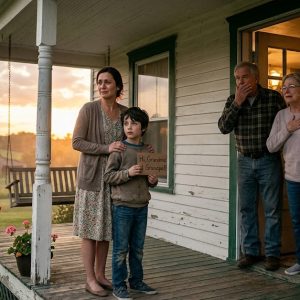
But they didn’t slam the door.
Instead, my father’s knees buckled.
A man who had once ruled our household with an iron fist and an unyielding pride collapsed onto the entryway bench, burying his face in his weathered hands.
My mother let out a low, ragged sob that sounded less like anger and more like a ghost leaving her body.
Noah Whitaker.
They knew the name.
The entire town of Oak Creek, Ohio, knew the name.
But to my parents, that name was a jagged piece of glass embedded in their hearTS.
Ten years ago, just three months before I stood in this very spot and told my parents I was pregnant, this town had suffered its greatest tragedy.
Maya Whitaker, a vibrant, beautiful seventeen-year-old girl, had gone missing on her way home from a high school football game.
The community searched for weeks.
The woods were combed, flyers were plastered on every lamppost, and volunteers marched through the freezing rain.
My family had been at the forefront of that search.
Noah Whitaker was Maya’s older brother.
He was twenty-one at the time, a quiet, fiercely protective young man who worshiped his little sister.
When the police eventually found Maya’s body in a shallow grave near the ravine, the town shattered.
But no one broke completely like Noah.
The grief consumed him.
He became a shadow, roaming the outskirts of town, his eyes hollowed out by a guilt he couldn’t escape because he was supposed to have picked her up that night.
What my parents never knew—what no one knew—was that in the dark, suffocating weeks following Maya’s funeral, Noah and I had found each other.
We weren’t lovers in a traditional sense; we were two drowning souls clinging to the same life raft.
I had been Maya’s closest friend, the one who shared her secrets, and Noah was the guardian who felt he had failed her.
We spent hours sitting in his rusted pickup truck by the overlook, weeping until our throats were raw, trying to make sense of a world that had suddenly turned so cruel.
And then, one devastating, rain-slicked night, the boundary between grief and comfort blurred.
It was a desperate, chaotic collision of two broken people trying to feel alive in the presence of so much death.
It happened only once.
A single night born out of pure, unadulterated sorrow.
Two weeks later, Noah’s truck veered off Route 4.
The police called it an accident—a slick road and heavy fog—but those who knew the depth of his despair whispered a different word.
Suicide. Noah was gone, buried right next to his sister, leaving the Whitaker family name completely wiped out.
There were no other siblings.
Their parents, completely hollowed out by the loss of both their children, sold their house within a month and vanished from Ohio entirely, moving out west to fade away in anonymity.
And three days after Noah’s funeral, I looked down at a plastic stick and saw two pink lines.
“Noah,” my mother whispered, her voice cracking as she stared at Leo.
She crawled forward on her knees, her eyes tracing every line of my son’s face.
Now that the truth was out, it was impossible to unsee.
Leo didn’t look like me.
He had the distinct, piercing blue eyes of the Whitaker family.
He had Noah’s jawline, the same slight cowlick at the crown of his dark hair, and that unmistakable, quiet gravitas that Noah had carried even as a boy.
“You…” My father finally looked up, his eyes bloodshot and brimming with tears.
“Emma… why didn’t you just tell us? Why did you let us think… why did you let me throw you out?”
“Because you were already broken!” I cried out, the ten years of pent-up pain finally rushing to the surface.
“Think about it, Dad! Maya was dead.
Noah was dead.
The police were investigating everything.
If I had told you I was pregnant with the baby of a boy who had just killed himself—a boy whose sister had just been murdered—what would you have done? You would have forced me to get an abortion even faster! You would have said his blood was cursed, that the grief would kill me, that it was a scandalous mess!”
My mother gasped, covering her mouth, unable to deny the truth of my words.
“I knew who Noah was,” I said, my voice trembling but resolute as I wrapped my arm tightly around Leo’s shoulders.
“He wasn’t a careless mistake.
He was a good man who got swallowed by darkness.
And when I found out I was pregnant, I realized something.
The Whitakers were gone.
Maya was gone.
Noah was gone.
This baby… this tiny heartbeat inside me… was the very last piece of Noah left on this earth.
It was the only piece of Maya’s family that survived the tragedy.
If I had aborted him, the Whitaker line would have ended in total darkness.
I couldn’t let death win.
I chose life.
I chose to save his legacy, even if it meant losing you.”
Leo looked up at me, his ten-year-old mind trying to process the magnitude of what he was hearing.
He didn’t understand the full weight of the tragedy, but he understood the most important part: “Mom… I’m named after a hero?”
 School Counselor Locks Her Office After Repeated Boundary Violations, Staff Call It ‘Uncollaborative’
“You are named after love and survival, sweetie,” I whispered, kissing the top of his head.
The silence that followed was heavy, filled with the ghosts of the past, but for the first time in a decade, the air in that house didn’t feel suffocating.
It felt like a clearing after a massive storm.
My father stood up slowly.
The rigid, stubborn posture he had maintained his entire life was completely gone.
He looked smaller, older, and profoundly humbled.
He walked over to the door where Leo and I stood.
I braced myself, unsure of what he would do.
Instead, he dropped to his knees right in front of my son.
“Leo,” my father said, his voice shaking violently.
“My name is Thomas.
I am your grandfather.
And I am a very, very foolish man.” He looked up at me, tears streaming freely down his wrinkled cheeks.
“Emma… I destroyed our family because I was blinded by pride and fear.
I thought I was protecting you from a mistake, but I was throwing away a miracle.
I don’t deserve your forgiveness.
I don’t ever expect it.
But please… let me know my grandson.
Let us try to fix the terrible thing I did.”
My mother joined him, reaching out a trembling hand, waiting for permission to touch Leo’s arm.
Leo looked at me, seeking guidance.
I nodded softly.
When Leo stepped forward and allowed his grandmother to pull him into a fierce, weeping embrace, I felt a physical weight lift off my chest.
The grudge I had carried through two jobs, sleepless nights, and endless poverty didn’t vanish, but it began to melt.
We stayed in Ohio for a week.
We didn’t move back into my parents’ house right away—too much history lived in those rooms—but we stayed at a nearby hotel and spent every day together.
My parents couldn’t take their eyes off Leo.
They watched him play, listened to him talk about his favorite school subjects, and marveled at how a boy raised by a struggling single mother could be so whole, so kind, and so deeply loved.
On our final day in town, I took Leo to the Oak Creek Cemetery.
The sun was shining through the maple trees, casting long, warm shadows across the grass.
We walked past the older headstones until we reached the quiet plot where two black granite stones stood side by side: Maya Whitaker and Noah Whitaker.
For ten years, I had avoided this place.
But standing there now, holding my son’s hand, I didn’t feel the suffocating grief that had defined my nineteen-year-old self.
“Is this him, Mom?” Leo asked softly, looking down at the name engraved in the stone.
“Yes, Leo.
That’s your father,” I said.
“He couldn’t stay with us, but he left the best part of himself behind.
Look at your reflection in the polished stone.
You carry his eyes.
You carry his heart.
And because of you, he is never truly gone.”
Leo knelt down and placed a small, smooth stone he had found on the riverbank onto the top of Noah’s headstone—an ancient gesture of remembrance.
“Hi, Dad,” he whispered.
“Mom took real good care of me.
You don’t have to worry anymore.”
A gentle breeze rustled the leaves above us, feeling remarkably like a soft stroke against our cheeks.
As we walked back to the car, I saw my parents waiting by the cemetery gates.
They hadn’t followed us to the gravesite, giving us our privacy, but they were there, standing together, waiting to take us to dinner before our long drive back home.
My world had fallen apart when I was nineteen, shattered by death, secrets, and a door slammed in my face.
But looking at my parents holding out their arms for Leo, and seeing my son run toward them with a bright, carefree laugh, I realized something profound.
Sometimes, the things that fall apart are put back together in ways we never could have planned.
It took ten years of silence, but out of the ashes of a town’s greatest tragedy, a new beginning had finally grown.
We were broken, yes—but we were finally whole.