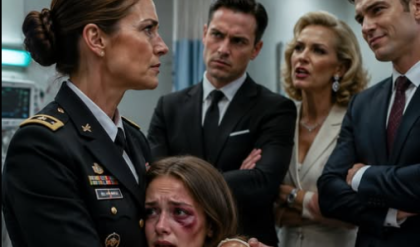
Fifteen years later, I walked back into Boston with a different name on my business card, a steel plate in my hip, and a folder full of ghosTS.
My parents did not recognize me at first.
That was the strangest part.
Not the courthouse.
Not the cameras waiting outside.
Not Lauren standing beside her husband with the same golden hair, the same perfect posture, the same frightened little smile she had practiced since childhood.
The strangest part was watching my mother stare at me like I was a stranger.
Then her face went pale.
“Sarah,” she whispered.
I had not heard my name in her mouth for nine years.
After the fall, they had buried me alive in paperwork.
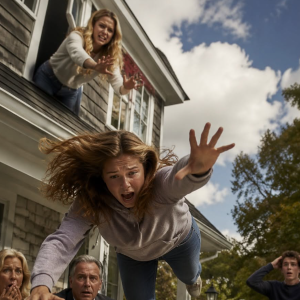
The police report said I had climbed onto the roof to take photographs and slipped.
My father used his medical reputation to explain my injuries.
My mother gave tearful statements about how “creative children sometimes take reckless risks.” Lauren cried into a tissue and said she had tried to stop me.
Everyone believed them.
Everyone except one person.
Dr. Elise Warren.
She was the orthopedic surgeon on call that night.
She was the woman who looked at my X-rays and frowned.
“These injuries do not match a simple slip,” she told my father.
My father’s face hardened.
“You are young,” he said coldly.
“Do not make accusations you cannot prove.”
Dr. Warren said nothing then.
But she kept copies.
Years passed.
I healed badly.
I walked with pain.
I left home at eighteen with a scholarship, a camera, and one suitcase.
I never went back.
I became a documentary photographer, not because my family made me invisible, but because invisibility taught me how to see.
Then, fifteen years after the fall, my mother made one final mistake.
She wrote a memoir.
The Perfect Family: Grace Under Pressure.
In chapter twelve, she described “the tragic roof accident that nearly destroyed us.” She called me unstable.
Careless.
Attention-seeking.
She wrote that Lauren had saved my life by screaming for help.
That lie became a bestseller.
And for the first time, the lie had a price tag.
My lawyer filed the lawsuit the next morning.
Defamation.
Fraud.
Intentional infliction of emotional distress.
Civil conspiracy.
And, because Dr. Warren finally agreed to testify, a request for the district attorney to reopen the criminal investigation.
The Wilson family thought I wanted money.
They never understood.
I wanted the truth placed somewhere they could not polish it.
Under oath.
The courtroom was full on the first day.
My father sat straight-backed in an expensive navy suit, looking offended that justice had dared schedule itself without his permission.
My mother wore pearls.
Lauren wore cream, as if innocence had a color.
When I took the stand, Lauren would not look at me.
My lawyer, Marianne Cole, placed the enlarged X-ray images before the jury.
“Ms.
Wilson,” she said, “what do these show?”
I looked at the white fractures glowing against black.
“They show where my body broke.”
My mother flinched.
Marianne nodded.
“And what did your family tell police?”
“That I slipped.”
“Did you slip?”
I turned my head slowly toward Lauren.
“No.”
The room went silent.
“My sister put both hands on my shoulders and pushed me.”
Lauren’s husband grabbed her hand.
She pulled away.
Then Marianne called Dr. Warren.
She was older now, silver-haired, calm, terrifyingly precise.
“These injuries,” Dr. Warren told the court, “were consistent with force applied from the front or upper torso before the fall.
The bruising pattern on Ms.
Wilson’s shoulders was not consistent with a backward slip.
It was consistent with hands.”
My father’s jaw tightened.
Then came the records.
Hospital notes my father had tried to suppress.
A nurse’s statement saying my mother told staff, “She fell while taking pictures.
That is what happened.”
A neighbor’s deposition confirming she heard my mother mention blood on the patio before asking if I was breathing.
And finally, the camera.
My old Nikon had survived the fall.
The police never took it seriously because my parents told them it contained “school photographs.”
But fifteen years later, a forensic expert recovered damaged image data from the corrupted memory card.
The last photo loaded slowly onto the courtroom screen.
Lauren’s face appeared above me.
Her hands were extended.
Her mouth was not open in fear.
She was smiling.
A sound moved through the courtroom like the whole room had inhaled at once.
My mother covered her mouth.
My father stared at the screen as if he could intimidate the past into disappearing.
Lauren stood up.
“That doesn’t prove anything,” she said.
The judge ordered her to sit.
But she did not.
Her perfect mask finally cracked.
“You ruined everything,” she whispered at me.
I felt no fear.
Only sadness.
“No, Lauren,” I said quietly.
“You did.”
She began to cry then, but this time nobody moved to comfort her.
Not her husband.
Not my father.
Not even my mother.
Because everyone in that room understood the truth at the same time.
Lauren had not been protecting the family.
The family had been protecting Lauren.
And in doing so, they had sacrificed me.
The verdict came three days later.
The jury found in my favor on every civil claim.
The district attorney reopened the criminal case before the sun went down.
 Vet Receptionist Blames The Doctor For Every Mistake, Now One Cat Owner Wants The Truth To Come Out
My mother’s publisher canceled the book tour.
My father resigned from the hospital board.
Lauren’s husband filed for separation within a week.
But the moment that stayed with me happened outside the courthouse.
My brother Tyler was waiting by the steps.
He looked older.
Tired.
Ashamed.
“I knew,” he said.
I stopped.
He swallowed hard.
“Not everything.
I was eleven.
But I heard Mom and Dad talking that night.
Dad said if Lauren went to prison, the family was finished.
Mom said you were strong enough to survive being hated.”
For a moment, the whole world narrowed.
“Why didn’t you tell anyone?”
His eyes filled with tears.
“Because I was a coward.”
I wanted to hate him.
Part of me did.
But another part of me remembered the boy who had also been raised inside that beautiful house where love was rationed like medicine.
So I said the only thing I could.
“Then don’t be one anymore.”
At Lauren’s criminal hearing six months later, Tyler testified.
So did Dr. Warren.
So did I.
Lauren pleaded guilty before trial.
My parents came to the sentencing, but they did not speak for her.
They sat in the back row, smaller than I remembered, stripped of reputation, stripped of control, finally forced to be ordinary.
Before the judge sentenced Lauren, she turned toward me.
For the first time in my life, she looked like someone who had run out of performances.
“I hated you,” she said.
“Because you escaped being what they wanted.
And I didn’t.”
It was not an apology.
But it was the closest thing to truth I had ever heard from her.
The judge sentenced her to prison.
Not forever.
But long enough.
Long enough for the world to stop calling it an accident.
Long enough for my sixteen-year-old self to finally be believed.
Afterward, my mother approached me outside the courtroom.
Her pearls were gone.
Her voice was thin.
“Sarah,” she said, “we made mistakes.”
I looked at the woman who had taught me that image mattered more than blood, more than pain, more than a daughter’s body broken on stone.
“No,” I said.
“You made choices.”
She began to cry.
Years ago, I would have done anything for those tears.
I would have apologized for being hurt.
I would have comforted her for hurting me.
But I was not sixteen anymore.
I walked away.
A year later, I opened my first major gallery exhibition in New York.
The title was Bones Do Not Lie.
The first photograph was not of Lauren.
Not of the roof.
Not of the patio.
It was a self-portrait.
Me, standing beneath a white wall, my surgical scars visible, my camera in my hand, my eyes looking straight into the lens.
Under the photo, I placed one sentence:
I was not careless.
I was betrayed.
And I survived.
On opening night, Dr. Warren came.
Tyler came too.
He stood in front of the self-portrait for a long time, then whispered, “I’m proud of you.”
I believed him.
Not because he was family.
But because he had finally earned the right to say it.
My parents never came.
Lauren wrote once from prison.
The envelope sat unopened on my kitchen table for three weeks.
When I finally read it, the letter was short.
She did not ask for forgiveness.
She wrote, “I remember your face when you fell.
I have seen it every night since.”
I folded the paper and put it away.
Not because it healed anything.
But because truth, even late, deserves a place to rest.
People always ask if justice fixed me.
It did not.
Justice does not erase scars.
It does not rebuild childhood.
It does not give back the girl who lay on cold stone while her mother worried about blood stains.
But justice did something quieter.
It returned ownership.
Of my story.
Of my body.
Of my name.
And one October afternoon, exactly sixteen years after the fall, I drove back to Brookline alone.
The Wilson house had been sold to another family.
Children’s bicycles leaned against the porch.
A basketball sat in the driveway.
The white hydrangeas were gone, replaced by wild lavender.
I stood on the sidewalk for a long time.
Then I lifted my camera.
I did not photograph the roof.
I photographed the lavender.
Something living where something cruel had once been planted.
And as I lowered the camera, I realized I was no longer waiting for anyone in that house to love me correctly.
I had built a life outside their lie.
A life with truth in the walls.
A life where silence was no longer survival.
A life where the girl who fell finally landed somewhere safe.
This time, when I walked away from the Wilson house, I did not look back.
Because some families teach you what love is.
And some teach you exactly what it is not.
Mine taught me the difference.
And that saved me.