

Rain hammered the city like a restless witness refusing to stay silent.
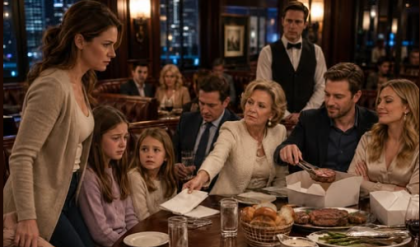
Inside the upscale restaurant, the glass container on the table looked ordinary now—too ordinary for what it held.
But Margaret Reed knew better.
Nothing about it was simple anymore.
Not the drink.
Not the smiles that had left her table minutes earlier.
Not even the daughter she had once believed she raised with love.
Daniel, the waiter, stood rigid beside her, watching the sealed evidence as if it might breathe.
“I keep thinking I should’ve stopped them,” he whispered.

Margaret didn’t look up.
“You did stop them.
That’s why I’m still alive.”
The words settled between them like a weight that had finally found the ground.
Outside, Claire and Evan were already gone into the storm.
But Margaret was not finished with them.
Detective Lena Ortiz arrived twenty minutes later.
She did not enter like someone coming for dinner.
She entered like someone stepping into a scene she had already seen too many times in other forms—just never involving Margaret Reed.
Her eyes dropped immediately to the sealed container.
“You called me in code,” Lena said quietly.
“That means you’re sure.”
“I don’t deal in uncertainty,” Margaret replied.
That made Lena exhale once, slow and controlled.
Then she looked at Daniel.
“Tell me what you saw.
Exactly.”
Daniel swallowed.
His hands trembled, but his voice did not break.
“He tried to contaminate her drink,” he said.
“The son-in-law.
I saw him pass something.
The other server refused.
He did it himself.”
Lena didn’t react emotionally.
She simply nodded once, already shifting the moment into procedure.
“Chain of custody?” she asked.
Margaret pushed the signed container forward.
“Clean.
Witnessed.
Sealed.”
Lena’s gaze lingered a fraction longer than necessary.
“You’ve done this before.”
“I taught people how to survive people like this,” Margaret said.
A silence followed that statement—heavier than rain.
Then Lena stood up.
“I’m calling this in.
If what you’re implying is true, we’re dealing with attempted poisoning of a protected witness-level civilian.”
Margaret corrected softly, “Not a witness.
A target.”
That distinction changed the air in the room.
By midnight, the restaurant was no longer a restaurant.
It had become a controlled perimeter.
Two uniformed officers sealed the exiTS. Evidence technicians moved quietly across the polished floor like shadows with purpose.
The glass container was already on its way to the state lab.
But Margaret wasn’t looking at any of that.
She was watching her phone.
Waiting.
Because she knew Claire.
And Claire always called when she thought the story was going according to plan.
At 12:17 a.m., the message arrived.
CLAIRE: Mom, we need to talk.
Something is wrong.
Evan says you’ve been confused lately.
Please don’t let anyone manipulate you.
Margaret read it twice.
Then she finally understood something she should have seen years ago.
This wasn’t panic.
It was adjustment.
They didn’t think they had failed.
They thought the system had failed them.
Her reply was slow.
Deliberate.
MARGARET: I’m not confused.
I remember everything.
Three dots appeared instantly.
Then stopped.
Then disappeared.
For the first time that night, Claire had nothing to say.
Detective Lena returned to the table.
“We’ve tracked them to a private residence in the north district,” she said.
“They’re still together.”
Margaret stood.
“So we go.”
Lena hesitated.
“You don’t have to be part of the arrest.”
Margaret picked up her coat.
“That’s where you’re wrong,” she said.
“I’ve been part of it since the first lie they told me.”
The drive through the rain was silent.
Daniel stayed behind at the restaurant, shaken but protected.
Lena drove.
Margaret sat beside her, staring at reflections of streetlights breaking across wet asphalt like fractured memories.
“You’re calm,” Lena said after a while.
“I’ve buried calmer emotions than this,” Margaret replied.
That earned her a brief glance.
“You really think your son-in-law planned to—”
“To remove me,” Margaret finished.
“Yes.”
“And your daughter?”
That question landed harder than the rest.
Margaret didn’t answer immediately.
When she finally did, her voice was quieter.
“I think she stopped asking questions a long time ago.
That’s not the same as innocence.”
Lena didn’t respond.
There were no good answers to that.
The house was lit like a promise.
Warm.
Perfect.
Carefully staged.
The kind of place people built when they wanted to look untouchable.
Claire opened the door before they knocked.
She smiled when she saw her mother.
It was a practiced smile.
Not relief.
Not surprise.
Performance.
“Mom,” Claire said softly.
“We were worried.”
Evan appeared behind her, adjusting his cufflinks.
Then he saw Lena.
And the smile changed.
Just slightly.
Not fear.
Calculation.
“You brought police?” Evan asked.
Margaret stepped forward.
“You brought poison,” she replied.
The air froze.
Claire laughed once—short, disbelieving.
“What are you talking about?”
Margaret held her gaze.
“I’m talking about the drink you told me to finish.”
A flicker.
So small most people wouldn’t notice it.
But Margaret had spent her life noticing what others missed.
Evan recovered first.
“This is absurd,” he said calmly.
“Margaret has been under stress.
She’s imagining things.”
Lena stepped forward, badge visible now.
“Then you won’t mind coming down to the station while we clarify it.”
Claire’s expression cracked for the first time.
“Mom… what did you do?”
That question should have been simple.
But it wasn’t.
Because Claire still didn’t understand.
Margaret looked at her daughter—not the version she had raised, but the version standing in front of her now.
“I did what you didn’t expect,” Margaret said.
“I survived you.”
The arrest happened quietly.
No shouting.
No struggle.
Just the sound of consequences arriving late but arriving completely.
Evan tried to negotiate.
Even then.
That told Margaret everything she needed to know about him.
Claire didn’t resist.
She only kept looking at her mother like she was waiting for the story to change back into something gentler.
But it didn’t.
Stories don’t undo themselves just because someone wishes they would.
Two weeks later, the lab results confirmed everything.
The substance had been slow-acting.
Carefully chosen.
Designed not to look like murder until it was too late to trace intent.
But intent had already been caught—in fingerprints, in surveillance gaps, in witness testimony, in the tremor of a waiter who refused to become complicit.
Daniel testified.
Lena ensured the case held.
Margaret never once raised her voice in court.
She didn’t need to.
On the final day of proceedings, Claire requested to see her mother.
They met in a supervised room.
No glass between them.
Just distance.
Claire looked smaller than she had in the house.
Or maybe Margaret was finally seeing her without illusion.
“I didn’t know it was that far,” Claire said.
Margaret studied her.
“That’s the problem,” she replied.
“You stopped wanting to know where far begins.”
Silence.
Then Claire whispered, “Did you ever love me less because of this?”
Margaret’s answer came after a long pause.
“No,” she said.
“I loved you less because you stopped being honest.
Not because you stopped being mine.”
Claire closed her eyes.
That hurt more than anger would have.
Evan received a sentence that matched intent, not just outcome.
Claire avoided the harshest penalty, but not the truth of what she had participated in.
The case became a quiet example in legal circles.
Not because it was dramatic.
But because it was preventable.
If someone had asked the right question earlier.
If someone had refused to normalize control.
If someone had listened to the smallest warning at the right moment.
Months later, Margaret returned to the restaurant alone.
Daniel greeted her like someone who had learned what survival looked like in real time.
“The table is still yours,” he said.
“I think I’ll sit somewhere new,” she replied gently.
She chose a seat by the window.
Rain fell outside again.
But this time, it didn’t feel like a threat.
It felt like distance.
A clean separation between what was lost and what remained.
Daniel brought her water.
Unasked.
Untouched by anyone else.
Margaret looked at the glass for a long moment.
Then she smiled—not because everything was good again.
But because she now understood something she hadn’t before:
Survival isn’t the moment you escape danger.
It’s the moment you stop calling it love.
And outside, the city kept moving—unaware that one woman had quietly taken her life back without asking permission from anyone who once tried to take it away.
Related Posts
Eight Months Pregnant, Locked Outside in Deadly Heat by My Husband—They Mocked My Collapse Until Black SUVs Rolled Into the Driveway and Changed Their Lives Forever
Thirty Minutes After They Toasted My “Failure,” My Ex-Husband’s Family Came Home to Find Their Empire on the Lawn—Because the House They Thought Was Theirs Had Never Belonged to Them
Every Night My Sister-in-Law Slept Between My Husband and Me—When I Learned She Wasn’t Afraid of Ghosts but of the Man Beside Me, One Terrifying Night Exposed a Family Secret That Changed All Our Lives Forever