HomeNewsPart 3 The Beach Cabana That Looked Like Luxury Until One Entitled Woman Humiliated a 90-Year-Old Grandmother and Triggered a Chain of Consequences That Turned a Quiet Family Vacation Into Public Accountability and Unexpected Justice
Part 3 The Beach Cabana That Looked Like Luxury Until One Entitled Woman Humiliated a 90-Year-Old Grandmother and Triggered a Chain of Consequences That Turned a Quiet Family Vacation Into Public Accountability and Unexpected Justice
It kept rolling in, wave after wave, soft and endless, like nothing in the world could ever be wrong for long.
But for me, something had already shifted so deeply that I could feel it in my chest with every breath.
I stood a few steps away from the cabana entrance, watching the woman in the designer swimsuit still lounging on the sofa I had paid for.
She looked bored now, not even aware that her moment of control was already slipping away.
Her friends were still laughing, but it was quieter.
Uneasy.
Like they could sense something coming.
Behind me, my children were with Grandma.
I didn’t turn around, but I knew exactly what I would see if I did—her small, trembling hands still holding onto dignity by a thread she didn’t deserve to have cut in the first place.
That was the moment I stopped thinking like a tired son, or a frustrated customer, or even an angry man.
I started thinking like someone who had evidence.
I walked back into the cabana area.
Not fast.
Not aggressively.
Just… deliberately.
The kind of calm that makes people uncomfortable before they even understand why.
The woman finally noticed me properly.
She sat up slightly, sunglasses sliding down her nose.
“Oh,” she said.
“You again.”
I looked at her for a second without speaking.
Then I held up my phone.
“I just want to make sure you understand something,” I said quietly.
She rolled her eyes.
“Oh my God, is this still going on? It’s a chair.
Move on.”
I tapped the screen.
“I’ve recorded everything.”
That sentence changed the air immediately.
Her friend’s laughter stopped first.
Then the silence spread.
She frowned.
“Recorded what?”
I didn’t answer right away.
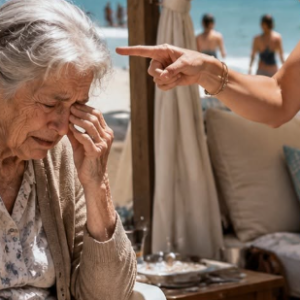
Instead, I turned the screen slightly so she could see the video thumbnail—my grandmother being pushed aside, her bag thrown onto the sand, her shaking hands trying to explain herself while being ignored.
Her expression flickered for half a second.
Then hardened.
“So what?” she said.
“She was in the wrong place.
It happens.”
That was the moment something inside me went very still.
Not anger.
Not shock.
Just clarity.
Because people like her always reveal themselves twice.
Once when they feel powerful.
And again when they think there are no consequences.
“I’m going to ask you one time,” I said.
“Move out of that cabana.”
She laughed.
Actually laughed.
“You’re not serious.”
I nodded once.
“I am.”
She stood up slowly now, annoyed, like I was wasting her time.
“You don’t even know who I am,” she said.
“Do you have any idea what kind of connections I—”
“I don’t care,” I interrupted.
That surprised her.
People like her expect fear.
Or respect.
Or hesitation.
What they don’t expect is indifference.
A man in a resort uniform arrived behind me.
Then another.
Then the manager.
I didn’t call attention to them.
I didn’t have to.
They had already watched the footage I sent from my phone a few minutes earlier—the full clip, timestamped, with guest ID records attached to the cabana reservation.
The manager looked uncomfortable before he even spoke.
“Sir,” he said carefully, “we’ve reviewed the situation.”
The woman straightened immediately.
Finally, something she recognized—authority.
“Good,” she said.
“Then you can tell him I was just trying to help.
That old lady—”
The manager raised a hand.
“No,” he said firmly.
“That’s not what happened.”
The silence that followed was sharp.
Even the ocean noise seemed to fade for a second.
He continued, more formal now.
“You forcibly removed a registered guest.
You had their belongings thrown out.
And you misrepresented them to staff.”
Her face tightened.
“Excuse me?”
“And,” he added, “you used discriminatory language regarding age.”
That word landed harder than anything else.
Discriminatory.
Not emotional.
Not opinion.
Official.
For the first time, she looked slightly uncertain.
“You’re seriously taking their side over a paying VIP guest?” she snapped.
The manager didn’t blink.
“Ma’am, that guest also paid.
In full.
For a private reservation.
Under their name.
With verification.”
I watched her process that.
Slowly.
Like a system failing.
One of her friends leaned in and whispered something to her.