
They thought my silence meant I was calculating how to surrender.
They had no idea I was giving them one final chance to choose decency before the door closed forever.
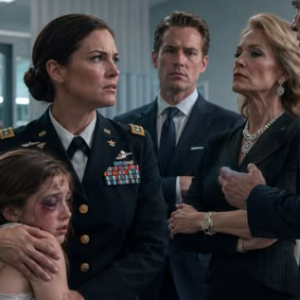
Nicholas stood there in his expensive gray suit, his wedding ring flashing beneath the hospital lights as if it still meant something.
Patricia’s chin remained lifted with that practiced arrogance only old money could teach.
Gregory kept smiling, but his eyes had begun to narrow, trying to read me.
I had seen that look before.
Men in boardrooms.
Officers in crisis briefings.
Commanders before impossible decisions.
People who suddenly realized the person in front of them was not afraid.
I looked at Patricia first.
“You said my rank doesn’t frighten you.”
Her smile sharpened.
“It doesn’t.”
“Good,” I said softly.
“It was never supposed to.”
The room went quiet.
I reached behind me and pressed the call button beside Abigail’s bed.
Nicholas scoffed.
“Calling a nurse won’t change what happened.”
“No,” I said.
“But Abigail’s statement will.”
Patricia’s face twitched.
Only slightly.
But I saw it.
For the first time, Abigail lifted her head from my shoulder.
Her swollen eye made it difficult for her to focus, but her voice, though trembling, was clear.
“They locked me in the guest house for three days.”
Nicholas took a step forward.
“Abigail, stop.”
I moved between them.
He froze.
Not because I touched him.
Because for one second, he saw what I had spent thirty years learning to control.
Rage with discipline.
Pain with purpose.
A storm that did not need to shout.
Abigail continued, her fingers tightening around the blanket.
“They took my phone.
Patricia said if I embarrassed the family, she would make everyone believe I was unstable.
Gregory said Nicholas could replace me before anyone believed me.”
Gregory’s smile disappeared.
“You spoiled little—”
“Finish that sentence,” I said.
He closed his mouth.
The nurse returned with hospital security behind her.
Patricia’s expression changed instantly.
Her voice became smooth, offended, almost wounded.
“This is ridiculous.
We are a respected family.
My daughter-in-law had a panic episode.
Colonel Gardner is clearly emotional.”
The nurse did not look at her.
She looked at Abigail.
“Mrs. Ferguson,” the nurse said gently, “do you feel safe with these people in the room?”
Abigail stared at Nicholas.
For a moment, I saw the battle inside her.
Fear was still there.
Love, maybe, or the memory of what she once believed love had been.
Shame too, though none of it belonged to her.
Then she looked at me.
And I nodded once.
Not commanding.
Just reminding her.
You are not alone.
“No,” Abigail whispered.
Then louder, “No.
I do not feel safe with them.”
Security moved immediately.
Nicholas’s face turned red.
“You cannot remove me from my wife’s room.”
The nurse’s voice hardened.
“She is the patient.
She has the right to decide who remains.”
Patricia laughed coldly.
“Do you know who we are?”
A new voice answered from the hallway.
“Yes, Mrs. Ferguson.
We do.”
Everyone turned.
Two police detectives stepped into the room.
Behind them came a woman in a navy pantsuit, carrying a leather folder.
Her silver hair was pulled back neatly, and her eyes were steady, sharp, and familiar.
Patricia went still.
For the first time since I arrived, she looked uncertain.
“Eleanor?” she breathed.
The woman did not smile.
“Hello, Patricia.”
Nicholas looked between them.
“Mother, who is this?”
I looked at my daughter.
Abigail’s lips parted in shock.
The woman stepped closer.
“My name is Eleanor Whitcomb,” she said.
“I was your family’s attorney for twenty-one years.”
Gregory paled.
Patricia whispered, “You have no right to be here.”
Eleanor opened the folder.
“I have every right.
Two months ago, Abigail contacted me privately.
She said she was afraid something would happen to her.
She asked me to hold certain documents in trust in case she disappeared, was hospitalized, or was declared mentally unstable by your family.”
Nicholas’s confidence cracked.
“That’s a lie.”
Eleanor removed a small flash drive from the folder.
“No, Nicholas.
The lies are on here.”
Patricia’s diamonds trembled against her ears.
Abigail stared at the flash drive as if it were a miracle.
“You got it?” she whispered.
Eleanor’s face softened.
“You hid it very well, sweetheart.”
Then she turned to the detectives.
“This contains audio recordings, medical photographs from previous incidents, financial records showing coercive control, and security footage from the Ferguson guest house.
I am turning it over voluntarily on behalf of my client.”
Nicholas lunged forward.
Security caught him before he crossed half the room.
“That belongs to us!” he shouted.
One of the detectives stepped in front of him.
“Mr. Ferguson, I suggest you stop speaking.”
Patricia recovered quickly, but now her voice had lost its silk.
“You think some edited files will destroy us? We have judges, donors, journalisTS. You have no idea what you are starting.”
Eleanor looked almost sad.
“You always believed power was a locked room, Patricia.
You forgot that doors open from both sides.”
Then the detective looked at Abigail.
“Mrs. Ferguson, when you are ready, we would like to take your statement.
A forensic nurse is already on the way.
You are under no pressure to speak before you receive care.”
Abigail began to cry.
Not the broken, terrified kind.
This cry sounded like the first breath after being underwater too long.
I held her hand.
Nicholas stared at her as if she had betrayed him.
That told me everything I needed to know.
Even now, he did not see a woman he had harmed.
He saw property that had escaped.
“You’ll regret this,” he said to her.
Before I could move, Abigail spoke.
“No,” she said.
The room froze.
She sat a little straighter, her body shaking, but her voice steadier than before.
“I regret marrying you.
I regret believing your apologies.
I regret hiding the truth because I thought shame belonged to me.
But I will never regret calling my mother.”
Nicholas’s face twisted.
Patricia snapped, “You ungrateful girl.”
I stepped toward her.
“Don’t.”
One word.
That was all it took.
Maybe she finally understood.
I was not there to threaten her with the Army.
I was not there to use a rank or a medal or a title.
I was there as the woman who had taught Abigail how to ride a bicycle, how to tie her boots, how to stand back up after falling.

And there is nothing more dangerous to cruelty than a mother who arrives in time.
The detectives escorted Nicholas and Gregory into the corridor for questioning.
Patricia tried to follow with dignity, but her heels clicked unevenly against the floor.
At the doorway, she turned back.
“This family will survive this.”
Eleanor answered before I could.
“No, Patricia.
The name may survive.
But the empire built on silence will not.”
The door closed.
For the first time, the room felt clean.
Abigail collapsed against me.
“I’m sorry,” she sobbed.
“I’m so sorry, Mom.
I should have told you sooner.”
I pressed my lips to her hair.
“No.
You survived until you could speak.
That is not failure.
That is courage.”
She cried harder.
I held her the way I had held her when she was seven and terrified during thunderstorms, the way I had held her at the airport before deployments, the way I had held her when she asked why some people came home from war and some did not.
Only this time, the war had been inside a mansion with polished floors and smiling monsters.
Hours passed.
Statements were taken.
Photographs were documented.
Eleanor stayed.
The nurse stayed.
I stayed.
When the detective returned near dawn, his face was serious.
“Colonel Gardner,” he said, “we found the guest house room.
The lock was changed from the outside.
There were marks on the interior doorframe consistent with someone trying to get out.”
Abigail closed her eyes.
He continued, “We also recovered another phone from the property.
It appears to contain messages between family members discussing how to make Mrs. Ferguson appear unstable if she contacted authorities.”
Eleanor exhaled slowly.
Patricia had been right about one thing.
Her family had connections.
But connections could not erase a locked door.
They could not erase timestamps.
They could not erase the sound of Abigail whispering on a hidden recording, “Please let me go home.”
Three months later, I sat in the front row of a courtroom in Charlotte.
Not in uniform.
That day, I wore a simple black dress.
Because Abigail had asked me not to come as Colonel Gardner.
She wanted her mother.
So that was who I was.
Nicholas took a plea before trial.
Gregory followed when his attorney saw the evidence.
Patricia held out the longest, convinced that reputation could still rescue her.
It did not.
Her social circle vanished first.
Then the donors.
Then the board seaTS. Then the carefully edited family interviews she had given to the press.
But the most powerful moment did not happen when the judge read the charges.
It happened when Abigail stood to speak.
Her bruises had faded.
Her voice had not.
She looked at Nicholas, then Patricia, then Gregory.
“You told me no one would believe me,” she said.
“You told me my fear made me weak.
But fear was never the weakest thing in that house.
The weakest thing was the need to control someone just to feel powerful.”
Nicholas stared at the table.
Patricia looked away.
Abigail continued.
“I am not here because I want revenge.
I am here because the next woman you try to silence deserves a louder warning than the one I had.”
The judge listened.
So did every person in that courtroom.
When it was over, Nicholas lost his freedom.
Gregory lost the career his family had purchased for him.
Patricia lost the image she had spent her life protecting.
But Abigail gained something no sentence could give her.
She gained herself back.
Six months later, I stood on the porch of my home outside Fayetteville and watched my daughter plant lavender along the walkway.
She moved slowly now.
Healing was not a straight road.
Some nights, she still woke up shaking.
Some mornings, she still apologized for needing help.
But each week, her laughter returned a little more fully, like sunlight entering a room that had been closed too long.
Eleanor helped her file for divorce.
The court granted it quickly.
Abigail changed her last name back to Gardner.
The day the papers arrived, she held them for a long time, then set them on the kitchen table beside two cups of coffee.
“I thought I would feel happy,” she said.
“What do you feel?”
She looked through the window at the lavender.
“Free,” she whispered.
“But also sad for the version of me who thought love meant enduring pain quietly.”
I sat beside her.
“That version of you kept you alive.”
She wiped her eyes.
“Do you think I’ll ever stop being afraid?”
I thought carefully before answering.
“No,” I said.
“Not completely.
But one day, fear will stop driving.
It may sit in the back seat for a while, but it won’t hold the wheel.”
She smiled faintly.
“That sounds like something a colonel would say.”
“No,” I said, touching her hand.
“That sounds like something a mother had to learn.”
A year after the night at St.
Bernard Hospital, Abigail stood before a small crowd at a community center in Charlotte.
No cameras.
No wealthy donors.
No polished lies.
Just women, advocates, nurses, social workers, and families who had come because they needed hope.
Behind her was a sign for the foundation she had created with the money from her settlement.
The Gardner House.
A safe place for women leaving dangerous homes.
She looked nervous before stepping onto the little stage.
I squeezed her shoulder.
“You don’t have to be fearless,” I told her.
She took a deep breath.
“I know.”
Then she walked forward.
“My name is Abigail Gardner,” she began.
“For a long time, I believed a locked door meant the world had forgotten me.
But one night, I found one phone.
I made one call.
And my mother came.”
Her eyes found mine in the crowd.
“She did not save me because she was a colonel.
She saved me because she believed me.
That is what survivors need first.
Not judgment.
Not suspicion.
Not silence.
Belief.”
The room went still.
Then one woman in the front row began to cry.
Another reached for her hand.
And I understood then that Abigail had not simply escaped the Fergusons.
She had become the door for someone else.
After the speech, we walked outside together.
The evening sky above Charlotte had turned soft gold, the same color Abigail used to describe to me over the phone when she was little and I was deployed oceans away.
She slipped her arm through mine.
“Mom?”
“Yes?”
“Thank you for coming.”
I stopped walking.
For a second, I could not speak.
Then I turned to her and held her face gently between my hands.
“Abigail,” I said, “there is no place on earth you could call from where I would not come.”
Her eyes filled with tears, but this time she was smiling.
Behind us, the doors of Gardner House opened as another woman stepped inside, carrying one suitcase and a child’s backpack.
Abigail saw her.
She wiped her cheeks, straightened her shoulders, and walked back toward the entrance.
Not as a victim.
Not as Mrs. Ferguson.
As Abigail Gardner.
A daughter.
A survivor.
A woman who had finally come home.
And this time, no one would ever lock the door behind her again.