For one second, I forgot how to stand.
My mother was at the back door.
Iván was at the front.
Dania was on the couch with a baby in her arms.
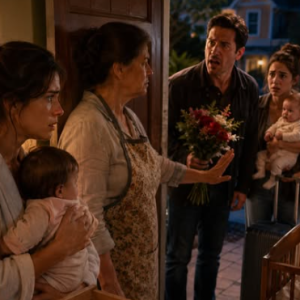
Doña Amparo stood in the middle of that little yellow kitchen with flour on her apron and a notebook full of ruined women under one hand, like she had been waiting for this exact storm for years.
My son cried from the bedroom.
Dania’s baby cried harder.
And between those two tiny voices, I understood something that made my skin go cold.
This was not a family argument.
This was a trap closing.
But not around me.
Around him.
Doña Amparo walked toward the back door and lifted the curtain just enough to see outside.
My mother’s face appeared through the glass, pale and tight, her hair wrapped in the same scarf she wore to church when she wanted people to think she was decent.
“Mija,” she said, softer this time.
“Open.
Please.”
I almost moved.
Because that was the horrible thing about mothers.
Even after they threw you out, some childish part of you still heard their voice and wanted to run to it.
Doña Amparo put one hand out.
“Stay.”
The word was not loud.
But I obeyed.
Iván hit the front door again.
“Mamá, stop making drama.
Dania and I need to talk.”
Dania looked at me as if she wanted to disappear into the sofa.
“She told me to come here,” she whispered.
“Who?”
Dania’s lips trembled.
“Your husband.”
The room stopped.
Doña Amparo turned from the back door.
“Iván told you to come here?”
Dania nodded quickly, tears already sliding down her cheeks.
“He said you were going crazy.
That you took his son and ran.
He said his mom would calm you down, and I could wait here until he fixed everything.”
I felt my mouth go dry.
Fixed everything.
That was what he called it.
My marriage.
My child.
My life.
A thing to fix between two lies.
Dania hugged her baby closer.
“I didn’t know about you,” she said.
“Not at first.
He told me he was separated.
He said you were cruel to him.
He said you used the baby to control him.”
I stared at her, wanting to hate her.
I wanted it so badly that for a second, it felt easier than breathing.
But she looked exactly like I had looked the night before.
No lipstick.
No pride.
No power.
Just a woman standing outside a house at the worst hour of her life, holding a child and hoping somebody would let her in.
That was when the back door opened.
Not because anyone touched it.
Because someone outside had a key.
My mother stepped in first.
Behind her came a woman I had never seen before.
Thin.
Quiet.
Not old, but worn down in a way that had nothing to do with age.
Her hair was cut short at her jaw.
Her left hand held a little girl’s hand.
The girl was maybe four.
She wore a yellow sweater and pink shoes that flashed lights when she walked.
The woman looked at Doña Amparo.
“I came because you said it was time.”
Doña Amparo’s eyes filled.
“Brenda.”
The name hit me like a stone.
Brenda.
The first name in the drawer.
The one written above the oldest date.
The one that made Doña Amparo tell me not to open the door.
My mother’s eyes darted toward me.
“Mija, don’t listen to them.”
That told me everything.
Because she had not asked who Brenda was.
She already knew.
I took one step back.
“Mom?”
She tightened her scarf.
“You’re tired.
You’re confused.
You need to come home before this woman fills your head with garbage.”
Doña Amparo laughed, but there was no humor in it.
“Garbage? Is that what you called it when I came to your house two years ago and told you what my son was doing?”
My chest locked.
Two years ago.
Before the wedding.
Before the white dress.
Before my baby.
Before I stood in church smiling at a man whose mother had already tried to warn mine.
I looked at my mother.
She looked away.
“No,” I said.
“No, tell me that’s not true.”
She pressed her lips together.
“Mija, all men make mistakes.”
Dania made a small sound, half sob, half disgust.
Brenda’s little girl hid behind her mother’s leg.
And Doña Amparo stepped forward.
“Not mistakes.
Patterns.”
Iván shouted from the front door.
“Mamá! Open the damn door!”
The whole house jumped with the force of his fist.
Doña Amparo walked to the kitchen table and lifted her phone.
“Iván,” she called, calm as morning.
He stopped knocking.
“I know you can hear me.
If you break that door, I call the police and give them the blue folder.”
Silence.
Not confusion.
Fear.
The first real fear I had ever heard from him.
“What blue folder?” he asked.
Doña Amparo smiled sadly.
“The one with your signatures.”
Dania looked at me.
Brenda closed her eyes.
My mother whispered, “Amparo, don’t.”
And that was how I knew the blue folder was real.
Doña Amparo took a chair and sat down like her legs had finally become too heavy.
“Sit,” she told me.
I didn’t.
If I sat, I was afraid I would never get up again.
Brenda stepped farther into the kitchen with her daughter.
“This is Abril,” she said quietly.
The little girl looked at me with Iván’s eyes.
Not similar.
The same.
That was the next crack.
Not because I still loved him.
Maybe some part of me did, but it was buried under shock now.
It cracked because my son had those eyes too.
Because Dania’s baby had them too.
Because that man had scattered himself into women’s lives like glass and left us barefoot to bleed.
Brenda placed a worn envelope on the table.
“I kept one copy,” she said.
“Like you told me.”
Doña Amparo nodded.
My mother reached for it.
Brenda pulled it back so fast the chair scraped.
“No, señora.
You don’t touch anything this time.”
This time.
I looked at my mother again.
“What did you do?”
She turned on me with sudden anger.
“What did I do? I kept you married.
I kept you respectable.
You think being a single mother is easy? You think people don’t talk? You think doors open for women who leave their husbands?”
I stared at her.
“You closed yours.”
Her face changed.
For one second, something almost like shame passed through it.
Then it disappeared.
“I wanted you to go back to him,” she said.
“That is what a wife does.
She returns.
She forgives.
She protects her home.”
“My home?” I said.
“He had another woman at your door.”
“That girl is nothing.”
Dania flinched.
I turned so fast my mother stepped back.
“Don’t you dare.”
The words surprised even me.
They came from somewhere lower than pain.
Somewhere harder.
“You don’t get to throw me into the street and then come here calling another woman nothing.”
My mother’s mouth opened.
No sound came out.
Doña Amparo watched me carefully, and I realized she had been waiting for that too.
Not just for me to find the drawer.
Not just for Brenda to arrive.
For me to stop begging women who had betrayed me for permission to stand up.
Iván’s voice came again, lower now.
“Mamá, you’re making this worse.”
Doña Amparo answered without looking at the door.
“No.
I made it worse when you were sixteen and your father taught you that women were rooms you could enter and leave.”
A silence fell so heavy even the babies stopped crying for a breath.
“My father?” Iván said.
Doña Amparo’s fingers tightened on the notebook.
“Yes.
Your father.”
Brenda looked down.
Dania blinked.
My mother looked furious.
I had never heard anyone mention Iván’s father.
He was a shadow in family stories.
Dead, gone, not talked about.
Iván always said he left when Iván was little, and Doña Amparo raised him alone with sacrifice and faith.
But the way she said his name now made me understand the sacrifice had not been holy.
It had been survival.
Doña Amparo opened the notebook to the first page.
There was no woman’s name there.
Only a date.
Then one sentence written in shaky blue ink:
I will never let another woman knock and be ignored.
She touched that sentence with two fingers.
“My husband did this first,” she said.
“Not the cheating.
That was only the surface.
He collected women who needed him.
Women with babies.
Women without money.
Women whose mothers told them to endure.
He would break them, then make them compete for his crumbs.”
Iván was silent outside.
Doña Amparo continued.
“I watched him ruin three lives before I understood that being quiet made me part of it.
By then, one woman was gone.
One child grew up calling himself unwanted.
And my son had learned every trick at the dinner table.”
She swallowed.
“I thought if I loved him better, he would not become his father.”
Her voice cracked for the first time.
“I was wrong.”
Nobody moved.
Then Brenda spoke.
“He told me the same thing he told you,” she said, looking at me.
“That I was special because I understood him.
That his wife was cold.
That his mother was dramatic.
That the baby would change him.”
Her laugh was small and broken.
“When I got pregnant, he cried.
I thought they were happy tears.”
I looked at Abril.
The little girl had found a wooden spoon on the counter and held it like a doll.
Brenda’s mouth tightened.
“Three months after she was born, he said I was too much.
Too tired.
Too emotional.
He said a real woman didn’t become ugly just because she had a baby.”
Dania closed her eyes.
I knew that sentence.
Not the exact words.
The shape of it.
The way men cut you and then act surprised when you bleed.
Brenda reached into the envelope and pulled out a folded paper.
“I signed this because I was scared.”
Doña Amparo looked at me.
“This is what I wanted you to hear.”
Brenda placed it on the table.
It was a custody agreement.
Not from a court.
Private.
Ugly.
Full of words that sounded official but felt rotten.
Iván’s name.
Brenda’s name.
Abril’s name.
A payment amount.
A promise of silence.
And at the bottom, as witness—
My mother’s name.
I stopped breathing.
The kitchen blurred.
For one impossible second, I thought there must be another woman with the same name.
Another signature.
Another mother.
But no.
I knew that curl on the last letter.
I had seen it on school forms, birthday cards, bank papers, notes on the fridge.
My mother had signed away another woman’s silence.
My mother had known.
Not guessed.
Known.
I looked at her, and the woman who raised me became a stranger in her own skin.
“How?” I whispered.
She lifted her chin.
“I was helping.”
“Helping who?”
Her answer came too fast.
“Everyone.”
Brenda slammed her palm on the table.
“My daughter went six months without diapers because he stopped paying after I refused to disappear.”
My mother snapped, “You took the money.”
“I took it because my baby needed formula!”
The little girl startled.
Brenda immediately bent down, kissed her hair, and softened her voice.
“I’m sorry, mi amor.”
That tiny apology broke something in me.
Because my own mother had not apologized once.
Not when she closed the door.
Not when she called me a shame.
Not when she walked into this kitchen carrying secrets that could bury me alive.
Doña Amparo stood.
“The reason Brenda lost when she opened her door,” she said, “is because she opened it to your mother.”
I felt the floor tilt.
Brenda looked at me, eyes full of a grief that was not accusation.
“She came to my apartment after I ran.
She said she was from church.
She said she knew how to help women in trouble.
She told me if I signed, Iván would leave me alone and Abril would have support.”
I stared at my mother.
“You went to her?”
My mother’s jaw clenched.
“Iván asked me to talk sense into her.”
“Why would you do that for him?”
The question hung there.
And my mother, for the first time that night, looked afraid.
Doña Amparo answered for her.
“Because my son paid her debt.”
The room emptied of air.
My mother turned white.
There it was.
The real door.
The one behind all her speeches about respectability and marriage and endurance.
Money.
I remembered two years ago, before my wedding, when my mother suddenly stopped crying over the bank notices.
When the leaking roof got fixed.
When she bought a new refrigerator and said God provides.
God had not provided.
Iván had.
And he had bought my mother before he married me.
I grabbed the edge of the table.
“He paid you?”
My mother’s eyes filled with tears, but not the kind that ask forgiveness.
The kind that ask pity.
“I was drowning.”
“So you sold me a husband?”
“No,” she said quickly.
“No, mija.
I thought he loved you.
I thought marriage would settle him.
Your father left us with nothing.
I did what I had to do.”
Doña Amparo’s voice cut through the room.
“You did what was easy.”
My mother pointed at her.
“And you? You raised him.”
The words landed hard.
Doña Amparo took them.
She did not dodge.
“Yes,” she said.
“I raised him.
And now I’m standing in front of him.”
Another slam hit the front door.
“I heard that,” Iván shouted.
“You all sound insane.
Open the door.”
My baby cried again.
That sound moved me when nothing else could.
I left the kitchen and went to the little room.
He was red-faced, fists waving, furious at a world that had grown too loud around him.
I picked him up, held him to my chest, and breathed in his warm baby smell.
For one second, I let myself be only his mother.
Not betrayed wife.
Not unwanted daughter.
Not witness.
Mother.
That word became a spine inside me.
When I returned, everyone looked at me.
Maybe because I was not crying anymore.
I sat down at the table.
“Tell me what happens tomorrow.”
Doña Amparo closed her eyes like she had been waiting years to hear that sentence.
Then she opened the blue folder.
It was thick.
Thicker than the notebook.
Inside were copies of everything.
Bank transfers.
Messages.
Photos.
Medical bills.
Birth certificates.
A list of women with dates beside their names.
Some names had check marks.
Some had question marks.
Some had only “gone.”
At the back was a business card.
Lic.
Patricia Salcedo
Family Law and Women’s Protection
Doña Amparo tapped it.
“She has been ready for three monThS.”
Dania whispered, “A lawyer?”
“Yes.”
“For all of us?”
“If you choose,” Doña Amparo said.
“Nobody gets forced in this house.
Not by men.
Not by mothers.
Not by fear.”
The front door went quiet.
Too quiet.
Brenda noticed first.
“He left.”
Doña Amparo froze.
“No.”
She ran to the living room and looked through the peephole.
Then she whispered something I had never heard from her before.
A curse.
The driveway was empty.
Iván’s car was gone.
My mother rushed toward the back door.
“I need to go.”
I stood.
“No.”
She turned on me.
“I am your mother.”
“Then act like it and sit down.”
Her face twisted.
For a second, I thought she might slap me.
Maybe she thought so too.
But Doña Amparo stepped between us.
My mother stopped.
Her phone rang.
 Student Slept Through 30 Calls From Parents After Defending His Thesis, Parents Assumed The Worst
She looked at the screen and went still.
I saw the name before she hid it.
Iván.
“Answer,” I said.
“Mija—”
“Answer it.”
She shook her head.
Doña Amparo reached calmly into her apron pocket, pulled out her own phone, and pressed record.
My mother’s phone rang again.
This time Brenda spoke.
“If you don’t answer, I will.”
Maybe it was the shame of being challenged by the woman she once helped silence.
Maybe it was fear.
Maybe it was habit.
My mother answered.
“Iván,” she said, voice trembling.
His voice came through sharp and loud enough for everyone to hear.
“Get her out of there now.”
My blood turned cold.
My mother closed her eyes.
“I can’t.”
“Yes, you can.
Tell her the baby needs his father.
Cry if you have to.”
Dania covered her mouth.
Brenda stared at the table.
Doña Amparo held the recording phone steady.
Iván continued.
“My mother is poisoning them.
Dania was not supposed to stay.
Brenda has no business there.
If they go to that lawyer, you and I are both finished.”
My mother whispered, “Don’t say that.”
“Why? It’s true.
You signed the papers.
You took the money.
Don’t start acting holy now.”
There it was.
Clear.
Alive.
No courtroom needed to understand it.
My mother made a sound like something inside her had finally split.
I should have felt satisfaction.
I felt nothing.
Only a clean, terrible emptiness.
Iván kept talking.
“Bring my wife and my son back tonight, or I send your bank papers to your church group.
Let them see how much it costs to raise a proper woman.”
My mother looked at me.
And for the first time since she arrived, she looked smaller than me.
“Mija…”
I took the phone from her hand.
“Iván.”
Silence.
Then his voice changed.
Soft.
Warm.
The voice that once made me feel chosen.
“Baby.”
I almost laughed.
That word had carried flowers once.
Now it smelled like rot.
“Don’t call me that.”
He sighed.
“You’re emotional.”
“No,” I said.
“I’m listening.”
“You don’t know what they’re telling you.”
“I know what you just said.”
Another pause.
Then, like a mask dropping, his voice became cold.
“You think you can raise my son without me?”
I looked down at the baby sleeping against my chest.
“No,” I said.
“I think I can raise him without teaching him to become you.”
Something hit on his end of the line.
Maybe his steering wheel.
Maybe the dashboard.
Maybe nothing.
“You will regret this.”
“No,” I said.
“I already regret staying.”
Then I hung up.
The kitchen stayed silent.
Doña Amparo stopped recording.
Brenda began to cry quietly, but not like before.
This time it sounded like relief.
Dania looked at me as if I had opened a window in a burning room.
My mother sat down.
Hard.
Like her bones had become stone.
Nobody comforted her.
That might sound cruel.
But that night, comfort belonged to the women who had been left outside.
Not the ones holding the locks.
At dawn, Doña Amparo made coffee.
Not the sweet kind she had served me the morning before.
Black.
Strong.
The kind that tells your body there is work to do.
Nobody slept.
Brenda’s daughter curled up on a blanket in the living room.
Dania’s baby finally settled in the travel crib Doña Amparo pulled from a closet that apparently held enough supplies for a small army of abandoned mothers.
My son slept in my arms until my shoulder went numb.
At 7:15, a white sedan parked outside.
A woman in a navy suit got out carrying a leather bag and the face of someone who had seen every lie men thought was original.
Lic.
Patricia Salcedo.
She stepped into the kitchen, took one look at all of us, and said:
“Good.
He got scared.”
Doña Amparo handed her the blue folder.
Patricia did not open it right away.
She looked at me first.
“You are his legal wife?”
I nodded.
“And this is your child?”
“Yes.”
“Do you have your documents?”
“My bag.
Some.
Not everything.”
“Fine.
We start with what we have.
Does he have access to your bank account?”
My stomach dropped.
“Yes.”
“Phone plan?”
“Yes.”
“House keys?”
“Yes.”
“Social media passwords?”
I closed my eyes.
“Yes.”
Patricia nodded like she expected all of it.
“Then before we go to court, we go to the bank.
Then your phone carrier.
Then a notary.
Then family court.”
I blinked.
“All today?”
She looked at me over her glasses.
“Men like Iván work fast when they lose control.
We work faster.”
For the first time in twenty-four hours, something almost like oxygen entered my lungs.
Dania raised her hand like a scared student.
“What about me?”
Patricia turned.
“Did he acknowledge your child?”
Dania shook her head.
“Then we file for recognition and support.”
Brenda lifted Abril into her lap.
“And me?”
Patricia’s face softened.
“You, Brenda, are the reason this stops being rumor.”
Brenda swallowed.
“I’m scared.”
“I know,” Patricia said.
“Do it scared.”
Then she looked at my mother.
“And you?”
My mother stared at the floor.
Patricia’s voice sharpened.
“You can either give a sworn statement today, or you can wait until Iván decides you are more useful as a scapegoat than an accomplice.”
My mother’s head snapped up.
“He wouldn’t.”
Doña Amparo gave a bitter smile.
“Mija, he is my son.
He would.”
Those words hit my mother harder than anything I could have said.
By nine, we were in two cars.
I rode with Patricia and Doña Amparo.
My baby was strapped in the back seat, asleep beneath a blue blanket.
Dania and Brenda followed in Doña Amparo’s neighbor’s car, because apparently the neighbor had known more than half the family and had been waiting for permission to hate Iván out loud.
My mother came too.
Not because I forgave her.
Because Patricia told her, “You can repair damage or become evidence.”
She chose repair.
For now.
The bank was first.
I expected paperwork.
I did not expect the teller to look at my account, frown, and call the manager.
The manager, a thin man with nervous hands, invited us into a glass office.
“Mrs. Morales,” he said to me, “there was an attempted transfer from your joint savings account at 6:42 this morning.”
My baby kicked in his carrier.
“How much?”
He looked at Patricia.
“All of it.”
My ears rang.
Patricia did not even blink.
“Destination?”
The manager hesitated.
Patricia leaned forward.
“I am going to ask once politely before we request it through the court.”
He printed the paper.
The destination account belonged to a company I had never heard of.
AMBAR EVENTS & CONSULTING.
Dania made a choking sound when Patricia showed her the name later.
“That’s me,” she whispered.
I stared.
“What?”
She shook her head fast.
“No.
I never opened a company.
I swear.”
Patricia’s eyes sharpened.
“I believe you.”
Doña Amparo went very still.
“My son opened it under her name.”
Patricia nodded.
“Or planned to make it look like she took the money.”
Dania turned gray.
That was the next shock.
Not only had Iván been cheating.
Not only had he been collecting women and babies and secreTS.
He had already chosen who to blame.
If I went back, I would be the unstable wife.
If I fought, Dania would be the thief.
If Brenda spoke, she would be the bitter ex.
If my mother talked, she would be the greedy witness.
He had made a cage for each of us and kept the keys in different pockeTS.
But cages have hinges.
And hinges break.
By noon, the joint account was frozen.
My new account was opened.
My phone number was moved.
My passwords were changed.
My son’s documents were copied.
Patricia filed emergency protection requests and custody papers with a speed that made every clerk sit up straighter when she spoke.
At 2:30, as we waited outside a family court office, my mother finally sat beside me.
There were fifteen empty seaTS.
She chose the one next to mine.
I did not look at her.
She said, “I thought if you stayed married, your life would be easier than mine.”
I watched a young couple argue near the vending machine.
“You thought wrong.”
“I know.”
I turned then.
“No.
You don’t know.”
She flinched.
“You don’t know what it felt like to stand outside your door at midnight with my baby crying and hear you call me a shame.”
Tears slid down her face.
“I was scared.”
“So was I.”
She covered her mouth.
“I’m sorry.”
I wanted those words to heal me.
They didn’t.
They were too late to erase the street.
Too small to erase the signature.
But they were the first true thing she had given me all day.
So I said the only honest thing I could.
“I heard you.”
Not I forgive you.
Not it’s okay.
Just I heard you.
Sometimes that is the first brick.
Sometimes it is the only one.
At 4:00, Patricia came out of the office.
“We have a temporary order,” she said.
My hand flew to my son.
“What does that mean?”
“It means your child stays with you.
Iván cannot remove him.
He cannot enter the residence where you are staying.
He cannot empty shared funds.
And he has a hearing in ten days.”
Doña Amparo exhaled like she had been holding her breath for four years.
Brenda hugged Abril.
Dania began crying openly.
I looked at Patricia.
“Will it hold?”
She did not lie to me.
“It is paper,” she said.
“Paper only matters if you keep moving.
But today, it matters.”
That was enough.
For one day, paper mattered.
For one day, my son was not a thing Iván could demand through a locked door.
For one day, I was not a wife being sent back like a borrowed pot.
I was a woman with an order, a lawyer, and three other women who knew the exact shape of my fear.
We returned to Doña Amparo’s house just before sunset.
The front door was open.
Not broken.
Open.
Doña Amparo froze on the sidewalk.
“No,” she whispered.
Patricia grabbed my arm.
“Stay back.”
But Doña Amparo was already running.
We followed.
The living room had been torn apart.
Cushions sliced open.
Drawers dumped.
Baby clothes scattered like little flags after a war.
The kitchen table was overturned.
The soup pot was on the floor.
The notebook was gone.
So was the blue folder.
For a second, nobody spoke.
Then Doña Amparo made a sound I will never forget.
Not crying.
Not screaming.
Something older.
Something from a mother who had spent years building one fragile bridge and found it burned.
Brenda grabbed Abril and covered her eyes.
Dania held her baby so tight he fussed.
My mother stood in the doorway, shaking.
Patricia walked through the mess carefully.
“Copies?” she asked.
Doña Amparo did not answer.
“Amparo.
Copies?”
The older woman slowly lifted her head.
Her face was wet.
But then something changed.
Not relief.
Not peace.
Something sharper.
She walked to the stove.
The big metal hood above it was old, stained from years of steam.
She reached behind it, felt along the back, and pulled down a plastic bag taped flat against the wall.
Inside was a flash drive.
Patricia smiled.
“Good woman.”
Doña Amparo wiped her face with the back of her hand.
“My husband taught me what men steal first.”
She turned to me.
“My son only found the paper.”
The front gate creaked outside.
Everyone turned.
A black truck stopped at the curb.
Iván got out.
He was no longer carrying flowers.
He was carrying the blue folder.
My blue folder.
Our blue folder.
He stood at the gate, smiling like a man who had already won.
“You people are unbelievable,” he said.
Patricia stepped onto the porch.
“You are violating a temporary order.”
Iván laughed.
“I haven’t been served.”
Patricia smiled back.
“No.
But your lawyer has.”
His smile twitched.
Behind him, another car pulled up.
Then another.
For one wild second, I thought he had brought friends.
Then the first car door opened.
A woman stepped out holding a toddler.
Then another woman.
Then another.
One had gray in her hair.
One was barely older than Dania.
One wore hospital scrubs.
One held a folder against her chest like a shield.
Doña Amparo covered her mouth.
Patricia looked at the flash drive in her hand, then at the women gathering on the sidewalk.
Brenda whispered, “You called them?”
Doña Amparo shook her head.
“No.”
My mother looked at me.
I looked at the gate.
The woman in scrubs spoke first.
“Are we too late?”
Iván turned around slowly.
And for the first time since I met him, my husband had nowhere to put his face.
Not on charm.
Not on anger.
Not on pity.
Nowhere.
Because every door he had closed was standing open on the sidewalk.
Every woman he had made feel alone was staring at him in daylight.
And every child he had treated like a secret was breathing in front of his mother’s house.
Doña Amparo stepped off the porch.
She was small beside him.
Older.
Tired.
Still wearing flour on her apron.
But when she spoke, even Iván listened.
“No, m’hijas,” she said to the women at the gate.
“You are not too late.”
She looked at her son.
Then at me.
Then at the babies, the daughters, the mothers, the women who had arrived carrying bags, folders, fear, and proof.
Her voice did not shake.
“This time, nobody leaves through the back door.”