The roar of Manhattan traffic faded into a dull, rhythmic thudding that mirrored the frantic beating of my heart.
I stood frozen on the curb, the ghost of a little girl’s handprint still etched into my mind against the tinted glass of that departing SUV.
Eight years.
For eight years, I had convinced myself that Seattle was just a beautiful, fleeting anomaly—a single night where two broken trajectories crossed, struck a spark, and parted in the dark.
I had raised my son, Leo, as a single father, scraping by on freelance design gigs, telling him his mother was a beautiful mystery who belonged to the wind.
But as I stared at the empty space where the armored vehicle had just been, the math slammed into me with the force of a physical blow.
The triplets were seven years old.
Eight years ago, Camila and I had spent that fateful night together.
If she had discovered she was pregnant shortly after vanishing from my life, the timeline didn’t just align; it locked into place like a heavy deadbolt.
Those girls weren’t just Camila’s daughters.
They were mine.
The Paper Trail of a Ghost
I didn’t go back to work.
I couldn’t.
I practically ran back to my cramped Brooklyn apartment, my hands shaking so violently I dropped my keys twice before managing to unlock the door.
Leo was at school, leaving the apartment suffocatingly quiet.
I sat at my desk and pulled out an old, battered metal lockbox from the back of my closet.
Inside lay the only proof that the night in Seattle hadn’t been a hallucination: a faded Polaroid we had taken in a diner at 3:00 AM, and the original napkin sketch of the broken compass.
I fired up my laptop.
For years, I had avoided searching the name “Camila Montgomery.” In the early days, it was out of pride—she had left without a trace, leaving a fake phone number.
Later, it was out of fear.
But now, the stakes were too high.
The search results flooded my screen, a cascade of high-society galas, corporate restructuring headlines, and architectural triumphs.
Camila Montgomery wasn’t just wealthy; she was the sole heiress to Montgomery International, one of the most powerful real estate empires on the East Coast.
As I scrolled through the glossy images, my breath caught.
There she was.
Older, her hair styled in a sharp, corporate bob, her eyes guarded and devoid of the wild, reckless light they had held in Seattle.
But it was her.
And in one photo, taken at a summer charity event where she wore a sleeveless emerald gown, it was visible.
High on her left shoulder, partially obscured by a delicate strap, was the unmistakable, jagged silhouette of my broken compass.
Then, I found the society column article from seven years ago.
“Montgomery Heiress Welcomes Triplet Daughters in Absolute Seclusion.”
There was no mention of a father.
The article hinted at a “private family matter” and emphasized that the Montgomery dynasty had secured its next generation under a strict veil of privacy.
I sank back into my chair, the room spinning.
I had been raising Leo in a fifth-floor walk-up, celebrating small victories like buying him a new bicycle, while across the river, my three daughters were being driven in armored cars, insulated from the world by a fortress of old money and nanny uniforms.
But how did Leo fit into this? Camila and I had only spent one night together.
Unless…
A memory, sharp and sudden, pierced through my panic.
The night in Seattle hadn’t ended at dawn.
We had parted ways at the airport, but two weeks later, she had unexpectedly tracked me down at my hotel in Portland, claiming she couldn’t get the broken compass out of her head.
We spent another frantic, emotional weekend together before she vanished permanently.
Leo was born prematurely.
The dates… the maddening, beautiful dates.
Leo and the triplets were separated by barely nine monThS. Camila must have known she was pregnant with the triplets after our first encounter, but what about Leo?
I needed answers.
And there was only one place to get them.
Infiltrating the Fortress
The Montgomery estate in upstate New York was less of a home and more of a modern fortress—a sprawling glass-and-stone compound nestled behind iron gates and guarded by private security.
I knew I couldn’t just walk up to the gate and demand to see the matriarch of a billion-dollar empire.
I would be arrested before I could even utter the word “compass.”
Using my background in graphic design and architectural rendering, I spent the next two days crafting a flawless, albeit highly illegal, contractor pass.
A major renovation project was underway on the estate’s west wing, handled by a premium firm.
I forged the credentials, threw on a high-visibility vest, carried a digital clipboard, and prayed the security guards were too tired to look closely at my face.
On Thursday morning, my heart hammering a frantic rhythm against my ribs, I walked up to the service entrance.
The guard glanced at my badge, checked his monitor, and frowned.
“You’re not on the primary shift manifest, pal.”
“Emergency diagnostic on the HVAC routing for the nursery wing,” I said, forcing my voice to remain steady, projecting the bored, authoritative exhaustion of a blue-collar worker.
“The project manager said if I didn’t get this signature from Ms.
Montgomery’s assistant today, the whole concrete pour tomorrow gets delayed.
You want to be the one to tell her why the trucks are idling?”
The guard groaned, muttered something about arrogant architects, and buzzed me through.
“Main office is through the courtyard.
Don’t wander off.”
I stepped into the inner sanctum.
The grandeur was suffocating.
Manicured lawns, marble fountains, and an oppressive silence that felt entirely unnatural for a home housing three young children.
I bypassed the courtyard, navigating toward the residential wing by following the distant, distinct sound of children’s laughter.
I found them in a sun-drenched conservatory.
Regina, Lucy, and Valerie were sitting at a low white table, painting.
The nanny from the park was nowhere to be seen, replaced by a younger staff member who was currently distracted by her phone near the double glass doors.
I stepped into the room, removing my hard hat.
“Hello again,” I whispered.
The three pairs of eyes snapped up simultaneously.
Recognition flashed in them instantly.
“The compass man,” Valerie whispered, her eyes widening.
“Shh,” Regina, clearly the leader, hissed.
She stood up, her tiny hands covered in blue paint.
“Are you a secret agent?”
 Friend Keeps “Joking” About Woman\'s Husband Having A Side Chick — So She Paid And Walked Out
“No,” I said, kneeling down so I was at their eye level.
“I’m just a man who knew your mother a long time ago.
Can you tell me… does your mother ever talk about the compass?”
Lucy nodded solemnly.
“She touches it when she thinks we’re asleep.
She tells us it’s a map to a place where people are allowed to be happy.”
A lump formed in my throat so thick I could barely swallow.
Before I could ask another question, a cold, sharp voice cut through the warmth of the conservatory like a shards of glass.
“Get away from my daughters.”
The Confrontation
I stood up slowly, turning to face the doorway.
Camila Montgomery stood there.
She was stunning, but her beauty was now encased in armor—a tailored charcoal suit, her posture rigid, her eyes flashing with a mixture of terror and fury.
She signaled the young maid, who looked terrified.
“Take the girls to their quarters.
Now.”
The girls didn’t protest.
They sensed the shift in the atmosphere and hurried out, though Regina cast one last, lingering look back at my forearm.
Once the doors clicked shut, Camila marched toward me, her heels clicking aggressively against the marble floor.
“I don’t know how you got past my security, but you have exactly ten seconds to leave before I have you thrown into a federal prison.
I don’t care what kind of extortion scheme you’ve cooked up.”
“Extortion?” I laughed, a bitter, breathless sound.
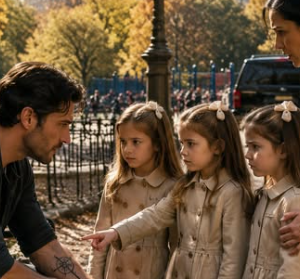
“I was sitting in Central Park, Camila.
Your daughters walked up to me.
They recognized the design.
The design I drew on a grease-stained napkin in a diner in Seattle.”
She flinched.
The corporate mask cracked for a fraction of a second, revealing the vulnerable, terrified woman I had held in the dark eight years ago.
“You shouldn’t be here, David,” she whispered, her voice losing its razor edge, replaced by a desperate plea.
“Please.
Just go.”
“They’re my daughters, aren’t they?” I stepped closer, pulling up my sleeve to expose the faded ink.
“Look at me and tell me they aren’t mine.”
Camila closed her eyes, a single tear breaking through her perfect makeup.
“Yes,” she breathed.
“They are yours.”
“Why?” my voice cracked.
“Why did you run? Why didn’t you tell me? I’ve been scraping by, wondering, while you hid them away in this… this gilded cage!”
“Because my father would have destroyed you!” she suddenly shouted, her eyes snapping open, blazing with a decade of suppressed trauma.
“You don’t understand the Montgomery family, David! My father controlled everything.
Every breath I took, every person I saw.
When I found out I was pregnant with triplets, he gave me an ultimatum.
I could either surrender the children to be raised by his corporate lawyers to become perfect little board members, or he would use his power to ruin whoever the father was, ensure you were put in prison on fabricated charges, and take the children anyway.”
She took a shaky breath, pressing her hand against her left shoulder, right over the hidden tattoo.
“The only way to keep them safe, to keep you safe, was to return to the fold, accept his terms, and pretend the night in Seattle was a mistake.
I traded my freedom to protect yours and theirs.
I waited until he passed away last year to even let them play in public parks.”
The anger in my chest evaporated, replaced by a profound, aching sorrow.
She hadn’t abandoned me.
She had sacrificed her soul to keep our children safe from a monster.
“But that’s not all, is it?” I asked, my voice dropping to a whisper as the final piece of the puzzle began to take shape.
“The Portland weekend.
Nine months after the triplets were born.”
Camila gasped, her hands flying to her mouth.
“You… you know?”
“I have a son, Camila,” I said, tears finally spilling over my eyes.
“His name is Leo.
He has your eyes.
He has your stubborn chin.
I thought his mother was a runaway artist who couldn’t handle the pressure.”
Camila sank onto a stone bench, weeping openly now.
“After my father forced me back, I felt like a prisoner.
I managed to escape for one weekend… just one… to find you in Portland.
I needed to feel human again.
When I realized I was pregnant a second time, with Leo, I knew I couldn’t bring another child into this prison.
I knew my father would break him.
So, I left him at the clinic near your apartment, ensuring the paperwork would lead him straight to your door.
I knew you would love him.
I knew you would give him the normal, beautiful life I could never give the girls.”
The Alignment of the Compass
The truth was out.
It was a messy, heartbreaking canvas painted in the dark by two people trying to survive.
We were two broken compasses that had somehow, against all mathematical and social odds, pointed back to the same origin.
“What do we do now?” Camila asked, looking up at me, completely stripped of her billionaire persona.
“My father is gone, but the board, the media, the public… if they find out about this…”
I walked over and sat down beside her on the stone bench.
For the first time in eight years, I reached out and took her hand.
It was cold, but as my fingers intertwined with hers, a familiar warmth flooded back.
“Let them talk,” I said softly.
“We’ve spent eight years running from a ghost who is no longer here.
You have three daughters who deserve to know their brother.
And I have a son who deserves to know his mother.
We don’t have to fix everything today.
But the compass isn’t broken anymore, Camila.
It’s just pointing in a new direction.”
Epilogue: A New Latitude
Six months later, the autumn air in Central Park was crisp and clear.
The leaves had turned into a brilliant canopy of gold and crimson.
On the very same bench where this journey had begun, I sat with a fresh, hot cup of coffee.
But this time, I wasn’t alone.
A loud, boisterous laugh echoed from the nearby playground.
Leo, wearing his favorite blue jacket, was sprinting across the grass, closely pursued by Regina, Lucy, and Valerie.
The girls’ hair bows were slightly askew, their polished shoes covered in dirt, and they looked radiantly, beautifully messy.
They looked like children.
Camila sat beside me, leaning her head against my shoulder.
She wore a simple knit sweater, completely unbothered by the lack of a designer label.
We watched our four children collide in a giant, giggling group hug at the bottom of the slide.
The world had thrown its worst at us—wealth, power, isolation, and lies—but the truth had a funny way of carving its own path through the stone.
I looked down at my forearm, at the faded black ink of the broken compass.
It would always be jagged, and it would always remind us of the nights we spent lost in the dark.
But as I felt Camila’s hand tighten in mine, I knew we were finally, unmistakably, home.