The NICU doors opened.
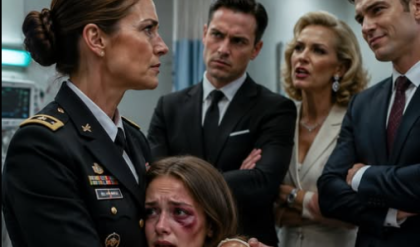
Colonel Adrian Whitaker stepped inside wearing a dark overcoat over his military uniform, silver hair combed neatly back, his posture so straight that the entire room seemed to reorganize itself around him.
Two people followed.
The first was a woman carrying a leather briefcase.
I recognized her immediately as Evelyn Shaw, senior partner at one of the most respected law firms in New England.
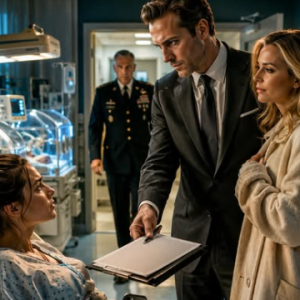
The second was a broad-shouldered man in a plain gray suit.
He did not introduce himself, but Russell recognized him.
I knew because the color drained from my husband’s face.
“Mr. Harlan,” the man said.
“I’m Special Agent Daniel Mercer.
We’ve been trying to arrange a conversation with you.”
Russell’s fingers tightened around the divorce folder.
“This is a private medical room,” he snapped.
“You can’t just walk in here.”
Colonel Whitaker looked toward the incubators.
His expression changed when he saw Jonah and Elise beneath the warm lighTS. The authority in his face softened into something almost unbearable.
He removed his cap.
“Those are Eleanor’s grandchildren,” he whispered.
My throat tightened at the sound of my mother’s name.
Russell looked from him to me.
“Who is Eleanor?”
Colonel Whitaker turned slowly.
“Callie’s mother.”
Russell gave a short, disbelieving laugh.
“Her mother is dead.”
“Yes,” the colonel replied.
“She died saving twelve people during a civilian evacuation in Afghanistan.
She was my intelligence officer, my closest friend, and the bravest person I ever commanded.”
The room went silent.
Even the nurses seemed to stop moving.
Russell looked at me as though I had suddenly become a stranger.
I had told him my parents were gone.
That was all he had ever wanted to know.
In the beginning, I thought his refusal to ask questions meant he respected my grief.
Later, I understood that Russell only cared about a person’s history when it could benefit him.
My mother’s life had been sacred to me.
Russell had never earned the right to hear it.
Colonel Whitaker stepped closer to my bed.
“Callie, are you safe?”
I looked toward the incubators.
“My children are.
That’s what matters.”
Evelyn placed her briefcase on the small table beside me.
“Not anymore,” she said gently.
“You matter too.”
Russell recovered enough to straighten his shoulders.
“This is absurd.
Callie signed the settlement voluntarily.
Whatever military story you’re trying to perform here has nothing to do with our marriage.”
Evelyn opened the briefcase.
“You’re correct about one thing.
Mrs. Harlan signed the documenTS.”
Russell’s confidence flickered back.
Tessa smiled nervously.
Evelyn removed a recording device from her pocket and placed it beside the papers.
“She signed them while heavily medicated, less than forty-eight hours after emergency abdominal surgery, inside a neonatal intensive care unit, after you informed her that you had closed her accounts and taken control of her home.”
Russell stared at the device.
The nurse nearest the door spoke quietly.
“The entire interaction was recorded on the hospital’s security system as well.”
His eyes snapped toward her.
“You recorded me?”
“This unit protects vulnerable patients,” the nurse replied.
“Including mothers.”
Tessa immediately stepped away from Russell.
He noticed.
“What are you doing?” he demanded.
“Nothing,” she said quickly.
“I just need some air.”
Special Agent Mercer moved between her and the door.
“I’m afraid you’ll both need to remain available.”
Tessa’s face went pale.
Russell looked at Mercer again.
“What exactly is this about?”
Mercer’s expression remained calm.
“Harlan Strategic Holdings.”
Russell said nothing.
Mercer continued.
“Specifically, diverted investor funds, falsified vendor contracts, unauthorized transfers through three shell corporations, and the attempted liquidation of protected assets during an active federal inquiry.”
Tessa turned toward Russell.
“You said the audit was finished.”
“It is finished,” he hissed.
“No,” Mercer said.
“It began this morning.”
The folder slipped slightly in Russell’s hand.
He caught it before it fell.
Colonel Whitaker looked at me.
“Callie, did you know about the investigation?”
“I knew Russell’s numbers didn’t make sense,” I answered.
“I knew invoices were appearing for companies that had no employees, no addresses and no working phone numbers.”
Russell’s voice hardened.
“You had no access to company finances.”
“I built your original accounting system.”
“That was years ago.”
“And you never changed the recovery architecture.”
For the first time, he looked truly frightened.
Tessa stared at me.
“You told me she was just doing administrative work.”
I almost laughed.
Before I became Russell’s invisible wife, I had been a forensic financial analyst for the Department of Defense.
My mother’s death had left me responsible for my own survival at twenty-four.
Colonel Whitaker had helped me finish graduate school, but I had earned every position that followed.
I met Russell three years later.
He had been charming, ambitious and full of impossible promises.
When his first company nearly collapsed, I found the accounting errors that were bleeding it dry.
I redesigned its financial controls.
I negotiated with the creditors who wanted to destroy him.
I created the forecasting model that helped him secure his first major investors.
Russell called me brilliant until my brilliance began to threaten him.
After we married, he persuaded me to leave government work.
After I became pregnant, he began telling people I had never worked at all.
He erased me one introduction at a time.
“My company exists because of me,” Russell said.
“No,” Evelyn replied.
“Your company exists because Callie placed three million dollars of inherited capital into it seven years ago.”
Tessa’s mouth fell open.
Russell turned toward me.
“You told me that money came from an anonymous investor.”
“It did.”
Colonel Whitaker’s voice was quiet.
“Her mother established the Whitaker-Eleanor Civilian Protection Trust before her final deployment.
Callie became the sole beneficiary at thirty.
She invested part of that money in your company without attaching her name because she wanted to know whether you loved her or her inheritance.”
The colonel looked at Russell with open disgust.
“You answered that question today.”
Russell’s face twisted.
“If the investment was anonymous, she has no claim.”
Evelyn removed another document.
“The investment was made through a protected trust agreement granting Callie controlling interest if the company’s founder committed fraud, concealed marital assets or attempted to deprive her minor children of financial support.”
She placed it on top of the divorce papers.
“Your signature is on page fourteen.”
Russell stared at it.
I remembered the day he had signed.
He had barely glanced at the document.
He had been too excited about the money entering his account.
He had kissed me afterward and said, “This changes everything.”
He had been right.
Tessa began removing my coat.
She pulled at the sleeves so quickly that one caught around her wrist.
“Take it,” she said, dropping it onto the chair.
“I didn’t know any of this.”
I looked at the cream-colored fabric crumpled on the floor.
“You knew he was married.”
She froze.
“You knew I was pregnant,” I continued.
“You knew my babies were in intensive care.
You walked into this room wearing the coat meant to carry them home.”
Her eyes filled with tears.
“I never wanted anyone to get hurt.”
“That sentence is usually spoken by someone standing in the middle of the damage they willingly helped create.”
Tessa lowered her gaze.
Russell suddenly stepped toward my bed.
“You planned this.”
The nearest nurse moved protectively between us, but Colonel Whitaker was faster.
He stood directly in Russell’s path.
“Take one more step toward her,” the colonel said, “and you’ll discover how little patience I have left.”
Russell stopped.
His jaw trembled.
“You think you can steal my company?”
I looked at him.
“No, Russell.
You stole from your company.
I’m simply refusing to let you bury our children beneath the wreckage.”
A sharp alarm sounded from Elise’s incubator.
Every adult in the room vanished from my awareness.
A nurse hurried to her side.
“What’s happening?” I asked.
Elise’s oxygen level had dropped.
The numbers on her monitor changed rapidly as the medical team moved around her incubator.
I tried to stand.
Pain ripped through my abdomen, and I nearly collapsed.
Colonel Whitaker caught my arm.
“Easy, Callie.”
“My baby.”
“I know.”
A doctor entered, issuing instructions in a calm but urgent voice.
A respiratory specialist adjusted Elise’s support while another nurse gently touched her tiny foot.
Russell stood several feet away.
He watched for perhaps three seconds.
Then he looked at Special Agent Mercer.
“Can we discuss this somewhere else?”
I turned toward him.
Our daughter was struggling to breathe.
And he was worried about himself.
That was the exact moment the last surviving piece of my marriage disappeared.
It did not break dramatically.
It simply went quiet.
The doctor stabilized Elise after several terrifying minutes.
Her oxygen level rose slowly, one number at a time, until the alarm stopped.
I pressed both hands against my mouth and cried.
Colonel Whitaker remained beside me.
Russell did not ask whether she was all right.
Mercer removed a set of documents from his jacket.
“Russell Harlan, this warrant authorizes the seizure of your electronic devices and business records.
You are not under arrest at this moment, but any attempt to leave the state or destroy evidence will change that.”
Tessa immediately handed over her phone.
Russell did not.
“There’s confidential information on this.”
Mercer extended his hand.
“There is evidence on it.”
Russell looked at me again.
“You’re enjoying this.”
 Mother Says Cancer Treatment Costs Too Much, Then Asks Her Sick Child To “Sacrifice” Himself
“No,” I said.
“I am watching the father of my children reveal that he never deserved them.”
His face hardened.
“I’ll fight you for custody.”
Evelyn almost smiled.
“You threatened to abandon two medically vulnerable newborns less than ten minutes ago.
You described them as a waste of your life.
The hospital has witnesses, audio and video.”
She closed the briefcase.
“You’ll be fortunate to receive supervised visitation.”
Russell’s confidence finally shattered.
He looked toward the incubators, perhaps hoping to manufacture the expression of a concerned father.
But love cannot be summoned like a courtroom performance.
Jonah moved one tiny hand beneath the blanket.
Russell stared at him.
For half a second, something human crossed his face.
Then it was gone.
“This is your fault,” he whispered to me.
Colonel Whitaker stepped aside as Mercer took Russell’s phone.
“No,” I replied.
“This is the first consequence that has ever belonged entirely to you.”
Mercer escorted Russell and Tessa out of the NICU.
The doors closed behind them.
The silence they left behind felt different from the silence before.
It was not the silence of fear.
It was the silence after a storm has passed, when the house is damaged but still standing.
Colonel Whitaker carefully lifted my coat from the floor.
He folded it and placed it on the chair beside me.
“Your mother used to say you were stronger than you knew,” he said.
“I don’t feel strong.”
“Strength rarely feels powerful while you’re using it.
Usually, it feels like surviving one more minute because someone needs you.”
I looked at Jonah and Elise.
“Why did you come so quickly?”
He sat beside my bed.
“Because your mother once called me from a burning embassy and asked me to get twelve civilians home.
She did not waste words then, and you do not waste them now.”
His eyes glistened.
“When you said you needed help, I knew it was serious.”
I reached for his hand.
“I thought I had no family left.”
He squeezed my fingers.
“You were wrong.”
The weeks that followed were the longest of my life.
Russell’s financial empire collapsed faster than anyone expected.
Investigators uncovered years of false invoices, hidden loans and money transferred into accounts controlled by Tessa’s brother.
Tessa accepted a cooperation agreement and admitted that Russell had promised to marry her after convincing me to sign away my righTS.
She also admitted he had planned to sell the condo before the twins left the hospital.
He believed premature babies would keep me too exhausted and afraid to fight back.
Instead, they gave me something worth fighting for.
The divorce papers were thrown out.
A judge issued temporary orders freezing Russell’s assets and prohibiting him from contacting me outside legal channels.
The trust activated its control provision, and I became majority owner of Harlan Strategic Holdings.
I changed the name.
Not to mine.
Not to my mother’s.
I called it J&E Recovery Group.
The board expected me to dismantle the company.
Instead, I saved every innocent employee Russell’s fraud had endangered.
I brought in independent auditors, repaid damaged investors and created a medical assistance fund for families with premature infanTS.
Russell had used money to make people feel helpless.
I used the same money to return choices to them.
Eight weeks after the night he brought divorce papers into the NICU, Jonah was cleared to go home.
Elise needed six more days.
I refused to leave her alone, so Colonel Whitaker carried Jonah through the hospital each morning while I sat beside his sister.
He learned how to prepare bottles.
He learned which lullaby made Jonah stop crying.
A decorated retired colonel who had commanded thousands of soldiers became terrified of fastening a newborn’s car-seat buckle incorrectly.
It was the gentlest thing I had ever seen.
On the morning Elise was finally discharged, the nurses gathered near the elevator.
I wore the cream-colored coat.
The torn lining had been repaired, and Jonah’s and Elise’s initials were still stitched inside.
Colonel Whitaker held Jonah.
I carried Elise against my chest.
As the elevator doors opened, Evelyn approached with an envelope.
“The final custody order,” she said.
Russell had chosen not to contest it.
His attorneys had advised him that every additional hearing would place more evidence into the public record.
He was awaiting trial on multiple federal charges.
His expensive suits had been replaced by plain institutional clothing, his penthouse by a detention center, his audience by men who did not care how powerful he once pretended to be.
I felt no triumph.
Only distance.
“He included a letter,” Evelyn said.
I looked at the second envelope.
“Do I have to read it?”
“No.”
I handed it back.
“Then I won’t.”
The elevator doors opened onto the hospital lobby.
Sunlight poured through the tall windows.
For months, I had imagined this moment with Russell beside me.
I had imagined him carrying one baby while I carried the other.
Life had taken that picture from me.
But it had given me another.
Colonel Whitaker stood at my side with tears in his eyes and Jonah asleep against his chest.
Evelyn carried the diaper bag.
Three nurses followed us toward the entrance, cheering softly so they would not wake the babies.
Outside, a dark sedan waited.
But before I reached it, I stopped.
Across the street stood Russell.
He had been temporarily released to attend a court-approved meeting with his attorneys.
A federal officer waited beside him.
He looked thinner.
Smaller.
For the first time since I had known him, he appeared to understand that confidence was not the same as character.
His eyes moved to the twins.
He took one step forward.
The officer stopped him.
Russell did not resist.
“Callie,” he called.
I looked at him from across the street.
“I made mistakes.”
The old version of me might have crossed the road.
She might have searched his face for regret, collected whatever crumbs of tenderness remained and tried to rebuild an entire marriage from them.
That woman had loved Russell.
But she had also been taught to doubt herself.
I no longer did.
“You made choices,” I answered.
His eyes filled with desperation.
“Tell them I’m their father.”
I looked down at Elise.
Then at Jonah in Colonel Whitaker’s arms.
“Biology will tell them that,” I said.
“Your actions will tell them everything else.”
Russell lowered his head.
I turned away.
Colonel Whitaker opened the car door for me.
Before I climbed inside, he touched the edge of my coat.
“Your mother would have loved seeing this.”
“The babies?”
“You.”
I looked back at the hospital where my children had fought for every breath, where my husband had tried to reduce my life to signatures on paper, and where one phone call had reminded me that isolation was the greatest lie he ever told me.
I had not been rescued by a powerful man.
Colonel Whitaker had brought support, truth and protection.
But I had made the call.
I had collected the evidence.
I had signed those papers because I knew arrogance would make Russell careless.
I had protected my children while my own body was breaking.
The strength had always been mine.
I simply needed someone to remind me where I had left it.
One year later, Jonah and Elise celebrated their first birthday in the garden behind our new home.
They were smaller than most children their age, but healthy, loud and determined.
Elise smashed her hand into the cake.
Jonah laughed so hard that he fell backward into Colonel Whitaker’s arms.
Around us stood nurses from the NICU, employees from J&E Recovery Group, Evelyn, neighbors and families supported by the premature-infant fund.
There were no magazine photographers.
No expensive business partners.
No people chosen for influence.
Only those who had stayed when staying required something from them.
As the sun began to set, Colonel Whitaker raised a glass.
“To Jonah and Elise,” he said.
“Who entered this world early, frightened everyone who loved them, and taught us that the smallest hearts can command the greatest courage.”
Everyone laughed.
Then he looked at me.
“And to Callie, who believed she was making one desperate phone call.”
His voice softened.
“But what she was really doing was opening the door to the life that had been waiting for her all along.”
I looked around the garden.
At my children.
At the company restored with honesty.
At the family built not from obligation, but from loyalty.
For years, Russell had convinced me that everything valuable in my life came from him.
He had been wrong.
My courage came from my mother.
My knowledge came from years of work.
My children came from love strong enough to survive pain.
And my family came from the people who showed up when the door opened.
I lifted my glass.
“To knowing when to make the call.”
The guests echoed the words.
Jonah reached for me.
I took him into my arms while Elise crawled across the blanket toward us.
The two of them pressed against my chest, warm and alive.
The first gift their father brought them had been abandonment.
But that was not the gift that defined their lives.
They would grow up surrounded by truth.
They would know that love never demands weakness as proof of devotion.
They would learn that wealth means nothing without integrity, that blood alone does not create a family, and that asking for help is not surrender.
Sometimes it is the bravest decision a person can make.
I kissed Jonah’s forehead, then Elise’s.
Above us, the evening sky stretched clear and endless.
For the first time, I did not wonder what I had lost.
I understood what remained.
And it was more than enough.