
Daniel’s face changed so quickly that, for one brief second, I saw the man beneath the tailored suit.
Not the respected attorney.
Not the confident husband.
Not the partner whose name appeared on the polished glass doors of Mercer, Vale and Knox.
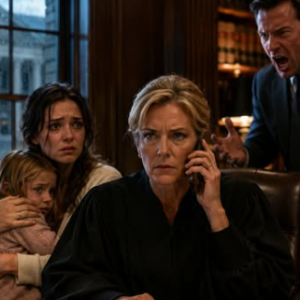
I saw a frightened bully realizing that the woman he had mocked as a harmless widow understood every rule he had tried to manipulate.
“Judge Hart?” he repeated.
The court reporter immediately looked uncomfortable.
She seemed to regret speaking, but the damage was already done.
Daniel stared at me.
His eyes moved from my face to the courthouse entrance, then to Clara, as though he were rearranging every conversation we had ever shared.
“You’re Evelyn Hart,” he said.
“I am Clara’s mother.”
“You’re a federal judge.”
“Today, I am Clara’s mother.”
His expression hardened.
“You planned this.”
“No, Daniel.
You planned this.
For years.”
He glanced around at the attorneys, deputies, clerks, and members of the public gathering near the courtroom doors.
His humiliation mattered more to him than the allegations against him.
I could see it in the tension along his jaw.
“You deliberately concealed your identity from me.”
“My daughter introduced me by my married name.
I never lied to you.”
“You allowed me to—”
“To underestimate me?”
His mouth closed.
Clara’s attorney, Rebecca Sloan, stepped between us.
“The hearing is about the protective order,” she said.
“Not Judge Hart’s profession.”
Daniel laughed, but the sound was strained.
“You expect anyone to believe she hasn’t influenced this case?”
Rebecca did not blink.
“Judge Hart disclosed the relationship, retained counsel from outside her district, contacted no assigned judge, and made no improper communication.
Every filing is supported by independently obtained records.”
Daniel turned toward Clara.
“This is what you wanted?” he asked.
“To have your mother destroy me?”
Clara’s fingers curled around the strap of her purse.
A month earlier, she might have apologized.
That morning, she looked directly at him.
“No,” she said.
“I wanted you to stop hurting me.”
The courtroom deputy opened the doors.
“Parties in Hart-Mercer, please enter.”
Daniel walked away first, shoulders stiff, briefcase held tightly against his side.
He no longer looked like a man who owned the room.
He looked like a man searching for an exit.
The assigned judge was the Honorable Marjorie Ellis, a state court judge with a reputation for patience and an intolerance for theatrics.
I had met her twice at public legal conferences, but we had never worked together.
To avoid even the appearance of influence, I sat in the public gallery behind Clara and Rebecca.
Daniel represented himself.
That was his first mistake.
His second was believing that charm could survive evidence.
He opened by describing Clara as emotionally unstable, easily manipulated, and prone to dramatic accusations.
He spoke gently, sadly, presenting himself as a devoted father trapped in a painful domestic misunderstanding.
“Mrs. Mercer has struggled for years,” he said.
“I attempted to protect her privacy.
Unfortunately, her mother’s arrival transformed a personal health crisis into a public attack.”
Judge Ellis studied him over her glasses.
“Mr. Mercer, are you suggesting the medical documentation is false?”
“I am suggesting the injuries may have explanations unrelated to me.”
“And the recordings?”
“Edited.”
“Do you have an expert report supporting that claim?”
“Not yet.”
“Then do not present speculation as evidence.”
His confidence faltered.
Rebecca called the forensic nurse, who described Clara’s injuries without exaggeration.
She explained that the bruises were in different stages of healing and were inconsistent with a single accidental fall.
A police officer testified about Clara’s fear, Daniel’s recorded threat, and the controlled retrieval of Sophie.
Then Rebecca introduced the hallway footage.
The courtroom screen showed Clara standing near the front door, holding Sophie’s small backpack.
Daniel stepped into her path.
In the recording, Clara’s voice shook.
“Please move.”
“You’re not taking my daughter anywhere.”
“She needs to get to preschool.”
“You’re not leaving until you apologize.”
“For what?”
“For embarrassing me in front of Gregory.”
Daniel moved closer until Clara’s back struck the wall.
Even without visible violence, the fear in her face filled the courtroom.
“You know what happens when you make me angry,” recorded Daniel said.
The video ended.
No one moved.
Judge Ellis looked at the real Daniel.
“Was that recording altered?”
He cleared his throat.
“The context is missing.”
“What context would make those words appropriate?”
“My wife and I had a volatile marriage.”
Clara flinched at the word wife.
Rebecca rose.
“Your Honor, the petitioner would like to testify.”
Daniel turned sharply.
For three years, he had counted on Clara’s silence.
He had mistaken her fear for loyalty.
Clara walked to the witness stand.
She swore to tell the truth and sat with both hands folded in her lap.
At first, her answers were barely audible.
She described the first time Daniel shoved her, six months after their wedding.
He had cried afterward and sent flowers to her office.
He promised counseling.
He blamed stress.
The second time, he grabbed her arm hard enough to leave fingerprinTS.
Then came the insulTS.
The bank accounts she could no longer access.
The friends he claimed were bad influences.
The job he persuaded her to leave after Sophie was born.
The passwords he controlled.
The medical appointments he attended so she could not speak freely.
Each incident had seemed survivable by itself.
Together, they formed a prison.
“He never started with the worst thing,” Clara said.
“He started with small things.
He criticized my clothes.
Then my friends.
Then my memory.
He told me I was lucky he tolerated me.
By the time he began hurting me, I already believed I caused everything.”
Daniel stared down at his notes.
Rebecca approached the witness stand carefully.
“Why didn’t you report him?”
Clara looked toward Daniel.
“Because he told me he knew how to make me look unstable.
He said he knew which words frightened judges.
He said courts did not give children to hysterical women without income.”
“Did you believe him?”
“Yes.”
“Do you still?”
Clara’s eyes found mine in the gallery.
Then she looked at Sophie’s empty seat beside Rebecca, where a small purple sweater had been placed as a reminder of why we were there.
“No,” she said.
The word was soft.
But it changed the room.
Daniel stood for cross-examination.
He approached Clara with the controlled smile I had seen him use at family dinners.
“Clara,” he said, “you still love me, don’t you?”
Rebecca rose.
“Objection.
Irrelevant and manipulative.”
“Sustained,” Judge Ellis said.
Daniel tried again.
“You returned home after several of these alleged incidents, correct?”
“Yes.”
“You attended social functions with me?”
“Yes.”
“You posted photographs where we appeared happy?”
“Yes.”
“Then why should the court believe you were afraid?”
Clara looked at him for a long moment.
“Because smiling beside you was often the safest thing I could do.”
A murmur moved through the gallery.
Judge Ellis struck her gavel once.
Daniel’s face reddened.
“You never told your mother.”
“You told me you would ruin her reputation if I did.”
“I did not.”
“You said you would file ethics complaints and claim she interfered in our marriage.”
“That was a private disagreement.”
“You also said you would make sure Sophie grew up believing I abandoned her.”
Daniel’s voice sharpened.
“You are twisting everything.”
Clara’s shoulders tensed.
Then she did something I had not expected.
She leaned toward the microphone.
“No, Daniel.
I am finally saying everything.”
Daniel stepped back.
 School Counselor Locks Her Office After Repeated Boundary Violations, Staff Call It ‘Uncollaborative’
Rebecca’s final evidence was the kitchen recording with Gregory Vale.
The audio was clear.
“Say she abuses pills,” Vale advised.
“Once we get temporary custody, she’ll have no choice but to come back.”
On the screen, Daniel laughed.
“She won’t fight.
She can barely order dinner without asking permission.”
Several people in the courtroom turned toward Clara.
She did not lower her head.
Judge Ellis ordered a recess.
Daniel disappeared into a consultation room and began making calls.
Gregory Vale arrived twenty minutes later with two other attorneys.
They whispered urgently in the hallway while reporters gathered outside after learning that two prominent lawyers were accused of manufacturing evidence in a custody case.
When court resumed, Daniel no longer represented himself.
His new attorney stood and requested a continuance.
Judge Ellis denied it.
“The respondent initiated this emergency litigation,” she said.
“He demanded immediate judicial action based on affidavits now alleged to be fraudulent.
He will not benefit from delay merely because the evidence has become inconvenient.”
Daniel’s attorney then argued that Clara’s claims were the product of influence by a powerful parent.
That was when Judge Ellis looked toward me.
“Judge Hart, please stand.”
I rose.
“Have you contacted me regarding this case?”
“No, Your Honor.”
“Have you contacted any member of my staff?”
“No.”
“Any prosecutor assigned to matters involving Mr. Mercer?”
“No.”
“Have you requested professional favors from any law-enforcement officer, judge, court employee, or government official?”
“No.”
“What have you done?”
“I took my injured daughter to a hospital.
I helped her reach counsel.
I held her hand.”
Judge Ellis nodded.
“You may sit.”
She turned to Daniel.
“The fact that the petitioner’s mother understands the law does not explain the respondent’s conduct.
It only explains why his efforts failed.”
Daniel closed his eyes.
By late afternoon, the protective order was extended for two years.
Clara received temporary sole custody of Sophie, with Daniel permitted only supervised visitation pending further evaluation.
His emergency petition was dismissed, and the false affidavits were referred for criminal investigation.
Judge Ellis also imposed sanctions for abusive litigation and ordered Daniel to pay Clara’s immediate legal fees.
But the moment that ended his certainty came after the ruling.
Two investigators entered the courtroom.
One approached Gregory Vale.
The other stopped beside Daniel.
“Mr. Mercer, we have warrants for the seizure of your firm-issued devices and your home electronics in connection with suspected witness intimidation, conspiracy, obstruction, and fabrication of evidence.”
Daniel looked at his attorney.
“This is ridiculous.”
The investigator remained calm.
“You are also ordered to preserve all client files, communications, cloud accounts, recordings, and financial records.”
Daniel’s eyes moved toward me.
For the first time, there was no contempt in them.
Only panic.
“You did this,” he said.
I stood slowly.
“No.
You did.”
Six weeks later, the evidence recovered from Daniel’s devices revealed far more than we expected.
Clara was not the only person he had threatened.
There were messages discussing altered billing records, pressure placed on junior employees, and a private list of clients whose vulnerabilities Daniel used to control them.
Gregory had helped prepare false affidavits in two other custody disputes involving wealthy clienTS.
One former employee had been paid to remain silent after Daniel assaulted him during an office argument.
A young associate had resigned after Gregory threatened to destroy her career for reporting misconduct.
Once Clara spoke publicly through her attorney, others came forward.
The state bar suspended Daniel and Gregory pending disciplinary proceedings.
Mercer, Vale and Knox removed both names from the building before the month ended.
Several partners claimed ignorance, but investigators examined whether the firm had ignored warning signs to protect its reputation.
Daniel was eventually indicted on multiple charges related to evidence fabrication, coercion, obstruction, and assault.
He accepted a plea only after learning that Gregory had agreed to cooperate.
The man who had told Clara that no one would believe her finally stood in court while witness after witness described the consequences of his choices.
I did not preside over his case.
I did not speak to the judge.
I did not ask for a particular sentence.
Justice is not revenge, even when the victim is your child.
Clara read a statement before sentencing.
She walked into the courtroom wearing a pale yellow dress and the wedding ring no longer visible on her hand.
Sophie sat with me in the back, drawing purple houses beneath bright orange suns.
Daniel looked older.
Smaller.
Clara faced him without trembling.
“For years, you told me that fear was proof you were powerful,” she said.
“But fear was the only thing holding your life together.
The moment I stopped protecting your secrets, everything you built began to collapse.”
Daniel looked away.
“You said no one would believe me because you were a lawyer.
You forgot that the law is not a private weapon belonging to men like you.
It belongs to the frightened woman who thinks she has no voice.
It belongs to the child who deserves a safe home.
It belongs to every person you expected to remain silent.”
The courtroom was still.
“I do not need you to apologize,” Clara continued.
“I do not need you to understand what you did.
I only need you to know that Sophie will not grow up believing love is supposed to hurt.”
Daniel received a prison sentence, followed by supervised release.
His law license was revoked.
Gregory was disbarred and sentenced separately.
None of it erased Clara’s injuries.
Court orders could not return the years she had spent doubting herself.
A conviction could not make nightmares disappear.
Healing was quieter than justice.
It happened in small momenTS.
Clara rented a townhouse near my home and chose every piece of furniture herself.
She began working part-time with a nonprofit that helped survivors navigate financial abuse and custody proceedings.
She attended therapy, rebuilt old friendships, and learned to make decisions without apologizing.
At first, she called me before buying groceries, choosing curtains, or enrolling Sophie in dance lessons.
“What do you think I should do?” she would ask.
I always answered the same way.
“What do you want?”
The question frightened her.
Then, slowly, it freed her.
One spring morning, nearly a year after she came home, I found Clara in my garden helping Sophie plant sunflowers.
Sophie’s knees were covered in dirt.
Clara was laughing because they had accidentally emptied half the seed packet into one hole.
“Grandma,” Sophie announced, “Mommy says flowers turn toward the sun.”
“They do,” I said.
“Even after storms?”
Clara’s smile faded for only a second.
Then she brushed the soil from Sophie’s cheek.
“Especially after storms.”
That evening, Clara and I sat on the porch while Sophie slept inside.
The rain had stopped.
The sky over Virginia was clear, and the first fireflies moved through the yard.
“I used to think you saved me,” Clara said.
I turned toward her.
“You helped me,” she continued.
“You knew what to do when I couldn’t think.
But I understand something now.”
“What?”
“You opened the door.
I was the one who walked through it.”
I reached for her hand.
“Yes,” I said.
“You were.”
She looked toward the upstairs window where Sophie’s night-light glowed.
“Do you think she’ll remember any of it?”
“Perhaps pieces.”
“I want her to know the truth someday.”
“She should.”
“But I don’t want Daniel to become the center of her story.”
“He won’t.”
Clara leaned her head against my shoulder.
“What will?”
I watched the fireflies rise above the garden Clara had once played in as a child.
“The day her mother chose courage,” I said.
“And taught her that leaving danger is not breaking a family.”
Clara was quiet.
Then she squeezed my hand.
“It’s saving one.”
The following week, she stood before a room of survivors at the nonprofit where she volunteered.
Some had protective orders folded inside their purses.
Some still checked the door whenever footsteps passed in the hallway.
Some had been told that wealth, professional status, or political connections made their abusers untouchable.
Clara did not tell them that justice was easy.
She did not promise that every system would work perfectly.
She told them to document, seek qualified help, protect their children, and tell someone safe.
Then she shared the sentence that had taken her three years to believe.
“Powerful people depend on your silence more than you depend on their permission.”
In the back row, I listened as my daughter spoke.
Not as Judge Evelyn Hart.
Not as the woman who had sentenced criminals, interpreted federal statutes, or faced attorneys who believed volume could replace truth.
I listened as a mother.
And when Clara finished, the room rose to its feet.
She looked at me through the applause.
There were no bruises hidden beneath her clothes.
No forced smile.
No fear asking permission to exist.
Only my daughter, standing beneath the light, finally understood that Daniel had never been powerful enough to define her.
He had only been cruel enough to make her forget who she was.
And she had remembered.