Sloane’s voice remained calm, which was how I knew the situation was worse than I had imagined.
“The purchase agreement lists Victor Pike and your mother as the lawful owners,” she said.
“Victor signed an affidavit claiming the original deed had been lost.
He also represented that there were no trusts, liens, life-estate restrictions, military covenants, or competing ownership claims.”
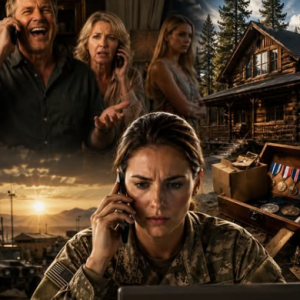
I stared through the operations-building window at the pale Texas sunrise.
“How many of those statements are false?”
“All of them.”
A mechanic crossed the yard outside carrying a toolbox.
Somewhere nearby, a radio crackled.
Ordinary life continued while my family’s lie began collapsing three states away.
Sloane turned a page.
“Your father transferred the cabin and the surrounding eighty-seven acres into the Calder Citadel Trust before he died.
The trust names you as the sole beneficial owner.
Your mother was granted limited residential access until remarriage, but no authority to sell, mortgage, lease, alter, or remove property.”
“My mother remarried Victor nine years ago.”
“Which automatically terminated her access righTS.”
I closed my eyes.
For nine years, I had allowed them to use the cabin during holidays because I thought preserving peace mattered more than enforcing every boundary.
My silence had not created peace.
It had taught them that my boundaries were imaginary.
“What happens now?” I asked.
“The sale cannot legally close.
But that is not the bear trap.”
I heard the faintest change in her tone.
“Victor borrowed against the cabin three years ago.”
My grip tightened around the phone.
“How?”
“Forged documenTS. A falsified trust release.
A fraudulent notarization.
He used the property as collateral for a private loan, then concealed the debt from the title company handling yesterday’s sale.”
“How much?”
“Four hundred and eighty thousand dollars.”
The number felt unreal.
Sloane continued.
“The buyer wired an earnest deposit.
Victor’s broker released part of it early based on fraudulent representations.
Some of that money was used last night to purchase airline tickets, a luxury resort package, and several large cash-equivalent gift cards.”
“For Brianna’s vacation.”
“And possibly to move money before creditors could seize it.”
I thought of Victor laughing while telling me he had thrown away my father’s medals.
“Can we stop him?”
“We already have.”
A second call beeped through my phone.
Unknown Colorado number.
Sloane said, “Answer it.
Put me on conference.”
I accepted the call.
A panicked man spoke before I could identify myself.
“Ms.
Calder? This is Nathan Corbett from Summit Crest Realty.
I’m representing Mr. Pike on the cabin sale.
I need to clarify a title issue immediately.”
His breathing sounded uneven.
“What issue?” I asked.
There was paper shuffling, followed by a whispered curse.
“The title examiner found a recorded deed that wasn’t disclosed.
It names the Calder Citadel Trust as the owner.
It also references a restricted preservation covenant and—”
His voice cracked.
“W-wait.
Whose name is on this hidden deed?”
“Mine,” I said.
Silence.
Then Sloane entered the conversation.
“This is Sloane Mercer, counsel for Captain Elena Calder and the Calder Citadel Trust.”
The broker inhaled sharply.
“I didn’t know,” he said.
“Mr. Pike gave us an affidavit.
He said the trust had been dissolved.”
“It was not dissolved,” Sloane replied.
“The document he provided contains a forged signature and references a notary whose commission expired two years before the alleged signing date.”
“I swear I had no idea.”
“Then preserve every email, text message, contract, recording, identification document, and payment instruction Mr. Pike provided.
Do not contact him to warn him.
Do not release any further funds.
Your firm will receive a litigation hold within the hour.”
The broker’s voice dropped.
“Is this a criminal matter?”
“That will be determined by law enforcement.”
I looked at the dust blowing across Fort Bliss.
Victor had called because he wanted to hear me break.
Instead, he had given us the exact time of his confession.
“Sloane,” I said, “the call with Victor may have been recorded by the secure communications system here.”
“Request preservation immediately.”
“I will.”
The broker spoke again, almost pleading.
“What about the buyer?”
“The buyer is protected,” Sloane said.
“Mr. Pike is not.”
The call ended.
I expected triumph.
Instead, I felt tired.
Not weak.
Not uncertain.
Just tired of discovering how much damage people could do while insisting they were family.
My commander approved emergency leave after reviewing the preliminary legal notice.
Thirty-six hours later, I was on a flight to Colorado with my uniform folded inside a garment bag and my father’s copy of Meditations in my carry-on.
Bear met me at the airport.
He was seventy now.
His beard had gone white, and he leaned slightly on a wooden cane.
But his eyes were unchanged—steady, watchful, impossible to deceive.
He hugged me once, hard.
“Your dad would hate that you had to come home for this,” he said.
Then he stepped back.
“But he’d be proud you came standing.”
We drove west beneath a sky heavy with snow.
The mountains rose in the distance, dark and familiar.
“Did Victor really throw away the medals?” I asked.
Bear’s jaw tightened.
“He tried.”
I turned toward him.
“What does that mean?”
“Three months ago, he called me and asked what old military decorations were worth.
Said he’d found a box of ‘war junk.’ I drove to the cabin that night.”
“You never told me.”
“You were deployed.
I thought I could handle it quietly.”
“Did you find them?”
Bear nodded.
“They’re safe.”
Relief hit so suddenly that I had to look away.
“Thank you.”
“He didn’t know your father’s medals included documents hidden behind the display backing.”
“What documents?”
Bear kept his eyes on the road.
“A letter.
A map.
A second inventory.”
The cabin stood two hours west of Denver, surrounded by pines and a crust of fresh snow.
I had not been there in nearly four years.
The moment I saw the stone chimney above the trees, I was twelve again, carrying nails in my pockets while my father measured timber.
Then I noticed the damage.
The front gate hung open.
Tire tracks carved through the snow.
A rental truck was parked beside the porch.
Victor was inside.
Bear killed the engine.
“He knows the sale stopped,” I said.
“He may be trying to clear the place out before the sheriff arrives.”
We called Sloane.
She told us not to enter until deputies reached the property.
Then a bedroom window opened.
Victor appeared carrying my father’s cedar chest.
He shoved it through the opening.
It crashed into the snow below.
Something inside me turned cold.
I stepped out of Bear’s truck.
“Elena,” Bear warned.
Victor saw me.
For one second, his face showed pure fear.
Then arrogance rushed in to cover it.
He disappeared from the window and came through the front door wearing a heavy coat and leather gloves.
“You,” he said.
“Yes.”
“You caused this.”
Snow drifted between us.
Behind him, my mother appeared on the porch.
Brianna stood farther back, wrapped in an expensive white coat, her phone clutched in one hand.
My mother looked older than I remembered.
“Elena,” she said, “please don’t make a scene.”
I almost laughed.
Victor had forged documents, stolen money, and attempted to sell property he did not own.
But I was still the one making a scene.
“You need to leave the cabin,” I said.
Victor walked down one step.
“This cabin belongs to your mother.”
“No.
It belongs to the Calder Citadel Trust.”
“That’s legal nonsense.”
“It is a recorded deed.”
He jabbed a gloved finger toward me.
“You abandoned this place.
Your mother and I maintained it.
We paid taxes.
We fixed the roof.
We kept it from rotting while you played soldier.”
“Played soldier?”
Bear stepped from the truck.
Victor’s confidence flickered.
Bear shut the door slowly.
“Careful,” he said.
Victor looked between us.
“You old men filled her head with this garbage.
Her father was the same way.
Always hiding papers.
Always treating everyone like thieves.”
“My father treated you like a thief,” I said, “because you became one.”
Brianna descended the porch.
“Dad said the trust wasn’t real.”
“It is real.”
“He said you signed the cabin over.”
“I did not.”
Her face changed.
She looked at Victor.
“You told me she gave it to Mom.”
Victor did not answer.
My mother stepped forward.
“Brianna, go inside.”
“No.” Brianna’s voice sharpened.
“You said this was settled.”
Victor turned on her.
“I said go inside.”
That was when I realized something.
Brianna had laughed at me years ago.
She had enjoyed being favored.
She had accepted gifts bought with money that should never have existed.
But she had not known everything.
Victor had built separate lies for each of us.
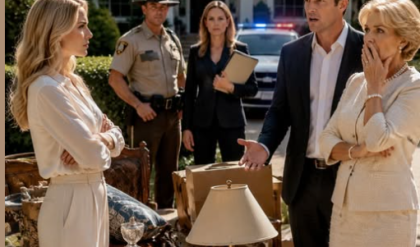
The sheriff’s vehicles appeared through the trees.
Red and blue lights flashed silently across the snow.
Victor’s face drained of color.
Two deputies stepped out.
Sloane arrived behind them in a dark SUV, carrying a leather case.
She walked toward us without hurrying.
“Mr. Pike,” she said, “step away from the property.”
Victor raised both hands.
“This is a family disagreement.”
“No,” Sloane replied.
“It is suspected real-estate fraud, forgery, theft, fraudulent conversion, and violation of a court-issued temporary restraining order.”
“What restraining order?”
“The one served electronically to your attorney forty minutes ago.”
“I don’t have an attorney.”
“You will.”
One deputy approached Victor.
“Sir, we need to speak with you about items being removed from the residence.”
Victor pointed at me.
“She set this up because she hates me.”
I said nothing.
Sloane opened her case.
“We also have a preserved recording of your call to Captain Calder, during which you admitted selling the property, using proceeds for personal debts and travel, and disposing of trust-owned military memorabilia.”
Victor stared at me.
“You recorded me?”
“You called a military installation.”
His mouth opened.
Nothing came out.
My mother moved down the steps.
“Elena, stop this.
He made a mistake.”
“A mistake is signing the wrong line.
He forged my name.”
“He was desperate.”
“So he stole from me.”
“We are your family.”
The words hung between us.
For most of my life, those words had been used as a key to unlock anything they wanted.
My money.
My silence.
My forgiveness.
My inheritance.
My dignity.
I looked directly at my mother.
“Family is not permission.”
Her face crumpled.
It might have moved me once.
Now I could see the pattern beneath the tears.
She had ignored every small cruelty until Victor became brave enough to attempt a large one.
One of the deputies led Victor toward the patrol vehicle.
He suddenly twisted around.
“This is your fault!” he shouted at my mother.
“You said she’d never fight us!”
My mother froze.
The entire clearing went silent.
Victor realized too late what he had revealed.
Brianna stared at her mother.
“You knew?”
My mother’s lips parted.
“Brianna, it’s complicated.”
“You knew the cabin wasn’t yours?”
“I thought Elena would understand.”
“You told Dad she wouldn’t fight?”
“I was trying to keep us afloat.”
Brianna stepped backward as though the ground had shifted.
“You said the sale was legal.”
 Man Refuses To Let His Ex-Wife Stay At His House, Now His Friends Are Canceling The Vacation
“I believed Victor had handled the paperwork.”
Sloane removed a document from her case.
“Mrs. Pike, this is an email you sent to Victor nine months ago.”
My mother went still.
Sloane read from it.
“‘Elena is overseas again.
She never checks county filings.
Use the old signature page if necessary.
Once the money is transferred, she will complain, but eventually she always gives in.’”
Snow gathered on my mother’s hair.
Brianna covered her mouth.
I felt no satisfaction.
Only clarity.
My mother had not been manipulated.
She had participated.
She had counted on the same daughter she had trained to apologize.
A deputy asked her to turn around.
“Am I under arrest?” she whispered.
“You are being detained for questioning.”
She looked at me as the deputy placed her hands behind her back.
“Elena, please.”
I thought of Thanksgiving.
Of the fifty-dollar bill.
Of every phone call that ended with me apologizing for being hurt.
Of my father building walls because he understood what I did not.
“I hope you tell the truth,” I said.
That was all.
Brianna remained on the porch after the vehicles disappeared.
The Hawaii trip was canceled within the hour.
The resort froze the reservation.
The airline refunded part of the money directly to the title company.
Victor’s creditors began filing claims.
But none of that seemed important while Brianna stood staring at the snow.
“I didn’t know,” she said.
“I believe you didn’t know everything.”
Her eyes filled.
“That isn’t the same as being innocent.”
“No.”
She nodded, accepting it.
“I liked being the favorite.”
The honesty surprised me.
“I liked watching him put you down because it meant he was lifting me up.
I told myself you were cold.
That you thought you were better than us.”
“I was trying to survive the house.”
“I know that now.”
She looked toward the cabin.
“What happens to Mom?”
“That depends on what she admits and what prosecutors can prove.”
“And Dad?”
“You should get your own attorney before speaking with investigators.”
She flinched at the distance in my voice.
“You really don’t trust me.”
“I don’t know you well enough to trust you.”
That hurt her.
But truth was not cruelty merely because it hurt.
Brianna handed me her phone.
On the screen were messages from Victor instructing her to open several payment accounTS. He had told her they were for travel rewards.
The accounts had been used to move portions of the deposit.
“I’ll give them everything,” she said.
“Why?”
“Because he used me too.”
I studied her face.
“Do it because it is right, not because you are angry.”
She swallowed.
“Does the reason matter?”
“In the beginning, maybe not.
Eventually, yes.”
Bear and I entered the cabin after the deputies cleared it.
The living room looked wounded.
Furniture had been dragged across the floor.
Cabinet doors stood open.
Boxes were stacked near the entrance.
My father’s tools had been dumped into plastic bins.
But the cabin was still standing.
Slow work lasTS.
Rushed work falls apart.
Bear retrieved the medal case from his truck.
The glass had a crack through one corner, but the medals were intact.
He set it on the dining table and removed the wooden backing.
Behind it was an envelope bearing my name.
The paper had yellowed.
I opened it carefully.
Elena,
If you are reading this, someone has mistaken your patience for surrender.
Do not hate them.
Hate is a debt that charges interest inside the person carrying it.
But do not protect them from consequences either.
A boundary without consequence is only a request.
The cabin is not your inheritance because it is valuable.
It is your inheritance because you helped build it before you understood what building meant.
Every straight wall begins with an honest measurement.
Measure people honestly.
Love them if you can.
Leave them if you must.
But never lie to yourself about what they are.
—Dad
I sat at the table and cried for the first time since Victor’s call.
Not because the cabin had nearly been stolen.
Because my father had known.
He had known I might spend years confusing endurance with love.
Bear sat across from me without speaking.
After a while, he unfolded the map hidden behind the medals.
A section of the forest was marked with my father’s handwriting.
“What is this?” I asked.
“Your father’s final project.”
We followed an old trail behind the cabin until we reached a narrow clearing among the pines.
Snow covered a low stone foundation.
At the center stood a weathered metal box sealed beneath a flat rock.
Inside were photographs, building plans, and documents establishing a charitable fund.
The Calder Veterans Renewal Project.
My father had intended the land to become a retreat for veterans and military families dealing with grief, injury, and difficult transitions home.
The trust contained more than the cabin.
It included investment accounts my father had quietly funded for years.
Not millions.
Enough.
Enough to restore the property.
Enough to build three small guest cottages.
Enough to begin.
Sloane reviewed the documents that evening.
“He left final approval to you,” she said.
I stood near the fireplace holding the plans.
Victor had tried to turn my father’s legacy into debt payments and a luxury vacation.
My father had intended it to become shelter.
“I want to finish it,” I said.
Bear smiled.
It was the first time I had seen him smile all day.
The criminal case lasted eleven monThS.
Victor eventually pleaded guilty to forgery, attempted theft, wire fraud, and falsifying real-estate documenTS. Investigators discovered he had used similar schemes against two former business partners and an elderly cousin.
His debts had not come from one emergency.
They came from gambling, failed investments, and years of pretending to be wealthier than he was.
My mother accepted a plea agreement after providing evidence against him.
She avoided prison but received probation, restitution obligations, and mandatory financial-crime counseling.
She wrote me seven letters.
The first blamed Victor.
The second blamed fear.
The third blamed me for being distant.
I returned all three unopened.
The fourth began differently.
I taught you that love meant giving in.
I did it because I was afraid people would leave me if I made them angry.
Then I punished you for refusing to live the same way.
I read that letter twice.
I did not answer.
Forgiveness, I learned, did not require immediate access.
The fifth letter contained no excuses.
The sixth described her counseling.
The seventh asked whether she might someday visit the completed retreat—not as my mother demanding entry, but as a volunteer willing to work.
I kept that one.
Brianna testified against Victor.
She sold the necklace he had given her at my Thanksgiving dinner and donated the money to the retreat.
When she told me, I said, “You did not have to do that.”
“I know.”
That was why it mattered.
We did not become close overnight.
Some months we spoke once.
Other months, not at all.
Trust returned like a damaged forest after fire—slowly, unevenly, through small living things pushing up where everything looked dead.
Two years after Victor’s phone call, the Calder Veterans Renewal Center opened.
The original cabin became the main lodge.
We preserved my father’s workbench exactly as he had left it.
His medals hung above the fireplace, not as decoration, but as history.
Three cottages stood among the pines.
One was named Kincaid House, though Bear complained for weeks that naming buildings after living people was “sentimental nonsense.”
He attended the opening anyway.
So did soldiers, spouses, widows, counselors, builders, and families who understood that returning home did not always mean feeling safe.
My commander came from Texas.
Sloane stood near the front wearing the expression of someone pretending not to be proud.
Brianna volunteered at the registration table.
My mother arrived alone.
She stayed near the edge of the gathering, uncertain whether she belonged.
I saw her before she saw me.
For a moment, I remembered her voice on the phone.
Don’t make this dramatic.
Sometimes family means sacrifice.
I also remembered my father’s letter.
Measure people honestly.
My mother had done terrible harm.
She had also begun the long work of naming it without hiding.
I walked toward her.
She looked frightened.
“Hello, Elena.”
“Hello, Mom.”
Her eyes moved toward the lodge.
“It’s beautiful.”
“Dad designed most of it.”
“He would have been proud of you.”
“I think he would have been proud that it helps people.”
She nodded.
“I brought work gloves.”
I looked at the gloves in her hands.
There were tables to clear, dishes to wash, supply boxes to move.
No speeches.
No public reconciliation.
No pretending the past had vanished.
Just work.
“Brianna can show you where volunteers check in,” I said.
My mother’s eyes filled, but she did not ask for more.
“Thank you.”
As she walked away, Bear joined me on the porch.
“You all right?” he asked.
“Yes.”
“Sure?”
I looked across the clearing.
Children ran between the trees.
A young veteran sat beside the firepit with his wife, their shoulders finally relaxed.
Snowmelt dripped from the roof my father and I had built.
“I spent years thinking justice would feel like watching Victor lose everything,” I said.
“And?”
“It felt like this instead.”
Bear followed my gaze.
“Building something?”
“Keeping him from deciding what the story became.”
That evening, after everyone left, I remained alone in the lodge.
The sunset turned the snow copper beyond the windows.
I placed my father’s letter inside the medal case and closed the wooden backing.
Then my phone rang.
For one second, I was back at Fort Bliss, hearing Victor laugh.
But the caller was a young Army medic scheduled to arrive at the retreat the next morning.
She sounded nervous.
“Captain Calder? I’m sorry to call late.
I just wanted to make sure my reservation is real.
I’ve had people promise help before.”
I looked around the cabin.
At the walls my father had built.
At the structure he had protected.
At the future Victor had almost sold.
“It’s real,” I told her.
“Your room is ready.”
She exhaled shakily.
“Thank you.”
After the call, I stepped onto the porch.
The mountains were quiet.
For years, I believed my father’s greatest gift was the hidden deed that saved the cabin.
I was wrong.
The deed protected the land.
His real gift was teaching me that calmness did not mean submission, forgiveness did not mean access, and family did not mean surrendering what was entrusted to you.
Victor thought I was helpless because I did not shout.
My mother thought I would give in because I always had before.
They both misunderstood the same thing.
Silence can be fear.
But sometimes silence is the sound of someone reading the blueprint, checking every measurement, and deciding exactly where the strongest wall must stand.
My father’s cabin was never sold.
His legacy was never destroyed.
It became a place where wounded people learned to rebuild.
And so did I.