
The message from Mark appeared beneath the first one.
Don’t let her change her mind.
The dealer said the new car should cover what we still owe, and you can keep the old sedan afterward.
For several seconds, nobody moved.
The refrigerator hummed behind us.
Rain tapped lightly against the kitchen window.
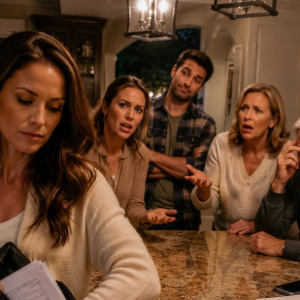
Somewhere in the living room, one of my sister’s children laughed at something playing on television, unaware that their mother had just been exposed in front of the entire family.
I read the message again.
Then a third one appeared.
Once you get the title signed, bring it over.
I already told the buyer we’d have it by tomorrow.
My father slowly lowered the knife he was holding.
My brother’s smirk vanished.
Mom looked at my sister as though she had suddenly become someone else.
“You were going to sell her car?” Dad asked.
My sister grabbed the phone from my hand.
“It isn’t what it looks like.”
I almost admired the sentence.
People always said that when something looked exactly like what it was.
“What does it look like?” I asked.
She locked the screen and held the phone against her chest.
“Mark and I were discussing possibilities.”
“Mark, the man you divorced?”
“He still helps with the kids.”
“The same man you said left you with nothing?”
Her jaw tightened.
“You don’t understand how complicated it is.”
“No,” I said.
“I understand perfectly.
You wanted me to give you my new car.
You planned to sell it with Mark, use the money to cover a debt you still share, and keep the old car anyway.”
Mom stood up.
“Is that true?”
My sister’s eyes filled with tears so quickly that years ago, they would have stopped the conversation.
Tears had always been her emergency exit.
The moment they appeared, everyone rushed to protect her from the consequences of whatever she had done.
This time, nobody moved.
“It was supposed to help me start over,” she said.
I looked at the dealership estimate on the island.
The highlighted resale value was nearly the exact amount I had spent from my savings.
“How much do you owe?” I asked.
She did not answer.
“How much?”
“Thirty-two thousand.”
Dad’s face drained of color.
“Thirty-two thousand dollars?”
“It isn’t all mine.”
“Then whose is it?” I asked, although I already knew.
She looked toward the dark window.
“Mark’s business debt.”
My brother pushed away from the island.
“You were going to sell her new car to pay your ex-husband’s business debt?”
“He said if we cleared it, he could start making proper child-support paymenTS.”
“And you believed him?” Dad demanded.
My sister’s voice sharpened.
“I was trying to protect my children.”
“No,” I said quietly.
“You were trying to protect Mark.”
She turned on me.
“You don’t know what it’s like to have two children depending on you.”
There it was.
The sentence my family had used for years.
You do not have children.
You do not understand.
Your time matters less.
Your money is more available.
Your exhaustion is optional.
Your boundaries are selfish.
I opened my folder and checked that the title was still inside.
Then I placed both sets of keys in my purse.
My sister stared at me.
“You can’t leave.”
“I can.”
“You brought the car for me.”
“I offered you the old car.
You refused it.”
“I didn’t refuse it.”
“You put the keys back on the table and asked for something more expensive.”
“Because the new one is safer for the kids.”
“No.
Because the new one could be sold for more.”
Her face crumpled.
Mom stepped between us.
“Everyone is upset.
Sit down, and we can work this out.”
I looked at her.
“What exactly is there to work out?”
Mom lowered her voice.
“Your sister made a mistake.”
“A planned mistake?”
“She is desperate.”
“She had a dealership valuation for a car she did not own.”
“She was scared.”
“She coordinated with her ex-husband before I arrived.”
“She wasn’t thinking clearly.”
“She was thinking clearly enough to arrange a buyer.”
Each excuse died before Mom could fully release it.
Dad pulled out a chair and sat down heavily.
He looked older than he had an hour earlier.
“How long has this been going on?” he asked my sister.
She wiped her cheeks.
“Mark called last week.”
“Last week?” I repeated.
“I only told Mom three days ago that I was thinking about giving you the sedan.”
Mom looked down.
That was answer enough.
I turned toward her.
“You told her about my new car.”
“I mentioned it.”
“You told her I might give her the old one.”
“I thought she should know.”
“And then all of you discussed whether I should give her the new one instead.”
Nobody responded.
My brother rubbed the back of his neck.
“It wasn’t some conspiracy.”
“What would you call it?”
“A family conversation.”
“About my property.”
“We talk about things.”
“You talk about what I own as though it belongs to everyone.”
“That’s not fair.”
I laughed once.
It was not a happy sound.
“Last year, you borrowed five thousand dollars from me because your hours were cut.”
His expression changed.
“That has nothing to do with this.”
“You told me you would pay it back in three monThS.”
“I’m working on it.”
“You bought a motorcycle six weeks later.”
“It was used.”
Mom closed her eyes.
I looked at Dad.
“Two years ago, I paid the property taxes when you were short.”
He shifted uncomfortably.
“We paid some of that back.”
“You paid back eight hundred dollars of six thousand.”
“We are your parenTS.”
“And I helped because I loved you.
Not because you were entitled to it.”
Then I faced Mom.
“I paid for the new refrigerator.
I paid the deposit for the roof repair.
I covered your dental work when insurance denied it.
Every time I helped, you said family takes care of family.”
Mom’s lips trembled.
“Family does take care of family.”
“Then why does care only move in one direction?”
The question settled over the kitchen.
Nobody had an answer.
My sister lowered herself into the chair.
“I was going to pay you back.”
“With what?”
“Once Mark’s business recovered.”
“You were going to sell my car without telling me.”
“I would have explained later.”
“After the title was transferred?”
She covered her face.
I thought anger would feel hot.
Instead, I felt cold clarity.
For years, I had believed my family failed to appreciate me because I had not explained myself well enough.
I thought if I gave a little more, spoke a little softer, helped one more time, they would finally notice the cost.
But people rarely respect a boundary that has never been enforced.
I zipped the folder closed.
“I am leaving.”
My sister stood abruptly.
“What am I supposed to do without a car?”
The old version of me would have answered immediately.
I would have searched for bus routes, rental options, payment plans, rideshare discounts, anything to rescue her from the discomfort of solving her own problem.
This time, I picked up my coat.
“You had a free car ten minutes ago.”
“So you’re punishing the kids?”
“No.
I am refusing to reward your plan.”
“They need transportation.”
“Then ask Mark to sell something he owns.”
“He doesn’t have anything.”
“Neither do you.
That was the problem until I offered to give you a car.”
She stepped closer.
“You know I can’t afford one.”
“You could have accepted mine.”
“It was old.”
“It was reliable.”
“It had almost ninety thousand miles.”
“It had new tires, a clean title, complete maintenance records, and no payment.”
Her voice rose.
“You have no idea how humiliating it is to show up at school pickup in an old sedan while everyone knows your life fell apart.”
That sentence finally revealed what no one had been willing to admit.
The car had never been about transportation.
It had been about appearance.
My sister did not want help.
She wanted restoration without sacrifice.
She wanted to look as though the divorce had cost her nothing, even if preserving that illusion cost me everything.
I looked at her for a long moment.
“Your children would rather have a mother in an old car than a mother who teaches them to take from people who love them.”
She flinched.
Mom whispered my name in warning.
I turned toward her.
“Do not tell me not to make this ugly.
I did not create this.”
Then I walked outside.
My father followed me onto the porch.
The rain had grown heavier, silver under the streetlight.
He stood behind me as I unlocked the old sedan.
“Are you really taking both cars?”
“Yes.”
He exhaled.
“She does need help.”
“I know.”
“Then why take the old one?”
“Because she did not see it as help.
She saw it as proof that she deserved more.”
Dad stared at the driveway.
“What will you do with it?”
“Sell it.”
He nodded slowly.
 Man Refuses To Let His Ex-Wife Stay At His House, Now His Friends Are Canceling The Vacation
Then he said something I did not expect.
“You should.”
I looked at him.
His shoulders had lowered.
For once, he did not look like the father preparing to lecture the difficult daughter.
He looked ashamed.
“I let this happen,” he said.
“You all did.”
“I told myself you were stronger.”
“I am stronger.”
“I used that as an excuse to ask more from you.”
The honesty hurt more than another defense would have.
He wiped rain from his forehead.
“I’m sorry.”
I wanted to forgive him immediately.
That was another habit of mine—accepting apologies before behavior had time to change.
So I said, “Thank you for saying it.”
Not It’s okay.
Not Don’t worry about it.
Just thank you.
I drove the old sedan home first, then returned in a rideshare to collect my new car.
By the time I came back, my sister and her children had left.
Mom stood behind the front window, but she did not come outside.
For the next two weeks, my family was silent.
Then the calls began.
Mom left messages saying my sister was missing work because she could not find reliable transportation.
My brother texted that I had made my point and should stop being stubborn.
My sister sent a photograph of her children standing beside a bus stop in the cold.
Under it, she wrote:
I hope you’re proud of yourself.
I stared at the photograph for a long time.
Then I noticed something reflected in the glass shelter behind them.
Mark’s truck.
He had driven them to the bus stop, taken the photograph, and apparently left them there to make the scene look worse.
I saved the image.
Then I replied:
Tell Mark to drive his children the rest of the way.
She did not answer.
Three days later, a dealership called me.
A man introduced himself and asked whether I was still interested in selling my new car.
I told him I had never contacted them.
There was a pause.
Then he asked me to verify my name and the vehicle identification number.
Someone had submitted an online purchase request using my information.
I filed a fraud report that afternoon.
The dealership provided copies of the documenTS. My sister had entered my address, estimated the mileage, and uploaded a photograph of the temporary registration visible through my windshield.
She had not forged my signature yet.
But she had come close enough.
When the police contacted her, the entire family finally understood that this was no longer a disagreement about generosity.
It was attempted fraud.
Mom called me in tears.
“Please don’t press charges.”
“I filed a report to protect myself.”
“She could lose custody.”
“She could have put a fraudulent sale in my name.”
“She wasn’t going to go through with it.”
“She already started.”
“She is your sister.”
“And I was her target.”
The old version of me would have folded at the word sister.
This time, I did not.
The case did not lead to jail.
Because the transfer had never been completed and my sister cooperated after being confronted, she was ordered to repay the dealership’s administrative losses, complete community service, and attend financial counseling.
Mark disappeared the moment the police became involved.
He stopped answering her calls.
Within a month, she discovered he had been using the promised child-support payments to manipulate her into covering his debt.
The buyer he claimed to have arranged was one of his business partners.
Their plan had been to sell my new car below market value, clear part of Mark’s debt, and leave my sister with the old sedan.
She had betrayed me for a future he never intended to give her.
I wish I could say that realization immediately changed her.
It did not.
At first, she blamed me.
Then Mom.
Then Mark.
Then the divorce.
Then the pressure of raising children alone.
But financial counseling required her to list every debt, every source of income, every expense, and every person she had borrowed from.
My name appeared twelve times.
The total she had received from me over four years was more than forty-seven thousand dollars.
When she saw the number on paper, she stopped speaking.
Two months later, she came to my apartment.
She arrived by bus.
I nearly did not open the door.
When I did, she stood in the hallway holding a paper grocery bag and a plain white envelope.
“I’m not here to ask for anything,” she said.
I waited.
Inside the bag was the grocery gift card I had hidden in the old sedan’s glove compartment.
She had found it the day of the dinner when she checked the car before coming inside.
She had known about that gift too.
The envelope contained two hundred dollars.
“It’s the first payment,” she said.
“For what?”
“Everything.”
I almost told her to keep it.
Then I realized refusing the money would protect her from the exact responsibility she was finally trying to accept.
So I took the envelope.
She looked relieved and devastated at the same time.
“I was angry when you offered me the old car,” she said.
“Not because it was bad.
Because it made my life feel real.”
I leaned against the doorframe.
“My divorce.
The rental.
The bus.
The debt.
I thought if I had your new car, people would think I was doing fine.”
“And selling it?”
She looked down.
“Mark said we could erase the debt and try again.
I wanted to believe him.”
“You were willing to steal from me.”
“Yes.”
The word came without an excuse.
That mattered.
She wiped her eyes.
“I don’t expect you to forgive me.”
“I don’t know if I do.”
“I understand.”
“And I won’t lend you money again.”
“I understand.”
“You cannot involve Mom or Dad when I say no.”
“I won’t.”
“If you ever use my information again, I will pursue every legal option available.”
She nodded.
“I know.”
For the first time in our lives, she stood in front of me without tears being used as leverage, without Mom translating her pain into my responsibility, without Dad reminding me that I was stronger.
She was simply my sister.
Flawed.
Ashamed.
Responsible for what she had done.
Before leaving, she said, “The kids ask about you.”
“I miss them.”
“Maybe one day you could see them.”
“One day.”
I did not promise when.
Healing was not another service I owed on demand.
I sold the old sedan the following week.
I received a little more than I expected.
I used part of the money to establish an emergency fund for myself—something I should have done years earlier instead of treating every family crisis as more urgent than my own future.
With the rest, I quietly donated reliable transportation vouchers to a local program for women leaving abusive or financially controlling marriages.
I did not tell my family.
Generosity felt different when it was given freely, not extracted through guilt.
Six months passed.
My sister found a steady administrative job close to her apartment.
She arranged a carpool with another mother and saved every extra dollar.
My father began repaying the property-tax money in small monthly transfers.
My brother sold his motorcycle and returned part of what he owed me.
Mom stopped calling me whenever someone in the family had a problem.
Not because they no longer had problems.
Because they had finally learned that I was not the family solution.
On my birthday, we gathered again in my parents’ kitchen.
The same granite island stood under the same warm lighTS.
But this time, nobody discussed my income, my car, or what I should give away.
My sister arrived late.
Through the window, I saw her park a twelve-year-old compact car at the curb.
The paint was faded near the trunk, and one hubcap did not match the others.
She came inside holding a small cake.
“I bought it myself,” she said.
“The cake?”
“The car.”
I looked through the window again.
“It’s not glamorous,” she added.
“Does it run?”
“Most days.”
We both smiled.
Then she placed a small key ring on the island.
For one terrible second, my body remembered the first clink of keys against granite.
But she did not push them toward me.
She held them in her own palm.
“I used to think help meant someone making my life look untouched,” she said.
“Now I think help is being given a chance to rebuild without pretending nothing broke.”
The kitchen went quiet.
Not the punishing silence from before.
A listening silence.
Mom reached for my sister’s hand, then stopped and allowed her to finish.
My sister looked at me.
“You gave me a car, and I treated it like an insult.
Then you took it back, and I treated that like cruelty.
But losing it forced me to see that I had stopped asking whether something was mine to take.”
She took a breath.
“I’m sorry.”
This time, I believed her.
Not because the apology was perfect.
Because six months of behavior stood behind it.
I hugged her.
It was not the kind of embrace that erased everything.
It was the kind that admitted something new might still be built.
Later that evening, as I walked outside, my nephew ran after me.
“Auntie!”
I turned.
He held out a folded drawing.
It showed three cars parked beside a crooked house.
One was bright red, one was gray, and one was an impossible shade of green.
Stick figures stood between them holding hands.
At the top, in uneven letters, he had written:
EVERYONE DRIVES THEIR OWN CAR.
EVERYONE STILL COMES HOME.
I laughed until tears filled my eyes.
For years, I had confused being needed with being loved.
I believed that if I stopped giving, the family would stop gathering around me.
But love that disappears when the money, rides, favors, and rescue plans stop was never love.
It was dependence wearing a familiar face.
I still helped my family after that.
But I helped differently.
I offered what I could without harming myself.
I said no without presenting a legal argument.
I allowed adults to experience the consequences of their choices.
And when guilt arrived, as it sometimes did, I reminded myself of the keys on the kitchen island.
The old ones had represented everything I gave without being valued.
The new ones had represented everything they thought they could claim.
Taking both sets back was not the moment I abandoned my family.
It was the moment I stopped abandoning myself.
And strangely, that was when we finally began learning how to become a family again.