For several seconds, the courtroom was so quiet that I could hear the faint hum of the overhead lighTS.
Grant stared at the incorporation agreement as though the words might rearrange themselves if he refused to blink.
“This is impossible,” he whispered.
Judge Whitmore placed the document beside the sealed letter.
“According to the trust records, Mrs. Mercer holds a fifty-one percent beneficial interest in the intellectual property on which Mercer Dynamics was founded.”
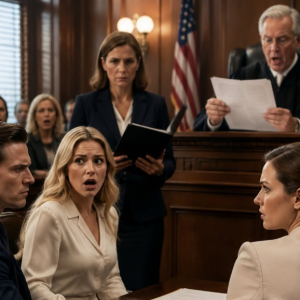
Grant’s attorney rose unsteadily.
“Your Honor, even if the document is genuine, the trust was dormant.”
“Dormant does not mean nonexistent,” Lena said.
Grant turned toward Martin Hale.
“You knew about this?”
Martin finally looked at him.
“I knew there was an old trust,” he answered.
“You told me it had been dissolved.”
“It was dissolved.”
“No,” I said.
“You prepared papers claiming it had been dissolved.
You forged my signature, but you never filed them because filing would have alerted the trustee.”
Grant’s jaw tightened.
Vanessa leaned close to him and whispered something I could not hear.
He shoved her hand away.
The gesture was small, but everyone saw it.
Only minutes earlier, they had entered the courtroom as a united couple, smiling as though they were attending the final ceremony of my humiliation.
Now Grant looked at Vanessa as if she were another liability he needed to remove.
Judge Whitmore turned another page.
“The court has also received evidence that Mr. Mercer transferred approximately forty-two million dollars through entities connected to Ms.
Vale’s family.”
Vanessa stood again.
“That money was payment for legitimate consulting work.”
The judge looked at her over his glasses.
“Did I give you permission to speak?”
She slowly sat down.
One of the federal investigators stepped forward and handed a document to the clerk.
After reading it, the clerk passed it to Judge Whitmore.
His expression changed.
The amusement disappeared.
“Mr. Mercer,” he said, “a federal judge has issued a temporary restraining order freezing the disputed corporate and personal accounTS. You are prohibited from transferring, selling, concealing, or destroying any property related to Mercer Dynamics.”
Grant’s face became rigid.
“You cannot freeze an entire company during a divorce.”
“This is no longer only a divorce.”
The words landed like a door slamming shut.
Grant’s attorney placed a hand on his arm.
“Do not say anything else.”
Grant pulled away.
He looked at me with the same anger I had seen the night he ordered security to remove me from my own office.
“You planned all of this because I left you.”
I felt something inside me grow still.
Even after everything—the affair, the fraud, the stolen work, the forged signatures—Grant still believed his greatest crime had been choosing another woman.
“No,” I said.
“I did this because you stole from me.”
“You were my wife.”
“I was your partner.”
“You stopped showing up.”
“Our son died.”
A faint ripple moved through the courtroom.
Grant’s mouth opened, but no words came.
For years, he had used my grief as evidence that I was weak.
He had told colleagues I had abandoned the company because I could not handle pressure.
He had never told them that I returned to work twelve days after burying our baby because Grant said investors would panic if both founders disappeared.
He had never told them I wrote the foundation of our most valuable software while sitting beside an empty crib.
“You told me you needed time,” Grant said at last.
“I told you I needed help.”
“You shut me out.”
“I woke up every night screaming his name.
You moved into the guest room because my grief interrupted your sleep.”
Vanessa looked away.
Grant’s arrogance cracked for the first time.
Judge Whitmore lowered his voice.
“Mrs. Mercer, you are not required to discuss this.”
“I know.”
I looked directly at Grant.
“But he has spent two years telling people that I became unstable for no reason.
I want the record to reflect the truth.”
Lena touched my wrist lightly, reminding me that I was not alone.
I continued.
“Three weeks after the funeral, Grant asked me to sign a patent assignment.
He said it was routine paperwork.
I could barely read the page through the medication my doctor had prescribed.
I trusted my husband, so I signed.”
Grant’s lawyer closed his eyes.
“The document submitted to the Patent Office,” Lena said, “contains a different final page from the version Mrs. Mercer signed.”
The investigator placed two copies on the evidence table.
One carried my signature beneath a limited licensing agreement.
The other used the same signature beneath a complete transfer of ownership.
Even Vanessa seemed shocked.
She turned toward Grant.
“You told me she sold you the patenTS.”
Grant said nothing.
“You said she wanted cash and disappeared.”
“Be quiet.”
“You lied to me.”
He looked at her with open contempt.
“You benefited from it.”
Vanessa’s face changed.
In that instant, I understood their relationship more clearly than I ever had before.
It had never been a love story.
It was an arrangement between two ambitious people who believed loyalty was useful only while it remained profitable.
Now the profit was disappearing.
Vanessa picked up her handbag.
“I’m leaving.”
The investigator stepped between her and the aisle.
“I’m afraid you need to remain available for questioning.”
Her confidence collapsed.
Grant watched her pale, and something like satisfaction flickered across his face.
Even while his own world burned, he was relieved to see someone else trapped beside him.
Judge Whitmore called a brief recess.
The moment he left the bench, reporters waiting outside began shouting through the courtroom doors.
News of the federal order had already spread.
Mercer Dynamics’ stock had been suspended.
The board had scheduled an emergency meeting.
Employees were gathering in the lobby, demanding information.
Grant’s attorney pulled him into a corner.
Lena guided me into a private consultation room.
Once the door closed, my knees nearly gave way.
She caught me before I hit the chair.
“You did well,” she said.
“I don’t feel well.”
“That’s different.”
I pressed both hands against my face.
For months, I had imagined this day.
In those fantasies, I felt victorious when Grant finally realized what I possessed.
Instead, I felt tired.
Not weak.
Not regretful.
Just tired of carrying evidence of every betrayal committed by the man I had once trusted with my life.
Lena poured me a glass of water.
“There’s something else,” she said.
Her voice warned me before her words did.
“What?”
“Martin gave the investigators access to Grant’s private archive.”
I lowered the glass.
“They found internal messages from the week your son was born.”
My chest tightened.
“What messages?”
Lena hesitated.
That frightened me more than anything she could have said.
“Grant had been negotiating with a foreign buyer.
The buyer wanted confirmation that you would sign over the patenTS. Grant told Martin your pregnancy made you emotional and difficult to control.”
The room seemed to tilt.
“He wrote that if something happened during the delivery, the company would be easier to restructure.”
I stopped breathing.
Lena quickly added, “There is no evidence that Grant caused your son’s death.
None.
The investigators were very clear.”
But those words could not erase the cruelty of what he had written.

While I had been in the hospital, terrified and bleeding, Grant had been considering how my pain might improve his negotiating position.
I stood so quickly the chair scraped across the floor.
“I want to see it.”
“You don’t have to.”
“I want to see it.”
Lena opened her tablet.
The message was brief.
If the delivery goes badly, delay all contact with Evelyn until we know her condition.
She will sign anything if she believes the company is the only thing holding us together.
I read it twice.
Then a third time.
Something inside me broke, but it did not break the way grief had broken me after my son died.
That grief had left sharp pieces everywhere.
This break was clean.
Final.
I no longer needed Grant to admit what he had done.
I no longer needed an apology, an explanation, or proof that some fragment of the man I married still existed.
The man I married had either disappeared long ago or had never existed at all.
When the hearing resumed, Grant refused to look at me.
Judge Whitmore reviewed the emergency agreements reached during recess.
The board of Mercer Dynamics had voted to place Grant on immediate administrative leave.
Martin had resigned as chief financial officer but agreed to remain as a cooperating witness.
An independent receiver would oversee the company until ownership and fraud claims were resolved.
Then the judge addressed the divorce.
“The prenuptial limitations are suspended pending a full determination of fraudulent concealment.
Temporary control of the disputed trust interest will remain with Mrs. Mercer.
The marital residence, investment accounts, and corporate distributions are frozen.”
Grant rose.
“This is my company.”
His attorney whispered urgently, but Grant ignored him.
“I built it.
I gave twenty years to it.”
I stood too.
“And I gave it the invention that made those twenty years valuable.”
His face twisted.
“You want to destroy everything we created?”
“No.
I want to separate what we created from what you corrupted.”
For once, he had no answer.
Outside the courtroom, the hallway had become a wall of cameras.
Reporters called my name.
“Mrs. Mercer, are you taking control of Mercer Dynamics?”
“Did your husband forge federal patent documents?”
“Is Vanessa Vale being charged?”
“Did the company hide millions from shareholders?”
Lena advised me to say nothing.
I intended to follow her advice until I saw the employees.
They stood behind the reporters—engineers, assistants, security guards, programmers, receptionisTS. Some had worked with me during the first years.
Others knew me only as the unstable wife Grant had erased from company history.
They were frightened.
Their jobs, savings, and families depended on what happened next.
I stepped toward the microphones.
“I will not discuss the criminal investigation,” I said.
“But Mercer Dynamics will not be dismantled to punish one man.”
The hallway quieted.
“The employees did not forge my name.
They did not hide asseTS. They did not betray my trust.
My legal team will work with the board and the court-appointed receiver to protect legitimate jobs, clients, and pensions.”
A reporter shouted, “Are you returning as chief executive?”
“No.”
That answer surprised everyone.
Especially Grant.
I looked at the people behind the cameras.
“I helped create a company to stop financial fraud.
Somewhere along the way, its leaders became the very thing our technology was designed to expose.
That must change before anyone deserves to lead it.”
Then I walked away.
Six months later, Grant pleaded guilty to conspiracy, wire fraud, obstruction, and falsifying patent records.
Vanessa accepted a separate agreement after providing evidence against him.
She surrendered the properties bought with diverted funds and was barred from serving as an officer of a public company.
Martin avoided prison because of his cooperation, but he lost his career, his reputation, and the friendship he had protected at the expense of his conscience.
Grant received seven years in federal prison.
The divorce was finalized two weeks before his sentencing.
I was awarded the controlling trust interest, restitution for the stolen intellectual property, and a significant portion of the concealed marital asseTS.
But the most valuable thing I recovered was not listed in the judgment.
It was my name.
The company restored me as cofounder in every official record.
My original research papers were republished.
The patents carried the correct inventorship.
A portrait of Grant was removed from the headquarters lobby, but I refused the board’s offer to replace it with one of me.
Instead, I asked them to hang a framed copy of the first handwritten algorithm from my black notebook.
Beneath it was a simple sentence:
No person becomes invisible merely because someone powerful stops acknowledging them.
I did not become chief executive.
I created an independent ethics foundation funded by the recovered money and a portion of my company shares.
It supported grieving parents returning to work, women whose intellectual property had been taken by partners, and employees who exposed corporate fraud.
For years, I had believed surviving meant becoming the person I was before my son died.
I eventually understood that she was gone.
Healing did not bring her back.
It allowed me to become someone new without feeling guilty for leaving her behind.
On the first anniversary of the courtroom hearing, I visited my son’s grave.
The morning was cool and bright.
I brought white tulips and the small ceramic star that had once hung above his crib.
I sat in the grass and told him everything.
I told him about the company.
The foundation.
The families we had helped.
I told him I was sorry I had spent so long believing grief made me useless.
Then I heard footsteps behind me.
Grant’s mother stood several feet away.
She looked older than I remembered.
In her hands was a cardboard box.
“I found these in storage,” she said.
Inside were photographs, hospital bracelets, and a tiny knitted blanket.
Grant had ordered them removed from our home after beginning his affair.
He said they made the house feel sad.
His mother lowered her eyes.
“I believed what he told us about you.”
I touched the blanket.
“I know.”
“I should have called.”
“Yes.”
Tears filled her eyes, but I did not comfort her.
Forgiveness, I had learned, was not the same as pretending harm had never happened.
“I’m sorry,” she whispered.
“I believe you.”
“Can you forgive me?”
I looked at my son’s name carved into the stone.
“Someday, perhaps.
But forgiveness is not a door you knock on once and expect someone else to open.”
She nodded slowly.
Then she left the box beside me and walked away.
I stayed until the afternoon light turned golden.
Before leaving, I placed the ceramic star beneath my son’s name.
Grant had once told me I would never touch his money again.
He had been right in a way neither of us understood.
By the end, I did not want his money.
I wanted the truth returned to its rightful owner.
I wanted my work, my dignity, and my voice.
And when I finally walked away from the grave, I carried none of the things Grant had used to define my value.
No wedding ring.
No corporate title.
No powerful husband’s name protecting me.
Only a black notebook beneath my arm, my own name on its first page, and a future no one else would ever be allowed to erase.