The champagne glass slipped from Ethan’s hand.
It struck the stone patio and shattered with a sharp crack that silenced the entire garden.
For one suspended second, my son simply stared.
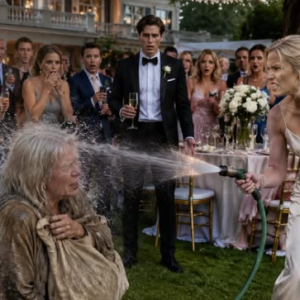
His eyes traveled from my soaked silver hair to the muddy hem of my skirt, then to Vanessa’s hand still wrapped around the green garden hose.
“Mom?”
He did not say it loudly.
He did not need to.
The single word moved through the crowd like thunder.
The man in the navy suit lowered his phone.
The women who had been laughing dropped their hands from their mouThS.
Patricia Mitchell’s smile froze.
George Mitchell finally looked directly at me.
Vanessa blinked several times.
Then she laughed.
It was short, nervous, and completely artificial.
“Ethan, sweetheart, I think you’re confused.”
My son did not even glance at her.
He crossed the lawn so quickly that two servers had to step aside.
He dropped to his knees in the mud beside me and pulled off his jacket.
“Mom, what happened?”
He draped the jacket around my shoulders, though it immediately became soaked.
“Are you hurt?”
“I am cold,” I answered.
“But I am not hurt.”
His hands trembled as he helped me stand.
Vanessa still held the hose.
Water continued to spill from its nozzle onto the grass.
Ethan turned toward her.
“What did you do?”
She stared at him as if he had suddenly begun speaking another language.
“I didn’t know she was your mother.”
“That is not what I asked.”
His voice was low.
I had heard that tone only twice before.
Once when he was fourteen and discovered a classmate had been bullying a younger boy.
And once when his father died.
It was not a loud kind of anger.
It was the kind that had already crossed beyond shouting.
Vanessa placed the hose on the ground.
“She came in through the service entrance dressed like that.
She was wandering around with a dirty grocery bag.
Anyone would have thought—”
“Thought what?”
“That she didn’t belong here.”
Ethan looked around the garden.
Thirty people stood beneath crystal lights and white roses, each one carefully avoiding his eyes.
“Did anyone ask her name?”
No one answered.
“Did anyone ask why she was here?”
Silence.
“Did anyone call me?”
Still nothing.
The young server who had tried to help me raised his hand slightly.
“I was going to, sir, but Miss Mitchell told me I would lose my job if I touched her.”
Ethan turned slowly toward Vanessa.
Her face tightened.
“That is not what happened.”
“It is exactly what happened,” I said.
Vanessa’s gaze snapped toward me.
For the first time, she looked afraid.
Not ashamed.
Afraid.
There is a difference.
Shame comes from recognizing the pain you caused.
Fear comes from realizing that pain may finally cost you something.
Patricia hurried forward.
“Ethan, this has been an unfortunate misunderstanding.”
She reached for his arm.
He moved away before she could touch him.
“An unfortunate misunderstanding?”
“Your mother’s appearance was… unexpected.”
Patricia looked at my secondhand clothes as though they were evidence of a crime.
“No one informed us she would be attending.”
“I did not inform anyone,” I replied.
“I wanted to arrive quietly.”
George Mitchell cleared his throat.
“Then surely you can understand why reasonable precautions were taken.”
I looked at him.
“Is spraying an elderly woman with freezing water a reasonable precaution?”
He frowned.
“You trespassed on private property.”
“This estate belongs to my son.”
His expression changed.
Only slightly.
But I saw it.
So did Ethan.
The Belle Meade mansion had once belonged to a nineteenth-century railroad investor.
Ethan had purchased it eighteen months earlier through a holding company after Vanessa said she dreamed of having her engagement celebration beneath its oak trees.
The Mitchells had spent the afternoon presenting the property as though it belonged to their family.
They had selected the flowers.
Approved the menu.
Directed the staff.
Patricia had even told one guest that the mansion represented “the joining of two powerful Southern legacies.”
My son had never corrected her.
Until that moment.
Ethan looked at George.
“My mother does not trespass on anything I own.”
George’s jaw tightened.
“Of course.”
“And she did not need an invitation.”
“Obviously.”
“And if she had walked in here wearing a garbage bag, barefoot, without a cent in her pocket, she still would have deserved basic human dignity.”
Vanessa shook her head.
“You’re making this into something it isn’t.”
“What is it, then?”
“It was a prank.”
The words dropped into the garden.
Even Patricia looked at her daughter.
Vanessa lifted her chin.
“I was teasing her.
Everyone understood that.”
The young server stared down at the grass.
The man in the navy suit slid his phone into his pocket.
A woman near the rose-covered table whispered, “Oh my God.”
Ethan looked at the guesTS.
“Did it seem like a prank?”
No one answered.
Vanessa’s voice sharpened.
“Why is everyone suddenly acting so righteous? Half of you were laughing.”
That statement finally made several people look at one another.
Because it was true.
Vanessa pointed toward them.
“You laughed, Caroline.”
A woman in a pale blue dress went white.
“And you recorded it, Brent.”
The man in the navy suit looked away.
“You told me to search her bag, Daddy.”
George stepped forward.
“That was before we understood the situation.”
Vanessa’s eyes widened.
“You’re blaming me now?”
“Lower your voice,” Patricia hissed.
“No.
You wanted her removed too.”
“Enough,” Ethan said.
Vanessa turned back to him.
Her expression softened instantly.
It was astonishing to watch.
The anger vanished.
The wounded fiancée appeared.
Tears gathered in her eyes with the precision of stage lighting.
“Ethan, please.”
She reached for him.
“I made a mistake.
I was stressed.
There are strangers everywhere, photographers were supposed to arrive, and your mother scared me by appearing from nowhere.”
“I scared you?”
I could not help asking.
Vanessa glanced at me.
For one second, the sweetness disappeared.
Then it returned.
“I didn’t mean it like that.”
Ethan looked at me.
“Why are you dressed this way?”
There was no accusation in his question.
Only confusion.
I opened the canvas grocery bag.
Vanessa took a step backward.
Patricia’s eyes moved toward George.
They thought I might pull out legal documenTS.
Or perhaps a weapon.
Instead, I removed a neatly folded charcoal dress and placed it over my arm.
Then I took out a pair of Italian leather shoes, a pearl necklace, and a small waterproof sleeve containing my phone.
“I came to Nashville yesterday,” I said.
“I stayed at the Hermitage under my assistant’s name.
This morning, I visited a secondhand store and bought everything I am wearing.”
Ethan stared at me.
“Why?”
“Because during the past six months, I heard several stories about Vanessa.”
Vanessa’s face became completely still.
“What stories?”
“Stories about restaurant staff being dismissed because you did not like where they seated you.
Stories about a florist who was never paid because the shade of ivory in the arrangements looked too yellow.
Stories about a housekeeper you accused of stealing a bracelet that was later found inside your own suitcase.”
“That’s ridiculous.”
“Stories about a parking attendant you slapped during your birthday dinner.”
“I never slapped anyone.”
“The hotel security report says otherwise.”
Patricia stepped between us.
“Margaret, this is becoming grotesque.”
I looked at her.
My name is Margaret Carter.
People in business magazines often attached other words to it.
Investor.
Founder.
Chairwoman.
Philanthropist.
Widow.
Depending on the publication, they estimated my net worth anywhere between six hundred million and one billion dollars.
Most of those estimates were wrong.
But not in the direction people assumed.
“I agree,” I told Patricia.
“What happened today was grotesque.”
“You deliberately deceived my daughter.”
“No.
I allowed her to believe exactly what she wanted to believe.”
Vanessa pointed at my bag.
“You dressed like a homeless person to spy on me.”
“I dressed like someone you believed could not harm your reputation.”
“This is entrapment.”
“No,” I replied.
“Entrapment requires persuasion.
I did not persuade you to do anything.”
I lifted the waterproof sleeve.
“I asked for my son.”
“That is all.”
The garden remained silent except for the water dripping from the edge of my skirt.
Vanessa stared at the phone.
“You recorded me without permission.”
“Tennessee permits a person to record a conversation when that person is a participant.”
George’s expression hardened.
“Are you threatening legal action?”
“Not yet.”
Ethan looked at me.
“What do you mean, not yet?”
I touched his arm.
“There are things you need to know.”
Vanessa immediately stepped closer.
“Ethan, don’t listen to her.
She came here planning to destroy us.”
I turned toward my son.
“I came here hoping to discover that the stories were wrong.”
He searched my face.
“And if they weren’t?”
“Then I hoped you were not already too deeply involved to walk away.”
Vanessa let out a broken laugh.
“Walk away?”
She looked from me to Ethan.
“From our engagement?”
I waited for my son to answer.
He did not.
That frightened her more than anything else had.
She reached for his hand.
He pulled it away.
“Ethan.”
“Did you spray my mother with a hose?”
“I told you, I didn’t know who she was.”
“That is the problem.”
His words were quiet.
Vanessa’s mouth opened.
Nothing came out.
Ethan continued.
“You keep talking as though her identity is the only thing that makes your behavior wrong.”
“She looked like she had broken in.”
“She asked for me.”
“She could have been lying.”
“You could have called security.”
“I was protecting our event.”
“You humiliated her.”
“I made a mistake!”
“No,” he said.
“You made several choices.”
The last of the afternoon sunlight cut through the trees.
It caught the diamonds on Vanessa’s ears.
For months, I had watched my son look at her as if she brought light into every room.
Now he studied her as though he were meeting a stranger.
Patricia sensed the change.
She moved closer to Ethan.
“Everyone is emotional.
Margaret is soaked and understandably upset.
Vanessa has apologized.
Let us go inside, change clothes, and discuss this as a family.”
“Vanessa hasn’t apologized,” Ethan said.
“I said I made a mistake,” Vanessa snapped.
“That is not an apology.”
Patricia touched her daughter’s elbow.
“Vanessa.”
Vanessa pulled away.
“What exactly do you want me to say?”
Ethan stared at her.
“That should not be difficult.”
She turned toward me.
The tears had vanished.
Her face looked tight and pale.
“I apologize that you were offended.”
“No,” Ethan said.
She glared at him.
“What?”
“You are not apologizing for my mother’s feelings.
You are apologizing for what you did.”
Vanessa folded her arms.
“Fine.”
She faced me again.
“I apologize for spraying you.
I thought you were a trespasser, and I reacted too strongly.”
I nodded.
“Thank you for finally naming the action.”
Relief flickered across Patricia’s face.
Then I continued.
“But I do not accept the apology.”
Vanessa stared at me.
“You don’t accept it?”
“No.”
“You wanted an apology.”
“My son wanted one.
I wanted the truth.”
She laughed again.
It sounded more brittle each time.
“You are enjoying this.”
“No, Vanessa.
I am grieving.”
That stopped her.
I looked at Ethan.
“I am grieving because I raised my son to recognize cruelty, and somewhere during the past year, he became so accustomed to excusing yours that he invited it into his home.”
Ethan flinched.
I had not intended to spare him.
Love is not always protection from consequences.
Sometimes love means refusing to help someone hide from the truth.
He lowered his eyes.
“You’re right.”
Vanessa turned on him.
“She is blaming you now.”
“I should have seen it.”
“There was nothing to see.”
“There was a great deal to see,” I said.
I unlocked my phone.
“I have not finished.”
PART 3
I opened a folder containing twenty-three files.
Photographs.
Invoices.
Security reporTS.
Voicemails.
Messages sent by former employees.
Statements from vendors.
Vanessa’s expression changed as she watched me scroll.
“Where did you get those?”
“People talk when they are no longer afraid of losing their jobs.”
“This is stalking.”
“No.
This is due diligence.”
“On your son’s fiancée?”
“On anyone asking to become part of a family trust.”
George’s eyes sharpened.
“What family trust?”
Ethan looked at me.
That was the moment I realized Vanessa had not told her parents everything.
My son and I had discussed the Carter family trust several weeks earlier.
He wanted to amend certain inheritance provisions after marriage.
Nothing had been signed, but his attorneys had begun preparing documenTS.
Vanessa knew the broad details.
Apparently, the Mitchells did not.
I placed the phone back in its sleeve.
“Ethan’s personal assets are his own,” I said.
“But controlling interests in Carter Medical Logistics, Carter Rural Health, and several real estate partnerships are held through trusts with conduct and succession provisions.”
George glanced at Ethan.
“You never mentioned this.”
Ethan did not answer.
Vanessa’s voice rose.
“That has nothing to do with what happened.”
“It has everything to do with why your behavior matters,” I said.
“You are not merely planning a wedding.
You have been pressuring my son to make you trustee of assets that fund clinics, employee pensions, medical transport programs, and disaster relief operations.”
“I am his future wife.”
“You are also someone who threatened to fire a server for helping a soaked woman stand.”
The young server’s eyes widened.
Vanessa glanced toward him.
“You are fired.”
The words left her mouth before she could stop them.
A collective breath moved through the garden.
The server’s face fell.
Ethan turned to him.
“No, he is not.”
Then he looked at Vanessa.
“You do not employ him.”
“I hired the event company.”
“With my money.”
“I planned this entire evening!”
“And apparently came to believe that gave you ownership of every human being working here.”
Her face twisted.
“You always do this.”
Ethan went still.
“Do what?”
“You make me look unreasonable whenever your mother is involved.”
I almost laughed.
Before that afternoon, Vanessa and I had met only four times.
At each meeting, she had been gracious.
Attentive.
Almost excessively affectionate.
She brought me flowers.
Asked about my late husband.
Praised my charitable foundation.
Once, she even told me she admired “women who never forgot where they came from.”
Now I understood why the sentence had sounded rehearsed.
Ethan looked exhausted.
“My mother was not involved when you refused to pay the florist.”
Vanessa’s eyes flashed.
“That arrangement was hideous.”
“You approved the sample.”
“The final flowers looked different.”
“They were fresh cream roses.”
“They looked cheap.”
“My mother was not involved when you accused Lena of stealing your bracelet.”
“She was in my room.”
“The bracelet was in your suitcase.”
“She could have put it there.”
“My mother was not involved when you had a valet dismissed.”
“He scratched my car.”
“The security footage showed he never moved it.”
Vanessa stared at him.
I watched a year of buried knowledge rise between them.
Ethan had seen more than I realized.
He had simply assigned each incident a separate excuse.
Stress.
Miscommunication.
Poor service.
A bad day.
An overreaction.
People often imagine that character reveals itself in one dramatic moment.
Usually, it does not.
Usually, it appears in dozens of small moments that loved ones collect and rename until the pile becomes too large to ignore.
Vanessa looked at me.
“You turned him against me.”
“No,” Ethan said.
“You did.”
Patricia stepped forward.
“That is enough.”
Her voice cut across the garden with the authority of a woman accustomed to stopping conversations she could no longer control.
She pointed toward the mansion.
“Everyone should leave.”
Several guests looked relieved.
“No,” I said.
Patricia glared at me.
“This is a private family matter.”
“It became a public matter when your daughter decided to perform cruelty for an audience.”
“You have made your point.”
“I have not.”
George moved toward me.
“Be careful, Mrs. Carter.”
Ethan stepped between us.
“Do not threaten my mother.”
George raised both hands.
“No one is threatening anyone.”
“You told staff to search her bag because you assumed she was poor.”
“I was protecting my family.”
“From a woman holding groceries?”
George’s face darkened.
“You have no understanding of the risks families like ours face.”
A sound escaped me before I could prevent it.
Not quite a laugh.
Not quite disbelief.
“Families like yours?”
His gaze shifted toward me.
“Yes.”
“Tell me, George.
What kind of family is yours?”
Patricia answered before he could.
“We are one of the most respected families in Tennessee.”
“I asked what kind, not how you market yourselves.”
Vanessa took a step toward me.
“Stop insulting my parenTS.”
“You called me a street person ten minutes ago.”
“Because you dressed like one.”
The words hung there.
She realized too late that she had said them.
Ethan closed his eyes.
Patricia whispered her daughter’s name.
But Vanessa was unraveling.
Humiliation had always been a weapon she used against other people.
She had no idea how to survive being exposed herself.
She pointed at my wet clothing.
“You set me up.
You wanted this.”
“I wanted to know whether you were kind when kindness offered you no advantage.”
“No one is kind all the time.”
“That is true.”
I looked toward the server.
“But most people do not threaten someone’s livelihood for offering a napkin.”
Vanessa’s face hardened.
“You think one little recording gives you power over me?”
“No.”
I opened another file.
“The recording simply confirms a pattern.”
I pressed play.
A woman’s voice came through the phone speaker.
It was thin and frightened.
“My name is Lena Alvarez.
I worked for Miss Mitchell for eleven monThS. She accused me of stealing a diamond bracelet.
Mrs. Mitchell told me that if I spoke to anyone, they would report me to immigration.
I am a United States citizen.
I was born in Murfreesboro.”
Patricia’s face drained of color.
Vanessa lunged toward the phone.
Ethan blocked her.
The recording continued.
“The bracelet was found in Miss Mitchell’s luggage.
They still refused to pay my final three weeks of wages.”
I stopped the audio.
“That woman is lying,” Patricia said.
“I have the employment records and text messages.”
George looked around at the guesTS.
“This is defamation.”
“Truth is a defense.”
“You have no right to broadcast private allegations.”
“I am not broadcasting them.
I am presenting them to the people you invited to witness what you believed was your daughter’s entrance into my family.”
Vanessa looked at Ethan.
“Make her stop.”
He did not move.
“Ethan!”
He looked at her with a sadness that was harder to watch than anger.
“Did you pay Lena?”
“She stole from me.”
“The bracelet was found.”
“That does not prove she didn’t take it first.”
“Did you pay her?”
Vanessa looked toward her mother.
Patricia answered.
“There was a dispute regarding damages.”
“What damages?”
“She broke several decorative items.”
“Which items?”
“That is irrelevant.”
“It is not irrelevant to the woman who lost three weeks of pay.”
George’s voice became sharp.
“Why are we discussing household staff during an engagement celebration?”
“Because you are about to discover that your family’s treatment of staff is not your greatest problem.”
This time, George looked truly alarmed.
I swiped to the next document.
It was an invoice.
Then another.
And another.
All bore the letterhead of Mitchell Development Group.
I handed the phone to Ethan.
“Read the project names.”
He studied the screen.
“Cedar Grove Senior Residences.
Hawthorne Veterans Housing.
Easton Community Clinic.”
He looked up.
“What are these?”
“Projects funded through municipal bonds and charitable granTS.”
George’s face became rigid.
“You have no authority to examine my company.”
“I invested in the bond portfolio supporting two of those projecTS.”
His mouth closed.
I continued.
“Three weeks ago, my analysts identified irregular construction invoices.
Materials billed at commercial grade were replaced with cheaper substitutes.
Accessibility modifications were invoiced but never completed.
Fire-resistant insulation was billed at full specification, but inspection photographs suggest a lower-rated product was installed.”
Several guests began whispering.
George pointed at me.
“You are making extremely serious accusations.”
“I know.”
“You are wrong.”
“I hope so.”
“You have no expertise in construction.”
“My late husband began his career installing electrical systems.
I spent twenty-nine years reviewing acquisitions in healthcare infrastructure.
I know what happens when contractors cut corners in buildings occupied by elderly people and disabled veterans.”
“This is absurd.”
“Then you will have no objection to an independent inspection.”
George said nothing.
Patricia stepped closer to him.
“George?”
He ignored her.
Ethan continued scrolling through the invoices.
“These approvals have Vanessa’s signature.”
Vanessa’s head snapped toward him.
“What?”
He turned the screen.
“Vanessa Mitchell, director of community partnerships.”
“That is ceremonial.
Daddy handles the actual contracTS.”
George’s expression became murderous.
“Be quiet.”
Every person in the garden heard him.
Vanessa stared at her father.
“What did you say?”
“I said stop talking.”
“You told me to sign those.”
“Not now.”
“You said they were routine.”
Patricia grabbed her husband’s arm.
“What invoices?”
George pulled away.
“This entire conversation is based on stolen corporate material.”
“The invoices were submitted to a public financing authority,” I said.
“They are not stolen.”
“Your interpretation is fraudulent.”
“Then explain why a supplier listed on nine invoices has no warehouse, no employees, and a mailing address belonging to your wife’s cousin.”
Patricia’s lips parted.
George looked at her.
That glance told me something my analysts had not yet confirmed.
She knew.
Perhaps not everything.
But enough.
Vanessa looked between her parenTS.
“Mother?”
Patricia recovered first.
“This is not the place.”
“What does Cousin Randall have to do with the projects?”
“Nothing.”
“My mother just said his address is on the invoices.”
Patricia turned toward me.
“You are trying to destroy an innocent family because your feelings were hurt.”
“No.
I contacted federal and state investigators yesterday morning.”
The chandeliers above us moved gently in the evening breeze.
Somewhere beyond the walls, a car horn sounded on the road.
Inside the garden, no one spoke.
Vanessa’s champagne glass slipped from her fingers.
Unlike Ethan’s, it landed on the grass and did not break.
George’s voice dropped.
“You contacted investigators?”
“Yes.”
“You had no right.”
“The investors whose funds supported those developments had every right.”
His face flushed.
“You will regret this.”
Ethan stepped forward.
“Leave.”
George looked at him.
“This is my daughter’s engagement celebration.”
“Not anymore.”
Vanessa stopped breathing.
I saw it happen.
Her chest rose.
Then remained still.
“What did you say?”
Ethan turned toward her.
His face had gone pale, but his voice did not shake.
“The engagement is over.”
PART 4
Vanessa stared at him as if he had struck her.
“No.”
Ethan’s eyes glistened.
“I am sorry.”
“No.”
“I cannot marry you.”
“You do not mean that.”
“I do.”
“You’re angry.”
“I am awake.”
She moved toward him.
He stepped back.
That small movement broke something inside her.
Vanessa began pulling at the engagement ring.
For a moment, I thought she intended to return it.
Instead, she clenched her fist around it.
“This ring is legally mine.”
Ethan looked at her.
“I did not ask for it.”
“You were thinking about it.”
“I wasn’t.”
“You humiliated me in front of everyone.”
He glanced at my soaked clothing.
The irony was so obvious that several guests lowered their eyes.
Vanessa followed his gaze.
Her face twisted.
“This is her fault.”
She pointed at me.
“She hated me from the beginning.”
“I barely knew you.”
“You never thought I was good enough for him.”
“I was afraid you were not good to people.”
“You wanted him to marry some dull woman from one of your charity boards.”
“I wanted him to marry someone who would not enjoy watching another person suffer.”
Vanessa’s voice cracked.
“I loved him.”
“I believe you loved what being with him gave you.”
“That is not true.”
I watched Ethan.
He deserved to hear the answer from her, not me.
“Vanessa,” he said, “would you have treated that woman differently if she had not been my mother?”
She looked at him.
“You know I would never treat your mother that way.”
“That is not what I asked.”
Silence.
He repeated the question.
“If she had been exactly who you thought she was—a poor woman who wandered into the garden—would you regret what you did?”
Vanessa looked toward the guesTS.
Some of them had laughed.
Some had recorded.
Some had remained silent.
But none would rescue her now.
“I would regret that it became such a spectacle.”
Ethan nodded slowly.
There it was.
The answer.
Not regret for the cruelty.
Regret for the consequences.
He looked down for several seconds.
When he raised his head, grief had settled across his face.
“Goodbye, Vanessa.”
He turned away.
She grabbed his arm.
“You cannot leave me like this.”
“I am not leaving you like this.
I am leaving because of this.”
“I will apologize properly.”
“You have had every chance.”
“I can change.”
“Perhaps you can.”
He gently removed her hand.
“But I cannot marry you while waiting to discover whether you will.”
Her face crumpled.
For the first time that evening, her pain appeared real.
I did not enjoy it.
There are people who imagine justice must feel triumphant.
Sometimes it does.
But when justice arrives inside a family, it often feels like standing in the ruins after a storm you prayed would change direction.
Patricia wrapped an arm around her daughter.
Vanessa shoved her away.
“Don’t touch me.”
“Vanessa—”
“You told me people like her only understand force.”
Patricia went still.
Every head in the garden turned toward her.
Vanessa was crying openly now.
“You told me never to let staff or beggars embarrass me in public.”
“I did not tell you to spray anyone.”
“You said weakness invites disrespect.”
“Stop talking.”
“You said Ethan admired women who take control.”
Patricia slapped her.
The sound cut through the garden.
Vanessa stumbled sideways.
Ethan moved forward instinctively.
So did I.
But Vanessa held up one hand.
She touched her cheek.
Then she looked at her mother.
“Thank you.”
Patricia blinked.
“For what?”
“For proving her right.”
Patricia’s face collapsed.
George seized his wife’s wrist.
“Get inside.”
She pulled away.
“Do not order me around.”
“Both of you are making this worse.”
“You made it worse,” Vanessa said.
George rounded on her.
“I built everything you have.”
“You put my name on those documenTS.”
“You begged to be included in the company.”
“You told me they were charity projecTS.”
“They were.”
“Did you steal from them?”
The question came from Vanessa.
But everyone waited for the answer.
George looked at his daughter with pure contempt.
“You have never understood how business works.”
“Did you steal?”
“Be quiet.”
“Did you?”
He stepped toward her.
Ethan moved between them.
“That is enough.”
George’s nostrils flared.
“This does not concern you anymore.”
“It concerns every person who might be living inside an unsafe building.”
“You think your family fortune is clean?”
George looked at me.
“You think she became rich without hurting people?”
Ethan glanced toward me.
I met his eyes.
“No fortune of this size is free from mistakes,” I said.
“The difference is whether we investigate them, repair the harm, and accept responsibility—or threaten anyone who asks questions.”
George laughed bitterly.
“Such noble words from a woman who arrived in costume to manipulate her own son.”
The accusation landed more deeply than I expected.
Because there was truth inside it.
Not all truth.
But enough.
I had deceived Ethan.
I had not trusted him to see Vanessa clearly.
And I had staged a test without warning him.
My reasons did not erase that.
I looked at my son.
“George is right about one thing.”
Vanessa stared at me.
George seemed surprised.
“I manipulated the situation,” I continued.
“I should have told Ethan what I had learned and trusted him to investigate it with me.”
Ethan looked down.
“I probably would have defended her.”
“Perhaps.”
“You knew I would.”
“I feared you would.”
“So you tested her.”
“Yes.”
“And me?”
I hesitated.
“Yes.”
The answer hurt him.
I saw it.
“I wanted to know whether you would defend someone you believed had no influence,” I said.
His face tightened.
“You think I wouldn’t?”
“I did not know.”
“That is worse.”
“I understand.”
“No, Mom.”
His voice cracked.
“You investigated the woman I loved, arrived at my home disguised as someone else, and recorded my guests because you didn’t trust me.”
“I trusted your heart.”
“But not my judgment.”
“No.”
The silence after that answer felt different.
This was no longer my confrontation with Vanessa.
It was my reckoning with my son.
I removed his jacket from my shoulders and placed it in his hands.
“I am sorry.”
He stared at the wet fabric.
“I was trying to protect you.”
“I know.”
“That does not make my methods right.”
“No.”
“I should have come to you first.”
“Yes.”
He looked toward Vanessa.
She was crying beside the white rose table, her cheek red where her mother had struck her.
Then he looked back at me.
“But if you had come to me, I would have said you were judging her.”
“I know.”
“I would have told you the complaints were exaggerated.”
“Yes.”
“I might still have married her.”
My throat tightened.
“That was what frightened me.”
He closed his eyes.
For a long moment, neither of us spoke.
Then Ethan stepped forward and wrapped the jacket around my shoulders again.
“I am still angry with you.”
“You have every right.”
“But you’re freezing.”
Despite everything, I almost smiled.
“That sounds like your father.”
His expression softened.
“Let’s get you inside.”
George blocked the patio doors.
“No one is going anywhere until I know exactly what you gave investigators.”
Ethan turned.
“Move.”
“I am speaking to your mother.”
“And I am telling you to leave my property.”
George did not move.
Two members of the event security team approached.
Until that moment, they had remained near the gate, uncertain whether they were permitted to intervene in a dispute involving the hosTS.
Ethan pointed toward George.
“Escort Mr. and Mrs. Mitchell from the estate.”
Patricia gasped.
“You cannot throw us out.”
“I can.”
“This celebration cost more than two hundred thousand dollars.”
“I paid for it.”
“We invited these people.”
“Then say goodbye.”
George stared at the guards.
“Do you know who I am?”
One of them answered calmly.
“Yes, sir.”
“Then you know better than to touch me.”
The guard looked at Ethan.
Ethan nodded once.
George’s confidence faltered.
Patricia grabbed her purse.
“This family is insane.”
She looked at me.
“You will regret humiliating my daughter.”
“I did not bring the hose.”
Her mouth tightened.
Vanessa watched her parents being escorted toward the side gate.
Neither one asked her to come with them.
Patricia did not look back.
George did not say her name.
Vanessa stood alone beneath the chandeliers.
That, more than anything else, explained the person she had become.
It did not excuse her.
But it explained her.
PART 5
The engagement celebration ended without music.
The string quartet packed their instruments in silence.
Servers cleared untouched plates of lobster, filet mignon, and roasted vegetables from the long tables.
The white roses began to wilt beneath the evening heat.
Guests left one by one.
Some approached me before going.
Most offered apologies.
A few tried to explain.
“I didn’t understand what was happening.”
“It all happened so quickly.”
“I thought Vanessa knew her.”
“I assumed it was some kind of performance.”
Each excuse meant the same thing.
They had watched someone be degraded and searched for a reason not to become involved.
Caroline, the woman in the pale blue dress, stood before me with tears in her eyes.
“I laughed.”
“Yes.”
“I am ashamed.”
“You should be.”
She swallowed.
“I don’t expect you to forgive me.”
“Then why are you apologizing?”
“Because you deserved to hear it.”
That was the first apology that evening I believed.
I nodded.
“Thank you.”
She walked away crying.
Brent, the man who had recorded me, approached next.
He held his phone in both hands.
“I deleted the video.”
“Did you send it to anyone?”
“No.”
“Did you upload it?”
“No.”
“Are you certain?”
“Yes.”
“Then restore it.”
He blinked.
“What?”
“Restore the recording.”
“I thought you would want it gone.”
“I want a copy.”
He looked confused.
“Why?”
“Because the world is full of people who perform cruelty when they believe the victim will disappear without evidence.”
His face reddened.
“I’m sorry.”
“Your apology will mean more if you are honest about why you recorded it.”
He stared at the phone.
“I thought it was funny.”
“Until you learned my name.”
“Yes.”
“At least you are telling the truth.”
He restored the file and sent it to my attorney’s secure address.
Before leaving, he handed the young server a folded bundle of cash.
The server looked uncomfortable.
“I don’t want this.”
Brent lowered his head.
“Then give it to someone who needs it.”
The server accepted the money reluctantly.
After the final guests left, only four of us remained in the garden.
Ethan.
Vanessa.
The young server.
And me.
The server introduced himself as Daniel Ruiz.
He was twenty-two and studying hospitality management at a community college outside Nashville.
He worked events on weekends to help his mother pay rent.
Ethan asked the catering manager to ensure Daniel received full pay and a written commendation.
Then my son turned to him.
“Thank you for trying to help her.”
Daniel looked at me.
“My grandmother raised me.
She would haunt me if I watched someone treat a woman her age like that.”
I laughed for the first time that evening.
It hurt my ribs, but it felt good.
“Your grandmother sounds formidable.”
“She is.”
“Tell her she raised you well.”
Daniel smiled.
Then he glanced toward Vanessa.
She was sitting alone at one of the tables, staring at the ring on her hand.
“Is she going to be okay?” he asked quietly.
Ethan looked at her.
“I don’t know.”
Daniel hesitated.
“She did something terrible.”
“Yes.”
“But everyone is leaving her.”
My son did not answer.
Daniel gathered the last tray and walked toward the house.
I studied Vanessa.
Part of me wanted to leave.
She had humiliated me.
Threatened an employee.
Mocked poverty.
Participated, knowingly or not, in a family culture built on intimidation.
But Daniel’s words remained with me.
Everyone is leaving her.
I walked toward the table.
Ethan followed.
Vanessa looked up.
Her mascara had streaked beneath her eyes.
Without the perfect smile, the diamonds, and the practiced posture, she looked much younger than thirty-one.
“You came to enjoy the view?” she asked.
“No.”
“To tell me I deserved this?”
“No.”
“Well, I did.”
She twisted the ring around her finger.
“My fiancé hates me.
My mother hit me.
My father used my name on fraudulent documenTS. And thirty people just watched my life collapse.”
She looked at me.
“Congratulations.”
“I did not come here to celebrate.”
“You won.”
“This was never a competition.”
“It was to me.”
“I know.”
That answer seemed to surprise her.
She looked back at the ring.
“I have competed with you since the day Ethan told me about you.”
“Why?”
“Because no one can compete with Margaret Carter.”
Her tone was bitter.
“Founder of Carter Medical Logistics.
Savior of rural hospitals.
Widow who built an empire after her husband’s death.
Mother who raised the perfect son.”
“My son is not perfect.”
“He thinks you are.”
Ethan shifted beside me.
Vanessa looked at him.
“You do.”
He did not deny it.
She laughed softly.
“You told me your mother could walk into a room wearing gardening clothes and senators would stand up.”
“I meant that she did not care about appearances.”
“I heard that she could never be embarrassed.”
Vanessa looked at me.
“So I spent a year trying to become someone you could not dismiss.”
“I never asked you to become anything.”
 Woman Refuses To Leave Her Dream Concert After Her Friend Has A Panic Attack, Now Everyone’s Calling Her Selfish
“You didn’t have to.”
She wiped her face with the back of her hand.
“My parents did.”
Ethan pulled out a chair but did not sit.
Vanessa continued.
“My mother said you would inspect everything.
My education.
My family.
My clothes.
My posture.
She said wealthy women can smell desperation.”
Patricia had been wrong.
Desperation was rarely something one smelled.
It was something one learned to recognize in the choices people made when they believed love had to be earned.
“My father said marrying Ethan would secure the company’s future,” Vanessa said.
“He told me the Mitchell name would finally be equal to the Carters.”
Ethan’s face tightened.
“Was that why you wanted to marry me?”
She looked at him.
“At first?”
Her honesty wounded him before she answered.
“At first, I wanted you to notice me because of who you were.”
He looked away.
“But then I loved you.”
“Did you?”
“Yes.”
“Or did you love who you became beside me?”
“I don’t know anymore.”
The truth of it settled between them.
Vanessa removed the ring.
Her fingers trembled.
She placed it on the table.
“I did love the way people treated me when I wore this.”
Ethan stared at the diamond.
“I know.”
She began to cry again.
“I am sorry.”
This time, she was not looking at me.
She was looking at Daniel’s abandoned napkin.
At the wet patch of grass where I had knelt.
At the hose lying near the hedge.
“I am sorry,” she repeated.
“Not because she was your mother.”
Her voice broke.
“Because I enjoyed making everyone look at her.”
No one interrupted.
“I liked being the person who could decide who belonged.”
She covered her mouth.
“I heard them laugh, and it felt powerful.”
I sat across from her.
“Why are you telling us this now?”
“Because lying has not saved me.”
That was the first truly useful thing she had said.
Ethan finally sat.
“Did you know about the construction fraud?”
“No.”
“Did you sign the documents?”
“Yes.”
“Without reading them?”
“Yes.”
“Why?”
“Daddy said if I wanted a title in the company, I needed to stop asking childish questions.”
“Did you receive money?”
“My salary.”
“How much?”
She named an amount that was nearly four times what the average household in Tennessee earned.
“Anything else?”
“A condo in Florida held by one of the project companies.”
I watched her.
“Did you know where the money came from?”
She shook her head.
“Did you ask?”
“No.”
“That matters.”
“I know.”
“You cannot claim complete innocence when you accepted rewards and chose not to ask questions.”
“I know.”
She looked at me.
“What happens now?”
“To the engagement?”
She gave a hollow laugh.
“I think that answer is obvious.”
“To me.”
“That depends on what you do next.”
Her eyes narrowed.
“You’re going to have me arrested.”
“I do not decide who is arrested.”
“You called investigators.”
“Because public funds may have been stolen and lives may have been endangered.”
“My father will say I approved everything.”
“Then you should obtain independent counsel immediately.”
She stared at me.
“Why are you helping me?”
“I am not helping you escape responsibility.”
“You’re telling me to get a lawyer.”
“I am telling you not to rely on the man who put your signature on documents you did not understand.”
Ethan looked at me.
“You believe her?”
“I believe she may be both responsible and manipulated.”
Vanessa closed her eyes.
“Those can both be true?”
“Yes.”
The question was so quiet that I almost missed it.
All her life, perhaps, Vanessa had been taught that people were either winners or losers.
Powerful or worthless.
Useful or disposable.
Guilty or innocent.
She had never learned that a person could be harmed and still cause harm.
Could be used and still make choices.
Could deserve compassion without avoiding consequences.
Ethan folded his hands.
“Vanessa, I meant what I said.
The engagement is over.”
She nodded.
“I know.”
“I cannot promise friendship.”
“I know.”
“But I hope you tell the truth about your father’s company.”
She looked at him.
“Will you hate me forever?”
He took a long breath.
“No.”
Her lips trembled.
“That would almost be easier.”
“I am not going to hate you.
But I am also not going to rescue you.”
She nodded again.
It was the first boundary he had ever set with her that she did not fight.
PART 6
At nine forty-three that night, three dark vehicles entered the Belle Meade driveway.
They did not arrive with sirens.
There was no dramatic line of police cars.
No agents storming the garden.
Real investigations rarely look like television.
Four people stepped from the vehicles.
Two investigators from the Tennessee Bureau of Investigation.
A federal inspector assigned to housing grant fraud.
And a structural engineer carrying a hard-sided equipment case.
I had expected them the following morning.
George Mitchell changed the schedule.
Less than an hour after leaving the mansion, he had ordered employees to remove files from Mitchell Development Group’s downtown office.
One employee became frightened and contacted investigators.
That was enough to accelerate the operation.
The lead investigator, Special Agent Renee Lawson, met us in the library.
She was a compact woman in her forties with calm eyes and a voice that never needed to rise.
She spoke first to me.
Then Ethan.
Then Vanessa.
Vanessa asked for an attorney.
I gave her the number of a lawyer who had never represented the Carter companies or the Mitchells.
While she waited, she sat beneath a portrait of the mansion’s original owner and stared at her bare ring finger.
Ethan stood near the window.
I had changed into dry clothes, but I could still smell damp grass in my hair.
Agent Lawson took my phone into evidence after confirming the recording had been backed up.
“The assault is a separate matter,” she explained.
“You can decide whether you wish to file a complaint.”
Vanessa looked toward me.
I considered it.
Spraying someone with freezing water could constitute assault.
Public humiliation did not become harmless merely because it left no bruise.
But the justice I wanted was not a night in jail.
Not yet.
“I do not wish to pursue charges for the hose incident at this time,” I said.
Vanessa’s eyes filled.
Agent Lawson nodded.
“You may change your mind within the applicable period.”
“I understand.”
When Vanessa’s attorney arrived, the interview continued behind closed doors.
Ethan and I waited in the kitchen.
All the food from the celebration had been packed into refrigerated containers.
Dozens of meals.
Thousands of dollars.
A feast prepared for a future that no longer existed.
Ethan opened the refrigerator.
“What are we going to do with all this?”
“Donate what can safely be donated.”
He nodded.
“There’s a shelter near downtown that takes prepared food if it has been handled properly.”
“Call them.”
He took out his phone.
Before dialing, he looked at me.
“Did you know she might be connected to her father’s fraud when you came here?”
“I knew her signature appeared on documenTS.”
“But you still came dressed like that.”
“Yes.”
“You could have confronted us privately.”
“I should have.”
He leaned against the counter.
“Do you regret it?”
I thought carefully.
“I regret deceiving you.”
“That wasn’t my question.”
“No.”
He looked hurt.
“I do not regret learning the truth before you married her,” I said.
“I regret that I believed deception was the only way to make the truth visible.”
Ethan put his phone down.
“Do you know why I didn’t tell you about the florist? Or the valet? Or Lena?”
“Because you knew I would question the relationship.”
“Yes.”
“Why did that frighten you?”
“Because you are usually right.”
There was no compliment in the words.
Only exhaustion.
I waited.
“When Dad died, everyone told me I had to take care of you,” he said.
“But you didn’t need taking care of.
You took over the company.
You paid off the hospitals’ emergency loans.
You raised me.
You seemed to know what to do every second.”
“I did not.”
“You looked like you did.”
“I cried in the laundry room so you would not hear me.”
He looked at me.
“I never knew that.”
“You were eleven.”
“You became impossible to disappoint.”
The sentence entered me like cold water.
“Ethan—”
“You never demanded perfection.
That almost made it worse.
You would just look at me with those calm eyes and ask whether I believed I had made the right choice.”
I remembered those conversations.
I had thought I was teaching him independence.
Perhaps I had also taught him that my disappointment was too powerful to risk.
“So when I met Vanessa,” he continued, “she didn’t care whether a decision was wise.
She cared whether it felt exciting.
She wanted bigger parties, faster cars, spontaneous trips.
She made mistakes and laughed about them.”
“And you liked that.”
“I liked not feeling examined.”
I lowered my eyes.
“I am sorry.”
“You keep saying that.”
“Because I keep discovering new things to regret.”
He almost smiled.
Then his face became serious again.
“I did see what she was doing.”
“I know.”
“I paid Lena after Vanessa refused.”
“You did?”
“Through an attorney.
Vanessa never knew.”
“Why did you stay?”
“Because every time something happened, she cried and told me her parents had made her afraid of being powerless.
I thought if I loved her well enough, she would stop needing to control everyone.”
“You cannot love another person into abandoning cruelty.”
“I know that now.”
“I once believed something similar about your father.”
Ethan stared at me.
“Dad?”
I had not spoken to him about the early years of my marriage.
His memories of his father were warm.
Fishing trips.
Baseball games.
Pancakes on Sunday mornings.
I had protected those memories because they were real.
But they were not the whole truth.
“Your father was never cruel the way Vanessa was,” I said.
“But he was proud.
When we first started the company, he took risks without telling me.
He borrowed against our home.
He signed a contract that could have ruined us.”
“What happened?”
“I found out three days before the first payment was due.”
“What did you do?”
“I sold my mother’s land.”
Ethan looked stunned.
“The farm?”
“Yes.”
“I thought Grandma sold it to pay medical bills.”
“That was the story we told.”
“Why?”
“Because your father was ashamed.”
“And you protected him.”
“I did.”
“Did he change?”
“Eventually.”
“How?”
“I stopped protecting him.”
The kitchen became quiet.
“I told the board what he had done.
He nearly lost the company.
We attended counseling.
He spent years rebuilding trust.”
“Why didn’t you leave?”
“Because he accepted responsibility.”
I looked toward the library doors, behind which Vanessa was speaking with investigators.
“Not immediately.
Not gracefully.
But he did.”
Ethan picked up his phone again.
“You think Vanessa can change?”
“I think anyone can change.”
“Should I wait for her?”
“No.”
The answer came quickly.
His eyebrows lifted.
“Change is not a performance someone gives to win back an audience,” I said.
“It is a private discipline.
If she changes, it must be because she no longer wishes to be cruel—not because she wants the ring returned.”
He nodded.
“That sounds like something Dad learned.”
“It took him years.”
“Did you ever trust him completely again?”
“Not in the same way.”
“Were you happy?”
“Yes.”
The answer surprised him.
“Trust rebuilt after betrayal is not innocent,” I said.
“But it can still be real.”
The shelter agreed to accept the food.
Within an hour, staff packed trays into insulated carriers.
Daniel volunteered to accompany the delivery.
Before the truck left, he approached me in the driveway.
“You came here carrying groceries,” he said.
“Yes.”
“What was in the bag besides the dress and phone?”
I had nearly forgotten.
At the bottom of the canvas bag were two cans of soup, a loaf of bread, apples, and a small box of tea.
“I wanted it to feel authentic,” I admitted.
Daniel smiled.
“My grandmother likes that tea.”
I handed him the box.
“For your grandmother, then.”
He accepted it carefully.
“You know, ma’am, when you were on the ground, I thought you were homeless.”
“I know.”
“I almost didn’t step forward.”
“Why did you?”
He looked toward the dark garden.
“Because everybody else was laughing.”
Sometimes courage does not begin with certainty.
Sometimes it begins because a decent person feels ashamed of the crowd.
PART 7
The arrests began two days later.
George Mitchell was taken into custody at Nashville International Airport while attempting to board a flight to the Cayman Islands.
Patricia was detained the same morning after investigators found financial records and two external hard drives in the trunk of her car.
Three executives from Mitchell Development Group were also charged.
The first reports appeared online before noon.
By evening, every local news station had photographs of George being escorted through the airport.
The accusations extended beyond inflated invoices.
Investigators alleged that Mitchell Development had diverted millions from housing and clinic projects through shell suppliers.
Several buildings required immediate safety inspections.
One senior residence was temporarily evacuated after engineers discovered improperly installed fire barriers.
No one had been injured.
That fact felt like mercy.
Vanessa was not arrested.
She entered into a cooperation agreement after turning over emails, property records, and access credentials to company accounTS.
Her lawyer argued that George had used her ceremonial title to approve transactions while concealing their purpose.
The evidence partly supported that claim.
Partly.
Vanessa had ignored warnings from two accounting employees.
She had signed documents she did not read.
She had accepted a condominium purchased through a project entity.
She had also sent an email telling an employee to “stop behaving like a frightened little clerk and approve whatever my father requesTS.”
She was not innocent.
But she was not the architect.
Her final legal outcome remained uncertain.
The social outcome arrived immediately.
Friends disappeared.
Charity boards removed her name.
Invitations stopped.
Fashion brands that had once sent gifts demanded she return borrowed pieces.
The same people who had laughed while she sprayed me now described themselves as “deeply disturbed” by her conduct.
Brent’s recording leaked within forty-eight hours.
Not from him.
An event photographer had captured the confrontation from another angle and sold the footage to a gossip site.
The video spread across the country.
The headline focused on my identity.
BILLIONAIRE MOTHER DISGUISES HERSELF AS HOMELESS WOMAN AND EXPOSES SON’S FIANCÉE.
I hated it.
Not because the facts were entirely wrong.
Because the story made wealth the moral center.
Commentators praised me as though spraying a rich woman were worse than spraying a poor one.
People wrote that Vanessa had “chosen the wrong beggar.”
They celebrated because the person she humiliated had power.
Very few asked what would have happened if I had possessed none.
For three days, reporters crowded outside the Nashville estate.
I released one written statement.
The person harmed in that garden deserved dignity regardless of her name, wealth, housing status, or relationship to the host.
The central issue is not that Vanessa Mitchell failed to recognize me.
It is that she believed cruelty became acceptable when she thought I was powerless.
I also asked media organizations not to publish Daniel’s name.
Naturally, several did anyway.
But something unexpected happened.
People praised him.
Scholarship offers arrived.
A hotel group offered him a paid internship.
A local hospitality association invited him to speak about ethical treatment of guests and staff.
Daniel called me in a panic.
“I don’t know what to do.”
“Choose nothing while you are overwhelmed.”
“Everyone wants an answer.”
“Then tell them you will answer when you are ready.”
“What would you choose?”
“The opportunity that teaches you the most without demanding that you become a mascot.”
“A mascot?”
“Some companies will want to display you as the heroic server from the viral video.
Find the one that wants to develop Daniel Ruiz.”
He chose the internship.
I quietly funded his remaining tuition through an existing scholarship program, though I insisted the selection committee review his application independently.
He earned it.
Ethan remained at the mansion for a week.
He canceled the wedding venue.
The honeymoon.
The catering contracTS.
The musicians.
The custom furniture Vanessa had ordered for a house they would no longer share.
Each cancellation seemed to remove another piece of his imagined future.
He rarely spoke.
Grief does not become less real merely because the person you lost is still alive.
One evening, I found him sitting beside the garden hose.
The staff had coiled it near the hedge.
He stared at it as the sun disappeared behind the trees.
“I should throw it away,” he said.
“It is only a hose.”
“It doesn’t feel like one.”
I sat beside him.
“Nothing is only what it is immediately after a painful event.”
He picked up the nozzle.
“I keep replaying the moment I saw you.”
“So do I.”
“You looked so small.”
“I was crouching.”
“You never look small.”
“There are worse things.”
“I thought she had hurt you.”
“She did.”
His face tightened.
“I mean physically.”
“I know.”
He placed the hose down.
“I keep wondering what would have happened if you hadn’t been recording.”
“Perhaps nothing.”
“That terrifies me.”
“It should.”
“How many times do people do something like that because they know no one important is watching?”
“Every day.”
“And how many people like me excuse it because they love the person doing it?”
“Every day.”
He rubbed his hands over his face.
“I miss her.”
“I know.”
“I hate that I miss her.”
“Do not.”
He looked at me.
“Missing someone is not proof that leaving was wrong.”
“I remember the good parTS.”
“They were real.”
“How can they be real if this was also real?”
“People are rarely one thing.”
He looked toward the empty tables that had not yet been collected.
“I wish she were only cruel.
It would be easier.”
“Yes.”
“She took care of me when I had pneumonia.”
“I remember.”
“She stayed in the hospital with me for three nighTS.”
“Yes.”
“She knew how I liked my coffee.
She remembered Dad’s birthday.
She made me laugh.”
“All of that can be true.”
“And she still did what she did.”
“Yes.”
He began to cry.
My son was thirty-five years old.
Tall.
Successful.
Responsible for thousands of employees.
But grief returned him to every age he had ever been.
I put my arm around him.
This time, I did not offer advice.
I did not ask whether he believed he had made the right decision.
I simply sat beside him until the garden grew dark.
PART 8
Three months passed.
The Belle Meade mansion was sold.
Ethan said the house no longer felt like a home.
He moved into a modest brick residence closer to the medical logistics headquarters and began attending counseling.
So did I.
My therapist asked why I had believed disguising myself was necessary.
“Because I needed certainty,” I said.
“Certainty about Vanessa?”
“And Ethan.”
“What would certainty give you?”
“Control.”
There it was.
A word I had criticized in Vanessa.
A word I had practiced in more elegant clothing.
My control looked different.
I did not threaten servers.
I did not humiliate strangers.
But I had used information, planning, and secrecy to shape a situation in which the truth would emerge on my terms.
The result had protected my son.
The method had still damaged his trust.
Both things could be true.
I began working to repair what I had broken.
Not by buying gifTS.
Not by funding a new project.
Not by arranging his life.
By asking Ethan questions and allowing the answers to disappoint, frighten, or surprise me.
One Sunday, he told me he intended to take a leave from the company.
My first instinct was to ask how long.
What the succession plan would be.
Whether the board had been informed.
Instead, I asked, “What do you need?”
“Time.”
“For what?”
“To figure out whether I want this life or whether I inherited it.”
The words frightened me.
Carter Medical Logistics had been built for him.
Or so I had always told myself.
In truth, it had been built because I could not bear losing both my husband and the work that connected us.
Ethan had inherited not only the company.
He had inherited my unfinished grief.
“How much time?” I asked.
“Six monThS.”
I nodded.
“The board can manage.”
His eyes narrowed.
“That’s all?”
“No.”
“What else?”
“I am afraid you may not return.”
“I might not.”
The honesty hurt.
But I did not argue.
“I would rather you leave honestly than remain resentfully.”
He stared at me.
“Therapy?”
“Expensive therapy.”
He laughed.
It was the first time I had heard that laugh since the engagement.
He spent part of his leave visiting rural clinics operated by our foundation.
Not as an executive.
He traveled without announcements and worked alongside transport coordinators, nurses, and maintenance crews.
He called me from Kentucky after helping transfer dialysis patients during a storm.
“I think we are measuring the wrong things,” he said.
“What things?”
“Delivery times.
Cost per mile.
Vehicle use.”
“Those matter.”
“Yes, but we don’t measure how many patients miss appointments because they are afraid of the bill.
Or how many drivers leave because supervisors treat them badly.”
“What do you propose?”
“A worker and patient dignity index.”
“That sounds difficult to quantify.”
“I knew you would say that.”
“Difficult does not mean useless.”
He paused.
“Did you just agree with me?”
“I am evolving.”
When he returned, he did not resume his old role.
He proposed a new division focused on ethical operations, employee protections, and patient access.
The board resisted.
I did not rescue him.
He defended the plan himself.
It passed by one vote.
His.
I abstained.
He later asked why.
“Because you needed to know whether the idea could stand without my authority.”
“And if it failed?”
“Then you would revise it and try again.”
He smiled.
“You are becoming less terrifying.”
“Do not spread that rumor.”
The investigations into Mitchell Development continued.
George remained in federal custody after a judge ruled him a flight risk.
Patricia was released pending trial.
She filed for divorce six weeks later.
Vanessa moved out of her luxury condominium and into a small apartment.
She sold most of her jewelry to pay legal fees and restitution.
I learned these details through attorneys, not gossip.
Then, one rainy afternoon, a letter arrived.
It was handwritten.
Mrs. Carter,
I have started this letter eleven times.
Every version sounded like I was asking you to forgive me, and I do not believe I have earned that request.
I sprayed you because I believed humiliating someone would make me look powerful.
I threatened Daniel because helping you challenged that power.
I laughed because other people were laughing, and I wanted them to admire me more than I cared whether you were hurt.
Learning your identity did not make what I did worse.
It only made the consequences reach me.
I understand that now.
My lawyer advised me not to contact you.
I am writing anyway because legal strategy has governed enough of my life.
I am cooperating with the investigation.
I have also begun repaying Lena Alvarez and two other former employees.
Lena has not forgiven me.
She should not have to.
I volunteer twice a week at a community kitchen.
I know how that sounds.
A judge has not ordered me to do it, but I also know part of me may be doing it because I want proof that I am changing.
My counselor says I should stop treating goodness as a performance with an audience.
I am trying.
I do not expect Ethan back.
Please tell him I finally understand why he left.
I am sorry for what I did to you when I thought you were someone the world would not defend.
Vanessa
I read the letter twice.
Then I placed it in a drawer.
I did not call her.
I did not write back immediately.
Change needed room to exist without applause.
Six months after the engagement, Lena Alvarez contacted my office.
She did not want money from me.
She wanted advice.
Several former domestic workers had approached her with stories of withheld wages, false theft accusations, and threats involving immigration status.
She wanted to start a nonprofit legal fund.
I met her at a small café in Murfreesboro.
Lena was forty-two, with dark hair streaked by gray and the calm posture of someone who had survived enough shouting to stop being impressed by it.
“You recorded my statement,” she said.
“With your permission.”
“You used it at the engagement.”
“Yes.”
“Did it help?”
“It helped expose a pattern.”
“And it made you look like a hero.”
Her directness surprised me.
“Yes.”
“Were you trying to be one?”
“No.”
“But you benefited.”
“Yes.”
She stirred her coffee.
“I don’t want this organization named after you.”
“I would not suggest it.”
“I don’t want your photograph on the website.”
“Good.”
“I don’t want donors controlling which workers deserve help.”
“Agreed.”
She studied me.
“What do you want, then?”
“To fund the first three years and remain out of your way.”
“Why?”
“Because when you were accused, the people with power controlled the story.”
“And now you want me to control it?”
“Yes.”
Lena leaned back.
“That answer I like.”
The organization became the Household Worker Justice Project.
Within its first year, it recovered more than four hundred thousand dollars in unpaid wages and helped dozens of workers obtain legal representation.
Vanessa sent them monthly restitution paymenTS.
Lena accepted the money.
Not the apology.
At least not yet.
PART 9
A year after the engagement, Ethan asked me to attend a community dinner in Nashville.
He would not tell me why.
“Should I dress formally?” I asked.
“No.”
“Business casual?”
“No.”
“Gardening clothes?”
He gave me a look.
“Too soon?”
“Much too soon.”
The dinner was held in a renovated warehouse near the Cumberland River.
Long wooden tables filled the room.
There were no chandeliers.
No couture gowns.
No champagne towers.
Nurses sat beside truck drivers.
Hotel managers beside former shelter residenTS.
Executives beside housekeeping staff.
At the front of the room hung a simple sign:
DIGNITY IS NOT A PRIVILEGE.
Daniel met me at the entrance.
He wore a dark suit and a name badge identifying him as an assistant operations manager at one of Nashville’s largest hotels.
“Your grandmother liked the tea?” I asked.
“She complained it was too expensive and then hid it from everyone.”
“I respect her already.”
He led me toward a table near the stage.
Lena was seated there.
So was Caroline, the guest who had admitted laughing.
Over the previous year, Caroline had become one of the Household Worker Justice Project’s volunteer fundraisers.
Brent was there too.
He now taught digital ethics workshops at local schools, using his own decision to record my humiliation as an example.
People can change.
Not because public shame purifies them.
Because some allow shame to become responsibility.
Ethan stepped onto the stage.
He explained that the dinner marked the launch of the Dignity Standard, a voluntary certification for hospitality companies, event firms, healthcare contractors, and domestic employment agencies.
Organizations seeking certification would undergo wage reviews, anti-harassment training, anonymous worker surveys, and independent complaint audiTS.
It was not perfect.
No system was.
But it placed the experiences of low-wage employees alongside financial performance.
Then Ethan called Daniel to the stage.
Daniel spoke without notes.
“A year ago, I almost stayed silent because I needed my job,” he said.
“I thought helping someone in trouble might cost me rent money.
That fear was real.”
The room listened.
“But the woman on the ground had less power than I did—or at least that is what I believed.
I learned that courage is not feeling safe enough to act.
Courage is deciding someone else’s dignity matters even when acting may cost you.”
He looked toward me.
“The truth is, I did not save Mrs. Carter.
She had a phone, attorneys, money, and a plan.”
Laughter moved through the room.
Daniel smiled.
“But I did save myself from becoming one more person who watched.”
That sentence stayed with me.
He received a standing ovation.
After dinner, Ethan approached our table.
“You arranged all this?” I asked.
“Many people did.”
“You didn’t ask the foundation for funding.”
“No.”
“Why?”
“I wanted the participating companies to fund the certification pool.”
“That is sustainable.”
“I knew you would approve.”
“I do.”
He hesitated.
“There is someone here who asked to speak with you.”
I followed his gaze.
Vanessa stood near the back wall.
For a moment, the room disappeared.
She looked different.
Her hair was shorter.
She wore a plain navy dress without jewelry.
No one stood beside her.
I glanced at Ethan.
“Did you invite her?”
“Lena did.”
That surprised me.
“Why?”
“She has been speaking to businesses about how abusive culture develops.”
“Lena trusts her?”
“No.”
That sounded more like Lena.
“But she believes Vanessa’s testimony is useful.”
I looked at my son.
“How do you feel about her being here?”
“I knew in advance.”
“That was not my question.”
He took a breath.
“Sad.
Calm.
A little angry.
Mostly grateful that my life is no longer tied to what she chooses.”
That was freedom.
Not forgetting.
Not indifference.
The end of captivity to another person’s choices.
Vanessa waited until I walked toward her.
“Mrs. Carter.”
“Vanessa.”
She held her hands together.
“I didn’t know whether you would come over.”
“Neither did I.”
“I received your note.”
Three months after her letter, I had sent a brief reply.
I believe your apology is sincere.
Continue repairing what you can.
Do not make forgiveness the measure of your progress.
“I keep it in my wallet,” she said.
“You do not need to.”
“I know.”
We stood in silence.
Then she looked across the room at Ethan.
“He looks well.”
“He is.”
“I heard about the new division.”
“He works hard.”
“He always did.”
Her expression softened.
“I am not going to ask about his personal life.”
“Good.”
She smiled faintly.
“I am learning boundaries.”
“So am I.”
Her eyebrows lifted.
“You?”
“I invaded my son’s relationship because I believed fear justified control.”
“That is not the same as what I did.”
“No.
But growth becomes difficult when we use other people’s worse behavior to avoid examining our own.”
She considered that.
“My father pleaded guilty last month.”
“I heard.”
“He wants me to visit.”
“Will you?”
“I don’t know.”
“You are allowed not to decide immediately.”
She nodded.
“My mother moved to Florida.
She tells people she knew nothing.”
“Did she?”
“Not everything.”
“But something?”
“Yes.”
Vanessa looked down.
“She still thinks our biggest mistake was getting caught.”
“And you?”
“I think my biggest mistake was believing cruelty proved I could not be controlled.”
She looked at me.
“But cruelty was how they controlled me.”
“That is often how it works.”
A server passed carrying a tray of sparkling water.
Vanessa stepped aside and thanked him.
It was a small thing.
So small that it would have meant nothing to an outside observer.
But she looked him in the eye.
She did not perform the courtesy for me.
She did not check whether I noticed.
Perhaps that was why I did.
“I am sorry,” she said again.
“I know.”
“Do you forgive me?”
The room seemed to quiet, though it had not.
I could have said yes.
People prefer clean endings.
A victim forgives.
The offender cries.
Everyone leaves healed.
But forgiveness is not a decorative ribbon tied around accountability.
It is not owed on demand.
And it is not always a single moment.
“I no longer wish you harm,” I told her.
“I believe you are trying to change.
I am willing to speak to you without hatred.”
She waited.
“That is what I can honestly give you today.”
Tears entered her eyes.
She nodded.
“Thank you for not lying.”
We shook hands.
Not as family.
Not as friends.
As two women who had once met in the ugliest possible way and now understood that neither revenge nor denial could build a better life.
PART 10
Two years after the garden incident, the last major Mitchell Development case concluded.
George received a federal prison sentence and was ordered to pay substantial restitution.
Patricia entered a plea agreement involving financial concealment and obstruction.
Vanessa received probation, community service, and a restitution order for her role in signing false documents and ignoring compliance warnings.
The judge acknowledged her cooperation.
He also told her that privilege did not erase responsibility.
She accepted the sentence without protest.
By then, the senior residence damaged by substandard construction had been fully repaired.
The clinic project reopened under new management.
A former Mitchell property in East Nashville was converted into transitional housing.
The irony was not lost on anyone.
Vanessa began working for an ethics training organization, though she remained banned from serving as an officer of companies receiving public development funds.
Some people accused her of turning scandal into a career.
Perhaps part of that criticism was fair.
But she never presented herself as a victim or inspirational celebrity.
She began every workshop by showing a still image from the garden video.
Not the frame in which my face was visible.
The frame showing her laughing with the hose in her hand.
“This is what I looked like when I believed power meant no one could question me,” she would say.
Then she discussed how humiliation, class prejudice, and fear-based management spread through organizations.
Lena attended one of those workshops.
She sat in the back row.
Afterward, Vanessa approached her.
Lena listened to the apology.
Then she said, “I am not ready to forgive you.”
Vanessa answered, “I understand.”
A year earlier, she might have cried.
Argued.
Explained.
This time, she simply accepted the boundary.
Lena later told me that was the first moment she believed Vanessa had truly begun to change.
Ethan eventually returned to dating.
He did so cautiously.
Too cautiously, perhaps.
For months, he searched for signs of manipulation in every disagreement.
Counseling helped him understand that discernment was not suspicion.
Kindness did not mean perfection.
Conflict did not mean abuse.
He met a woman named Rachel Kim during a rural health conference in Memphis.
Rachel was a pediatric nurse practitioner.
She knew nothing about the viral engagement video when they met.
Or so she claimed.
I later discovered she had seen it but decided pretending ignorance would help Ethan relax.
When she eventually confessed, he laughed for ten minutes.
Their relationship developed slowly.
Rachel disagreed with him openly.
Refused expensive gifTS.
Sent me blunt articles about healthcare policy.
The first time she visited my home, she dropped a bowl of soup on my white kitchen rug.
She stared at the stain in horror.
I stared at her.
Then Ethan began laughing.
Rachel laughed too.
So did I.
No one was fired.
No one was humiliated.
The rug survived after professional cleaning, but I kept a faint trace of the stain.
It reminded me that a home should not be a museum of everyone’s fear.
Three years after the hose incident, Ethan proposed to Rachel.
There was no mansion.
No string quartet.
No diamond larger than good judgment.
He proposed beside a small lake after a picnic.
When they announced the engagement, Rachel asked me one question.
“Are you planning any undercover inspections?”
“I have retired from disguises.”
“Good.”
“I do reserve the right to ask direct questions.”
“I would be disappointed if you didn’t.”
Their wedding took place on my family’s restored farm outside Nashville.
The same farm I had once sold to rescue the company after my husband’s reckless contract.
Years later, I had quietly repurchased it.
Until the wedding, Ethan did not know.
I gave him the deed as a gift.
He stared at the document.
“This belonged to Grandma.”
“Yes.”
“You bought it back?”
“Fifteen years ago.”
“Why didn’t you tell me?”
“I intended to build something here.”
“What?”
“I never decided.”
Rachel looked across the fields.
“Perhaps you were waiting.”
“For what?”
“For the right thing.”
They married beneath a wide oak tree.
The guest list included executives, nurses, drivers, old friends, neighbors, and several families served by the rural clinics.
Daniel attended with his grandmother, who carried the expensive tea in her purse because she did not trust the catering staff to prepare it correctly.
Lena came with her daughter.
Caroline and Brent sat several rows apart.
Vanessa was not invited.
That was not punishment.
It was respect for boundaries.
She sent a simple card with no request for acknowledgment.
May your marriage be built on truth spoken early and kindness offered when no one important is watching.
Rachel kept the card.
During the reception, dark clouds gathered.
A warm Tennessee rain began falling just as the band started its second song.
Guests rushed toward the tent.
Rachel remained beneath the oak tree.
She lifted her face to the rain and laughed.
Ethan joined her.
Within seconds, dozens of people were dancing in the wet grass.
I stood beneath the tent at first.
Daniel’s grandmother tapped my arm.
“Are you made of sugar?”
“No.”
“Then go dance with your son.”
I stepped into the rain.
Water soaked my dress.
Flattened my silver hair.
Ran down my face.
For one brief instant, I remembered the freezing stream from the garden hose.
The laughter.
The mud.
The bag clutched against my chest.
But this water felt different.
Not because rain is kinder than a hose.
Because no one was using it to reduce another person.
Context does not change every pain.
But it changed that one.
Ethan reached for my hand.
Rachel took the other.
We danced beneath the oak tree while thunder rolled beyond the fields.
No chandeliers hung above us.
No one cared about photographs.
No one asked who belonged.
Everyone did.
EPILOGUE
People still ask whether I planned everything that happened at the engagement celebration.
They want the story to be simple.
A wealthy mother disguises herself.
A cruel fiancée reveals her true character.
A recording exposes a corrupt family.
Justice arrives before dessert.
But life is never as clean as the stories people tell about it afterward.
I planned the clothing.
I planned the grocery bag.
I protected my phone from water, though I never expected anyone to use a hose.
I planned to observe.
I did not plan to be humiliated.
I did not plan for my son’s heart to break.
I did not plan for thirty adults to remain silent.
I did not plan to discover my own need for control reflected back at me through someone else’s cruelty.
Vanessa was responsible for what she did.
George and Patricia were responsible for the corruption they cultivated.
The guests were responsible for their laughter or silence.
Ethan was responsible for the warning signs he ignored.
And I was responsible for believing that love gave me permission to manipulate the truth into appearing on my schedule.
Accountability did not make all our actions equal.
It made healing possible.
The garden recording is now used in several workplace dignity programs.
I rarely watch it.
When I do, I notice something most people miss.
Not Vanessa’s laugh.
Not the hose.
Not Ethan emerging through the glass doors.
I notice Daniel.
In the first seconds of the video, he stands behind a table holding a stack of napkins.
He looks toward the other servers.
Then toward the guesTS.
He is afraid.
His job matters.
His mother needs help with rent.
The woman on the ground appears to be a stranger with no influence.
Daniel could have remained still.
No one would have blamed him.
Instead, he takes one step forward.
That step is the most important moment in the recording.
Not the reveal of my name.
Not the canceled engagement.
Not the evidence hidden inside my bag.
A frightened young man sees someone being treated as less than human and moves toward her while everyone more powerful moves away.
That is the lesson I carried from the garden.
Character is not proven by how we treat people after learning they are important.
Character is revealed in the moment before we know.
Before the name.
Before the title.
Before the bank account.
Before the cameras turn.
Before the consequences arrive.
The world often waits for powerful people to expose cruelty.
It should not have to.
Sometimes justice begins with an investigation.
Sometimes with a recording.
Sometimes with a courtroom.
But more often than we realize, it begins with one ordinary person stepping away from the laughing crowd, extending a hand, and quietly saying:
“Let me help you stand.”