My phone vibrated again.
BEACON RECEIVED.
RESPONSE ACTIVE.
I did not see the message.
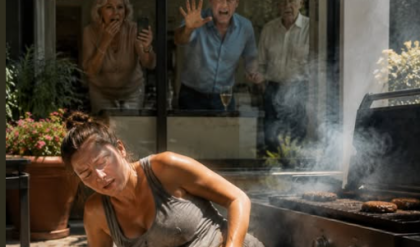
By then, my cheek was pressed against burning patio stone, one arm trapped beneath my belly and the other stretched toward the shadow beneath the table.
Inside the kitchen, nobody moved for nearly five seconds.
Later, the security footage would show those five seconds clearly.
Daniel stared through the glass with his hand still resting on the lock.
Vivian lowered her phone, but she did not stand.
Grant looked toward the grill as another burger began to blacken.
No one rushed to me.
No one called for help.
Daniel finally unlocked the sliding door because smoke had started drifting into the kitchen.
He stepped outside, bent over me, and touched my shoulder with two fingers.
“Claire,” he said sharply.
“Get up.”
My body did not respond.
He shook me harder.
“Claire, stop it.”
Vivian appeared in the doorway but refused to step onto the hot patio.
“She’s pretending,” she said.
“She always does this when she doesn’t get her way.”
Daniel rolled me partly onto my back.
My face was bright red.
My lips were dry.
My breathing had become shallow, each breath arriving with a faint sound that made even Grant stop smiling.
Daniel looked toward his father.
“What do I do?”
Grant glanced at his watch.
“Bring her inside and put some water on her face.”
“I can’t lift her.”
“Then drag her.”
Those words would matter later.
They would matter in a courtroom filled with reporters.
They would matter when a prosecutor paused a recording and asked twelve jurors to listen again.
They would matter when Vivian finally understood that the phone she had used to humiliate me had captured the destruction of her own family.
But at that moment, Daniel still believed the only witnesses were the people who loved him enough to lie.
He hooked his hands beneath my arms.
My head rolled backward.
The movement exposed the underside of my belly to the sun, and something about that finally frightened him.
“Mom,” he said.
“Call somebody.”
Vivian’s expression tightened.
“Absolutely not.
Do you know what an ambulance on this street would look like?”
“Mom, she’s not waking up.”
“Then put her in the car.”
Grant stepped onto the patio at last.
“Hospitals ask questions.
Get her cool first.”
Daniel dragged me less than a foot before my body went limp again.
That was when the first alarm sounded.
It did not come from my phone.
It came from the other side of the house.
A sharp electronic chirp echoed near the driveway, followed by the hiss of brakes and the heavy slam of vehicle doors.
Daniel froze.
Grant turned toward the side gate.
Vivian gripped the frame of the sliding door.
“What was that?”
A man’s voice answered from beyond the fence.
“Sentinel Ridge emergency response! Claire Bennett, announce if you can hear me!”
Daniel released my arms.
My shoulders struck the patio.
The baby inside me did not move.
The side gate burst inward.
Three people entered with such speed and precision that Daniel stumbled backward before any of them touched him.
The first responder was a woman in dark tactical trousers and a gray Sentinel Ridge polo.
Her hair was pulled into a tight braid, and a medical bag crossed her chest.
Behind her came two security officers wearing body cameras.
The taller officer raised one hand.
“Everyone step away from her.
Now.”
Daniel tried to recover his voice.
“This is private property.”
The woman was already on her knees beside me.
“My name is Mara Singh.
I’m a paramedic.
Claire, can you hear me?”
She touched my neck, checked my breathing, and looked at the red skin across my face and shoulders.
Then she pressed two fingers to the side of my belly.
“How long has she been unconscious?”
No one answered.
Mara’s voice hardened.
“How long?”
Daniel glanced at his parenTS.
“Maybe thirty seconds.”
The body-camera footage would later show that it had been almost four minutes.
Mara pulled a radio from her shoulder.
“Dispatch, confirm municipal EMS is rolling.
Pregnant female, approximately thirty-two weeks, unconscious after prolonged heat exposure.
Possible hyperthermia, dehydration, trauma from collapse, fetal distress unknown.”
A voice crackled back immediately.
“Confirmed.
Fire and EMS are two minutes out.
Police notified.”
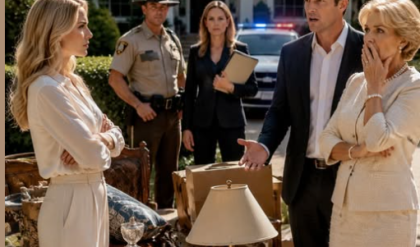
Vivian stepped forward.
“Police? There is no reason for police.”
One of the officers looked toward the locked sliding door, then at my bare feet and the spatula lying beside my hand.
“Ma’am, step inside and remain where we can see you.”
“You cannot order me around in my son’s home.”
The officer’s body camera turned toward Daniel.
“Is this your home?”
Daniel opened his mouth.
Before he could answer, the side gate slammed again.
My brother came through it like the storm the cloudless sky had refused to provide.
Ethan was not wearing a polo shirt.
He wore a charcoal suit with the jacket open, no tie, and an earpiece still clipped behind his right ear.
He must have left a client meeting without stopping to change.
I would learn later that he had been twelve minutes away when my beacon appeared on the Sentinel Ridge dispatch wall.
He had watched the location pulse over the address he already knew too well.
He had called me twice.
When I did not answer, he authorized an immediate welfare response.
Then he opened the live emergency audio channel.
For three minutes and forty-one seconds, Ethan had listened to my husband and his parents decide whether my life was inconvenient enough to hide.
He crossed the patio and saw me lying beneath the sun.
Every part of his face changed.
“Claire.”
Mara held up one hand without looking away from me.
“Give me room.”
Ethan stopped instantly.
His fists closed at his sides, but he did not interfere.
That was the difference between my brother and Daniel.
Ethan could be terrified without making his fear someone else’s danger.
He looked at Daniel.
“What happened?”
Daniel pointed toward the grill as if it could explain everything.
“She got overheated.”
Ethan’s gaze moved to the locked door.
“Why was she outside?”
“We were having lunch.”
“Why was the door locked?”
“It sticks.”
One of the security officers reached out and tested the handle.
The door slid open easily.
The officer said nothing.
He did not need to.
Ethan looked back at Daniel.
“I heard you.”
For the first time, Daniel’s face lost all color.
“What?”
“I heard every word transmitted after Claire activated the beacon.”
Vivian stepped between them.
“You had no right to listen to a private family conversation.”
Ethan looked at her.
“My sister was unconscious on stone hot enough to burn skin while your son asked whether he should drag her inside.
Your husband warned him that hospitals ask questions.
You were worried about an ambulance embarrassing the neighborhood.”
Vivian’s jaw trembled.
“That is not what happened.”
“All three responders are wearing body cameras.
The dispatch recording is preserved.
The beacon log is encrypted and time-stamped.”
Grant folded his arms.
“You think your little company can intimidate us?”
Ethan’s voice became dangerously calm.
“No.
I think evidence can.”
Sirens rose in the distance.
Mara cut open the side of my apron and placed cold packs beneath my arms and against my neck.
Another Sentinel Ridge medic arrived with oxygen and a portable monitor.
The moment the sensor touched my abdomen, the machine produced a rapid, uneven rhythm.
Mara’s expression sharpened.
“Fetal heart rate is too high.”
Ethan took one involuntary step forward.
“What does that mean?”
“It means the baby is under stress.”
The municipal paramedics entered through the gate seconds later, followed by two police officers.
The patio filled with clipped instructions, opened equipment bags, and the plastic snap of medical packaging.
Someone placed an oxygen mask over my face.
Someone started an IV.
Someone covered the burning stone beneath me with a cooling mat before transferring me onto a stretcher.
Through all of it, Daniel stood near the grill, saying variations of the same sentence.
“She was only outside for a few minutes.”
“No one forced her.”
“She insisted on cooking.”
“She’s sensitive to heat.”
“She exaggerates.”
One of the police officers, a broad-shouldered woman named Officer Ramirez, wrote down each version.
Then she asked Daniel a simple question.
“If she chose to stay outside, why did she ask you to unlock the door?”
Daniel looked at Vivian.
Vivian answered for him.
“She did not ask.”
Officer Ramirez pointed toward the camera mounted above the patio.
“Does that record sound?”
The kitchen became silent.
Daniel stared upward.
I had installed that camera six months earlier after packages began disappearing from the front porch.
Daniel had complained that it was ugly.
He had also forgotten it captured the entire backyard.
Officer Ramirez followed his gaze.
“I’ll need the footage.”
“The camera is broken,” Daniel said quickly.
Ethan’s head turned.
“No, it isn’t.”
Daniel glared at him.
“You don’t know anything about my security system.”
“I know Claire called me when you changed the administrator password.
I helped her create a separate cloud backup.”
The lie died on Daniel’s face.
Vivian whispered something to Grant.
Grant stepped toward the kitchen counter where my phone was no longer visible.
One of the Sentinel Ridge officers blocked him.
“Sir, remain where you are.”
Grant’s eyes narrowed.
“I was getting water.”
“There is water beside your chair.”
Grant looked at the full glass of iced tea sweating on the table.
For the first time that afternoon, he seemed to understand that every ordinary object had become evidence.
The untouched drinks.
The air-conditioned kitchen.
The locked door.
The grill tools placed outside.
My bare feet.
The recorded laughter.
The phone Vivian had aimed through the glass.
The ambulance crew lifted my stretcher.
Ethan walked beside me until the back doors opened.
Mara climbed in with the hospital paramedic.
Ethan caught her arm lightly.
“Tell me where they’re taking her.”
“St.
Catherine Medical Center.”
“Is the baby—”
“We are doing everything we can.”
The doors closed.
The ambulance pulled away with its siren screaming.
Daniel started toward the driveway.
“I’m her husband.
I’m going with her.”
Officer Ramirez stepped into his path.
“No, you’re staying here.”
His face twisted.
“You can’t keep me from my wife.”
“At this moment, I’m not keeping you from your wife.
I’m keeping you at the scene of a possible domestic assault while we determine what happened.”
“Assault? I never touched her.”
Ethan’s eyes went to the patio camera.
“No,” he said.
“You only locked the door.”
I remember none of the ambulance ride.
My first clear memory came in fragmenTS.
White ceiling tiles.
A blood pressure cuff squeezing my arm.
Cold air.
A voice saying, “Claire, stay with us.”
Another voice answered, “Fetal heart rate is decelerating.”
Someone removed my wedding ring because my fingers had swollen.
A doctor leaned over me beneath a surgical cap.
“Claire, my name is Dr. Lena Ortiz.
You are at St.
Catherine Medical Center.
Your body temperature was dangerously high.
Your baby is showing signs of distress, and we may need to deliver today.”
I tried to speak.
Only air came out.
Dr. Ortiz lowered her face closer.
“Do you understand me?”
I blinked once.
“Is there anyone you trust to make medical decisions if you cannot?”
My lips moved around one name.
“Ethan.”
A nurse heard me.
“Her brother is in the hall.”
“No husband?” Dr. Ortiz asked.
My whole body tightened.
The monitor beside me accelerated.
The nurse saw it.
“She said her brother.”
Dr. Ortiz nodded.
“Bring him in.”
Ethan entered wearing a disposable gown over his suit.
His hair was damp at the temples, and one sleeve had a dark stain where he must have leaned against the wet cooling packs.
He came to the bed but did not touch me until I reached for him.
Then he took my hand in both of his.
“I’m here.”
“The baby,” I whispered.
“They’re helping both of you.”
“Daniel?”
His expression changed.
“He is not here.”
I closed my eyes.
Ethan leaned closer.
“He will not get near you unless you ask for him.
The hospital has restricted your room.
Sentinel Ridge officers are downstairs.
Police are handling the house.”
A contraction tightened across my abdomen.
I gasped.
Dr. Ortiz looked at the monitor.
“Claire, the heat exposure may have triggered premature labor.
We’re giving you medication, fluids, and cooling treatment, but the baby’s heart rate keeps dropping.
We need to prepare for an emergency cesarean section.”
Fear cleared some of the fog in my head.
“No.
Too early.”
“Thirty-two weeks is early, but the neonatal team is ready.
Staying inside while your body is this stressed may be more dangerous for your baby than delivering now.”
I looked at Ethan.
He had always been able to tell when I needed truth instead of comfort.
“Will they survive?” I asked.
He swallowed.
“The doctors believe this gives both of you the best chance.”
Dr. Ortiz placed a consent form on the tray.
“If you can sign, sign here.
If your condition worsens, your brother can act as your medical proxy based on what you’ve told us.”
My hand shook so badly that my signature barely resembled my name.
The last thing I remember before the operating room was Ethan pressing his forehead to my knuckles.
“You activated the beacon,” he said.
“You saved yourself.”
I wanted to tell him that I had almost waited.
That I had stood outside convincing myself I could endure five more minutes.
That Daniel would eventually unlock the door.
That Vivian would eventually stop laughing.
That Grant would eventually remember I was carrying his grandchild.
I had spent years believing rescue only counted if someone else decided I deserved it.
But the beacon had not asked whether I was being dramatic.
It had not asked whether Daniel meant to hurt me.
It had not asked whether calling for help would embarrass the family.
It had simply sent the truth of where I was.
And people came.
Our daughter was born at 3:06 p.m.
She weighed four pounds, one ounce.
For forty-two seconds, she did not cry.
The neonatal team worked beneath a warmer while Dr. Ortiz controlled my bleeding and the anesthesiologist kept telling me to breathe.
Then a small, furious sound cut through the room.
It was not loud.
It did not need to be.
I started sobbing before I realized I could hear her.
Dr. Ortiz leaned close.
“That is your daughter.”
“Can I see her?”
A nurse brought her beside me for less than ten seconds.
She was wrapped in a white blanket with a tiny blue cap pulled over her head.
Tubes ran near her face.
Her skin was flushed, and her eyes were closed.
But one miniature hand escaped the blanket.
Her fingers opened.
I touched one of them.
She closed her hand around the tip of my finger with impossible strength.
“What is her name?” the nurse asked.
I had discussed names with Daniel for monThS.
He wanted Vivian Rose.
His mother had ordered embroidered blankets before we agreed.
I looked at my daughter’s hand around my finger.
“Hope,” I whispered.
Ethan had once told me that hope was not the same thing as waiting.
Waiting was passive.
Hope was what you carried while you moved toward safety.
“Hope Elise Bennett.”
The nurse glanced at my chart.
“Bennett is your maiden name.”
“Yes.”
The word left my mouth without hesitation.
“Yes, it is.”
While I was in surgery, Officer Ramirez obtained the patio video.
The footage lasted eighteen minutes and thirteen seconds.
It began with Daniel carrying a tray of raw hamburger patties outside while I followed with a bowl of salad.
At that point, I still wore sandals.
The video showed Vivian complaining that the smoke was blowing toward her chair.
It showed Daniel telling me to move the grill to the far side of the patio.
It showed Grant carrying my sandals inside after I slipped them off because my feet had swollen.
It showed me trying to open the sliding door eight minutes later.
It showed Daniel locking it.
There was no missing sound.
The microphone above the patio captured everything.
“Open the door, Daniel.”
“Finish the food.”
“I need water.”
“There’s a hose.”
“I feel sick.”
“You always feel sick when my parents visit.”
Then Vivian’s voice:
“Do not let her drip sweat across the kitchen floor.”
Grant laughing:
“At least the baby will be used to hard work.”
And Daniel:
“Flip the burgers, Claire.
The smoke is ruining my mother’s hair.”
The recording also captured the moment I pressed the beacon.
My face was turned away, but my hand disappeared into the apron pocket.
Three minutes later, I collapsed.
Officer Ramirez watched Daniel wait behind the locked glass.
She watched Vivian continue recording me.
She watched Grant finish his drink.
Then she watched Daniel drag me across the stone while his father told him not to call an ambulance.
By the time Daniel finished giving his third written statement, Officer Ramirez had already seen him contradict every sentence.
He was arrested at 5:18 p.m.
The charges began with unlawful confinement, reckless endangerment, and domestic assault.
They grew after the hospital documented burns on the soles of my feet, bruising from the fall, severe dehydration, hyperthermia, premature labor, and fetal distress.
Grant was arrested for obstruction after officers discovered him attempting to delete the cloud-camera application from Daniel’s laptop.
Vivian was not arrested that day.
She was released after surrendering her phone.
She left the house wearing sunglasses, though the sun had already begun to set.
A neighbor filmed her stepping past reporters who had gathered near the driveway.
“Mrs. Whitmore,” someone called.
“Did you record your pregnant daughter-in-law while she collapsed?”
Vivian stopped.
For one second, the old expression returned—the polite, superior smile she used whenever she believed she could control a room.
“This is a family misunderstanding,” she said.
“Claire has always been emotionally fragile.”
That sentence spread across the local news before midnight.
It became the worst mistake she made.
Because at 12:04 a.m., while I lay unconscious in a recovery room and my daughter breathed through a machine in the neonatal intensive care unit, Sentinel Ridge released a statement through its attorney.
It did not include private medical information.
It did not accuse anyone of a crime.
It said only:
“At 2:17 p.m., our emergency dispatch center received a verified domestic-threat beacon from a protected client.
Responders arrived within six minutes and found an unconscious pregnant woman in a locked residential backyard during extreme heat.
All relevant audio, location, and body-camera evidence has been preserved and provided to law enforcement.”
The public stopped calling it a misunderstanding.
I woke fully the next morning.
The first thing I felt was pain.
The second was absence.
My belly was no longer heavy beneath my hands.
For one terrifying second, I thought I had lost her.
Then I saw the photograph taped to the rail of my hospital bed.
Hope lay inside an incubator, wrapped in a patterned blanket.
A breathing tube rested beneath her nose.
A handwritten card beside her read:
HOPE ELISE — 4 LB 1 OZ — STRONG GIRL
Ethan slept in a chair near the window.
His suit jacket had been folded beneath his head, and his phone rested in his open palm.
I said his name.
He woke instantly.
“Claire?”
“Hope.”
“She’s stable.”
“Can I see her?”
“As soon as the doctor clears you to move.”
I studied his face.
“What happened at the house?”
He sat forward.
“Daniel was arrested.
Grant was arrested later.
Vivian is being investigated.
The police have the patio footage and the beacon recording.”
My throat tightened.
“I should have left before.”
“No.”
“I knew what he was.”
“You knew pieces of what he was.
And every time you tried to assemble them, he convinced you that you were looking at the picture wrong.”
“I let them hurt her.”
Ethan’s voice became firm.
“Daniel hurt you.
His parents helped him.
You activated the beacon.
You got Hope to a hospital.
Those facts belong to the people who caused this and the person who survived it.
Do not rearrange them to punish yourself.”
Tears slid into my hair.
“I almost didn’t press it.”
“But you did.”
“I thought maybe he would open the door.”
“He should never have locked it.”
“I thought I could finish the burgers and keep everyone calm.”
“You were not responsible for keeping dangerous people comfortable.”
I turned toward the window.
Morning light covered the buildings outside.
For years, Daniel had called Ethan controlling.
He said my brother worried too much.
He said Sentinel Ridge had made Ethan paranoid.
He said the emergency beacon was ridiculous.
The night Ethan installed it, Daniel laughed over dinner.
“What does he think will happen?” he asked.
“You’ll be kidnapped by the grocery store?”
I laughed too.
Not because it was funny.
Because I was still measuring every room by how quickly Daniel’s mood could change.
Ethan watched me quietly.
“There’s something else,” he said.
I looked back at him.
“Police found the folder.”
My heart stumbled.
“What folder?”
“The one under the false bottom of your desk drawer.”
I closed my eyes.
The photographs.
Medical notes.
ScreenshoTS.
Copies of financial records.
A handwritten timeline covering three years.
“I was going to bring it to you.”
“I know.”
“I kept waiting for the right time.”
“You made the right time yesterday.”
A nurse entered before I could answer.
“Claire, the NICU team says you can visit your daughter for ten minutes if you’re able to sit in a wheelchair.”
I pushed the blanket away too quickly.
Pain tore across my abdomen.
Ethan stood.
“Slow down.”
“No.
I need to see her.”
The nurse helped me sit, then lowered me into the chair.
Every movement hurt.
My feet were wrapped in gauze from the burns.
An IV line hung beside me.
My abdomen felt as if it had been pulled apart and stitched around fire.
But when the NICU doors opened, pain became background noise.
Hope lay beneath clear plastic, smaller than any baby I had ever held.
Wires crossed her chest.
A monitor traced her heartbeat in green.
A nurse opened one side of the incubator.
“You can place your hand over her back.
Gentle pressure is comforting.
Try not to stroke her skin yet.”
I slid my hand inside.
Hope’s back fit beneath my palm.
She moved once.
Then settled.
“I’m sorry,” I whispered.
The NICU nurse looked at me.
I kept my eyes on my daughter.
“I’m sorry I stayed.
I’m sorry I kept thinking love meant surviving what people did to us.”
Hope’s fingers shifted near her face.
I bent closer to the incubator.
“But I’m done now.”
The monitor continued its steady rhythm.
“I promise you, I’m done.”
Daniel called from jail that afternoon.
I rejected the call.
He called again.
I rejected it.
The third time, I handed my phone to Ethan.
“Block the number.”
Ethan studied me for one second, then did it.
Daniel’s attorney called next.
He left a voicemail saying Daniel was deeply concerned about my health and hoped to resolve the “family situation” privately.
My attorney, Rachel Kim, listened to the message twice.
Rachel had represented Sentinel Ridge in employment matters, but she also volunteered with a domestic violence legal clinic.
Ethan contacted her before I woke.
She arrived at the hospital wearing a navy suit and carrying a yellow legal pad.
“We need to discuss an emergency protective order,” she said.
“We can also file for temporary possession of the home, financial restraints, and immediate preservation of marital asseTS.”
I looked toward the photograph of Hope.
“Can Daniel take her?”
“Not if we act now.”
“Then act now.”
Rachel nodded.
“Do you want a divorce?”
The question should have felt enormous.
It did not.
The enormous thing had already happened.
The locked door.
The heat.
The fall.
The moment my daughter arrived too early because Daniel preferred his mother’s hairstyle to our lives.
“Yes,” I said.
“I want a divorce.”
Rachel wrote the words down.
I watched the pen move.
Three years of marriage became one clean line on a legal pad.
“Do you believe there are assets Daniel may hide?”
“Yes.”
“What kind?”
I thought of the financial copies in my folder.
Six months earlier, I had noticed monthly transfers from our joint account into a consulting company called G.W.
Strategic Holdings.
The initials matched Grant Whitmore.
When I asked Daniel about it, he told me the payments covered investment advice.
But Grant had never worked in finance.
He owned two car dealerships and spent most afternoons at a golf club.
“I think Daniel has been moving money to his father,” I said.
“At least sixty thousand dollars.
Maybe more.”
Rachel’s eyes sharpened.
“Do you have records?”
“In the folder police found.”
“Anything else?”
“There’s an account in the Cayman Islands.”
Ethan turned toward me.
“What?”
“I saw an email on Daniel’s laptop.
It mentioned distributions from something called North Quay.”
“How long ago?” Rachel asked.
“Two monThS.”
“Did you save it?”
“I photographed the screen.”
Rachel placed her pen down.
“Claire, this may be larger than a divorce.”
It was.
Much larger.
Daniel had spent six years working as chief financial officer for a regional medical supply company called Meditron Alliance.
He earned enough money to make every insult about my background sound absurd.
But money was never really what Vivian and Grant cared about.
They cared about hierarchy.
They wanted to believe some people were born above others.
Vivian had grown up in a family that owned farmland outside Richmond.
Most of the land had been sold before Daniel was born, but she spoke about it as if she still woke each morning overlooking an estate.
Grant built his dealerships through aggressive loans and quieter arrangements no one discussed at dinner.
Daniel inherited their favorite conviction: appearances were more valuable than character.
My family had nothing they respected.
Our father repaired elevators.
Our mother worked nights as a respiratory therapist until cancer took her when I was seventeen.
Ethan joined the military at nineteen, then built Sentinel Ridge after leaving active service.
I became a public school occupational therapist.
To the Whitmores, our achievements were evidence of effort, and effort was something they considered embarrassing.
They preferred to believe success should look effortless.
That was why Daniel mocked Ethan’s company.
Sentinel Ridge began in a rented office above a printing shop.
Ethan’s first desk came from a liquidation sale.
His first two employees were veterans he had served with.
But by the time Daniel locked me outside, Sentinel Ridge employed more than four hundred people in six states and held contracts with federal courts, hospital networks, technology firms, and international aid organizations.
Daniel knew none of this because contempt had made him incurious.
He had never asked.
Grant’s “parking lot company” joke became less amusing when Sentinel Ridge’s forensic division reviewed the financial documents from my emergency folder.
The photograph of Daniel’s email contained routing information.
The North Quay account connected to a chain of shell companies.
One of those companies had received payments from Meditron suppliers.
Another had purchased a condominium in Vivian’s name.
A third paid the property taxes on Grant’s lake house.
Rachel referred the information to investigators.
Within four days, state financial-crimes officers contacted federal authorities.
Within six days, Meditron placed Daniel on unpaid leave.
Within eight days, auditors discovered almost three million dollars in suspicious vendor contracts approved through Daniel’s office.
The story moved from local news to national headlines.
But none of that mattered to me as much as Hope gaining two ounces.
For the first week, I lived between my hospital room and the NICU.
My body temperature stabilized, but my kidneys had been strained by dehydration.
The burns on my feet made walking painful.
My incision became infected and required additional treatment.
Hope needed respiratory support.
She had episodes where her breathing paused.
Every alarm stopped my heart.
Every nurse who moved quickly toward her incubator made the room tilt.
Ethan stayed during the day.
At night, one of his security officers sat outside the hospital wing because Vivian had begun sending people.
First came a florist with three dozen white roses.
The card read:
Families forgive.
Think of the baby.
— Vivian
I asked the nurse to throw them away.
The next morning, a church friend of Vivian’s appeared in the lobby and told staff she was my aunt.
Security removed her after she demanded to pray over Hope.
Then Daniel’s cousin sent me a message.
You are destroying an entire family over a bad afternoon.
I stared at the screen until the words blurred.
Then I opened the patio footage for the first time.
Rachel had warned me that I did not need to watch it.
But I needed to see what I had spent years minimizing.
The video began with me setting down the salad bowl.
I looked tired before the door ever locked.
My ankles were swollen.
One hand remained beneath my belly as I walked.
Daniel looked at me the way people look at a piece of furniture placed slightly wrong.
I watched myself ask for water.
I watched him imitate my voice after closing the door.
Vivian laughed.
Grant raised his drink.
Then came the sentence.
“You are destroying an entire family over a bad afternoon.”
I copied it.
Beneath it, I typed:
No.
Daniel destroyed our family one decision at a time.
The rest of you are angry because I survived long enough for people to see it.
Do not contact me again.
I sent the message.
Then I blocked the number.
It was the first time I defended myself without including an apology.
On the tenth day, Hope stopped breathing while I was holding her.
The nurse had arranged our first skin-to-skin session.
Hope rested beneath my hospital gown, her tiny cheek against my chest.
I could feel each breath.
Fast.
Soft.
Precious.
Then nothing.
At first, I thought I had missed it.
I held my own breath.
The monitor alarmed.
The nurse lifted Hope from me and placed her inside the incubator.
“Come on, sweetheart.”
Another nurse entered.
They stimulated her back, adjusted oxygen, and called the neonatal doctor.
I sat frozen with my gown open and my empty hands pressed against my chest.
The entire event lasted less than a minute.
Hope started breathing again.
The monitor settled.
The doctor explained that premature babies sometimes experienced apnea because the part of the brain controlling breathing was still developing.
He said it was treatable.
He said she had recovered quickly.
He said many reassuring things.
I heard only the silence where her breath had been.
Afterward, I went into the family restroom and locked the door.
The lock clicked.
My body stopped belonging to the present.
Suddenly I was back on the patio.
My feet burned.
Smoke covered the sky.
Daniel’s hand rested on the other side of the glass.
I clawed at the restroom handle even though I had locked it myself.
When the door opened, Ethan stood outside.
He did not enter.
He kept the doorway clear.
“Claire.”
“I can’t breathe.”
“You are breathing.”
“I can’t.”
“Look at me.”
I looked at him.
“You’re in the NICU hallway,” he said.
“The door is open.
It is seventy-two degrees.
You are wearing blue hospital socks.
I’m standing three feet away.
Hope is breathing.”
I gripped the sink.
“She stopped.”
“She started again.”
“What if she doesn’t next time?”
“Then the doctors will help her again.”
“What if I had pressed the beacon sooner?”
Ethan’s face softened.
“This is not happening because you waited three extra minutes.”
“You don’t know that.”
“No, I don’t.
But I know who locked the door, and it was not you.”
My knees weakened.
Ethan moved forward, then stopped himself.
“Can I hold your arm?”
I nodded.
He supported me until I could stand.
That small question—Can I?—nearly broke me.
Daniel never asked before touching me.
He grabbed my wrist during argumenTS.
Moved me by the waist when I stood in his way.
Took my phone from my hand.
Pulled blankets off me when I refused to talk.
Controlled the thermostat, the bank account, the car keys, and eventually the door.
I had forgotten that care could include permission.
Two weeks after Hope’s birth, I received a letter from Daniel.
It arrived through his attorney, who described it as part of a proposed reconciliation process.
Rachel read it first.
“You do not have to see this.”
“I want to.”
She handed it to me.
Daniel’s handwriting filled four pages.
He began by saying he loved me.
Then he explained that his parents had been under stress.
He said Vivian’s blood pressure medication made her irritable.
He said Grant’s business problems had affected the whole family.
He said I knew how important family gatherings were to him.
He said the heat had been unexpected.
The temperature had been in every local forecast for five days.
He said he locked the door because flies were entering the kitchen.
He said he thought I was exaggerating because pregnancy had made me emotional.
He said he was sorry I interpreted his actions as cruel.
He said he had already forgiven me for involving Ethan.
On the final page, he wrote:
When this media attention ends, we can bring Vivian Rose home and rebuild.
My mother is willing to move past your accusations if you issue a public correction.
I read that sentence three times.
“Vivian Rose,” I said.
Rachel nodded.
“He apparently has not been informed of the name you selected.”
“He knows.
It’s on the birth certificate.”
“Then he’s refusing to use it.”
I folded the letter.
For most of our marriage, Daniel’s refusal to recognize my reality had worked.
He renamed control as concern.
Fear as sensitivity.
Isolation as privacy.
Cruelty as humor.
Now he was trying to rename my daughter.
I handed the letter back.
“Tell his attorney there will be no reconciliation.”
Rachel placed it in her folder.
“Anything else?”
“Yes.
Tell him our daughter’s name is Hope.”
The protective-order hearing took place three weeks after the patio.
I attended by video from a private hospital conference room because Hope was still in intensive care.
Daniel appeared in court wearing a dark suit.
His attorney had arranged for him to be released on bond after the first several charges.
Grant sat behind him.
Vivian sat beside Grant in a cream dress and pearls, as if attending a fundraiser.
The judge reviewed photographs of my feet, medical records, beacon data, and still images from the patio camera.
Daniel’s attorney argued that the footage lacked context.
The judge asked what context could explain denying water to an eight-month-pregnant woman during an extreme heat advisory.
The attorney said Daniel believed I could enter through another door.
 Friend Keeps “Joking” About Woman\'s Husband Having A Side Chick — So She Paid And Walked Out
The prosecutor played the moment I tried the side gate.
Grant had secured it with a padlock that morning because he did not want a neighbor’s dog entering the yard.
The judge looked at Daniel.
“Was there any unlocked exit available to your wife?”
Daniel whispered to his attorney.
The attorney answered.
“Not to our knowledge.”
The judge’s expression did not change.
“Then she was confined.”
Vivian shifted in her seat.
The prosecutor played another clip.
My voice came through the courtroom speakers.
“Daniel, please.
I feel dizzy.”
Then Daniel:
“You wanted to be part of this family.
Families help.”
The clip stopped.
The judge granted the protective order for two years, barred Daniel from contacting me or entering the hospital, suspended his access to firearms, and ordered that any future custody request be evaluated only after the criminal case and a full psychological assessment.
Daniel stood.
“Your Honor, that is my child.”
The judge looked over her glasses.
“Then you should have acted like her father before she was born.”
Vivian made a small sound.
Daniel turned toward her.
For the first time, someone had spoken to him in a way his mother could not correct.
After the hearing, Vivian requested an interview on a local television program.
Her attorney advised against it.
She did it anyway.
She sat beneath studio lights wearing pale blue and spoke in a soft voice about cancel culture, false narratives, and the pain of losing access to her first grandchild.
The interviewer asked why she had continued filming after I collapsed.
Vivian said she thought I was pretending.
“Why?” the interviewer asked.
“Claire often used emotion to manipulate my son.”
“Can you give an example?”
Vivian paused.
“She cried during disagreemenTS.”
The interviewer waited.
Vivian realized too late how the answer sounded.
She changed direction.
“I loved Claire like a daughter.”
The program displayed a still image from her phone.
It showed me outside the glass with sweat darkening my clothes while Vivian sat inside holding iced tea.
“Would you have treated your daughter this way?” the interviewer asked.
Vivian removed her microphone and walked off the set.
The clip spread across the internet within hours.
Meditron’s board announced an independent investigation the same day.
Grant’s dealerships lost two major financing partners by the end of the week.
Their church removed Vivian from the charity committee.
Friends stopped returning calls.
Not because all of them suddenly developed courage.
Some were afraid of being photographed beside her.
Others were worried about investigators.
A few had always known what the Whitmores were like but found it easier to remain silent while the cruelty stayed private.
The family that valued appearances above everything else was destroyed by the appearance of the truth.
Hope remained in the NICU for forty-seven days.
She learned to breathe without oxygen.
Then to regulate her temperature.
Then to drink from a bottle without exhausting herself.
Every milestone felt like a door opening.
One afternoon, the nurse removed the final feeding tube.
Hope sneezed, frowned, and opened her eyes.
They were gray-blue.
Daniel’s eyes were gray-blue.
For one dark second, fear moved through me.
Then Hope wrapped her fingers around mine.
She was not a continuation of him.
She was herself.
No child inherits someone else’s guilt.
I leaned over her crib.
“You get to become whoever you choose.”
On the morning of discharge, Ethan arrived carrying a tiny yellow dress and a car seat that looked complicated enough to launch a spacecraft.
He had read the instruction manual twice and still made the nurse inspect every strap.
“You protect heads of state,” I told him.
“Babies are harder.”
The nurse smiled.
Hope weighed six pounds, three ounces.
She wore the yellow dress beneath a white cardigan.
No monogram.
No silver bracelet from Vivian.
No name selected by Daniel.
Just Hope.
Before leaving, I asked Ethan to stop near the hospital chapel.
I was not ready to go inside.
I stood in the hallway holding my daughter and looked through the open doors.
People sat in silence beneath colored windows.
For years, Vivian had used religion as decoration.
She quoted obedience when she wanted compliance and forgiveness when she wanted freedom from consequences.
But standing there with Hope against my chest, I understood something.
Forgiveness did not mean reopening a locked door for the person who trapped you behind it.
It did not require silence.
It did not erase evidence.
Sometimes forgiveness meant refusing to let another person’s cruelty decide what kind of life you built afterward.
I kissed Hope’s forehead.
Then we went home.
Not to Daniel’s house.
To mine.
The house had belonged to my mother.
That was the secret the Whitmores never bothered to understand.
After my mother died, she left a small life-insurance policy to Ethan and me.
Ethan invested his portion in Sentinel Ridge.
I used mine as a down payment on a modest three-bedroom house near the elementary school where I worked.
Years later, when Daniel and I married, he convinced me to move into the larger home he said his parents had “given us.”
I kept my house and rented it to a teacher named Melissa.
Daniel called the decision sentimental and financially inefficient.
But my mother had spent twenty years paying rent while raising us.
Owning that house felt like keeping a promise she never got to see fulfilled.
When Melissa heard what happened, she offered to move out immediately.
I refused.
Instead, Ethan found a furnished rental for Hope and me near the hospital until Melissa’s lease ended.
Three months later, I returned to the house.
The rooms smelled faintly of lemon cleaner and old wood.
Sunlight reached the hallway.
The backyard was small, shaded by a maple tree, with no grill and no sliding glass door.
Ethan installed new locks, cameras, smoke detectors, and a medical alert system.
Then he handed me every password.
“All administrator access is yours,” he said.
“Not yours?”
“I have emergency access only if you authorize it.”
The distinction mattered.
My first night there, Hope slept in a bassinet beside my bed.
I woke at 2:17 a.m.
The same time I had activated the beacon twelve hours earlier on the day she was born.
For several minutes, I listened to her breathe.
Then I walked barefoot to the back door.
The floor was cool.
I unlocked the door and stepped onto the porch.
Night air moved through the yard.
No smoke.
No laughter behind glass.
No one controlling whether I could return inside.
I opened and closed the door three times.
Then I left it unlocked while I stood beneath the maple tree and cried.
Not because I was trapped.
Because I wasn’t.
The criminal case took eleven months to reach trial.
By then, the financial investigation had become a separate federal case.
Daniel was charged with fraud, money laundering, commercial bribery, tax evasion, and conspiracy alongside two Meditron vendors.
Grant was charged with laundering proceeds through dealership accounts and obstructing investigators.
Vivian claimed she knew nothing about the money.
Then prosecutors found emails showing she had selected furniture for the condominium purchased through one of the shell companies.
She accepted a plea agreement on a financial charge, but refused to cooperate in Daniel’s domestic case.
She still believed loyalty meant following him into destruction.
The domestic trial came first.
The prosecutor warned me that Daniel’s defense would attack my memory, motives, pregnancy, and relationship with Ethan.
They did.
His attorney suggested I had activated the beacon because I wanted to embarrass the Whitmores.
I answered, “I activated it because I believed I was going to lose consciousness.”
He asked whether Daniel had ever said he wanted me or the baby to die.
“No.”
“So he never threatened to kill you?”
“He locked an eight-month-pregnant woman outside during a heat emergency and denied her water.
I did not need him to describe the possible result.”
The courtroom became still.
The attorney asked why I stayed in the marriage if Daniel was abusive.
I had prepared for the question.
Still, hearing it felt like being pushed toward the locked door again.
“Because abuse does not begin with the worst day,” I said.
“It begins with small punishments you are taught to excuse.
By the time the door locks, you have already spent years being told you imagined the sound.”
Daniel stared at the table.
The attorney asked about my records.
“Isn’t it true you secretly photographed disagreements and saved private messages?”
“Yes.”
“That sounds calculated.”
“It was.”
He looked surprised.
I continued.
“I calculated that one day Daniel would tell people nothing happened.
I was right.”
The prosecutor played the patio video.
Not selected clips.
All eighteen minutes and thirteen seconds.
I watched the jury watch Daniel.
They saw him lock the door.
They saw me ask for water.
They saw Vivian film.
They saw Grant laugh.
They saw me press one hand beneath my belly while the other searched for my phone.
They saw me fall.
Then they saw nobody move.
Five seconds can be endless when every person in the room is waiting for someone to choose compassion.
Daniel did not.
Neither did his parenTS.
When the video ended, one juror wiped her face.
The prosecutor called Mara Singh.
Mara explained my temperature, blood pressure, altered mental state, dehydration, and the fetal heart-rate pattern.
“Would a reasonable person have understood she needed urgent medical attention?” the prosecutor asked.
“Yes.”
“Could delaying treatment have caused death?”
“For Claire, the baby, or both.”
The defense suggested Mara had exaggerated because she worked with Sentinel Ridge.
“I do not work for Sentinel Ridge,” Mara said.
“I contract with their emergency medical response unit twice a month.
My primary employer is the county trauma service.”
“Were you influenced by Mr. Bennett?”
“No.”
“Did he tell you what conclusion to reach?”
“He told me one thing.”
“What?”
“He said, ‘Help my sister.’”
Ethan testified next.
Daniel’s attorney tried to portray him as an overprotective brother who disliked the marriage.
“Did you approve of your sister marrying Daniel Whitmore?”
“No.”
“Why not?”
“Because Daniel treated waiters, receptionists, junior employees, and my sister as if respect were something they had to earn from him, while he expected it automatically.”
“Did you ever threaten Mr. Whitmore?”
“No.”
“Did you want the marriage to end?”
“I wanted my sister to be safe.
The marriage ending was Daniel’s decision when he locked the door.”
Then the dispatch audio played.
Unlike the patio camera, the beacon captured sound from inside my apron pocket after I fell.
The recording carried the scrape of Daniel dragging me.
His breath.
Vivian’s voice.
“Do not call an ambulance until we clean this up.”
Grant:
“Get the apron off her.
It makes this look worse.”
Daniel:
“What if the baby’s hurt?”
Vivian answered:
“Then we say she refused to come inside.”
The courtroom changed after that.
Until those words, Vivian had maintained that she misunderstood the danger.
But the audio proved she understood appearances immediately.
She knew exactly what the scene looked like.
Because she knew exactly what they had done.
The jury deliberated for less than four hours.
Daniel was convicted on every domestic charge.
At sentencing, the judge allowed me to speak.
I stood with Rachel beside me.
Daniel sat at the defense table wearing a suit that no longer fit.
He had lost weight.
His hair had gone gray near the temples.
For three years, I had believed seeing him diminished might make me feel powerful.
It did not.
It made me sad for the person I had once hoped he could become.
But sadness was not the same thing as surrender.
I unfolded my statement.
“Daniel, you told me families help.
You used those words while keeping me outside.
“You were right about one thing.
Families do help.
“My brother answered when I called without requiring me to prove I deserved rescue.
Paramedics protected my child before they knew my name.
Nurses held my hand when I was frightened.
Friends brought meals without asking what I had done to cause your anger.
Strangers testified because truth mattered more to them than comfort.
“That is family.
“You believed locking a door made you powerful.
It did not.
It showed how afraid you were of anyone you could not control.
“Our daughter survived.
She is growing.
She laughs when sunlight moves across the wall.
She loves music, pears, and the sound of rain.
She knows nothing about the man who chose a hamburger over her safety.
“One day she may ask about you.
“I will not lie to her.
But I will also not teach her that cruelty is inherited.
I will tell her that her father was given many chances to choose differently, and he refused.
“I will tell her that the moment I understood we both deserved better, I pressed a button.
“And people came.”
Daniel looked at me for the first time.
His mouth moved.
“I’m sorry.”
The words were too late, but they were also incomplete.
He was sorry in a courtroom.
Sorry after the video.
Sorry after losing his career, his home, and his freedom.
He had not been sorry while my hand was against the glass.
The judge sentenced him to twelve years in state prison.
His federal sentence would later add nine more, partially concurrent.
Grant received seven years on the financial and obstruction charges.
Vivian received probation and home confinement under her plea agreement, along with restitution that required selling the condominium, lake house, and much of the property she had spent decades using to impress others.
The Whitmore family did not lose everything because of my beacon.
They lost everything because the beacon preserved what they had chosen to become.
The divorce became final six weeks after sentencing.
Daniel received no share of my mother’s house because it remained separate property.
Most marital assets were frozen or seized due to the fraud investigation.
The larger home where I collapsed was sold.
After liens, legal fees, and restitution claims, almost nothing remained.
I asked Rachel what happened to the patio camera.
“Evidence storage,” she said.
“I never want it back.”
“You don’t have to.”
The court granted me sole legal and physical custody of Hope.
Daniel was prohibited from contacting her during incarceration unless a future court determined communication served her interesTS.
Vivian filed for grandparent visitation.
Her petition included photographs from my baby shower, messages where I had once thanked her for gifts, and statements from friends who described her as a devoted grandmother.
Rachel asked whether I wanted to settle with supervised visiTS.
“No.”
The hearing lasted two days.
Vivian testified that she had made a single error in judgment.
My attorney played the video of her holding up her phone after I collapsed.
Then she displayed the text Vivian sent Daniel’s cousin two days later:
Claire has always been weak.
The baby may be better off with us.
The judge denied her petition.
Outside the courthouse, Vivian waited near the steps.
She wore dark glasses and carried a structured leather bag.
A deputy stood between us, but she called my name.
“Claire.”
I kept walking.
“Please.
I only want to see my granddaughter.”
I stopped.
Rachel touched my elbow.
“You don’t have to respond.”
I looked at Vivian.
She seemed smaller than I remembered.
Not kinder.
Just smaller.
“You saw her,” I said.
Vivian’s lips parted.
“What?”
“You saw her before she was born.
You saw my hand under my belly.
You saw me ask for water.
You saw me collapse.”
Her face tightened.
“I made a mistake.”
“No.
You made a series of choices.”
“She is my family.”
“Family is not ownership.”
“I can change.”
“Then change.”
Hope shifted in the stroller beside me.
Vivian’s attention dropped immediately.
She took one step forward.
The deputy raised his hand.
I moved between her and the stroller.
“If you change,” I said, “do it because becoming decent matters, not because you expect access to a child as a reward.”
Tears gathered behind her glasses.
Once, that would have made me soften.
I would have comforted the person who hurt me because their discomfort felt more urgent than my pain.
Not anymore.
“Goodbye, Vivian.”
I walked away.
She did not follow.
Hope turned one beneath the maple tree.
Ethan hung yellow paper lanterns from the branches.
Mara Singh came with her wife and brought a stuffed elephant.
Officer Ramirez brought a board book about brave animals.
Dr. Ortiz sent flowers.
Three NICU nurses arrived together and argued cheerfully about which of them Hope liked best.
Melissa, my former tenant, baked the cake.
There were no crystal glasses.
No perfect family photographs.
No one commented on my clothes, my weight, the food, or the way smoke moved through the air.
We did not grill.
Ethan ordered too much barbecue from a restaurant and served it from foil trays.
At 2:17 p.m., he found me standing near the back door.
“You okay?”
I nodded.
“Just noticed the time.”
He looked at his watch.
“You want to go inside?”
“No.”
Hope sat on a blanket in the shade, smashing cake between her fingers.
She had soft brown curls and serious gray-blue eyes.
When she saw me, she raised both arms.
I crossed the yard and picked her up.
Cake covered her hands.
She pressed one palm against my cheek.
Everyone laughed.
For a moment, I could smell smoke from a neighbor’s yard.
My body tightened.
Then Hope squealed.
The sound returned me to the present.
I kissed her sticky fingers.
“I’m here.”
That evening, after the guests left, Ethan gave me a small box.
Inside was a new phone.
“I already have one.”
“This one has the updated Sentinel Ridge emergency system.”
I raised an eyebrow.
“Are you trying to turn my house into a command center?”
“No.
The beacon is optional.”
He showed me the settings screen.
At the top, a question appeared:
Who should be contacted in an emergency?
My name was listed as the primary account holder.
Below it, I could choose responders.
Police.
Medical services.
Ethan.
A trusted friend.
No one had been selected automatically.
I looked at him.
“You didn’t set yourself as the first contact?”
“It’s your phone.”
I selected emergency medical services first.
Then police.
Then Ethan.
He smiled.
“Third place?”
“Try not to take it personally.”
“I’ll recover.”
I closed the settings.
For months after the patio, I thought strength meant never needing another beacon.
I wanted to become someone who could predict every danger and rescue herself before anyone else knew she was afraid.
Therapy taught me something different.
Strength was not isolation.
Self-reliance did not mean refusing help.
The beacon had not made me weak.
It had turned a private emergency into a public fact.
Abuse depends on isolation.
Safety grows through connection.
I set the phone on the table.
“Thank you,” I said.
Ethan looked toward Hope, asleep against my shoulder.
“You thanked yourself yet?”
“For what?”
“For pressing it.”
I thought about the woman I had been on the patio.
Barefoot.
Dizzy.
Still trying to finish lunch for people who despised her.
I used to feel ashamed of her.
Now I understood how hard she had fought.
She had collected evidence in secret.
Protected a backup account.
Memorized emergency steps.
Kept the phone close.
Pressed the button even while every voice around her called her dramatic.
“Yes,” I said.
“I have.”
Two years later, I returned to work.
Not at the same elementary school.
I accepted a position with a family advocacy center that supported women and children leaving dangerous homes.
My training as an occupational therapist helped survivors rebuild daily routines—opening bank accounts, arranging transportation, adapting homes after injury, returning to work, creating safe bedtime rituals for children who woke at every sound.
I never told clients what decision to make.
I had hated when people asked why I stayed.
The more useful question was always:
What do you need to leave safely?
Sometimes the answer was money.
Sometimes documenTS.
Sometimes medication.
Sometimes a place for a pet.
Sometimes one person who believed them.
Sentinel Ridge donated emergency phones to the center, but I insisted the program include more than technology.
A device was only useful if people knew someone would respond.
We created a network with shelters, paramedics, legal clinics, transportation services, and childcare providers.
We named it the Open Door Initiative.
On the day the program launched, a reporter asked whether the name referred to the door Daniel locked.
“In part,” I said.
“But it also refers to what should happen when someone asks for help.”
Within the first year, the program distributed six hundred emergency devices.
One belonged to a woman named Rosa.
Her boyfriend had taken her car keys, emptied their bank account, and threatened to report her immigration status if she left.
She activated the beacon from a grocery-store restroom.
A volunteer met her within eight minutes.
Months later, Rosa sent me a photograph from her new apartment.
She stood beside a green front door holding a ring of keys.
Her message read:
I decide when this one opens.
I printed the photograph and placed it above my desk.
Not because I had saved her.
I had not.
Rosa saved herself.
The program simply answered.
Hope grew into a child who asked questions without fear.
At three, she wanted to know why the moon followed our car.
At four, she wanted to know whether trees felt cold in winter.
At five, she found an old wedding photograph in a storage box.
Daniel stood beside me beneath white flowers.
Hope pointed at him.
“Who is that?”
I sat on the floor beside her.
For years, I had rehearsed the answer.
No version felt perfect.
“That is your biological father.”
She studied the photograph.
“Where is he?”
“He is in prison because he made dangerous choices and hurt people.”
“Did he hurt me?”
My throat tightened.
“He made a choice that put both of us in danger before you were born.”
Hope looked down at her hands.
“Did he say sorry?”
“Yes.”
“Did that fix it?”
“No.”
She nodded as if the answer made sense.
“Can people be sorry and still have consequences?”
“Yes.”
“Do you hate him?”
I looked at the smiling man in the photograph.
“I do not spend much time deciding how I feel about him anymore.”
“Why?”
“Because our life is bigger than what he did.”
Hope considered this.
Then she pointed at my dress.
“That is very ugly.”
I laughed so hard I cried.
She closed the album and asked for a snack.
Children often understand what adults complicate.
The truth did not have to consume the entire day.
When Hope was seven, Daniel sent a letter through the prison family-services office.
He had completed several intervention programs.
He wrote that he understood why direct contact was prohibited.
He asked whether I would keep the letter until Hope was old enough to decide whether she wanted it.
The letter did not ask for forgiveness.
It did not blame his parenTS.
It did not refer to the heat as an accident.
He wrote:
I locked the door because I wanted control more than I cared about safety.
I saw Claire suffering and chose humiliation over help.
I became the kind of man I once insisted I could never be.
I cannot undo what happened.
I can only stop lying about it.
I read the paragraph twice.
Then I placed the letter in a sealed file with Rachel.
Maybe Daniel had changed.
Maybe prison had only taught him better language.
It was not my responsibility to determine which.
Change did not create an obligation for reunion.
Accountability did not guarantee access.
Hope would decide when she was an adult.
Until then, my job was not to preserve Daniel’s comfort.
It was to preserve her right to choose without pressure.
That night, Hope and I ate dinner on the back porch.
The temperature was warm but comfortable.
She had lost one front tooth and kept pushing her tongue through the gap.
“Uncle Ethan says you saved my life with a button,” she said.
“He exaggerates.”
“He says you pressed it when you were scared.”
“That part is true.”
“Were you very scared?”
“Yes.”
She looked toward the maple tree.
“Did being scared mean you weren’t brave yet?”
I smiled.
“No.
Being brave usually means you’re scared and do the necessary thing anyway.”
She took another bite of corn.
“What was the necessary thing?”
“Letting someone know where I was.”
She thought about it.
Then she reached across the table and pressed one finger against my phone.
“Beep.”
“Is that your emergency signal?”
“Yes.”
“What should I do?”
“Bring dessert.”
She grinned.
I brought two bowls of ice cream.
Years passed.
The scars on my feet faded from dark red to pale silver.
The surgical scar across my abdomen softened.
For a long time, I avoided mirrors after showers because the marks felt like evidence of failure.
Eventually, they became coordinates.
They marked where I had been.
They did not determine where I had to remain.
Hope became a teenager.
She ran track, played the cello badly but enthusiastically, and volunteered at the Open Door Initiative.
She knew the broad truth about her birth.
At sixteen, she asked to see the patio footage.
I said no.
She became angry.
“It’s about me too.”
“Yes.”
“Then I should be allowed to know.”
“You are allowed to know.
But watching someone almost die is not the only form of truth.”
“You watched it.”
“I was an adult preparing for court.”
“You think I’m too weak?”
The question struck deeper than she knew.
“No.
I think you should not have to carry an image simply because it exisTS.”
She folded her arms.
“That sounds like avoiding it.”
Maybe she was right.
I asked her therapist for guidance.
We decided Hope could listen to the audio first, with support, and stop whenever she wanted.
She made it forty seconds.
The moment she heard Daniel mock my voice, she removed the headphones.
“That’s enough.”
I closed the laptop.
Hope stood and walked to the window.
For several minutes, she said nothing.
Then she asked, “Did Grandma Vivian ever apologize?”
“She said she was sorry many times.”
“That’s not what I asked.”
I looked at my daughter.
“No.
She never gave an apology that did not include an excuse or a request.”
Hope nodded.
“Did Grandpa Grant?”
“No.”
“And Daniel?”
“Eventually, he accepted responsibility in a letter.”
“Did you forgive him?”
“I stopped needing my anger to protect me every minute.
That is the closest answer I have.”
She turned from the window.
“Do you wish he were a different person?”
“I wish he had chosen to become one before hurting us.”
Hope sat beside me.
“I don’t feel like he’s my father.”
“You do not have to use any relationship word that feels false.”
“Uncle Ethan feels more like my dad.”
“He has been a good father figure.”
“Would that hurt Daniel?”
“Possibly.”
“Does that matter?”
“His feelings can matter without controlling your truth.”
Hope rested her head on my shoulder.
For a moment, she was small again.
Then she said, “I’m glad you pressed it.”
“So am I.”
On the twentieth anniversary of Sentinel Ridge, Ethan held a ceremony at the company’s new headquarters.
The old rented office above the printing shop had become a glass-and-brick campus with a training center, dispatch facility, and emergency operations room.
He invited employees, former clients, community partners, and families helped through the Open Door Initiative.
I stood in the back beside Hope, who was home from college.
She was studying neonatal nursing.
When I asked why, she shrugged.
“Someone took care of me before I could remember it.
I like the idea of returning the favor.”
Ethan took the stage.
He disliked speeches and kept his remarks brief.
Near the end, he looked toward us.
“Sentinel Ridge began with a belief that response time matters,” he said.
“But experience taught us something else.
People do not always need the strongest person in the room.
They need someone willing to believe the signal.”
Behind him, a screen displayed anonymous statistics.
Emergency calls answered.
Families relocated.
Medical crises reached.
Missing children found.
Domestic-threat beacons activated.
Ethan continued.
“Years ago, someone I love pressed a beacon from a place where she had been told her pain was inconvenient.
She did not know whether anyone would arrive in time.
“We did.
“But the truth is, she had already done the hardest part.
“She believed herself.”
The room stood.
I wanted to disappear.
Hope took my hand.
“Don’t,” she whispered.
“Don’t what?”
“Make yourself smaller because people can see you.”
The sentence belonged to a child raised behind an open door.
I remained standing.
After the ceremony, Ethan led us through the dispatch center.
A wall of screens displayed weather alerts, active assignments, and encrypted location systems.
One panel showed a map dotted with small lighTS.
Hope pointed.
“What are those?”
“Registered emergency devices,” Ethan said.
“Only approximate regions are visible until someone activates a signal.”
A light began pulsing.
The dispatch room changed instantly.
An operator accepted the alert.
“Beacon verified.
Medical and law-enforcement response requested.”
Coordinates appeared.
A supervisor assigned the nearest unit.
Nobody asked whether the person was overreacting.
Nobody complained about inconvenience.
Nobody waited to see whether the problem would become embarrassing.
The system moved.
Hope watched the light.
“Do you ever find out what happens?”
“Sometimes,” Ethan said.
“Usually we only know the person was reached.”
“Is that enough?”
“It has to be.”
I looked at the pulsing point on the map.
Somewhere, a stranger had done what I once did.
Pressed once.
Twice.
Three times.
Maybe she was hiding in a bathroom.
Maybe he was injured beside a highway.
Maybe a child had been taught to use the signal if home became unsafe.
The operator spoke into her headset.
“Response unit is two minutes away.”
The light continued pulsing.
Then it changed from red to green.
CONTACT MADE.
I exhaled.
For years, I had believed the most important moment of my story was when Daniel locked the door.
It was not.
The most important moment was when I stopped waiting for him to open it.
I had thought my life ended on that patio.
In a way, one life did.
The life built around Daniel’s moods.
The life where Vivian’s approval mattered.
The life where I believed endurance was the price of belonging.
What began afterward was not perfect.
Healing rarely is.
There were nightmares, legal bills, hospital alarms, therapy sessions, and mornings when fear arrived before memory.
There were questions I could not answer and apologies I never received.
But there was also Hope’s first breath.
Her first step beneath the maple tree.
Her first day of school.
Her laughter when rain struck the windows.
There was work that mattered.
A home whose doors opened from both sides.
A brother who responded.
Friends who believed me.
A daughter who understood that love without safety was not love.
People sometimes asked whether I regretted marrying Daniel.
The honest answer was complicated.
I regretted every moment I abandoned my own instincts to preserve his comfort.
I regretted the years spent apologizing for needs that were ordinary and human.
I regretted that Hope began life fighting for breath.
But I did not regret surviving.
I did not regret pressing the beacon.
And I would never regret the child who taught me that a person could arrive early and still arrive exactly when she was needed.
That evening, Hope and I returned to my house.
The maple tree had grown high above the roof.
Ethan joined us for dinner.
The air was warm, so we carried our plates onto the porch.
A bowl of iced tea sat on the table.
For years, I refused to drink it.
The sound of ice against glass returned me to the kitchen window, Vivian’s bracelet, and Grant’s laughter.
But healing was not always about avoiding what hurt.
Sometimes it was about choosing the meaning again.
I poured three glasses.
Hope lifted hers.
“What are we celebrating?”
Ethan looked at me.
I looked toward the back door.
It stood open behind us, allowing the cool air from the house to meet the summer evening.
“No special reason,” I said.
“We’re here.”
Hope smiled.
“That seems like a reason.”
We raised our glasses.
Ice clicked softly.
No one laughed at my fear.
No one controlled the lock.
No one stood behind glass deciding whether I deserved help.
The door remained open.
And this time, so did my life.