The reinforced door opened with a low mechanical hum.
Special Agent Leah Cross entered first.
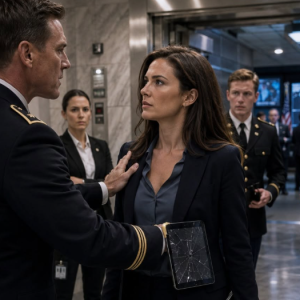
I followed her into the White House Situation Room carrying a cracked tablet, a classified folder, and the uncomfortable knowledge that Major Derek Vance had not tried to stop me because he was arrogant.
He had tried to stop me because he was afraid.
The room was colder than the corridor.
President Nathan Hayes sat at the center of the long conference table with his jacket draped over the back of his chair and his sleeves rolled to his forearms.
The National Security Advisor stood beside a wall of screens.
The Vice President, the Secretary of Defense, the Chairman of the Joint Chiefs, the Director of National Intelligence, and three senior cyber officials occupied the remaining seaTS.
A map of the North Atlantic glowed across the main display.
Three satellite icons were red.
A blinking triangle marked the Navy station in Iceland.
Another warning showed an evacuation sequence spreading through Pentagon security systems.
No one spoke when I entered.
President Hayes looked at the crack across my tablet screen.
“What happened?”
“An access dispute in the corridor, Mr. President.”
Agent Cross closed the door behind me.
The President’s eyes moved toward the security camera feed displayed in the corner of the room.
Major Vance was still outside.
“This room has enough disputes,” Hayes said.
“Tell me why someone is using an old White House authentication prefix to simulate an attack.”
I placed the black folder on the table.
“Because this is not an attack.”
The Secretary of Defense leaned forward.
“Three satellites are offline.”
“No, sir.
Three satellites are reporting themselves offline.”
The National Security Advisor frowned.
“Explain the difference.”
I connected my tablet to the secure display.
A fracture ran through the image, but the data appeared.
“Every warning we have received contains a legitimate government authentication layer,” I said.
“That is why automated systems accepted the events as real.
But underneath that layer, the timing is wrong.”
I enlarged a sequence of code.
“The alerts are arriving at perfectly measured intervals—eleven minutes, then seventeen, then twenty-three.”
“Prime numbers,” the Director of National Intelligence said.
“Yes.
Real attacks contain chaos.
Delays.
Human mistakes.
Network congestion.
Atmospheric interference.
These signals were designed to appear complex while remaining mathematically elegant.”
The Chairman studied the screen.
“So someone created a false national emergency.”
“Someone created the appearance of one.”
The Vice President pointed toward the red satellite icons.
“Then why can’t we communicate with the satellites?”
“Because we stopped asking the satellites.”
Silence settled across the table.
I opened a diagnostic window.
“The command center has been querying a relay server inside our own defense network.
That server says the satellites are offline.
But when I bypassed it and contacted an independent civilian astronomy station in Greenland, they confirmed all three satellites were still broadcasting.”
The Secretary of Defense’s face hardened.
“Who controls the relay server?”
“That is one of the questions we need to answer.”
President Hayes glanced at the clock.
“What is the other question?”
“Why the false emergency was created.”
I opened the folder.
Inside were fourteen pages of intercepted traffic, access logs, banking records, and one photograph.
The photograph showed a weather buoy being serviced at sea by two men in civilian jackeTS.
One of them was Captain Noah Mercer.
“The authentication signal found by the Coast Guard did not originate from the buoy,” I said.
“It was inserted into the report after the cutter transmitted its findings.”
The Director of National Intelligence lifted the photograph.
“Mercer works for Vance.”
“Yes.”
“You believe both men are involved?”
“I believe Captain Mercer received five payments from a shell company connected to a defense subcontractor.
Major Vance personally approved Mercer’s temporary assignment to White House continuity operations three weeks ago.”
The Secretary of Defense looked toward the door.
“Bring them both in.”
“No.”
Every face turned toward me.
I kept my voice calm.
“If we detain them now, we may catch two participants and lose the operation.”
“Operation?” the Vice President asked.
I changed the display.
A new map appeared, showing emergency command facilities across Washington, Virginia, and Maryland.
Red lines connected the White House, Pentagon, Raven Rock, Mount Weather, Fort Meade, and a communications center beneath northern Virginia.
“The false emergency is activating dormant continuity systems,” I said.
“Systems that are almost never used together.
When the President was moved underground, emergency permissions expanded automatically.
Old databases opened.
Cold-storage archives connected to live networks.
Command authority was duplicated across several locations.”
The Chairman’s expression changed.
“They are not trying to frighten us.”
“No, General.”
“They are trying to make us open something.”
“Yes.”
President Hayes rested both hands on the table.
“What?”
I hesitated.
Not because I did not know.
Because the answer had been buried with my father.
“Project Lantern.”
No one moved.
The name carried weight even in a room built to hold secreTS.
The Director of National Intelligence closed the folder.
“That program was terminated.”
“That is what the official record says.”
The Secretary of Defense looked at the President.
Hayes looked at me.
“How do you know about Lantern?”
“My father designed it.”
The President’s expression softened slightly.
“Dr. Gabriel Ward.”
“Yes, sir.”
Seven years earlier, my father had died in a helicopter accident over the Aleutian Islands.
The wreckage had burned in freezing water.
Four passengers were declared dead.
Only two bodies were recovered.
My father’s was not one of them.
I had buried an empty coffin because the government told me there was nothing left to bring home.
I had stood beside my mother under a gray Virginia sky while an honor guard folded a flag.
I had listened as officials described him as a patriot, a scientist, and a man whose work could never be publicly acknowledged.
For seven years, I had believed his death was one more sacrifice hidden beneath the surface of national security.
Now the most secure room in America was staring at me as if his ghost had just entered.
The National Security Advisor folded his arms.
“What was Project Lantern?”
I looked at the President.
He gave one small nod.
“Lantern was built after a series of cyber intrusions revealed that our emergency command structure could be compromised from inside,” I said.
“My father believed the greatest threat was not a foreign missile or a hacker overseas.
It was a trusted official using a legitimate crisis to seize systems that normally remained separated.”
The Vice President glanced around the room.
“A coup mechanism?”
“A protection against one.”
I displayed an old architectural diagram.
“Lantern created a hidden verification layer beneath continuity-of-government protocols.
If someone tried to manipulate succession, military orders, nuclear authorization, or presidential communications during a national emergency, Lantern would record the original commands and identify who altered them.”
The Secretary of Defense slowly exhaled.
“A perfect audit trail.”
“More than that.
Lantern could suspend unauthorized orders before they reached operational uniTS.”
“Then why was it terminated?”
“My father found evidence that someone wanted to use it offensively.”
The room became still again.
“Lantern was designed to detect an internal takeover,” I continued.
“But in the wrong hands, it could create one.
It could isolate the President, redirect military communications, manufacture authentication, and make lawful officials appear compromised.”
President Hayes stared at the red warning icons.
“And someone has spent this morning reconnecting every system Lantern needs.”
“Yes.”
“How long before they have it?”
I looked at the clock.
6:47 a.m.
“Thirteen minutes.”
Part 3: The Name Buried in the Code
The President stood.
The entire room changed with him.
“General, isolate strategic command from every automated continuity protocol.
Secretary, suspend all emergency transfers of authority unless confirmed in person by me.
Director, identify every official who accessed Lantern records in the last ten years.”
The officials moved immediately.
Phones were lifted.
Orders were given.
Secure terminals came alive.
President Hayes turned to Agent Cross.
“Find Major Vance and Captain Mercer.
Do not arrest them unless Dr. Ward authorizes it.”
Cross looked at me.
I had never enjoyed being handed responsibility for another person’s freedom.
That morning, I accepted it without hesitation.
“Keep them under observation,” I said.
“Vance wants access to this room.
Let him believe he may still get it.”
Cross nodded and left.
I returned to my tablet.
The false emergency continued unfolding.
An automated fire alert activated beneath the Capitol.
A military communications station reported a breach that did not exist.
A classified aircraft was ordered to relocate from Joint Base Andrews without presidential approval.
Each event pushed another emergency system online.
Each system fed Lantern.
The Director of National Intelligence studied the sequence.
“Whoever planned this understands our procedures better than most of the people in this room.”
“They may have helped write them,” I said.
The President looked at me sharply.
“Vance?”
“No.
He is too young.
Project Lantern began twenty-four years ago.”
“Then he is working for someone.”
“Yes.”
A message appeared on my tablet.
It came through an internal channel that should not have existed.
No sender.
No routing trail.
Only six words:
THE FIRST LIGHT IS ALWAYS FALSE.
My breath stopped.
The room around me vanished.
I saw my father at our kitchen table when I was eleven, spreading a blanket over two chairs to create a tent.
I saw the old brass lantern he placed between us during summer storms.
I heard him telling me that fear made shadows look larger than the things casting them.
“The first light is always false,” he would say when lightning flashed through the windows.
“Wait for the second.
That is when you see what is actually there.”
It was not a government phrase.
It was not part of Lantern.
It belonged to my father and me.
The President noticed my face.
“What is it?”
I turned the tablet toward him.
No one spoke.
The National Security Advisor read the sentence twice.
“Could Vance know this phrase?”
“No.”
“Could it be in your father’s files?”
“No.”
The Director of National Intelligence leaned closer.
“Are you certain?”
“I have reviewed every declassified page and every personal notebook released to my family.
That sentence was never written down.”
The President lowered his voice.
“Then who sent it?”
I did not answer.
Another message appeared.
ELENA, DO NOT OPEN LANTERN.
My name struck harder than the first message.
The Secretary of Defense pushed away from the table.
“Trace it.”
A cyber officer began typing.
“Already trying, sir.”
The message disappeared.
The officer cursed under his breath.
“What happened?”
“It deleted itself from the network.”
“Recover it.”
“I can’t.
It did not use the network.”
“That is impossible.”
“No,” I said.
Everyone looked at me.
“It used Lantern.”
The main screen flickered.
For less than a second, the map vanished.
A black field appeared with a single white symbol in the center.
A circle divided by three vertical lines.
My father’s original Lantern mark.
Then the map returned.
The National Security Advisor whispered, “Someone is already inside.”
I pulled the cracked tablet closer.
My hands had begun trembling.
I placed them flat against the table.
I would not let the room see my grief before I understood whether it was real.
“Dr. Ward?” the President said.
“My father created a private diagnostic channel,” I explained.
“A maintenance path that could communicate beneath standard networks.
It was supposedly erased before the program was shut down.”
“Could someone have reconstructed it from his work?”
“Possibly.”
“But you don’t believe that.”
I looked at the words still burning in my memory.
Elena, do not open Lantern.
“No, sir.”
The President gave me a moment.
Then he asked the question everyone else was avoiding.
“Do you believe your father is alive?”
I thought of the empty coffin.
The folded flag.
My mother’s hand clutching mine as rain struck the black umbrellas around us.
I thought of the final call I had received from my father the night before his helicopter disappeared.
He had sounded distracted.
He had asked whether I still kept the brass lantern from our storm tenTS.
I had laughed and told him it was in my closet.
Then his voice changed.
“Keep it somewhere safe,” he said.
I had believed he was being sentimental.
Now I understood it might have been an instruction.
“I believe,” I said carefully, “that someone wants me to think he is.”
The President nodded.
It was the answer of an analyst, not a daughter.
I hated myself for needing the distinction.
A secure phone rang.
The Chairman answered.
His expression darkened as he listened.
“What happened?” President Hayes asked.
The Chairman replaced the receiver.
“A missile-defense battery in Alaska just received an authenticated readiness order.”
“From whom?”
“From this room.”
No one had sent it.
The digital clock changed.
6:51 a.m.
Nine minutes remained.
Part 4: The Order That Could Start a War
“Cancel the order,” the President said.
The Chairman lifted the phone again.
A cyber officer shook his head.
“The battery is rejecting standard cancellation codes.”
“Why?”
“It says the cancellation source is compromised.”
The Secretary of Defense stared at the display.
“Lantern is reversing trust.”
I opened a direct diagnostic feed.
The system was doing exactly what it had been designed to do.
It had detected contradictory commands and chosen one source as authentic.
The problem was that someone had taught it to identify the lawful chain of command as hostile.
“Whoever controls Lantern is not trying to access an archive anymore,” I said.
“They have already activated it.”
The President moved beside me.
“Can you shut it down?”
“I need the founder key.”
“Where is it?”
“It died with my father.”
Another readiness order appeared.
This one went to a naval tracking station in the Pacific.
Then a third to an Air Force early-warning unit.
None instructed anyone to fire.
Not yet.
They created posture changes—small adjustments that a foreign intelligence service could detect and misinterpret.
The National Security Advisor understood first.
“They are manufacturing the visible preparation for an attack.”
“Yes.”
The Vice President turned pale.
“If Russia or China sees coordinated missile-defense movement—”
“They may raise their own alert levels,” the Chairman said.
“And when they do,” I added, “our systems will interpret their response as confirmation that the original emergency was real.”
The President looked at the clock.
“An automated escalation loop.”
“Designed to make every side believe the other moved first.”
The Secretary of Defense slammed his palm against the table.
“Who benefits from that?”
“Someone who wants extraordinary powers activated,” I said.
“Someone who needs the President isolated while military authority is transferred to emergency command.”
The room fell quiet.
A continuity protocol notification appeared on the central screen.
PRESIDENTIAL COMMUNICATIONS INTEGRITY UNCONFIRMED.
Under it, a timer began counting down from four minutes.
The Vice President stared at the message.
“What happens at zero?”
The National Security Advisor answered.
“Emergency authority begins transferring to the designated continuity commander.”
“Who is the designated commander?” President Hayes asked.
The Secretary of Defense turned to a terminal.
His face changed.
“Major General Roland Pike.”
I knew the name.
Everyone did.
Pike had spent thirty years inside national command infrastructure.
He had overseen continuity exercises under three administrations.
He was respected, decorated, and considered politically invisible.
He had also signed my father’s death notification.
The blood in my body seemed to cool all at once.
“Where is Pike?” I asked.
The Chairman checked.
“Raven Rock.”
Of course he was.
The underground command complex near the Pennsylvania-Maryland border had activated at the beginning of the false emergency.
If the countdown reached zero, control would shift toward a facility where Pike held operational authority.
President Hayes looked at the Director of National Intelligence.
“Find everything on Pike.”
The Director spoke quietly into his phone.
I searched the files my team had assembled overnight.
The fake emergency had begun at 5:11 a.m.
Pike arrived at Raven Rock at 4:38.
His travel authorization had been issued by Major Derek Vance.
The Secretary of Defense read over my shoulder.
“There is your chain.”
“Pike created the plan,” I said.
“Vance gave him access.
Mercer handled the authentication hardware.”
“And your father?” the President asked.
“I don’t know.”
The countdown reached three minutes.
I tried every shutdown sequence documented in Lantern’s archive.
Rejected.
I tried my father’s old development credentials.
Rejected.
I tried splitting the system from its emergency feeds.
Lantern rerouted through a classified backup line.
The cracked screen blurred beneath my fingers.
I remembered watching my father work when I was a child.
He hated passwords.
He said passwords were promises made to machines by people who forgot them.
He preferred patterns.
Stories.
ObjecTS.
Things humans remembered because they meant something.
The brass lantern.
The phrase.
The first light is always false.
Wait for the second.
I opened the diagnostic path and entered the phrase.
Nothing happened.
The timer reached two minutes and thirty seconds.
I entered it again, this time requesting a secondary verification layer.
A hidden window opened.
Three questions appeared.
WHERE DID THE LIGHT BEGIN?
I stared.
The answer was not in any classified record.
I typed:
BENEATH THE TABLE DURING THE STORM.
The second question appeared.
WHAT SURVIVED THE DARK?
I remembered the night our neighborhood lost power for eleven hours.
My father had placed the lantern beneath our blanket tent.
My mother had brought us peanut-butter sandwiches.
We had stayed there until dawn.
I typed:
THE STORY WE TOLD EACH OTHER.
The timer reached one minute and forty-eight seconds.
The third question appeared.
WHO MAY EXTINGUISH THE LANTERN?
I knew what the technical answer should have been.
The founder.
The President.
The verified lawful authority.
But my father never asked questions with technical answers.
He asked questions to discover who a person had become.
I typed:
THE ONE WILLING TO STAND IN THE DARK AFTERWARD.
The screen went black.
For one terrible second, I believed I had failed.
Then a live video feed opened.
A man sat in a dim room beneath a single overhead light.
His hair was gray.
His face was thinner.
A scar ran from his left temple toward his ear.
But I knew the shape of his eyes.
I knew the way he tilted his head when he was trying not to show emotion.
I knew him before he spoke.
“Elena.”
My father was alive.
Part 5: The Dead Man on the Screen
No one in the Situation Room moved.
I could hear the timer counting down behind the video feed.
One minute and twenty-one seconds.
My father looked directly into the camera.
“You have to listen to me carefully.”
I wanted to ask where he had been.
I wanted to ask why he had allowed us to bury him.
I wanted to demand an explanation for seven birthdays, seven Christmases, seven anniversaries of a death that had never happened.
Instead, I said, “Can you stop Lantern?”
“Yes.”
“Then stop it.”
“I can’t from here.”
“Where are you?”
He glanced beyond the camera.
The movement was small, but I recognized what it meant.
He was not alone.
“Elena, Pike rebuilt Lantern after the program was terminated.
He removed the constitutional locks and created a command pathway only he could control.
I discovered what he was doing seven years ago.”
The timer reached fifty-nine seconds.
“Father, we do not have time.”
“You need two keys to shut it down.
The founder key and the lawful authority key.”
“You are the founder.”
“And President Hayes is the lawful authority.”
The President stepped beside me.
“Dr. Ward, what do you need?”
My father looked at him.
“Mr. President, place your hand on the biometric panel built into the conference table.”
The National Security Advisor looked underneath the edge.
“There is no panel.”
“Third seat from the head of the table.
Press beneath the wooden trim.”
The President moved to the chair.
His fingers found a hidden indentation.
A thin glass panel slid out.
No one in the room had known it existed.
The timer reached thirty-eight seconds.
“Place your palm on it,” my father said.
President Hayes obeyed.
The panel illuminated.
“Now what?” I asked.
My father’s expression changed.
“Elena, you must enter the founder transfer.”
“I don’t have it.”
“Yes, you do.”
“No.”
“I built it into the three questions.
You answered them correctly.”
A new prompt appeared on my tablet.
FOUNDER AUTHORITY MAY BE TRANSFERRED ONCE.
ACCEPT?
I stared at my father.
“You are giving me control of Lantern?”
“I am giving you the ability to destroy it.”
The timer reached twenty-two seconds.
I pressed ACCEPT.
A line of text appeared.
IDENTITY CONFIRMED: Dr. ELENA GABRIELLE WARD.
“Say the shutdown phrase,” my father instructed.
“What phrase?”
His eyes shone.
“The second light.”
I remembered.
I had not heard those words in twenty years.
“Morning does not ask permission from the dark,” I said.
The President’s biometric panel flashed.
My father spoke at the same time.
“And truth does not ask permission from power.”
The countdown stopped at seven seconds.
Every red icon on the main screen froze.
Then the false alerts began disappearing.
The satellite warnings cleared.
The Pentagon evacuation canceled itself.
The missile-defense readiness orders were revoked.
Communications returned to lawful control.
Around the table, officials exhaled as if the room had been underwater.
I did not.
I stared at my father.
He was still alive on the screen.
He gave me the same tired smile he used when I was a child and had solved a puzzle he believed was too difficult for me.
“You became better than I hoped,” he said.
A shadow moved behind him.
My father’s smile vanished.
The video shook.
“Listen to me.
Pike knows Lantern failed.
He will initiate the physical backup.”
“What physical backup?”
“The emergency archive beneath Raven Rock.
It contains enough falsified intelligence to justify arrests, military deployments, and emergency rule.
If he releases it, he can still claim the White House was compromised.”
“Where are you?”
“I am beneath Raven Rock.”
The Secretary of Defense stepped forward.
“Are you being held prisoner?”
My father looked away again.
“For seven years.”
My throat closed.
The President’s voice became cold.
“Who is holding you?”
“General Pike.”
The screen went dark.
The connection vanished.
I touched the tablet as if I could pull my father back through it.
The room remained silent until Agent Cross’s voice came through the internal channel.
“Dr. Ward, we have a problem.”
“What happened?”
“Major Vance is gone.”
Part 6: The Man Who Knew the Hidden Door
The security footage showed Vance walking calmly toward a service corridor thirty seconds after I entered the Situation Room.
He did not run.
He did not look over his shoulder.
He passed two agents using an emergency access credential issued to the National Security Advisor.
The Advisor checked his jacket.
His credential was still there.
“It was cloned,” I said.
Agent Cross appeared on the main display from the corridor.
“We found Captain Mercer unconscious inside a maintenance room.
He is alive.
Vance took his phone and access card.”
The Secretary of Defense frowned.
“Vance abandoned his own accomplice?”
“Mercer may never have understood the entire plan,” I said.
“What about the deposits?”
“Payment for cooperation, not necessarily knowledge.”
The President pointed toward the White House map.
“Where is Vance going?”
I studied the service corridor.
The route passed beneath the West Wing, turned through an old communications area, and ended near a vehicle access tunnel that had supposedly been sealed decades earlier.
My father had once shown me blueprints of historic White House renovations.
Not classified drawings.
Public architectural sketches.
But he had pointed at one tunnel and said, “Governments never close doors.
They only stop telling people where those doors lead.”
“Vance is leaving through the old executive tunnel,” I said.
Cross moved immediately.
“Teams are converging.”
“No.
He expects that.”
I enlarged the tunnel map.
“Pike’s operation depends on physical access at Raven Rock.
Vance is probably carrying a hardware key or command package.
If we arrest him here, Pike activates without confirmation.
If we follow him, he takes us to the rest of the network.”
The President studied me.
“You want to let him leave the White House?”
“I want him to believe he escaped.”
The Director of National Intelligence shook his head.
“He could disappear.”
“Not today.
He has invested too much in the emergency.
He will go where he believes the plan can still be saved.”
“Raven Rock.”
“Yes.”
President Hayes looked at Cross through the screen.
“Can you track him without being seen?”
Cross gave a tight smile.
“He already has three trackers on him.”
Vance’s arrogance had made him underestimate more than me.
When he shoved me, Agent Cross had stepped close enough to attach a microtransmitter beneath the back seam of his uniform.
The lieutenant he nearly ordered to detain me had slipped another into Vance’s coat after learning my identity.
The trembling intern had dropped coffee on Vance’s briefcase and placed the third beneath its handle while apologizing.
He had believed the corridor belonged to him.
In reality, everyone in it had seen what he was.
“Follow him,” the President ordered.
“No intervention until Dr. Ward gives the word.”
Cross disappeared from the screen.
I opened the recovered files from Mercer’s phone.
Most were ordinary military messages.
One contained a photograph of an underground door marked with the same three-line Lantern symbol.
Another showed my father seated at a steel table.
The date stamp was only four days old.
For years, I had imagined his final moments in freezing water.
Now I saw him alive in a windowless room, hands resting before him, gray hair untidy, eyes fixed on the person taking the picture.
He did not look defeated.
He looked patient.
A text accompanied the photograph.
FOUNDER REMAINS NONCOMPLIANT.
DAUGHTER MAY BE REQUIRED.
The message had been sent by Pike.
The reply came from Vance.
WARD BELIEVES HE IS DEAD.
KEEP IT THAT WAY UNTIL TRANSFER.
I read the words twice.
Something inside me changed.
Until that moment, Major Vance had been a participant in a national security conspiracy.
Now he was the man who knew my father was alive and helped keep him buried.
Anger rose through me, clean and cold.
President Hayes saw it.
“Dr. Ward.”
“I am fine.”
“No, you are not.”
The honesty of his answer stopped me.
He lowered his voice so only those nearest could hear.
“You do not need to be fine.
You need to remain accurate.”
I looked at the President.
Then at the photograph.
He was right.
Rage could wait.
Accuracy would bring my father home.
A location signal appeared.
Vance had entered the old tunnel.
He moved west beneath the city, reached a hidden vehicle bay, and entered a black government SUV.
The vehicle joined morning traffic heading toward Maryland.
Agent Cross’s team followed from a distance.
The Director of National Intelligence placed a report before me.
“We found Pike’s personal financial structure.”
I read the summary.
General Roland Pike had not taken bribes.
He had built something more dangerous.
A private network of retired officers, intelligence contractors, political consultants, technology executives, and wealthy donors who believed elected governments were too unstable to manage national security.
They called themselves the Custodians.
Their internal messages described democracy as an “uncontrolled variable.”
They believed presidents should be permitted to govern only when their decisions aligned with permanent security institutions.
Lantern was not merely a weapon.
It was their insurance policy against elections they disliked, treaties they opposed, investigations they feared, and leaders they considered weak.
The false emergency was designed to prove that the President had lost control.
Pike would then emerge from Raven Rock with authenticated records showing foreign interference, compromised White House communications, and fabricated orders.
He would not call it a coup.
He would call it stabilization.
The Secretary of Defense read one of the documenTS.
“He planned to detain half the Cabinet.”
“And replace them with emergency deputies,” I said.
The Vice President’s name appeared near the top of the arrest list.
So did mine.
Beside my name, someone had written:
SECURE ALIVE.
REQUIRED FOR FOUNDER VALIDATION.
They had not planned to kill me.
They had planned to use me against my father.
The President closed the file.
“We go to Raven Rock.”
The Secret Service Director objected immediately.
“Mr. President, that facility may be compromised.”
“That is exactly why I am going.”
“Sir—”
“If Pike claims the lawful chain of command is corrupted, I will stand inside his command center and prove otherwise.”
The President looked at me.
“Dr. Ward, are you coming?”
I picked up the classified folder.
“Yes, sir.”
Part 7: The Road Beneath the Mountain
The presidential convoy did not use the usual vehicles.
A public motorcade would have warned Pike.
Instead, President Hayes left through a secure underground exit with a small protective team.
The Vice President remained at the White House to preserve continuity.
The Secretary of Defense and Chairman coordinated loyal forces from separate locations.
I rode in an armored SUV beside Agent Cross.
The President sat across from us, reading Pike’s files beneath a small overhead light.
Washington passed outside the tinted windows.
Commuters waited at traffic signals.
Parents drove children to school.
Coffee shops opened.
Delivery trucks crowded intersections.
Millions of people began an ordinary morning without knowing that seven seconds had separated them from a manufactured military crisis.
That was the strange burden of national security.
Success often looked like nothing happening.
Cross watched Vance’s signal on a small display.
“He is twelve miles ahead.”
“Has he contacted Pike?” I asked.
“Not through any device we can detect.”
“He may be carrying an offline message.”
The President closed the file.
“Tell me about your father.”
The question surprised me.
“What would you like to know?”
“Not the official biography.”
I looked through the window.
“He burned toast every morning because he refused to believe the settings on the toaster were accurate.”
Cross smiled faintly.
“He collected broken clocks,” I continued.
“He said a clock that had stopped was more honest than one running five minutes slow.
He hated formal dinners.
He loved old detective novels and could never remember where he left his glasses.”
“Was he a good father?”
The answer should have been simple.
Until that morning, it had been.
“Yes,” I said.
“But now I do not know what seven years of silence makes him.”
The President waited.
I appreciated that he did not tell me to forgive.
“He may not have had a choice,” Cross said.
“Everyone has choices.”
“Not always good ones.”
“No.
But still choices.”
My father had been imprisoned.
I understood that.
Yet part of me remained twenty-nine years old, standing beside an empty grave, holding my mother upright while officials lowered a coffin containing no body.
My mother had died two years later.
The doctors called it heart failure.
I called it grief.
My father had been alive for every day of her decline.
Even if he had been trapped, the truth did not soften the cost.
Cross’s screen flashed.
“Vance is changing route.”
The SUV ahead had left the highway.
It moved onto a narrow service road winding through wooded hills near the Pennsylvania border.
“He knows the primary entrance may be watched,” I said.
The President looked at the map.
“There is another way into Raven Rock?”
“Several.”
Officially, the complex had controlled entrances and hardened access poinTS.
Unofficially, facilities designed to survive national catastrophe rarely depended on a single road.
Vance’s signal stopped.
Cross contacted the surveillance team.
No answer.
She tried again.
Static.
Then a short burst of sound came through the radio.
A door slamming.
A man shouting.
The transmission ended.
“Ambush?” the President asked.
“Possibly.”
I studied the topography.
The service road crossed an old quarry.
Beneath it ran ventilation and utility tunnels connected to the mountain.
“Vance expected surveillance,” I said.
Cross looked at me.
“Then why lead us there?”
“He did not lead us.
He led the tracking team.”
The realization came too late.
A warning sounded inside our SUV.
The driver spoke through the partition.
“Communications interference ahead.”
All screens flickered.
Vance’s signal vanished.
The convoy slowed.
Cross reached for the emergency radio.
It produced only static.
A black truck emerged from a side road behind us.
Another appeared ahead.
Our driver accelerated.
The truck in front swerved across the road.
The presidential SUV struck its rear corner and forced past, metal grinding against metal.
Cross pushed the President down as the windows shook from impacts against the armored glass.
No bullets pierced the cabin.
The attackers were not trying to kill us.
They were trying to stop us.
Our escort vehicle rammed the second truck.
The road narrowed between steep rock walls.
The presidential driver kept moving until a steel barrier rose from the pavement ahead.
He braked hard.
The SUV stopped inches from it.
Cross opened a compartment and handed the President a protective vest.
“We need to move.”
A side door in the rock wall stood open.
Too convenient.
Too deliberate.
Pike had created one path forward.
The President looked at me.
“He wants us inside.”
“Yes.”
“Why?”
“He needs lawful authority physically present for the archive transfer.”
Cross stared toward the open door.
“This is a trap.”
I picked up my tablet and folder.
“Then we should stop letting him choose who walks into it.”
We exited through the rear under the protection of the escort team.
The mountain air was cold and damp.
The black trucks remained behind us, their drivers gone.
No shots were fired.
No attackers emerged.
Only the open door waited in the stone.
The President stood beside me.
“Can Pike force me to validate the transfer?”
“Not if you refuse.”
“Then he needs leverage.”
I thought of my father beneath the mountain.
“That is why he kept Gabriel alive.”
We entered the tunnel.
Part 8: The Custodians
The passage descended beneath the rock.
Emergency lights cast pale circles along concrete walls.
Old pipes ran overhead.
The air smelled of dust, machinery, and rainwater.
Cross led with two agenTS.
The President followed.
I walked beside him.
After three hundred feet, the passage ended at a steel security door.
It opened before we touched it.
Major Derek Vance stood on the other side.
His uniform jacket was gone.
His sleeves were rolled up.
A small cut marked his eyebrow, but his expression remained controlled.
Four armed security contractors stood behind him.
Their weapons were lowered, though not far.
Vance looked at me first.
“You should have stayed in the corridor.”
“You should have learned who controlled access before pretending it was you.”
His jaw tightened.
The President stepped forward.
“Major Vance, order those men to stand down.”
Vance looked at the President of the United States without saluting.
“With respect, sir, your command integrity is under formal review.”
“By whom?”
“The Continuity Council.”
“No such lawful council exisTS.”
“It does now.”
President Hayes took another step.
“You are an officer in the United States Army.
Your oath is to the Constitution.”
“My oath is to the survival of the country.”
“You do not get to separate the two.”
For the first time, Vance showed real emotion.
“Politicians separate them every day.”
There it was.
The belief beneath the uniform.
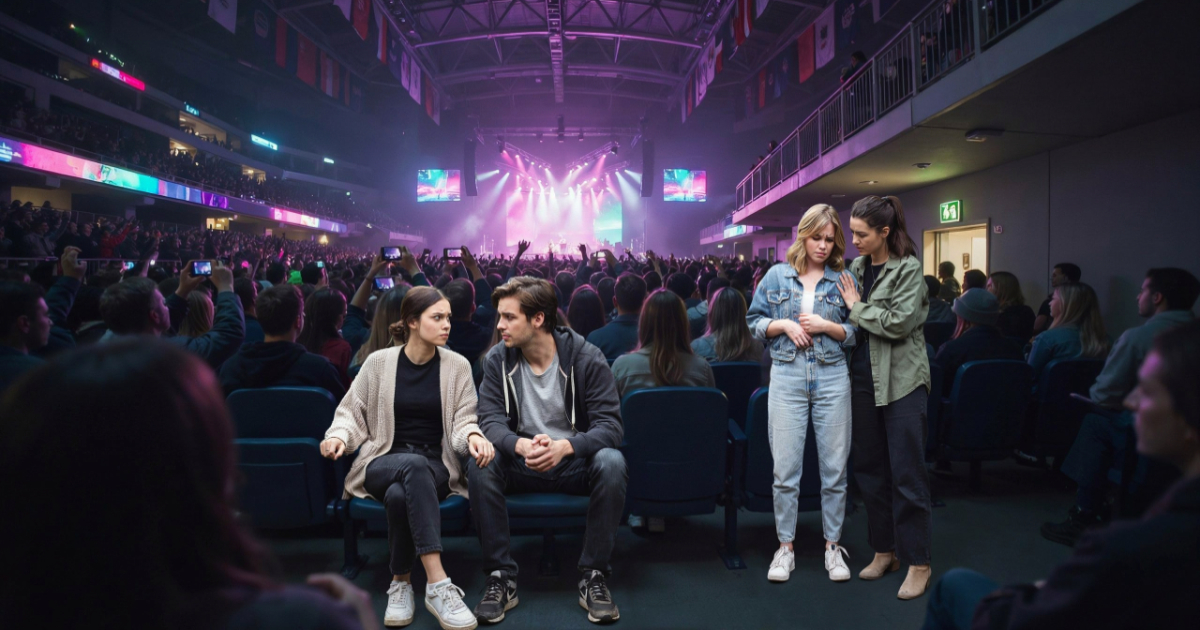 Woman Refuses To Leave Her Dream Concert After Her Friend Has A Panic Attack, Now Everyone’s Calling Her Selfish
Not loyalty.
Superiority.
He believed he had outgrown the laws that gave him authority.
I studied the contractors.
Two watched Cross.
One watched the President.
The fourth watched Vance.
That mattered.
Not everyone in the tunnel shared the same confidence.
“You know the emergency was false,” I said.
Vance met my eyes.
“I know the emergency revealed weakness.”
“You created it.”
“We demonstrated how easily the system could be manipulated.”
“You issued unauthorized military orders.”
“Orders designed not to be executed.”
“You brought nuclear powers closer to escalation.”
“For seven seconds.”
His tone was almost dismissive.
I felt Cross shift beside me.
Vance heard himself and realized too late what he had admitted.
The fourth contractor looked toward him.
I spoke directly to the man.
“He did not tell you the alerts reached strategic units, did he?”
The contractor said nothing.
“He told you this was an exercise,” I continued.
“A continuity test to identify compromised officials.”
Vance stepped between us.
“Do not listen to her.”
I kept my eyes on the contractor.
“Captain Mercer was paid through a shell company.
He believed he was installing diagnostic hardware.
When Vance no longer needed him, he left him unconscious in a maintenance room.”
“That is a lie,” Vance said.
“Mercer is alive and in federal custody.”
A flicker passed through the contractors.
Vance had not expected them to learn that.
The President addressed all four.
“You were told I had been compromised.
I am standing in front of you, under my own authority, ordering you to lower your weapons.”
One contractor slowly lowered his rifle.
Vance turned.
“Raise it.”
The man did not.
The second followed.
Then the third.
The fourth had never aimed directly at us.
Vance stood alone between two groups.
His power dissolved so quickly it almost looked quiet.
Cross moved forward and removed the sidearm from his belt.
Vance did not resist.
He looked at me with pure hatred.
“You think Pike needs me?”
“No,” I said.
“I think Pike needed you to believe he did.”
Cross secured his hands.
The steel door behind him began closing.
An alarm sounded deeper in the facility.
Vance’s confidence returned.
“You are too late.”
I stepped through before the door could seal.
Cross and the agents followed with the President.
The contractors held it open.
Beyond lay a modern security corridor leading toward the main underground complex.
Personnel moved rapidly through intersecting passages.
Some wore military uniforms.
Others wore contractor badges.
Most looked confused.
Pike had divided the facility’s staff into layers of knowledge.
The majority believed they were responding to a genuine national emergency.
Only a small group knew the crisis had been manufactured.
That was how conspiracies survived.
Not by making everyone guilty.
By giving each person one innocent-looking task and hiding the meaning of the whole.
A warning repeated through overhead speakers:
“Presidential command integrity unresolved.
Continuity transfer proceeding.”
The President looked at Vance.
“How do we reach the archive?”
Vance smiled.
“You don’t.”
I held up Mercer’s recovered photograph.
The Lantern symbol marked the underground door.
“Sublevel six,” I said.
“Original analog command chamber.”
A facility officer nearby turned toward us.
“There is no sublevel six.”
“That is what you were told,” Vance said.
I noticed a bank of elevators.
Five buttons.
A key slot beneath them.
No sixth button.
My father hated passwords.
He preferred patterns.
The first light was always false.
I pressed the button for level one.
Then level two.
Then level one again.
The panel changed.
A sixth button appeared beneath the others.
Vance stopped smiling.
The elevator doors opened.
Part 9: The Father Beneath the Mountain
The elevator descended farther than the visible facility plans allowed.
No one spoke.
Vance stood between two agents, hands secured behind him.
The President watched the floor indicator.
Cross watched Vance.
I watched my reflection in the steel doors and tried to understand what waited below.
My father was alive.
The sentence still did not fit inside my mind.
It felt too large to be true and too painful to be hope.
The elevator stopped.
The doors opened onto a circular chamber built from concrete and dark steel.
Old computer terminals lined the walls beside new servers.
Thick cables ran across the floor.
At the center stood a glass-walled control room.
General Roland Pike waited inside.
He was seventy-one years old, silver-haired, broad-shouldered, and still carried himself with the rigid balance of a career officer.
Beside him stood my father.
Gabriel Ward wore a gray shirt and dark trousers.
His wrists were secured in front of him.
A guard held his arm.
For seven years, I had known him only through photographs.
Now he was thirty feet away.
Older.
Thinner.
Alive.
His eyes found mine.
Everything I had prepared to say disappeared.
Pike activated the intercom.
“Mr. President, Dr. Ward.
Thank you for coming.”
President Hayes approached the glass.
“Release Gabriel and surrender.”
Pike almost smiled.
“You still believe authority is created by saying something in the correct tone.”
“No.
Authority was created by the Constitution you are betraying.”
“The Constitution is a framework.
Frameworks require guardians.”
“Not owners.”
Pike’s smile faded.
He turned toward me.
“Elena, your father spoke of you often.”
My voice came out colder than I expected.
“You buried him.”
“I preserved him.”
“You forged his death.”
“I prevented his knowledge from being exploited by foreign powers.”
“You imprisoned him because he discovered what you were doing.”
Pike did not deny it.
“He built the most important security instrument in modern history, then lost the courage to use it.”
My father looked at him.
“I found the courage not to.”
Pike ignored him.
“Elected leaders think in four-year intervals.
Markets think in quarters.
Public opinion changes in hours.
Civilization cannot be protected by people addicted to approval.”
President Hayes said, “So you manufactured a crisis to appoint yourself guardian.”
“I manufactured evidence of a crisis that already exisTS.”
“You sent false military orders.”
“I revealed how fragile command systems have become.”
“You nearly caused another nation to respond.”
“They did not.”
“Because Dr. Ward stopped you.”
Pike looked at me.
“Because Elena completed the test.”
The words unsettled me.
“What test?”
Pike gestured toward the servers surrounding the chamber.
“Lantern was never simply a command system.
It was a succession system.
Gabriel designed it to transfer founder authority to someone who understood its moral architecture.”
My father shook his head.
“That was never its purpose.”
“It became its purpose when you refused to cooperate.”
Pike touched a control panel.
The glass wall displayed a map of government facilities.
Hundreds of archive files waited in a release queue.
“Your daughter now holds the founder key,” Pike said.
“The President holds lawful authority.
With both, we can stabilize the government without bloodshed.”
I looked at the queue.
The files contained fabricated intelligence linking Cabinet officials, military leaders, journalists, judges, and foreign governments to a fictional conspiracy.
Once released through trusted channels, the lies would be almost impossible to contain.
People believed information when it confirmed their fear.
Pike had prepared a story for everyone.
For political conservatives, he had evidence of foreign infiltration.
For liberals, he had evidence of military extremism.
For intelligence agencies, he had proof of compromised politicians.
For military leaders, he had proof of corrupted civilian command.
Every faction would receive the version most likely to make them distrust the others.
Pike did not need the entire nation to believe one lie.
He only needed everyone to believe a different one.
“You want my key,” I said.
“Yes.”
“And if I refuse?”
Pike looked toward my father.
The guard tightened his hold.
I stepped closer to the glass.
“You kept him alive for seven years because you could not force him to transfer founder authority.”
“Correct.”
“You created the false emergency because you needed to activate Lantern.”
“Yes.”
“You arranged for me to be summoned to the White House.”
“Yes.”
Vance turned toward Pike.
The movement was small.
But I saw it.
Pike had not trusted him with the full plan.
Vance had believed he was preventing me from entering the Situation Room.
In reality, Pike needed me inside.
The confrontation in the corridor had been useful whether Vance succeeded or failed.
If he delayed me, the emergency transfer completed.
If he provoked me into displaying authority, Pike confirmed I possessed direct access to the President.
Vance had never been a partner.
He had been another instrument.
“You used me,” Vance said.
Pike looked at him through the glass.
“You served your function.”
The words struck harder than any accusation.
Vance’s face emptied.
Pike returned his attention to me.
“Place your hand on the founder panel.
President Hayes will confirm continuity authority.
The government will be reorganized for a period of national recovery.”
“Under your control.”
“Under competent control.”
My father stepped forward despite the guard.
“Elena, do not touch the panel.”
Pike pressed another control.
The guard released my father and moved away.
A door in the glass chamber opened.
“Come inside,” Pike said.
“Speak with him.
You deserve the truth before you decide.”
Cross shook her head.
“It is another trap.”
“Yes,” I said.
“But this one contains my father.”
I entered alone.
Part 10: Seven Stolen Years
The glass door closed behind me.
My father stood several feet away.
For a moment, neither of us moved.
Then he lifted his hands as far as the restraints allowed.
“Elena.”
I crossed the distance and held him.
He felt real.
Not like a recording.
Not like a photograph.
His shoulder was narrow beneath my hands.
His hair brushed my face.
His breath caught once, and I realized he was crying.
I had imagined this impossible reunion during the first year after his death.
In those dreams, I ran toward him.
He apologized.
I forgave him.
We went home.
Reality was not so merciful.
I stepped back.
“Mother waited for you.”
Pain crossed his face.
“I know.”
“She died believing you were dead.”
“I know.”
“You do not get to say that as if knowing is enough.”
“I know.”
The repeated answer angered me more than an excuse would have.
“Did you ever have a chance to contact us?”
My father looked toward Pike.
Pike watched from the control station.
“Yes,” my father said.
The truth entered me slowly.
“How many times?”
“Three.”
I could barely breathe.
“And you chose not to?”
“The first time, your mother was under surveillance.
Pike told me any attempt to reach her would result in her detention.”
“Did you believe him?”
“I had seen what he was capable of.”
“The second time?”
“You had just joined the National Security Council.
Pike offered to release me if I transferred Lantern.
I believed he was testing whether you knew I was alive.”
“And the third?”
My father lowered his eyes.
“The third time was the night before your mother died.”
The room seemed to tilt.
“You could have spoken to her.”
“For less than a minute.”
“But you did not.”
His voice broke.
“No.”
“Why?”
“Because Pike said the call would be traced to your location.
He planned to use you to force the transfer.
Your mother was already in the hospital.
I believed contacting her would place you in this room years earlier, with fewer allies and no authority.”
I wanted to understand.
Understanding felt like betrayal.
“You made the decision for all of us.”
“Yes.”
“You decided her final comfort mattered less than protecting me.”
“Yes.”
“You decided I should bury you.”
“Yes.”
“Why?”
He met my eyes.
“Because I was afraid.”
That answer reached me in a way his explanations had not.
Not strategy.
Not sacrifice.
Fear.
He had been a brilliant scientist, a trusted advisor, and the architect of a system powerful men wanted to control.
But beneath all that, he had been a frightened father choosing between terrible possibilities.
He had chosen wrong.
He had also chosen me.
Both truths could exist.
“I cannot forgive you here,” I said.
“I did not expect you to.”
“I may never forgive you.”
“I know.”
“But I am taking you out of this mountain.”
For the first time, he smiled.
“That sounds like your mother.”
Pike’s voice came through the chamber.
“We are running out of time.”
I turned.
The release queue showed two minutes remaining.
Pike had initiated it while we spoke.
“Stop the countdown,” I said.
“Validate the transfer.”
President Hayes stood outside the glass with Cross and the agenTS.
The panel before him had activated.
Pike’s system expected his biometric confirmation.
The President kept his hands at his sides.
My father looked at the founder panel beside me.
“Elena, Lantern cannot be destroyed from the outside.”
“Can it be destroyed from here?”
“Yes.”
Pike heard him.
“Do not lie to her, Gabriel.
Destroying Lantern will erase every record of my operation.”
My father looked toward the servers.
“Not every record.”
Pike’s expression changed.
I understood.
The black folder I carried contained fragmenTS.
Mercer’s phone contained messages.
The White House had recorded Vance’s obstruction.
The President, Secret Service agents, military personnel, and contractors had witnessed the conspiracy.
Pike believed Lantern contained the only complete evidence.
But he had made the mistake powerful men always made.
He believed if they destroyed the system, they destroyed the truth.
Truth did not live in one machine.
It lived in people willing to carry it.
“How do I erase Lantern?” I asked.
My father nodded toward the founder panel.
“Transfer authority to yourself, open the primary core, and choose permanent decommission.”
“What happens then?”
“The system destroys its authentication architecture and releases a verifiable audit of every command it processed this morning.”
Pike struck the control panel.
“Do that and hostile governments will learn how our continuity systems function.”
My father answered, “The audit can be limited to lawful investigators.”
“You cannot guarantee containment.”
“No,” I said.
“But you cannot guarantee obedience anymore.”
Pike’s calm finally cracked.
“You think democracy survives because people are good? It survives because men like me prevent the worst choices from reaching daylight.”
“No,” President Hayes said through the glass.
“It survives because men like you can be removed.”
The countdown reached one minute.
Pike lifted a small device.
A dead-man switch.
“If the release is interrupted, every archive file is transmitted.”
Cross aimed through the glass, but Pike stood behind reinforced material.
My father whispered, “He is bluffing.”
“How do you know?”
“Because he cannot release the files without your founder validation.
The countdown is theater.”
Pike heard him.
“Are you willing to risk the country on that belief?”
I studied the display.
The files showed transfer paths but no active encryption keys.
Pike had created urgency because urgency made intelligent people surrender judgment.
The first light was always false.
I waited for the second.
The countdown reached thirty seconds.
I saw it.
A small line beneath the release queue:
FOUNDER AUTHENTICATION PENDING.
“He cannot send anything,” I told the President.
Pike pressed the device.
Nothing happened.
Vance laughed from outside the chamber.
It was not amusement.
It was the bitter sound of a man finally understanding how completely he had been deceived.
Pike pressed again.
The countdown continued, but the files remained locked.
I placed my hand on the founder panel.
Pike straightened.
For one instant, hope returned to his face.
Then I selected:
PERMANENT DECOMMISSION.
The system requested lawful authority confirmation.
President Hayes placed his hand on the external panel.
“Confirmed,” he said.
Pike moved toward me.
My father stepped between us.
Pike struck him aside and reached for the controls.
I completed the command.
The chamber lights went out.
Part 11: The Second Light
Darkness lasted three seconds.
Then emergency lights illuminated the chamber.
The server displays began shutting down one by one.
A final message appeared across every screen:
LANTERN DECOMMISSIONED.
ORIGINAL COMMAND AUDIT SECURED.
UNLAWFUL AUTHORITY TRANSFER REJECTED.
The archive release queue vanished.
Pike stood motionless.
For twenty-four years, he had built his plan around controlling Lantern.
In less than a minute, it no longer existed.
Cross opened the chamber door using an emergency override.
Agents entered.
Pike did not resist when they secured his hands.
He looked at my father.
“You destroyed the only system capable of protecting this country from itself.”
My father rose slowly.
“No system can protect a country from itself.”
Pike’s eyes hardened.
“Then what can?”
I answered before my father could.
“People who know power must have limiTS.”
The agents led Pike away.
Major Vance remained in the outer chamber.
His posture had changed.
The polished confidence was gone.
He looked smaller without it.
As Cross prepared to move him, Vance looked at me.
“I did not know Pike planned to hold your father permanently.”
“You knew he was alive.”
“I was told he was being protected.”
“You saw the photographs.”
“I believed—”
“No.
You decided not to ask because the answer might interfere with what you wanted.”
He lowered his eyes.
The corridor shove seemed distant now.
At the time, he had mistaken me for someone powerless.
In truth, he had mistaken cruelty for authority, secrecy for importance, and obedience to a superior for service to a country.
Those mistakes would cost him his career and his freedom.
But I refused to let them define what happened next.
“Major Vance,” I said, “you will receive the due process you were willing to take from others.”
He looked at me again.
It was not mercy he saw.
It was the limit he had abandoned.
Law.
Cross escorted him into the elevator.
President Hayes remained beside my father and me.
Medical personnel arrived to examine him.
He resisted until I said, “Sit down.”
He sat immediately.
Some habits survived seven years.
The physician checked his blood pressure, pupils, breathing, and the old scar beside his temple.
I stood a few feet away.
My father watched me as if afraid I might disappear.
I understood the feeling.
The President approached.
“Dr. Gabriel Ward.”
My father tried to stand.
Hayes placed a hand on his shoulder.
“You have done enough standing today.”
My father looked at him.
“I failed to stop Pike seven years ago.”
“You survived him.”
“I allowed my family to believe I was dead.”
“That is a conversation for your daughter, not your President.”
My father glanced at me.
“For now,” Hayes continued, “you helped prevent an unlawful transfer of power and a manufactured military escalation.
The country owes you a debt.”
My father gave a tired smile.
“Countries are poor at repaying personal debTS.”
“That may be true.”
The President looked at me.
“But governments can still tell the truth.”
Part 12: What the Nation Was Told
The public did not learn everything.
Some truths could not be released without exposing systems still needed for national defense.
But President Hayes refused to bury the entire event.
At noon, he addressed the nation from the White House.
He said a group of military and civilian officials had attempted to exploit emergency protocols using falsified intelligence.
He confirmed that the attempt had failed.
He announced an independent investigation, congressional oversight, and the arrest of General Roland Pike, Major Derek Vance, and fourteen others connected to the Custodian network.
He did not describe Lantern.
He did not mention nuclear command structures.
He did say something no advisor had included in the prepared remarks.
“No person, no uniform, no office, and no institution stands above the Constitution.
Security without accountability is not security.
It is control.”
By evening, the false satellite crisis had been explained as a coordinated internal systems attack.
Foreign governments quietly reduced their alert posture.
Markets stabilized.
Military units returned to normal readiness.
The ordinary world resumed.
But beneath the surface, the consequences spread.
Captain Noah Mercer cooperated.
He admitted accepting money to install authentication equipment but insisted he believed it was part of a classified vulnerability test.
His financial crimes remained real, but his testimony helped investigators identify dozens of Custodian accounTS.
The young lieutenant from the corridor submitted a statement describing Vance’s attempt to block my briefing.
The intern provided the briefcase tracker and became an unexpected hero inside the protective detail.
The four contractors from Raven Rock testified that they had been told the President was under foreign influence.
Some faced charges.
Others received reduced sentences for surrendering and helping secure the facility.
General Pike refused to cooperate.
He claimed history would vindicate him.
History rarely grants that wish to men who try to own it.
My father spent twelve days in a secure military hospital.
Years underground had damaged his health but not destroyed it.
He had chronic pain from the helicopter crash, untreated fractures, hearing loss in one ear, and a heart weakened by prolonged stress.
The crash itself had been staged only in part.
Pike had learned that my father planned to expose the illegal reconstruction of Lantern.
The helicopter was diverted during a storm and forced down on a remote island under the pretense of a mechanical emergency.
Two passengers died in the landing.
My father and another engineer survived.
The engineer later died in captivity.
Pike’s people moved my father through a series of unofficial detention sites before bringing him to Raven Rock.
He remained alive because Lantern required him.
He remained silent because Pike watched everyone he loved.
That explanation answered the government’s questions.
It did not answer mine.
On his thirteenth day in the hospital, I found him sitting beside a window overlooking trees washed in afternoon rain.
A chessboard rested on the table.
The pieces were arranged exactly as he used to arrange them when I was a child.
“You still put the white queen on the wrong square,” I said.
He looked down.
“I wondered how long it would take you to notice.”
“It was the first thing I noticed.”
“That is encouraging.”
I sat across from him.
For several minutes, we listened to the rain.
Finally, he said, “Your mother deserved better.”
“Yes.”
“I loved her every day.”
“She did not know that.”
“No.”
The honesty hurt, but it was cleaner than justification.
He moved one chess piece.
“I wrote letters.”
“To us?”
“One for every month.”
“Where are they?”
“Pike kept most of them.
I hid some inside Lantern’s analog maintenance logs.”
The audit team had recovered hundreds of handwritten pages from a sealed compartment beneath the core.
They were being reviewed for security information before they could be released to me.
I was angry even about that.
My father had returned from the dead, yet the government still needed to read his letters before I could.
“I do not know whether I want them,” I said.
“That is your choice.”
“Did you write to Mother after she died?”
He looked at the rain.
“Every week.”
I closed my eyes.
“When they told you?”
“Three days afterward.”
“And you still did not give Pike the system?”
“No.”
“Why?”
“Because grief made me want to destroy him.
Giving him Lantern would have destroyed everyone else instead.”
I studied his face.
For years, I had imagined courage as action.
A warning delivered.
A door broken open.
A truth spoken publicly.
My father’s courage had looked different.
It had meant remaining in a room with the man responsible for his wife’s death and refusing to hand him the power he wanted.
That did not erase the pain he had caused.
But it changed its shape.
“I am not ready to call you Dad,” I said.
His eyes lowered.
“I understand.”
“I am not ready to forgive you.”
“I understand.”
“But I would like to play one game.”
He looked up.
Hope can be a dangerous thing.
In that room, it was also gentle.
“One game,” he said.
I turned the white queen to the correct square.
Part 13: The Hearing
Three months later, Congress held a closed hearing on the failure of emergency command safeguards.
I testified for six hours.
Major Vance sat behind his attorneys on the opposite side of the chamber.
He wore a dark civilian suit.
Without the uniform, he looked less like a symbol and more like a man who had made a series of choices.
The committee asked about the corridor confrontation.
They asked whether his conduct had delayed the presidential briefing.
“Yes.”
They asked whether his behavior was motivated by bias.
“I cannot testify to what existed inside his mind.”
“Then what can you testify to?” a senator asked.
“That he ignored visible credentials, bypassed established access procedures, and used physical force because he believed I could not impose consequences.”
The senator leaned forward.
“Is that not bias?”
“It is entitlement.
Bias is often one of the tools entitlement uses.”
Vance stared at the table.
His attorney later argued that he had been following General Pike’s orders.
When given an opportunity to speak, Vance said he had believed the country faced a leadership crisis.
He said he had trusted a decorated superior.
He said he had acted in defense of national stability.
Then a committee member asked him one question.
“Major, when Dr. Ward told you that you were obstructing a presidential briefing, why did you not verify her identity?”
Vance remained silent for nearly twenty seconds.
Finally, he said, “Because I did not believe she could be important.”
That sentence ended his defense more completely than any classified evidence.
He had not been tricked into every decision.
Pike had manipulated his ambition, but Vance supplied the arrogance.
He later pleaded guilty to conspiracy, unlawful detention, misuse of classified systems, and obstruction of presidential duties.
Captain Mercer received a reduced sentence in exchange for cooperation.
General Pike went to trial.
The evidence filled thousands of pages.
He was convicted on every major charge.
At sentencing, he delivered a long statement about decline, disorder, and the need for permanent guardians.
The judge listened.
Then she said:
“You were trusted with protecting lawful government.
You mistook proximity to power for ownership of it.”
Pike spent the rest of his life in federal custody.
The Custodian network collapsed.
Some members claimed they had supported only policy research.
Others said they had never understood Pike’s final objective.
Investigators found enough evidence to prove that many of them knew exactly what they were funding.
Companies lost contracTS.
Officials resigned.
Retired officers lost honors.
Several influential people discovered that private certainty did not protect them from public evidence.
The country moved on, as countries do.
New arguments replaced old ones.
New crises filled screens.
Most people never learned my name.
That was fine with me.
I had never entered the Situation Room to become famous.
I entered because eighteen minutes remained.
Finale: Morning Does Not Ask Permission
A year after the false emergency, I returned to the cemetery where we had buried my father.
The headstone still stood beneath an old oak tree.
Dr. GABRIEL WARD
SCIENTIST.
PATRIOT.
HUSBAND.
FATHER.
The death date remained carved into the stone.
My father stood beside me holding the brass lantern from my childhood.
I had found it in the back of my closet after Raven Rock.
Dust covered the glass, but the wick still worked.
He was stronger now.
He walked with a cane on difficult days and tired more easily than he admitted.
His hair had grown longer.
He still burned toast.
We had spent the year learning each other again.
It was not a perfect reunion.
Some mornings I called him Dad without thinking.
Other days I could barely answer his messages.
We argued about my mother.
We argued about his choices.
We argued about whether sacrifice remained noble when the people being sacrificed were never asked.
Sometimes he apologized.
Sometimes I told him apologies were not enough.
Sometimes we sat in silence and accepted that love did not repair everything at once.
Healing was not a door.
It was a corridor.
You crossed it one honest step at a time.
He placed the lantern at the base of the headstone.
“What should we do with this?” he asked.
“The stone?”
“Yes.”
Officially, the government had offered to remove it.
I had refused until he and I could decide together.
I touched the carved letters.
“This man did die.”
My father looked at me.
“The man I knew seven years ago,” I continued.
“The husband Mother waited for.
The father I buried.
He never came home.”
Pain moved across his face, but he did not look away.
“And the man standing here?” he asked.
“I am still getting to know him.”
He nodded.
It was not the answer he wanted.
It was the truth.
We left the stone where it stood.
Not because the lie deserved permanence.
Because grief had been real even when death was not.
My mother had mourned there.
I had mourned there.
The empty grave marked seven stolen years, and removing it would not return them.
My father lit the lantern.
The flame was small in the afternoon light.
“I used to think this protected us from storms,” I said.
“You were eleven.”
“You let me believe it.”
“It made the tent feel safer.”
“No.
You made the tent feel safer.”
He looked down.
For a while, neither of us spoke.
Then I took his hand.
It was the first time I had done so since Raven Rock.
His fingers closed around mine carefully.
“Come home, Dad,” I said.
His breath caught.
He nodded.
We walked toward the cemetery gate together.
My phone rang before we reached the car.
Special Agent Leah Cross.
She had been promoted after the investigation and now led a new interagency unit responsible for protecting constitutional command integrity.
“Ward,” I answered.
“Are you near a secure terminal?”
“No.”
“Can you reach one?”
“What happened?”
“A verification anomaly appeared during a continuity exercise.”
I stopped walking.
My father watched my face.
“False emergency?” I asked.
“We do not know yet.”
“How long?”
“Twenty-two minutes before the exercise enters automated command review.”
I looked at the lantern.
Then at my father.
A year earlier, those words would have filled me with fear.
Now they gave me direction.
“I will be there in twelve.”
I ended the call.
My father raised an eyebrow.
“Another storm?”
“Possibly.”
He handed me the lantern.
“You may need this.”
I smiled.
“No.”
I placed it back in his hands.
“The first light is always false.”
He smiled in return.
“And the second?”
I opened the car door.
“The second is what we choose to see.”
Twelve minutes later, I entered another secure corridor.
This time no one tried to stop me.
But power had taught me not to take open doors for granted.
Systems failed.
Titles corrupted.
Trusted people lied.
Even the most secure buildings in the world could hide dangerous men beneath polished uniforms and patriotic words.
The answer was not to find perfect leaders.
There were none.
The answer was to build limits, preserve evidence, question certainty, and make sure no single person could turn fear into permanent authority.
My father once built Lantern because he believed a machine could protect lawful government from human ambition.
In the end, the machine failed.
What saved the country was simpler.
An intern who noticed cruelty.
A lieutenant who reconsidered an order.
Contractors who lowered their weapons.
An agent who planted a tracker.
A President who refused to surrender authority.
A prisoner who endured seven years without giving power to the man holding the key.
And a woman with a cracked tablet who did not move when someone powerful told her she did not belong.
Major Derek Vance had placed his hand on my shoulder because he believed importance had a certain face.
General Pike had built a conspiracy because he believed patriotism belonged only to men like him.
Both were wrong.
Power does not become lawful because it wears a uniform.
Security does not become honorable because it is classified.
And a person does not become powerless simply because someone stronger shoves them backward.
Sometimes being pushed reveals where you are standing.
Sometimes a closed door exposes the person desperate to keep it closed.
Sometimes the person everyone underestimates is the only one in the room who can see that the emergency is false.
I reached the secure briefing room with ten minutes remaining.
Agent Cross waited beside the door.
She looked at the tablet in my hand.
“You finally replaced the cracked one.”
“No.”
I turned it over.
The original tablet rested inside a new protective case.
The fracture still crossed the screen.
Cross smiled.
“Sentimental?”
“Evidence.”
“Of Vance?”
“Of the morning everyone learned something.”
“What did they learn?”
I looked through the glass at the officials waiting around the conference table.
“That being dismissed does not make you small.”
Cross opened the door.
I entered the room.
Outside, dawn spread over Washington.
It did not ask permission from the darkness.
It simply arrived.