“Rebecca,” I said, watching Vanessa tear off her veil in fury, “release the files.”
There was a brief silence on the phone.
My attorney understood exactly what those words meant.
“Everything?” she asked.
“Everything.”
Across the lawn, Charles Whitmore was still smiling.
He believed I was bluffing.
That smile lasted another eleven seconds.
Then phones began vibrating beneath the white silk canopies.
At first, only one or two guests glanced down.
A banker near the champagne fountain frowned at his screen.
A city councilman seated in the first row stopped speaking mid-sentence.
Two executives from Whitmore Development turned away from each other and began scrolling rapidly.
Within moments, the sound spread across the estate.
Buzzing phones.
Whispered questions.
Sharp breaThS.
The wedding guests had received a secure email from Northbridge Capital’s legal department.
Attached were notices of loan acceleration, suspension of credit facilities, evidence-preservation orders, and copies of financial records that Charles had spent years hiding.
His smile finally disappeared.
“What did you do?” Vanessa demanded.
I opened the driver’s door but did not get inside.
“What your family should have done years ago,” I replied.
“I told the truth.”
Charles pushed through the guests and came toward me.
His face had darkened.
“You think you can threaten me on my own property?”
“This property belongs to Northbridge Holdings,” I said.
“Your family transferred the deed as collateral nineteen months ago.”
“That was temporary.”
“No.
It became permanent when you defaulted on the restructuring agreement.”
His eyes flickered.
That was the first sign of fear.
Vanessa stepped beside him.
“Dad, what is he talking about?”
Charles ignored her.
“You were my consultant,” he said.
“You signed confidentiality agreemenTS.”
“I signed an agreement protecting lawful business information.
Fraud is not protected.”
The chief financial officer of Whitmore Development hurried across the lawn.
His name was Martin Hale, a thin, nervous man who had spent the entire engagement party avoiding eye contact with me.
“Charles,” he whispered, “the banks have frozen the revolving accounTS.”
Charles stared at him.
“What?”
“All three facilities.
Northbridge called the loans.”
“They cannot do that.”
“They already did.”
Martin swallowed.
“And there is something else.”
He held out his phone.
A financial news alert filled the screen.
WHITMORE DEVELOPMENT FACES EMERGENCY AUDIT AFTER CREDITOR ALLEGES FALSE ASSET REPORTING.
Below the headline was a photograph of Charles cutting a ribbon in front of one of his newest luxury towers.
The article had been published less than two minutes earlier.
Charles knocked the phone from Martin’s hand.
“You incompetent idiot!”
The guests fell silent again.
Vanessa looked from her father to me.
“This is because of the wedding?”
“No,” I said.
“This is because your father borrowed hundreds of millions of dollars using inflated property values, falsified occupancy reports, and pension funds he had no authority to pledge.”
“You’re lying.”
“Am I?”
I reached into my car and removed a waterproof document case.
From it, I took a single page.
It was a copy of a transfer authorization for forty-eight million dollars from the Whitmore Employee Retirement Trust.
Vanessa’s signature was at the bottom.
I held it up.
“Do you recognize this?”
She stared at it.
“I sign hundreds of documenTS.”
“You signed this one as a trustee.”
Her expression tightened.
“My father told me it was routine.”
“It moved retirement money belonging to six hundred and twelve employees into a shell company registered in the Cayman Islands.”
Vanessa glanced at Charles.
He did not look at her.
“That’s impossible,” she said.
“Your family used employee pensions to cover losses on the Harbor Crest project.
Then you reported the fund as fully capitalized.”
Charles stepped closer.
“You have no idea how large companies operate.”
“I know exactly how they operate.
That is why Northbridge spent the last two years preventing yours from collapsing.”
My mother sat quietly inside the car, wrapped in my jacket.
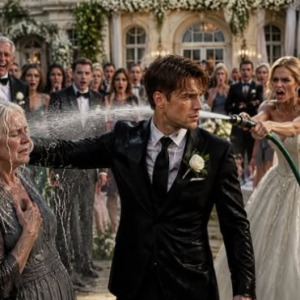
Water still dripped from her silver hair.
She should never have been forced to witness any of this.
I wanted to drive her away immediately, but she lowered the window.
“Daniel,” she said gently.
I turned toward her.
She looked at Charles.
“Tell him why we saved the company.”
Charles’s face changed.
Until that moment, he had treated my mother like an unwanted stranger.
Now he studied her more carefully.
Something in her voice unsettled him.
Vanessa laughed nervously.
“What could she possibly know about our company?”
My mother opened the passenger door and stepped out.
My jacket hung around her shoulders.
Her gray dress was soaked, her shoes were muddy, and her face was pale from the cold.
Yet when she stood upright, the atmosphere changed.
She did not look poor.
She looked powerful.
Not because of money.
Because she no longer appeared ashamed.
“My husband founded Northbridge Capital,” she said.
Charles blinked.
Several guests turned toward one another.
My father, Jonathan Mercer, had died twelve years earlier.
Publicly, he had been known as an economics professor and occasional government adviser.
Very few people knew that he had also created one of the largest private investment networks in the country.
After his death, control passed to my mother.
She could have appeared in financial magazines, attended charity galas, and filled her closets with designer clothes.
Instead, she continued living in the modest house where my parents had raised me.
She drove my father’s old sedan until the engine finally failed.
She repaired her clothes instead of replacing them.
She gave anonymously to hospitals, veterans’ programs, public schools, and shelters.
The gray dress Vanessa had mocked had belonged to my grandmother.
My mother wore it because my grandmother had sewn it by hand.
Charles stared at her.
“Eleanor Mercer?”
My mother nodded.
His voice dropped.
“The Eleanor Mercer?”
“I have never understood why people add the word ‘the’ before a name,” she replied.
“But yes.”
A murmur moved through the crowd.
The banker near the fountain lowered his champagne glass.
A state senator took two steps closer.
Martin Hale looked as if he might collapse.
Charles’s arrogance returned in a desperate burst.
“That proves nothing.
Northbridge is managed by a board.”
“My family controls seventy-eight percent of the voting shares,” I said.
“My mother is chairwoman.
I am managing director.”
Vanessa’s face went white.
“You told me you were a consultant.”
“I told you I worked in corporate restructuring.”
“You let me believe you worked for my father.”
“No.
Your father assumed I worked for him.
You never bothered to ask.”
“That is insane.”
“What is insane,” my mother said quietly, “is believing a person’s value can be measured by the price of her clothing.”
Vanessa looked at the guests surrounding us.
She seemed to understand, at last, how completely the balance of power had shifted.
She stepped toward my mother.
“Mrs. Mercer, I am so sorry.
The hose was only a joke.”
My mother looked at the soaked fabric clinging to her arms.
“A joke is something everyone can laugh at.”
“I was nervous.
I had too much champagne.”
“You were sober when you told the caterer not to give me a seat at the family table.”
Vanessa froze.
I turned to my mother.
“What?”
She lowered her eyes.
Before the ceremony, Vanessa had ordered the staff to move my mother’s place card to the rear of the lawn near the service entrance.
She had also told a security guard to watch her because “people like that sometimes steal wedding gifTS.”
My mother had said nothing because she did not want to ruin my day.
A pressure built behind my ribs.
“You knew about this?” I asked Vanessa.
She folded her arms.
“Your mother made everyone uncomfortable.”
“By doing what?”
“By being out of place.”
I stared at her.
There it was.
No apology.
No remorse.
Only embarrassment that her cruelty had consequences.
I turned to Rebecca, who had just arrived through the side gate with two members of Northbridge’s legal team.
She wore a navy suit and carried three sealed folders.
Behind her were two federal investigators and four uniformed county deputies.
The guests began moving aside.
Charles’s face hardened.
“This is private property.”
One investigator showed him a warrant.
“Not for the next several hours.”
Vanessa backed away.
“What are they doing here?”
“Preserving company records,” Rebecca answered.
“Mr. Whitmore received three notices during the last six months requiring him not to destroy financial evidence.
At 3:14 this afternoon, a server connected to the estate began deleting archived correspondence.”
Charles looked toward Martin.
Martin raised both hands.
“I didn’t do anything.”
The investigator spoke calmly.
“The deletion command originated from the study inside the main house.”
Every head turned toward Charles.
“That computer is used by dozens of people,” he said.
“At the moment the command was entered, the security system recorded your access code opening the study.”
Charles’s mouth tightened.
A deputy moved toward the house.
Charles blocked his path.
“You are not entering my home.”
The deputy looked at the warrant.
Then at him.
“Step aside, sir.”
Charles did not move.
For years, people had stepped aside for him.
Employees.
Contractors.
JournalisTS.
Politicians.
Even family members.
He seemed incapable of understanding that the world had stopped obeying him.
The deputy repeated himself.
“Step aside.”
Charles raised his voice.
“Do you know who I am?”
My mother answered before anyone else could.
“Yes.
That appears to be the problem.”
A few guests laughed.
Not cruelly.
Not triumphantly.
The laughter came from the sudden absurdity of Charles demanding respect after spending the afternoon humiliating someone he considered powerless.
His face flushed dark red.
He stepped toward my mother.
“This is your fault.”
I moved between them.
“No,” I said.
“It is yours.”
He pointed at me.
“You infiltrated my family.”
“I tried to save your company.”
That was the truth Charles refused to understand.
Two years earlier, Northbridge had discovered that Whitmore Development was weeks away from insolvency.
Thousands of construction jobs were at risk.
Hundreds of retirees depended on the company pension.
Several cities had unfinished housing projects tied to Whitmore contracTS.
My mother had approved a rescue package because she believed innocent people should not lose everything because of one man’s greed.
Northbridge gave Charles access to emergency capital under strict conditions.
Accurate financial reporting.
Independent oversight.
No transfer of pension asseTS.
No new debt without approval.
Charles violated every condition.
I entered the company under my real name but without publicizing my position.
My purpose was to determine whether Whitmore Development could be repaired.
During that assignment, I met Vanessa.
At first, she appeared different from her father.
She volunteered at charity evenTS.
She spoke about building affordable housing.
She said she hated the arrogance of wealthy families.
I believed her.
Perhaps I wanted to believe her.
After we became engaged, small things began to change.
She mocked restaurant servers after they walked away.
She criticized my car.
She asked why my mother lived in “that depressing little house.”
When I defended people, Vanessa called me sensitive.
When her father insulted employees, she said he was simply demanding excellence.
Each incident seemed small enough to excuse.
Until the hose.
Cruelty rarely arrives wearing a warning sign.
Sometimes it arrives as a joke.
Sometimes it appears as a comment that everyone is expected to ignore.
Sometimes it smiles beneath a wedding veil.
Rebecca handed a folder to the lead investigator.
“This contains the original pension transfers, internal communications, and recordings of the March board meeting.”
Charles turned toward me.
“You recorded me?”
“The boardroom system records all meetings automatically.
You ordered Martin to disable the archive.
He did not.”
Martin looked down.
Charles’s gaze shifted toward his CFO.
“You betrayed me.”
Martin finally looked at him.
“No, Charles.
I spent seven years lying for you.
Telling the truth is not betrayal.”
The words seemed to strike harder than any accusation I could have made.
For the first time, other Whitmore executives began speaking.
A vice president admitted she had been pressured to falsify apartment occupancy.
An accountant said Charles had ordered him to delay vendor payments while claiming the company had record cash reserves.
A construction supervisor revealed that cheaper materials had been used in a high-rise project despite safety warnings.
One confession encouraged another.
Fear had held the empire together.
Once fear broke, the empire began collapsing from the inside.
Vanessa turned on them.
“You are all cowards! My family paid you!”
A woman near the front stepped forward.
She was in her late sixties and wore the dark uniform of the Whitmore estate’s housekeeping staff.
Her name was Rosa.
She had worked for the family for twenty-three years.
“You paid us late,” Rosa said.
“You cut our health insurance.
You made us serve food at parties where one bottle of wine cost more than our monthly salary.”
Vanessa stared at her.
“No one asked you to speak.”
Rosa’s shoulders stiffened.
“That is true.
No one ever asked us anything.”
My mother took Rosa’s hand.
It was a simple gesture.
Yet it drew a clear line across the lawn.
On one side stood people who believed wealth gave them permission to humiliate others.
On the other stood everyone who had grown tired of being silent.
Vanessa looked at me again.
“Daniel, make them leave.”
“I cannot.”
“You can.
You control Northbridge.”
“Control is not the same as immunity.”
Her eyes filled with tears.
For a moment, part of me remembered the woman I thought she had been.
The woman who brought coffee to my office during late meetings.
The woman who danced barefoot with me in the kitchen.
The woman who once said she wanted our marriage to be kinder than her parents’ marriage.
I wondered whether that woman had ever truly existed.
Perhaps she had.
Perhaps people are not divided into monsters and sainTS.
Perhaps they become what they repeatedly choose.
Vanessa had chosen cruelty too many times.
She reached for my hand.
“We can fix this.”
I stepped back.
“You aimed a hose at my mother.”
“I said I was sorry.”
“You apologized after discovering she was rich.”
“That isn’t fair.”
“It is exactly fair.”
She lowered her voice.
“I love you.”
“No.
You loved the version of me you thought you could control.”
Her tears spilled.
“What do you want me to do? Beg?”
“I want you to understand that some things cannot be repaired by saying the correct words after consequences arrive.”
A sudden crash came from inside the house.
Two deputies rushed through the terrace doors.
Moments later, they returned with Charles’s younger brother, Stephen, who had attempted to carry a computer tower through a rear hallway.
He claimed he was moving it away from a leaking pipe.
There was no leaking pipe.
The investigator ordered the computer seized.
Charles swore loudly.
Stephen pointed at him.
“You told me to get rid of it!”
The accusation echoed across the terrace.
Charles lunged.
The deputies restrained him before he reached his brother.
Guests gasped as the groom’s former future father-in-law struggled against two officers beneath an arch of white roses.
Vanessa screamed at them to release him.
My mother closed her eyes.
This was no longer a wedding.
It was the final public performance of a family that had mistaken intimidation for strength.
The investigators did not arrest Charles immediately.
They informed him that he was being temporarily detained while the search was conducted.
He continued shouting about attorneys, political connections, and lawsuiTS.
Rebecca waited until he stopped for breath.
“Your attorneys resigned thirty minutes ago.”
His face went blank.
“They cannot resign.”
“They can when a client asks them to destroy evidence.”
Charles turned toward the guests, searching for support.
The mayor looked away.
The senator stepped backward.
The banker near the fountain took a phone call and walked toward the gate.
One by one, the people who had laughed with Charles began distancing themselves from him.
I felt no satisfaction watching it.
Only exhaustion.
Power attracts crowds.
Character determines who remains when power disappears.
My mother touched my arm again.
“Take me home, Danny.”
 Woman Stops Paying For Her Friend’s Meals After Repeated Requests, Now Her Friend Thinks She’s A Bad Friend
I nodded.
Rebecca walked us toward the car.
Before I opened the door, she spoke quietly.
“There is another issue.”
“What?”
“The investigator found medical records in Charles’s study.”
My mother looked at her.
“What kind of records?”
“Yours.”
The air seemed to leave my lungs.
Rebecca handed me a transparent evidence sleeve.
Inside were copies of my mother’s cardiology reports, medication list, home address, and hospital schedule.
Handwritten notes covered the margins.
Weak heart.
Possible stress trigger.
Avoid direct confrontation.
Use Daniel.
I read the words twice.
Then a third time.
My mother’s hand trembled.
Charles had known about her heart condition.
He had obtained confidential records and used them to design a strategy against us.
The garden hose had not merely been a cruel impulse.
My mother had suffered a serious cardiac event three years earlier.
Sudden cold exposure and acute stress could trigger dangerous complications.
I looked back toward Charles.
He had gone silent.
The investigators were watching him now with a different kind of attention.
Vanessa saw the document in my hand.
“What is that?”
I crossed the lawn.
“Did you know?”
She looked at the medical records.
Her expression shifted from confusion to recognition.
That tiny reaction told me everything.
“You knew,” I said.
“No.”
“You recognized them.”
“My father mentioned that your mother had health problems.”
“How did he know?”
“I don’t know.”
“Vanessa.”
“He said we needed leverage.”
My mother stopped behind me.
Vanessa’s eyes darted toward her.
“I never wanted anyone hurt.”
“You sprayed freezing water at a woman with a heart condition.”
“I didn’t think—”
“No,” I said.
“You did not.”
The lead investigator took the evidence sleeve from me.
“Ms.
Whitmore, we need you to remain on the property.”
Her mouth opened.
“Am I under arrest?”
“Not at this time.”
“At this time?”
She looked at me in panic.
“Daniel, tell them I had nothing to do with this.”
I wanted to tell her something comforting.
I wanted to discover that she had been manipulated, that there was still an innocent explanation.
But love does not require blindness.
And forgiveness does not require lying.
“Tell them the truth,” I said.
Then my mother suddenly gripped my arm.
Her knees weakened.
“Mom?”
She tried to answer, but her face had turned gray.
I caught her before she fell.
Someone shouted for a doctor.
A wedding guest who worked as an emergency physician rushed forward.
He checked her pulse and ordered someone to call an ambulance.
My mother remained conscious, but her breathing was shallow.
“Danny,” she whispered.
“I’m here.”
“Do not hate them.”
I could barely speak.
“You’re worried about that now?”
“Hatred makes another person your permanent master.”
The ambulance arrived nine minutes later.
I rode beside her to the hospital.
The wedding, the investigators, the collapsing company—none of it mattered during that drive.
I sat beside my mother’s stretcher holding her cold hand and listening to the monitor.
Every beep felt like a verdict.
At the hospital, doctors diagnosed an irregular heartbeat triggered by stress and cold exposure.
They stabilized her quickly, but kept her overnight for observation.
I remained beside her until shortly after midnight.
She woke to find me sitting in a plastic chair near the window.
“You look terrible,” she said.
“So do you.”
She smiled faintly.
“That is rude.”
“You raised me badly.”
“That must be it.”
I leaned forward, resting my elbows on my knees.
“I should have seen what Vanessa was.”
“You saw what you hoped she could become.”
“That was stupid.”
“No.
Hope is not stupidity.
Refusing to accept the truth after it appears—that is stupidity.”
I looked toward the monitor.
“I kept excusing things.”
“Most people do.
We think character is revealed during extraordinary momenTS. Usually it is revealed through ordinary behavior.
How someone treats a waiter.
How they speak about a stranger.
Whether they laugh when another person is humiliated.”
“I almost married her.”
“But you did not.”
“Only because she attacked you.”
My mother studied me.
“Would you have left if she had done it to Rosa?”
The question hurt because I did not know the answer.
“I hope so.”
“Then make sure that next time, you do not need the victim to be someone you love before cruelty becomes unacceptable.”
I nodded slowly.
That lesson stayed with me longer than the anger.
At 2:17 in the morning, Rebecca called.
The investigation had uncovered enough evidence to freeze Whitmore Development’s major asseTS.
Charles and Stephen had both been arrested on charges related to obstruction and financial fraud.
Vanessa had not been arrested, but investigators had seized her phone and passport.
The estate was being placed under court supervision.
By sunrise, Charles’s empire was not literally gone.
Buildings still stood.
Bank accounts still existed.
Employees still reported to work.
But his control had ended.
And without control, the empire he bragged about had never truly belonged to him.
The next morning, financial markets reacted violently.
Whitmore Development’s bonds collapsed.
Lenders demanded repayment.
News networks broadcast footage from the wedding because the drone operator had quietly preserved the recording.
The image of Vanessa spraying my mother appeared everywhere.
Public outrage spread faster than any legal filing.
Some people celebrated the Whitmores’ downfall.
Others claimed the video had been taken out of context.
A public relations firm released a statement describing the incident as “a private family misunderstanding during an emotionally heightened celebration.”
No one believed it.
Three days later, Vanessa came to the hospital.
Security called before allowing her upstairs.
My mother had been cleared for discharge, but was waiting for final paperwork.
Vanessa entered without makeup.
She wore plain black trousers and a white blouse.
There were no diamonds, no designer handbag, no entourage.
For the first time since I met her, she looked young and frightened.
She remained near the door.
“I came to apologize.”
My mother gestured toward a chair.
Vanessa sat.
For several seconds, no one spoke.
Then she looked at my mother.
“What I did was disgusting.”
My mother did not respond.
Vanessa’s hands tightened together.
“I could blame my father.
I could say I grew up watching him treat people that way.
But I am thirty-one years old.
I knew it was wrong.”
“Yes,” my mother said.
“I wanted the guests to laugh.
I wanted them to see that I controlled the room.”
“Why?”
Vanessa looked down.
“Because I was afraid they did not respect me.”
“So you tried to become frightening.”
“Yes.”
“Did it work?”
Vanessa began crying.
“No.”
My mother waited.
Vanessa looked at me.
“I did love you.”
“I believe you loved me in the only way you understood love.”
“What does that mean?”
“You loved me while you thought I was beneath you.
The moment I refused to obey, you treated me like an enemy.”
She wiped her face.
“Can you ever forgive me?”
I thought carefully before answering.
“One day, perhaps.”
Her eyes lifted with hope.
“But forgiveness does not mean marriage.
It does not mean trust.
It does not mean escaping consequences.”
The hope disappeared.
She nodded.
“I understand.”
My mother leaned forward.
“No, you do not.
Not yet.
Understanding is something you prove over time.”
Vanessa stood.
At the door, she stopped.
“My father says you destroyed our family.”
My mother’s expression remained calm.
“Your father built his family around lies.
Daniel only opened the curtains.”
Vanessa left without another word.
For the next eighteen months, the Whitmore case moved through federal court.
The details were worse than we expected.
Charles had bribed inspectors.
He had hidden structural defecTS.
He had stolen from pension accounts and falsified insurance documenTS.
He had threatened employees who tried to report him.
Several public officials resigned after investigators uncovered improper paymenTS.
Stephen agreed to testify in exchange for a reduced sentence.
Martin Hale provided years of records.
Vanessa eventually pleaded guilty to one count of signing a false financial statement.
The court found that she had participated in fraud but had also cooperated extensively after the wedding.
She received probation, community service, and a permanent ban from serving as an officer of a publicly regulated company.
Charles received twelve years in federal prison.
At sentencing, he continued insisting that everyone had betrayed him.
His employees.
His brother.
His daughter.
His attorneys.
The banks.
Northbridge.
He never once admitted that his own choices had caused his downfall.
Whitmore Development entered court-supervised restructuring.
Northbridge could have liquidated everything and recovered most of its money.
Instead, my mother proposed a different plan.
The profitable construction divisions were preserved.
Unsafe projects were repaired.
Executive bonuses were canceled.
The stolen pension funds were restored using proceeds from the sale of the Whitmore estate, private aircraft, art collection, and vacation properties.
Employees received representation on the new board.
Rosa became an adviser to a workplace standards committee after retiring from household service.
The mansion where my wedding had nearly occurred was sold to a nonprofit organization.
It became a vocational training center for young adults leaving foster care.
The white terrace remained, but the silk canopies were gone.
Classrooms replaced ballrooms.
The wine cellar became a commercial kitchen.
The room where Charles had hidden financial records became a legal aid office.
My mother personally attended the opening ceremony.
She wore the same gray dress.
It had been cleaned and repaired.
A reporter asked why someone of her wealth continued wearing such an old garment.
My mother smiled.
“My mother made this dress when she had very little money,” she said.
“But she gave me patience, dignity, and courage.
Those things have appreciated more than any investment I have ever owned.”
The quotation appeared in newspapers across the country.
A photograph showed her standing beside Rosa, both women laughing.
Two years after the wedding, I received a letter from Vanessa.
She had moved to another city and was working for an organization that helped victims of financial exploitation.
At first, I suspected the work was merely part of rebuilding her public image.
Then I learned she had refused all media interviews.
She used her mother’s maiden name.
She worked quietly.
The letter contained no request for reconciliation.
No excuses.
Only a statement.
You were right.
I apologized because I was afraid of losing everything, not because I understood what I had done.
Losing everything was the beginning of understanding, not the end.
She wrote that her father still sent angry letters from prison.
For months, she answered them.
Eventually, she stopped.
She had realized that trying to earn his approval was the chain that had shaped her entire life.
At the bottom, she wrote:
I do not expect forgiveness.
I only wanted you to know that your mother’s mercy affected me more deeply than your power ever could.
I showed the letter to my mother.
She read it twice, folded it, and returned it.
“Do you believe her?” I asked.
“I believe she has begun.”
“Is that enough?”
“For today.”
I never saw Vanessa again.
Sometimes an ending is not a reunion.
Sometimes the most honest ending is distance without hatred.
I eventually left my position as managing director of Northbridge.
Not because I disliked the work, but because the wedding had changed the way I understood responsibility.
For years, I believed saving a company meant repairing balance sheeTS.
I began to understand that numbers could be restored while cultures remained poisoned.
I created a smaller investment firm focused on employee-owned businesses and ethical restructuring.
My mother remained chairwoman of Northbridge for another five years before retiring.
On her final day, she arrived at headquarters in my father’s old sedan, which she had secretly paid to restore.
The board had prepared a luxury car as a retirement gift.
She donated it to a transportation program for cancer patienTS.
Then she drove home in the old sedan with the windows down.
Three years later, I married again.
Her name was Claire.
She was a public school teacher whom I met at the vocational center built on the former Whitmore estate.
Our wedding was small.
Forty guesTS.
No drone.
No champagne tower.
No silk canopies.
We held it in my mother’s backyard beneath an old maple tree.
Rosa brought flowers from her garden.
Martin Hale attended with his wife.
Rebecca performed a reading.
My mother wore the gray dress.
Before the ceremony, Claire approached her with a small wooden box.
Inside was a silver brooch shaped like a leaf.
“My grandmother gave this to me,” Claire said.
“She told me to wear it when I joined a family that understood what matters.”
Then she pinned it gently to my mother’s dress.
My mother cried.
So did I.
During the reception, rain began falling.
Guests rushed beneath the porch and laughed as the tables became wet.
Claire remained in the yard.
She lifted her face toward the rain, then reached for my hand.
For one brief second, I remembered freezing water striking my mother at the Whitmore estate.
Claire saw the memory cross my face.
She squeezed my fingers.
“This water is different,” she said.
She was right.
The rain did not humiliate anyone.
It washed dust from the leaves.
Children ran barefoot across the grass.
My mother stood beneath the porch, wrapped in a warm shawl, laughing as Rosa tried to protect the wedding cake with an umbrella.
Nothing about the day looked like an empire.
There were no marble fountains.
No politicians.
No financial headlines.
No guests measuring one another by clothing, influence, or wealth.
Yet I had never felt richer.
Near sunset, my mother asked me to walk with her.
We stopped beneath the maple tree after the rain ended.
Drops of water shone on the branches above us.
“Do you remember what you said that day?” she asked.
“Which part?”
“That by sunrise, their empire would be gone.”
“I remember.”
“You were very dramatic.”
“I was angry.”
“You sounded like your father when he watched courtroom movies.”
I laughed.
Then she became serious.
“Empires do not disappear because buildings are taken away.
They disappear when people stop believing fear deserves obedience.”
I looked toward Claire, who was helping a child retrieve a paper flower from a puddle.
“What did the Whitmores really lose?” I asked.
My mother considered the question.
“The illusion that they were greater than the people they hurt.”
“And what did we gain?”
She slipped her arm through mine.
“A chance not to become like them.”
That was the real victory.
Not the frozen bank accounTS.
Not the arresTS.
Not the headlines.
Not even the moment Charles discovered that the poor woman he mocked could have purchased everything he owned.
The victory was leaving without becoming cruel.
It was rebuilding the company without abandoning its workers.
It was allowing Vanessa to face consequences without demanding that she remain broken forever.
It was learning that dignity does not come from power, and kindness is not weakness.
Most importantly, it was understanding that a person’s worth is never revealed by the car they drive, the dress they wear, or the size of the house behind them.
Worth is revealed in the instant when cruelty becomes entertaining.
Some people laugh.
Some people look away.
And some people step in front of the water.
On the worst day of my life, I removed a wedding ring and believed I was losing my future.
In truth, I was being given one.
By sunrise, the Whitmore empire had begun to fall.
But beneath an old maple tree years later, surrounded by ordinary people who knew how to treat one another with dignity, I finally understood something Charles Whitmore never had.
An empire built on fear will always collapse.
A family built on respect does not need an empire at all.