The envelope was sealed with a dark green wax stamp shaped like a rose.
My father had used that stamp only twice in his life.
The first time was on the letter he wrote me before my wedding to Calvin.
The second was on the note he left beneath my pillow after my mother died, reminding me that grief did not mean love had ended.
It meant love had nowhere physical left to go.
Seeing it again made my knees weak.
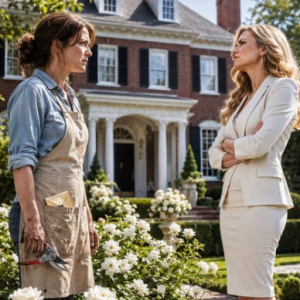
I sat on the stone border beside the rose bushes and turned the envelope over carefully.
The paper was damp along one corner, but the seal remained intact.
On the front, in my father’s unmistakable handwriting, were four words:
For Paige.
Before the will.
I stared at them until the letters blurred.
My father had known.
He had known there would be a confrontation before the reading.
He had known someone would come to the house, perhaps even Tabitha.
He had hidden the envelope in the one place he trusted me to find it—the garden where he had taught me patience, discipline, and the danger of ignoring rot beneath a healthy-looking stem.
A car pulled into the circular driveway twenty minutes later.
Penelope Shaw stepped out carrying a leather case beneath one arm.
She was sixty-three, silver-haired, straight-backed, and dressed in the same navy suits she had worn throughout the thirty years she served as my father’s attorney.
She had also been my mother’s closest friend.
She entered the garden without waiting for me to open the gate.
“Show me,” she said.
I handed her the envelope.
Her face changed the instant she saw the wax seal.
“You haven’t opened it?”
“No.”
“Good.”
“Why?”
“Because your father gave me specific instructions concerning anything marked with that seal.”
She glanced toward the house, then toward the road.
“Are you alone?”
“I think so.”
“Thinking so isn’t enough.”
Penelope walked through the house room by room, checking the doors and windows.
Then she asked me to disable the wireless security system and disconnect the smart speaker in the kitchen.
That frightened me more than Tabitha’s threats had.
When she returned to the garden, I was still sitting beside the roses.
“What is happening?” I asked.
Penelope sat beside me, smoothing her skirt.
“Your father believed someone was trying to manipulate his estate.”
“Calvin?”
“He suspected Calvin.
He feared Kyle was involved.”
The words struck harder than I expected.
Kyle was my younger brother by four years.
We had never been especially close, but after our mother’s death, we had promised each other that whatever happened, we would protect Dad and the house.
For years, I believed we had kept that promise.
During Dad’s illness, Kyle began visiting less often when I was present.
He always had an excuse.
Work.
Traffic.
His son’s soccer games.
A strained marriage.
Yet the nurses sometimes told me he had stopped by when I was gone.
So had Calvin.
“Why didn’t Dad tell me?” I asked.
“Because he didn’t know how far the manipulation had gone.
And because he was trying to protect you.”
“Protect me from what?”
“From being accused of influencing him yourself.”
I looked down at the envelope.
Penelope removed a small evidence bag from her leather case.
“Your father instructed me that any letter discovered outside my presence had to be photographed, logged, and opened with a witness.”
“You knew this was here?”
“I knew he hid documents around the property.
I didn’t know where.”
She photographed the envelope from several angles, recorded the time, then placed her phone on the stone ledge with the camera running.
“Go ahead,” she said.
My hands shook as I broke the seal.
Inside was a single sheet of paper and a small brass key taped to the bottom.
I unfolded the letter.
My dearest Paige,
If you are reading this before the formal reading of my will, then someone has become impatient.
Impatience is useful.
It causes greedy people to reveal the plan before the plan is finished.
Listen carefully to what they say.
Write down every word.
Do not argue about ownership.
Do not promise anything.
Do not leave the house.
The key attached to this letter opens the bottom drawer of the writing desk in my old workshop.
Inside, you will find a black ledger and a silver recorder.
Take both to Penelope.
Do not confront Kyle.
Do not confront Calvin.
Trust the roses.
Rot often begins where the leaves look greenest.
I am sorry I could not tell you everything while I still had the strength.
I needed to know the truth before I placed the burden in your hands.
Whatever happens tomorrow, remember this: a house is not a legacy.
A legacy is what we refuse to let others destroy.
Love always,
Dad
I read the letter twice.
By the third time, I was crying.
Penelope rested one hand over mine.
“He knew you would find it.”
“He knew Tabitha would come.”
“He suspected someone would.”
I wiped my face with the back of my hand.
“What does he mean by a black ledger?”
“We’re going to find out.”
My father’s workshop stood behind the carriage house, beneath an enormous oak tree.
When I was a child, it smelled of cedar shavings, motor oil, and the peppermint candies he kept in an old coffee tin.
After his diagnosis, he had stopped working there.
I had entered only once since his death, to place his gardening hat on the shelf above his tools.
The room felt preserved in time.
His work gloves rested beside the vise.
Half of a wooden birdhouse remained clamped to the bench.
His glasses lay folded on a stack of sandpaper.
The writing desk stood near the back window.
The brass key opened the bottom drawer.
Inside were three objecTS.
A black leather ledger.
A silver digital recorder.
And a photograph of my father standing beside Calvin and Kyle at the country club.
Across Calvin’s face, my father had drawn a red line.
Across Kyle’s, a question mark.
Penelope pulled on a pair of thin gloves.
“Don’t touch anything else.”
She opened the ledger.
The first pages contained dates, names, and financial figures.
My father’s handwriting grew less steady toward the end, but the entries were precise.
January 14: Calvin visited.
Asked whether Paige would inherit residence.
Claimed Paige planned to sell immediately.
False.
January 28: Kyle requested authorization to manage medical bills.
Refused.
February 3: Unknown withdrawal attempt from Evergreen Trust.
Bank alerted me.
February 7: Calvin brought revised estate summary.
Claimed Penelope prepared it.
She did not.
February 10: Kyle insisted I sign “tax documenTS.” Signature pages concealed.
February 16: Medication increased without consultation from Dr. Singh.
Penelope stopped reading.
“What medication?”
“I don’t know.”
She turned the page.
February 18: Discovered pills in evening container do not match prescription list.
Saved samples.
February 20: Memory problems after tea prepared by Kyle.
February 22: Calvin recorded conversation after asking repeated questions about Paige’s divorce settlement.
February 25: They believe I am weaker than I am.
A cold pressure spread through my chest.
“He thought they were drugging him.”
Penelope’s expression hardened.
“He did more than think.”
She pointed toward a notation at the bottom of the page.
Sample delivered to P.S.
through Franklin.
“Who is Franklin?” I asked.
“Your father’s driver.”
“Did Dad give you pills?”
“No.
Which means P.S.
may not refer to me.”
The recorder contained dozens of audio files.
Penelope selected the earliest one.
At first, there was only the scrape of a chair.
Then Calvin’s voice filled the workshop.
“You don’t want Paige trapped here alone, Everett.
She’s emotional.
She makes decisions based on memories.”
My father answered faintly.
“The house belongs with my children.”
“Of course.
But Kyle understands property.
Paige understands flowers.”
Kyle laughed.
The sound made my stomach turn.
Calvin continued.
“You can protect her by placing the property into a management trust.
Kyle and I handle the asseTS. Paige can stay temporarily.”
“No.”
“You should at least read the documenTS.”
“I said no.”
The recording ended.
I pressed my hand to my mouth.
Penelope played another.
This time Kyle was speaking.
“You’re confused, Dad.
We already discussed this.”
“No, we didn’t.”
“Yes, we did.
Calvin explained the trust.
You said it was sensible.”
“I would remember.”
“You haven’t been remembering much lately.”
A long silence followed.
Then my father said, “Get out.”
The third recording was worse.
Tabitha’s voice was unmistakable.
“You don’t have to like me, Everett.
But Calvin and I are your future family.”
“You broke my daughter’s marriage.”
“Your daughter lost Calvin years before I came along.
She just didn’t notice.”
There was the sound of glass hitting wood.
Then Tabitha said, “Once Paige is out of the house, she’ll finally move on.”
My father’s response was quiet.
“You will never live in this house.”
Tabitha laughed.
“That isn’t what Kyle says.”
Penelope stopped the recording.
Neither of us spoke for several seconds.
Finally, I asked, “Why would Kyle do this?”
“Money.”
“He has a good job.”
“He also has debTS.”
I looked at her sharply.
“How much?”
“Your father asked me to investigate quietly.
Kyle’s construction company has been failing for nearly two years.
He personally guaranteed several loans.”
“How much, Penelope?”
“More than three million dollars.”
I felt as if the workshop floor had shifted.
Kyle had never mentioned financial trouble.
At Dad’s funeral, he had arrived in a new Range Rover and spent most of the reception complaining that the caterer’s wine was cheap.
“And Calvin?”
“Calvin’s investment firm is under investigation by two former clienTS. Your father’s property is worth approximately eleven million dollars.
The surrounding land may be worth twice that to a developer.”
I looked toward the workshop window.
Beyond the oak tree lay the rose garden, the orchard, and the meadow where my father once built us a treehouse.
“They want to sell it.”
“More likely they have already promised it.”
Penelope turned to another page in the ledger.
There was a company name written in block letters.
Blackridge Residential Partners.
Underneath it, my father had written:
Potential purchase proposal: $24.8 million.
Contingent upon vacant possession and rezoning cooperation.
My anger became strangely calm.
“They’ve already negotiated a sale.”
“Possibly.”
“Before Dad was dead.”
“Yes.”
“And Tabitha just told me they planned to rip out the roses and remodel.”
Penelope looked at me.
“That may be the mistake your father was waiting for.”
I didn’t understand until she explained.
If Calvin, Tabitha, and Kyle had already made representations to a developer claiming control of property they did not own, they might have committed fraud.
If they had produced estate documents or promised vacant possession, the problem became more serious.
Tabitha’s threat was not merely cruel.
It was evidence that she believed the outcome had already been secured.
“Tomorrow’s will reading cannot proceed normally,” Penelope said.
“What do you mean?”
“Your father prepared more than one testamentary instrument.”
My stomach tightened.
“How many?”
“Three.”
“Why?”
“The first was his standard will from six years ago.
The second was signed four months before his death.
The third was a conditional codicil completed eleven days before he died.”
“What is a conditional codicil?”
“A final amendment activated only if certain conduct occurred before or after his death.”
“What conduct?”
Penelope closed the ledger.
“An attempt to intimidate you from the residence.
An effort to remove or destroy personal property.
Any claim by a beneficiary that the outcome was predetermined.
And any evidence that someone attempted to interfere with your father’s medical care or mental capacity.”
I stared at her.
“Tabitha activated it.”
“Her visit may have.”
“What happens now?”
“Tomorrow, we let them believe the reading is proceeding as expected.”
“You want me to sit in a room with them and say nothing?”
“I want you to listen.
Your father was right.
Impatient people talk.”
That night, I slept in my childhood bedroom with a chair pushed beneath the door handle.
At 2:13 in the morning, headlights moved across the ceiling.
A vehicle had entered the driveway.
I got out of bed and looked through the curtains.
Kyle’s Range Rover stopped near the carriage house.
He climbed out wearing dark jeans and a baseball cap.
Another man emerged from the passenger side.
Calvin.
They moved toward the workshop.
I called Penelope.
“They’re here.”
“Do not go outside,” she said.
“Call the police.”
“What if they destroy the evidence?”
“We removed the evidence this afternoon.”
“What?”
“The ledger and recorder are in a secure location.
What you saw in the drawer after we finished were duplicates.”
I almost laughed from relief.
Penelope had thought of everything.
The workshop door opened.
A flashlight moved inside.
Then another light appeared near the garden.
Tabitha.
She had come too.
I dialed emergency services and reported intruders on the property.
While I spoke, my security cameras recorded all three of them.
Calvin emerged from the workshop carrying the duplicate ledger.
Kyle followed with the recorder.
Tabitha stood beside the roses, shining her phone light across the soil.
“She must have hidden something else,” I heard her say through the camera microphone.
“You should never have gone here this morning,” Calvin hissed.
“How was I supposed to know the old man left scavenger hunts?”
Kyle kicked at the stone border.
“Keep looking.
There could be letters.”
I stood in the dark bedroom, watching them tear through the garden my father loved.
Calvin opened the duplicate ledger and swore.
“It’s blank.”
“Then she found the real one,” Kyle said.
Tabitha straightened.
“Maybe Paige has it.”
Calvin looked toward the house.
For one terrible second, I thought they would come inside.
Then sirens sounded at the end of the road.
They ran.
Kyle and Calvin reached the Range Rover.
Tabitha’s heel caught between two stones, and she fell hard beside the garden gate.
Calvin looked back.
He hesitated only a moment before getting into the vehicle and leaving without her.
The police found Tabitha sitting in the mud, one shoe missing, screaming that she had been abandoned on property that would legally belong to her husband by morning.
Her exact words were captured on an officer’s body camera.
So was the forged key in her purse.
She claimed she had been invited.
I declined to press charges that night.
Penelope had advised me not to.
“Why let them go?” I asked after the police released Tabitha to a taxi.
“Because trespassing is the smallest thing they may have done,” she said.
“And because tomorrow, they need to believe they still have a chance.”
The will reading took place at ten o’clock in my father’s library.
Kyle arrived first, wearing a charcoal suit and an expression of wounded dignity.
“You called the police on your own brother?”
“You entered the property at two in the morning.”
“I was checking on Dad’s workshop.”
“With Calvin?”
His jaw tightened.
“We were concerned you might remove estate asseTS.”
“You mean the black ledger?”
His face went pale.
Only for a second.
But I saw it.
He looked away.
“I don’t know what you’re talking about.”
Calvin and Tabitha entered together.
Tabitha wore oversized sunglasses, though the morning was cloudy.
She had covered the scrape on her chin with heavy makeup.
Calvin did not look at me.
He walked directly toward the fireplace and stood beneath my father’s portrait as if he already owned the room.
Two additional people attended.
One was Dr. Raj Singh, my father’s oncologist.
The other was a woman I did not recognize, carrying a thick document case.
Penelope introduced her as Marisol Vance, a forensic accountant.
Kyle’s confidence weakened.
“What is she doing here?”
“Your father retained her,” Penelope said.
“For what?”
“All questions will be answered in order.”
We sat around the long walnut table.
I took my father’s usual chair.
Tabitha immediately objected.
“That seat should remain empty out of respect.”
I looked at her.
“My father told me never to surrender a place merely because someone else wanted to occupy it.”
Calvin gave an exhausted sigh.
“Can we avoid the theatrics?”
Penelope opened her folder.
“The primary testamentary document was executed by Everett James Whitmore on March 3, in the presence of two independent witnesses and a physician who certified his capacity.”
Kyle leaned forward.
“March 3?”
“Yes.”
“That was after his diagnosis.”
“A diagnosis of pancreatic cancer does not automatically remove legal capacity.”
“He was taking medication.”
“That issue will be addressed.”
Penelope began reading.
My father left modest charitable gifts to the hospital, the local horticultural society, and the scholarship fund he established after my mother’s death.
He left his collection of antique tools to Kyle’s son, Ethan.
He left my mother’s jewelry to me.
He left cash gifts to several employees.
Then Penelope reached the business asseTS.
“My controlling interest in Whitmore Agricultural Holdings shall be transferred into the Everett and Elaine Whitmore Preservation Trust.”
Calvin shifted.
Kyle frowned.
Penelope continued.
“The trust shall be managed by my daughter, Paige Whitmore Bennett, together with two independent trustees.”
“What?” Kyle shouted.
Penelope raised one finger.
“I have not finished.”
The house, gardens, orchard, meadow, carriage house, and surrounding two hundred fourteen acres were also transferred into the preservation trust.
The land could not be sold to a commercial developer for a minimum of fifty years.
The main residence would serve as Paige’s home for as long as she wished to occupy it.
The gardens would be opened to the public four weekends each year, with proceeds benefiting pancreatic cancer research.
Tabitha removed her sunglasses.
“This is ridiculous.”
Calvin placed a hand on her arm.
Penelope kept reading.
Kyle received five hundred thousand dollars, but only if he disclosed all outstanding business liabilities and repaid any money improperly obtained from my father.
If he failed to do so, his inheritance would pass directly to his son.
Calvin received one item.
My father’s country-club membership pin.
Nothing else.
Tabitha laughed in disbelief.
“A pin?”
Penelope lifted a small velvet box.
“Mr. Whitmore included a note.”
She read it aloud.
“Calvin once told me that membership in the right club was more valuable than loyalty to the wrong people.
I leave him the symbol of what he chose.”
Calvin’s face darkened.
“This isn’t valid.”
“It is valid,” Penelope replied.
“He hated me because of the divorce.”
“He continued seeing you socially for a specific purpose.”
“What purpose?”
“To document your attempts to influence him.”
The room fell silent.
Kyle stood.
“I’m leaving.”
“No,” Penelope said.
“You should remain for the codicil.”
His hand froze on the back of his chair.
“What codicil?”
“The amendment your father executed eleven days before his death.”
“That is impossible,” Calvin said.
“He was barely conscious.”
Dr. Singh spoke for the first time.
“Everett was lucid during that period.
His pain medication was carefully adjusted to preserve awareness when he requested legal meetings.”
Calvin turned toward him.
“You weren’t with him every hour.”
“No,” Dr. Singh said.
“But someone interfered with his medication on at least three occasions.”
Tabitha’s eyes moved toward Kyle.
Kyle noticed.
“Don’t look at me.”
Penelope placed a copy of the ledger on the table.
Kyle’s face collapsed.
Calvin did not move at all.
“My father documented everything,” I said.
Kyle looked at me with raw hatred.
“You went through his private things?”
“He left them for me.”
“They belong to the estate.”
“They are evidence,” Penelope said.
Calvin stood slowly.
“This has gone far enough.
Everett was paranoid.
Grieving.
Drugged.
Any notes he made are unreliable.”
“That is why he created recordings,” Penelope said.
She placed the silver recorder beside the ledger.
Tabitha looked as though she might be sick.
Penelope played the conversation in which Calvin had pressured my father to create a management trust.
Then the one in which Kyle insisted Dad had forgotten agreeing to new documenTS.
Finally, she played Tabitha’s declaration that once I was removed, I would “finally move on.”
When the recording ended, rain tapped softly against the library windows.
Calvin recovered first.
“These are fragmenTS. Edited fragmenTS.”
“They have been digitally authenticated,” Penelope said.
“This was entrapment.”
“Mr. Whitmore recorded conversations inside his own home.”
Kyle pointed at me.
“She manipulated him against us.”
I stood.
“I spent eight months taking him to chemotherapy, preparing his food, cleaning his wounds, and sitting beside him when he was afraid to sleep.
You visited when you wanted signatures.”
“I have a family and a company!”
“So did I.”
“You lived here for free.”
“I lived here because Dad asked me to help him.”
“You always were his favorite.”
“No, Kyle.
I was the one who stayed.”
His face twisted.
“You think that makes you better than me?”
“No.
I think it made me available when he needed someone.”
Tabitha suddenly pushed back her chair.
“This entire thing is a setup.
Calvin told us Everett had already signed the transfer.”
Every head turned toward Calvin.
He stared at her.
“Stop talking.”
But Tabitha was angry, frightened, and incapable of restraint.
“You said the March documents didn’t matter because Kyle had the new signature pages.”
“Tabitha,” Calvin said softly, “be quiet.”
She did not.
“You said once the medical report proved he was incompetent, the earlier trust would be invalid.
You said Blackridge already approved the purchase.”
Kyle whispered, “Shut up.”
Tabitha looked between them, finally understanding that both men intended to blame her if the plan failed.
“No.
I’m not taking the fall for this.
Kyle brought the papers.
Calvin arranged the buyer.
I only spoke to Everett because Calvin asked me to.”
Penelope turned to the forensic accountant.
“Ms.
Vance?”
Marisol opened her case.
Blackridge Residential Partners had transferred a two-million-dollar “consulting advance” to a shell company controlled by Calvin.
From there, eight hundred thousand dollars had been sent to Kyle’s construction company.
 School Counselor Locks Her Office After Repeated Boundary Violations, Staff Call It ‘Uncollaborative’
Another two hundred thousand had funded renovations on Calvin and Tabitha’s new house.
The remaining money had moved through multiple accounTS.
The payment agreement referred to the future acquisition of my father’s estate.
Calvin sat down.
For the first time since I had known him, he looked genuinely afraid.
“That proves nothing illegal.”
Marisol slid a document across the table.
It bore my father’s signature.
The signature was convincing.
But the date was wrong.
The document claimed my father had signed it at the country club on February 16 at 3:40 p.m.
At that exact time, he was undergoing a medical procedure at St.
Vincent’s Hospital.
The hospital records, security footage, and witness statements made that indisputable.
Kyle looked at Calvin.
“You said the dates were checked.”
“You prepared the paperwork,” Calvin snapped.
“You gave me the signature sample!”
Tabitha began crying.
Not quiet tears of remorse.
Loud, panicked tears from someone watching luxury disappear.
“I didn’t forge anything.”
“No,” Penelope said.
“But you entered this property last night using an unauthorized key and searched for evidence.”
Tabitha stared at her.
“You told the police you weren’t pressing charges.”
“Paige did not press a trespassing complaint last night.
That decision has no effect on an investigation into conspiracy, fraud, destruction of evidence, or financial exploitation of a vulnerable adult.”
The library doors opened.
Two detectives entered.
Behind them stood Franklin, my father’s former driver.
Kyle went white.
Franklin had worked for our family for twenty-two years.
During Dad’s illness, he drove him to appointments whenever I could not.
He walked to the table and placed a small pharmacy bag beside the recorder.
“I found these under the passenger seat after Mr. Kyle borrowed the car,” he said.
The pills inside were not part of my father’s prescribed treatment.
Dr. Singh examined the bag.
“These are sedatives.”
Kyle shook his head.
“That isn’t mine.”
Franklin’s voice remained steady.
“I saw you crush one into your father’s tea.”
“You liar.”
“I photographed you.”
He produced his phone.
The image showed Kyle standing at the kitchen counter, holding a pill between two spoons.
I remembered that day.
Dad had been incoherent for hours.
Kyle told me the confusion was part of the cancer.
I had believed him.
I moved around the table before I realized what I was doing.
Kyle stepped back.
“You drugged him.”
“It wasn’t like that.”
“You drugged our father.”
“He was in pain!”
“You weren’t treating pain.
You were trying to make him look incompetent.”
Kyle’s eyes filled with tears.
“I needed time.”
“For what?”
“To save my company.”
“So you sold Dad’s home?”
“I was going to fix everything after the deal.”
“You were going to bulldoze everything.”
“It’s land, Paige!”
I slapped him.
The sound cracked through the room.
No one moved.
I had never struck another person in my life.
Kyle touched his cheek.
For one instant, I saw the little boy who once followed me through the orchard, begging me to lift him into the apple trees.
Then his face hardened again.
“You’ve always thought this place belonged to you.”
“No,” I said.
“I thought it belonged to our family.”
“It was never equal.
Dad trusted you more.”
“Because you kept giving him reasons not to trust you.”
The detectives asked Calvin and Kyle to stand.
Tabitha immediately began bargaining.
“I’ll cooperate.
I have messages.
Calvin kept documents at the apartment.
I can show you everything.”
Calvin looked at her with disgust.
“You said we were a team.”
“You left me in the mud last night.”
It was almost absurd.
Their great love story, the affair that destroyed my marriage, ended not with devotion but with two frightened people racing to betray each other first.
The detectives escorted Calvin and Kyle from the library.
Tabitha followed, speaking rapidly about immunity, messages, passwords, and a storage unit in her name.
Before she reached the door, she looked back at me.
“This isn’t over.
Calvin will fight the will.”
“No,” Penelope said.
“The codicil addresses that too.”
Tabitha stopped.
Penelope opened the final document.
If Calvin, Kyle, Tabitha, or any person acting on their behalf contested the preservation trust, threatened an occupant, removed property, destroyed evidence, or claimed authority over the estate before probate, every discretionary benefit connected to them would be revoked.
Kyle’s five-hundred-thousand-dollar inheritance was gone.
His son’s educational trust remained protected, but Kyle could never control it.
The country-club pin left to Calvin was revoked.
In its place, my father directed that the pin be auctioned for charity.
Tabitha had no inheritance to lose.
But her visit to the garden had triggered the release of an evidence package my father had placed with three separate law firms, the district attorney, and Blackridge’s board of directors.
Her threat had not merely activated the codicil.
It had ensured that every document my father collected would reach the authorities even if Penelope or I were pressured into silence.
Tabitha’s mistake was believing cruelty had no legal consequence.
My father had turned her arrogance into a tripwire.
After they left, the house became very quiet.
I stood in the library staring at the empty chairs.
Penelope came beside me.
“Are you all right?”
“No.”
It was the honest answer.
My father was still dead.
My brother had still betrayed him.
My ex-husband had still spent months pretending to be a grieving family friend while planning to profit from the estate.
Winning did not erase any of that.
It only prevented the damage from becoming permanent.
“I keep thinking I should have noticed,” I said.
“Your father worked hard to keep you from noticing.”
“Why?”
“Because he knew you would confront them.
He needed them to continue.”
“He let Kyle drug him.”
“He did not understand what was happening at first.
When he did, he stopped drinking anything Kyle prepared.
Franklin helped him replace the medication samples.
Dr. Singh monitored him.”
“So everyone knew except me.”
“Not everyone.
Only those needed to preserve the evidence.”
“That doesn’t make it hurt less.”
“No,” Penelope said.
“It doesn’t.”
She handed me another envelope.
This one was clean and unsealed.
“He asked me to give you this after the codicil was activated.”
I opened it.
Paige,
You may be angry that I did not tell you.
Be angry.
Anger is honest when it grows from love.
But understand that you spent fifteen years married to a man who trained you to doubt your instincTS. Whenever you noticed something wrong, Calvin called you emotional.
Whenever you defended yourself, he called you difficult.
Whenever you asked for truth, he called you suspicious.
I would not let him use that weakness against you again.
If you confronted him without evidence, he would make you question yourself.
So I gathered enough evidence that you would never need to question what happened.
Kyle may tell you that I loved you more.
That is not true.
I trusted you more.
Love can survive disappointment.
Trust must be earned.
Do not let this house become a monument to betrayal.
Fill it with something better.
And do not cut down the white roses.
They have survived too much to be punished for who walked among them.
Dad
I pressed the letter to my chest.
For the first time since the funeral, I allowed myself to cry without trying to remain composed.
Not because of the house.
Because my father had seen the damage Calvin left inside me, even when I pretended I was fine.
He had understood that the deepest theft was not money or property.
It was certainty.
Calvin had taught me to distrust my own mind.
My father’s final gift was not land.
It was proof.
The criminal investigation lasted fourteen monThS.
Calvin was charged with conspiracy to commit fraud, forgery, financial exploitation of a vulnerable adult, and obstruction of justice.
Kyle faced many of the same charges, with an additional count related to administering medication without authorization.
Tabitha cooperated.
She gave investigators access to encrypted messages, property proposals, and recordings Calvin had made without her knowledge.
In exchange, she received a reduced sentence and probation after pleading guilty to conspiracy and attempted destruction of evidence.
She filed for divorce before Calvin’s trial.
Apparently, loyalty remained ancient history whenever prison was involved.
Blackridge terminated the executives connected to the deal and paid a substantial settlement to my father’s trust to avoid prolonged litigation.
The company also agreed to fund the public garden program for ten years.
Calvin was convicted.
The man who once believed he could talk his way out of anything sat expressionless as the judge sentenced him to eight years in federal prison.
Before the deputies led him away, he asked to speak to me.
I almost refused.
Then I remembered my father’s words.
Treat roses firmly, but never cruelly.
I met Calvin in a courthouse conference room with my attorney present.
He looked older than he had a year earlier.
His expensive suit hung loosely on him.
The confidence that once filled every room had vanished.
“I never wanted Everett hurt,” he said.
“You tried to steal everything he built.”
“I needed the Blackridge deal.”
“You wanted it.”
“My firm was collapsing.”
“So was Kyle’s company.
You used each other’s desperation.”
He looked down.
“Tabitha says you blame her for our marriage ending.”
“I used to.”
“And now?”
“Now I understand she didn’t destroy my marriage.
She walked through a door you had already opened.”
He flinched.
“I did love you.”
“No.
You loved the version of me who tolerated you.”
“That’s not fair.”
“Fairness stopped mattering to you long before it stopped mattering to me.”
He leaned forward.
“Paige, there are things you don’t know.
Your father humiliated me for years.”
“My father saw you clearly.”
“He treated me like I was never good enough for this family.”
“You proved him right.”
His eyes hardened.
There he was.
The old Calvin.
The man who could imitate remorse only until remorse failed to produce the result he wanted.
“You think keeping that house makes you powerful?”
“No.”
“Then why are you here?”
“Because I wanted to look at you once without being afraid you might be right about me.”
He stared at me.
“And?”
“You never were.”
I stood and walked out.
Kyle accepted a plea agreement.
His sentence was shorter because he testified against Calvin and helped recover most of the missing money.
He spent three years in prison.
His wife divorced him during the first year.
His son, Ethan, visited me several months after the sentencing.
He was nineteen, tall and uncertain, with my brother’s eyes.
“I don’t want the trust money,” he said.
We were standing in the workshop where Dad’s unfinished birdhouse still rested on the bench.
“It isn’t your father’s money,” I told him.
“It’s Grandpa’s gift to you.”
“It feels wrong.”
“Your grandfather protected it because he didn’t want Kyle’s actions to punish you.”
Ethan touched the edge of the birdhouse.
“Did Grandpa hate him?”
“No.”
“How can you know?”
“Because disappointment that deep can only exist where love once stood.”
Ethan looked toward the window.
“Do you hate my dad?”
I considered lying.
Instead, I said, “Some days.”
He nodded.
“Me too.”
“But not every day.”
“No.”
We finished the birdhouse together.
That spring, I began transforming the estate.
Not into a museum.
Not into a private fortress.
Into something alive.
The carriage house became offices for the Everett and Elaine Whitmore Preservation Trust.
The old guest wing became temporary housing for families whose loved ones were receiving cancer treatment at St.
Vincent’s.
The orchard supplied fruit to local food banks.
The meadow hosted school programs on conservation and sustainable agriculture.
And four weekends each year, exactly as my father instructed, the gates opened to the public.
Thousands of visitors walked through the gardens.
They came to see the white roses.
Some tied small ribbons to a wooden arch beside the path, each ribbon carrying the name of someone they had lost.
At first, I worried Dad would have disliked the crowds.
Then I remembered how he used to stand at the garden fence talking to anyone who passed.
He never guarded beauty.
He shared it.
Three years after his conviction, Kyle wrote to me from prison.
His first letters had been excuses.
Calvin pressured me.
The company was failing.
Dad never believed in me.
You always had everything.
I never answered.
Then one letter arrived without excuses.
Paige,
I keep remembering the day Dad planted the white roses.
You were inside changing out of your wedding dress.
Calvin was angry because the photographer left early.
I was helping Dad dig the last hole.
I asked him why he was planting roses for a marriage when roses eventually died.
He said, “Not if someone knows how to prune them.”
I thought he was talking about flowers.
I understand now that he was talking about what people must remove from their lives so something healthy can grow.
I don’t expect forgiveness.
I only want you to know that I finally understand what I destroyed.
Kyle
I read the letter in the garden.
For a long time, I held it over the metal bin where we burned diseased branches.
Then I folded it and placed it in my pocket.
Understanding was not repentance.
But perhaps it was where repentance began.
When Kyle was released, I did not invite him to live at the estate.
I did not give him money.
I did not pretend the past had disappeared.
I agreed to meet him once a month in a café near his halfway house.
The first meeting lasted eleven minutes.
The second lasted twenty.
At the third, he asked about the roses.
“They’re healthy,” I said.
“Did you replace the ones Tabitha damaged?”
“No.”
“Why?”
“They recovered.”
He looked down at his coffee.
“Some things do.”
“Some things don’t.”
He nodded.
“I know.”
It took another two years before I allowed him through the garden gate.
By then, his hair had begun turning gray at the temples.
He worked as a project manager for a nonprofit that renovated homes for disabled veterans.
He lived in a small apartment and took the bus because no bank would finance him.
Consequences had made his life smaller.
Humility had begun making him human again.
He stopped beside the white rose bushes.
“I’m sorry,” he said.
He had apologized before.
But this time he did not explain.
He did not mention debt, pressure, Calvin, jealousy, or fear.
He simply stood in the place where our father had taught us both to dig, and said he was sorry.
I handed him a pair of pruning shears.
He looked at them, confused.
“That branch is diseased,” I said.
“Cut beneath the dark section.”
He examined the stem.
“How far beneath?”
“Far enough that the rot can’t return.”
His hand trembled as he made the cut.
The branch fell into the basket between us.
I did not forgive him that day.
Forgiveness was not a gate that opened once.
It was a path cleared slowly, one dangerous thorn at a time.
But I allowed him to remain in the garden.
Sometimes that was the beginning.
Five years after Dad’s death, the estate held its largest public event yet.
Doctors from St.
Vincent’s announced that the trust’s fundraising program had financed an early-detection study for pancreatic cancer.
Families filled the meadow.
Children ran between the orchard trees.
Ethan, now an architect, unveiled plans for a new family lodge near the hospital.
He had designed the central courtyard around a white rose garden.
Kyle stood near the back of the crowd.
He did not ask to sit with the family.
I went to him anyway.
“You can come forward,” I said.
“I’m fine here.”
“Dad hated people hiding at the edge of photographs.”
A weak smile crossed his face.
We stood together as Ethan spoke about his grandfather.
After the ceremony, I returned alone to the original rose garden.
The sun was setting behind the house, turning the windows gold.
A woman stood at the gate.
For a second, I did not recognize her.
Tabitha’s blond hair was shorter.
Her clothes were simple.
No designer handbag.
No diamonds.
No heels sinking into the soil.
She remained outside the gate.
“I wasn’t sure you’d let me in,” she said.
“I haven’t decided.”
She looked at the roses.
“They’re still here.”
“Yes.”
“I heard about the hospital lodge.”
“Why did you come?”
She clasped her hands.
“I’m moving to Arizona.
I wanted to say something before I left.”
I waited.
Her eyes filled with tears.
Not the theatrical tears from the will reading.
Quieter ones.
“I hated you,” she said.
“Before I even knew you.”
“Why?”
“Because Calvin talked about you constantly.”
“He claimed I was impossible.”
“He said you were cold.
Controlling.
Spoiled.
He said you used your father’s money to make him feel small.”
“And you believed him.”
“I needed to.”
“Why?”
“Because if you weren’t terrible, then I was just a woman sleeping with someone else’s husband.”
The honesty surprised me.
Tabitha looked toward the rose bushes.
“When I came here that morning, I wanted to see you afraid.
I thought if I could make you feel powerless, it would prove I had won.”
“Did it?”
“No.”
She gave a bitter laugh.
“I think I knew I had lost the moment you looked at me like I was making noise in a place that would outlive me.”
I said nothing.
“I’m sorry I threatened you,” she continued.
“I’m sorry I spoke to your father.
I’m sorry I helped Calvin.”
“Are you asking me to forgive you?”
“No.
I’m trying to become someone who can say what she did without demanding comfort from the person she hurt.”
The answer sounded like something learned through painful effort.
I opened the gate.
Tabitha looked startled.
“This doesn’t mean I forgive you,” I said.
“I understand.”
“You may walk through the garden.
You may not enter the house.”
“I understand.”
She stepped inside carefully.
When we reached the white roses, she stopped beside the place where her heel had broken the stone border years earlier.
The stones had been repaired, though one remained a slightly different shade.
“I thought Calvin loved me because he chose me,” she said.
“He didn’t choose either of us.
He chose whatever made him feel powerful.”
She nodded.
“I know that now.”
A breeze moved through the branches.
Several white petals drifted to the ground.
Tabitha crouched and picked one up.
“Your father was brilliant.”
“He was stubborn.”
“Both can be true.”
For a moment, I almost smiled.
She left before dark.
I never saw her again.
Years later, when people told the story of the estate, they often focused on the dramatic parTS.
The secret recordings.
The forged documenTS.
The midnight search.
The arrogant mistress who activated a legal trap by ordering the grieving daughter to pack.
Those details made newspaper articles interesting.
But they were not the part that mattered most.
The true story was quieter.
It was about a dying father who understood that wealth attracts people who confuse possession with love.
It was about a daughter who believed protecting a home meant keeping everyone else outside, then learned that preservation sometimes meant opening the gates.
It was about a brother who nearly destroyed his family and discovered that remorse did not entitle him to immediate forgiveness.
And it was about roses.
Every winter, the garden looked almost dead.
The branches became bare.
The leaves disappeared.
The flowers collapsed into the soil.
Visitors sometimes asked whether we worried the roses would not return.
I always gave them the answer my father once gave me.
“You cannot judge a living thing only by the season in which it has been wounded.”
Then spring would arrive.
Small green shoots would appear along the stems.
The first buds would open slowly.
And the white roses would bloom again over the same soil where Tabitha once ordered me to pack my belongings.
I never packed.
Instead, I unpacked years of shame, doubt, fear, and anger.
I removed what was rotten.
I protected what still had rooTS.
On the tenth anniversary of my father’s death, I placed a bronze plaque beside the garden entrance.
It did not mention the inheritance battle.
It did not mention Calvin, Kyle, Tabitha, fraud, or betrayal.
It contained only my father’s words:
A house is not a legacy.
A legacy is what we refuse to let others destroy.
Beneath that sentence, I added one of my own:
And sometimes, what we save becomes large enough to shelter people we have never met.
That evening, after the last visitors left, I walked through the garden with my pruning shears.
A branch near the center bush had begun turning black.
I held it between my fingers, found the healthy section, and cut firmly beneath the rot.
The damaged piece fell away.
The rest of the bush remained standing.
Strong.
Rooted.
Covered in white flowers.
Exactly as my father had known it would be.