The officers did not handcuff my parents immediately.
That disappointed Caleb.
He seemed to believe that if no one was dragged through the snow in chains, then nothing serious was happening.
One officer, a broad-shouldered woman named Detective Mara Collins, asked my father to step into the dining room.
Her partner remained near the front door while my mother lowered herself onto the sofa and began trembling with theatrical precision.
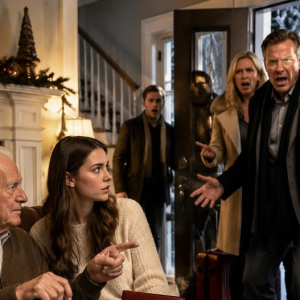
“This is a misunderstanding,” she kept saying.
“A terrible misunderstanding.”
Grandpa watched her from his rocking chair.
“You said the same thing when eighty thousand dollars disappeared from my investment account,” he replied.
Mom’s tears stopped for half a second.
That was all Detective Collins needed to notice.
Dad refused to answer questions without an attorney.
Mom tried to explain everything at once.
She claimed Grandpa had gifted them money, forgotten about it, changed his mind, become confused, and fallen under my influence.
Her version changed four times in ten minutes.
Mine did not.
Neither did Grandpa’s.
When the officers finally left, they took copies of the medical forms, financial statements, forged checks, and recordings from Grandpa’s meetings with his attorney.
They warned my parents not to remove documents, contact certain bank employees, or attempt to pressure Grandpa.
The front door closed.
For the first time since they had returned, the five of us were alone.
Dad turned toward me slowly.
“You have no idea what you’ve done.”
“I know exactly what she’s done,” Grandpa said.
“She believed me.”
Dad ignored him.
He crossed the room until he stood a few feet from me.
His expensive coat was still dusted with snow, but sweat had appeared near his temples.
“My company employs sixty-three people.
If this investigation becomes public, innocent families could lose their income.”
“You should have considered them before depositing forged checks through the company,” I said.
His expression hardened.
“You’ve always wanted to punish us.”
The accusation struck deeper than I expected.
Not because it was true.
Because some part of me had spent years wondering whether it was.
I had moved to Boston after college, built a quiet career in compliance analysis, and learned to keep my distance from the family arguments that somehow always became my fault.
Whenever I questioned Dad’s business practices, I was jealous.
Whenever I confronted Mom about lying, I was dramatic.
Whenever Caleb made a mistake, I was cruel for wanting him held accountable.
They had turned my ability to recognize wrongdoing into a character defect.
Grandpa’s voice broke through the old spell.
“No, Grant.
You wanted her to doubt herself because she was the only person in this family who could see you clearly.”
Dad looked at his father with naked hatred.
“You think she loves you? She barely visited.”
The words found their mark.
I had called Grandpa on birthdays and holidays.
I had sent books and sweaters.
But I had visited only twice in the past three years.
Each time, Mom had told me he tired easily.
Dad had said he barely recognized people.
Caleb had joked that Grandpa spent most days asleep.
I had believed enough of it to stay away.
Grandpa saw the guilt on my face.
“They made sure you stayed away,” he said.
“You were the one person they couldn’t control if we compared stories.”
Mom stood abruptly.
“This family has problems, but we are still a family.
We can fix this privately.”
“You mean bury it privately,” I said.
She grabbed my wrist.
Her fingers tightened exactly as they had when I was sixteen and refused to lie to a teacher about Caleb stealing exam answers.
“You will call the police,” she whispered.
“You will tell them your grandfather misunderstood.
You will say you pressured him because you were angry about the trip.”
I looked down at her hand.
Then back at her face.
“Let go of me.”
“Avery, listen—”
“Let her go.”
Grandpa had risen from his chair.
He stood without the cane, his back straighter than I had seen it all week.
Mom released me.
For one suspended moment, no one spoke.
Then Caleb kicked one of the fallen ornaments across the floor.
“So what happens to us?” he demanded.
“Our cards don’t work.
Dad’s accounts are frozen.
The hotel in New York declined my reservation.
Are we supposed to live like poor people because Grandpa suddenly got paranoid?”
Grandpa studied him with a sorrow that looked heavier than anger.
“You went to Europe while your sister spent Christmas here caring for the man you called a burden.”
“I didn’t plan the trip.”
“You accepted the ticket.”
Caleb rolled his eyes.
Grandpa reached into the side table and removed a white envelope.
“Your tuition, apartment, car, and monthly allowance have been paid from a family education trust I created when you were born.
Effective yesterday, those payments ended.”
Caleb’s face emptied.
“You can’t do that.”
“I created it.
I can dissolve it.”
“I have one semester left.”
“Then work.”
Caleb laughed because he thought Grandpa was joking.
No one joined him.
“You’re choosing her over me?”
“No,” Grandpa said.
“I’m choosing the truth over all of you.”
Dad moved toward the stairs.
“I’m getting the files from my office.”
“You were ordered not to remove anything,” I reminded him.
“They are my files in my house.”
Grandpa’s answer came calmly.
“This is not your house.”
Dad stopped.
Mom slowly turned toward Grandpa.
He reached into his cardigan and placed another document on the coffee table.
“The house belonged to your mother and me.
After she died, Grant convinced me to add his name to the deed.
He used a refinancing agreement disguised as estate planning.
Attorney Morris found evidence that the signature page had been replaced.”
Dad stared at the paper.
“The original deed and handwriting analysis have already been submitted,” Grandpa continued.
“The property is now under an emergency protective order until the court reviews the fraud claim.”
Mom’s voice dropped to a whisper.
“Where are we supposed to go?”
Grandpa looked toward the suitcases blocking the entryway.
“You appeared to enjoy Europe.”
Dad’s fist struck the wall.
A framed photograph fell and shattered.
It was our last family portrait with Grandma.
Everyone looked perfect in that photograph.
Dad’s hand rested on Mom’s shoulder.
Caleb smiled in his expensive school blazer.
I stood slightly apart, trying not to look uncomfortable.
Grandpa and Grandma sat in front of us.
Grandma had died six months later.
Grandpa stared at the broken glass surrounding her face.
Something inside him changed.
“Get out,” he said.
Dad did not move.
Grandpa pointed toward the door.
“You will not spend another night beneath the roof you tried to steal.”
Mom appealed to me with wide, wounded eyes.
“Avery, it’s freezing outside.”
“You still have your suitcases,” I said.
“And according to your social media, you have many close friends.”
Her expression turned vicious.
“This is what you wanted, isn’t it? To finally have the house, the money, and Grandpa all to yourself?”
“I don’t want your money.”
“You expect us to believe that?”
Grandpa walked to the fireplace and lifted a small black recording device from the mantel.
“I hope the court believes it,” he said.
Mom went pale.
Every word since their arrival had been recorded.
They left twenty minutes later.
Dad called an attorney from the car.
Mom called three friends, none of whom answered.
Caleb stood in the driveway shouting that he would never forgive us until Dad forced him into the rental vehicle.
As their taillights disappeared through the snow, silence settled over the house.
I expected triumph.
Instead, I felt hollow.
Grandpa sat heavily in the rocking chair.
For the first time, he looked eighty-two.
“Did we do the right thing?” I asked.
He stared at Grandma’s broken photograph.
“The right thing rarely feels clean while you’re doing it.”
I knelt and began gathering the glass.
Under the broken frame, I noticed something taped to the back of the photograph.
A small brass key.
Grandpa’s face changed when he saw it.
He closed his eyes.
“I wondered where she put that.”
“Grandma?”
He nodded.
The key opened a cedar chest in the attic.
We carried it downstairs together, though Grandpa refused to let me lift it alone.
Inside were old tax records, family photographs, letters tied with faded blue ribbon, and a sealed envelope with my name written across the front.
I recognized Grandma’s handwriting immediately.
My hands began to shake.
The letter had been written eleven days before she died.
My dearest Avery,
If you are reading this, then Theodore has finally decided that protecting people from the consequences of their actions is not the same as protecting a family.
Your father has been taking money from us.
At first, he called them loans.
Then he began moving funds without permission.
Your mother knows.
She believes everything will be repaired when his business succeeds.
I fear it will never be enough.
You have always seen more than people wanted you to see.
This has made your family treat you as difficult.
Please do not let them convince you that truthfulness is cruelty.
There is another matter you must know.
The Whitaker house was purchased with money inherited through my family.
I have instructed Theodore that if Grant continues abusing our trust, the house should eventually pass to you—not as a reward, but because you are the only one who ever loved this family without demanding payment for it.
Do not allow anger to make you resemble the people who hurt you.
Make this house a place where no one must earn the right to belong.
With all my love,
Grandma
 Woman Refuses To Leave Her Dream Concert After Her Friend Has A Panic Attack, Now Everyone’s Calling Her Selfish
I read the letter twice before the words blurred.
Grandpa sat beside me.
“She knew?” I whispered.
“She knew enough.”
“Why didn’t she stop him?”
“She was dying.
Your father promised to repay everything.
I wanted to believe my son.”
“And after she died?”
“I was ashamed.”
He looked toward the dark window.
“I built businesses.
Negotiated contracTS. Raised a family.
Yet I could not admit that my own son had learned to treat love like an account he could empty.”
I folded the letter carefully.
“Why didn’t you call me?”
“Because they told me you were busy.
Then they told me you believed I was confused.”
My throat tightened.
“They told me the same thing about you.”
“That is how dishonest people survive,” he said.
“They keep everyone separated long enough to become the only source of truth.”
The investigation lasted four monThS.
Dad’s company did not collapse, though he lost control of it.
The board placed him on leave after auditors discovered that he had mixed personal funds, family money, and company accounts for years.
Three executives testified that Dad had ordered them to disguise transfers as consulting fees.
Mom claimed she had signed medical forms without reading them.
Then Detective Collins produced emails showing that Mom had asked a doctor how quickly Grandpa could be declared incapable of managing his own asseTS.
Caleb avoided charges, but losing the trust fund transformed him faster than any lecture could have.
He moved into a small apartment with two roommates and took a job at a hardware store.
For the first month, he sent me furious messages.
Then the messages stopped.
One rainy afternoon in May, he arrived at Grandpa’s house wearing a store uniform and carrying Grandma’s repaired photograph.
“I had the frame replaced,” he said.
Grandpa did not invite him inside immediately.
Caleb looked thinner.
Tired.
Older than twenty-one.
“I didn’t know what they were doing,” he said.
“You did not ask,” Grandpa replied.
Caleb lowered his eyes.
“No.”
It was the first honest answer I had ever heard him give when dishonesty would have been easier.
Grandpa opened the door.
Forgiveness did not happen that day.
But something began.
Dad accepted a plea agreement involving restitution, probation, and a permanent ban from controlling certain financial accounTS. The prosecutor said his age, lack of prior convictions, and cooperation prevented prison time.
He called Grandpa once after sentencing.
I was in the kitchen but could hear both sides.
“I lost everything,” Dad said.
Grandpa looked around the house.
“No.
You lost access to things that were never yours.”
“You destroyed my reputation.”
“You spent years building a reputation on stolen foundations.”
Dad was silent.
Then he asked the question that revealed he still did not understand.
“Are you leaving the money to Avery?”
Grandpa’s face filled with disappointment.
“Goodbye, Grant.”
He ended the call.
Mom filed for divorce six weeks later.
She sent me a four-page letter explaining that she had been manipulated by Dad, trapped by marriage, frightened of financial insecurity, and desperate to preserve the family.
She apologized eleven times without identifying a single decision she regretted making.
I did not answer.
Not every apology requires immediate acceptance.
Some are simply requests to escape discomfort.
Grandpa’s health improved once he no longer had to pretend to be weaker than he was.
He attended physical therapy, joined a local chess club, and began cooking Sunday breakfast badly but enthusiastically.
In October, he had a mild stroke.
I found him in the garden, sitting beside the last surviving tomato plant, his speech slightly blurred.
At the hospital, he squeezed my hand.
“Don’t look so frightened,” he whispered.
“You’re not allowed to leave yet.”
“I’m eighty-three.
I am allowed almost anything.”
He recovered, but the stroke changed our understanding of time.
We began discussing what would happen to the house after he died.
“I don’t want it,” I told him.
“That is precisely why your grandmother chose you.”
“It should not become another thing that divides us.”
“Then don’t let it.”
Together, we created the Evelyn Whitaker Foundation for Elder Advocacy.
The house would remain in trust.
After Grandpa’s death, it would become a temporary residence for older adults escaping financial exploitation by relatives or caregivers.
The first floor would contain legal offices.
The second would have private rooms.
The garden would remain untouched.
Grandpa signed the documents beneath Grandma’s repaired photograph.
“This is better than leaving you a mansion,” he said.
“Much better.”
The following Christmas, snow covered Connecticut again.
But the house was not dark.
Volunteers filled the kitchen.
A retired teacher named Mrs. Alvarez decorated cookies at the dining table.
A former mechanic named Henry argued with Grandpa about the correct way to hang lighTS. Detective Collins arrived carrying two pies and refused to admit she had baked them herself.
Caleb came early.
He wore an inexpensive green sweater and brought a wooden chessboard he had made in a workshop behind the hardware store.
He handed it to Grandpa without a speech.
Grandpa ran his fingers over the carved pieces.
“You made this?”
Caleb nodded.
“It isn’t perfect.”
“Neither are most valuable things.”
They played beside the fireplace for almost an hour.
Near sunset, a car stopped outside.
Mom stood at the gate.
She held no luggage, wore no cashmere, and looked smaller than I remembered.
I went outside alone.
“I heard about the foundation,” she said.
News of it had appeared in the Hartford paper that morning.
“You did something good with the house.”
“Grandpa did.”
“You helped.”
Snow gathered on her hair.
For once, she did not cry.
“I have been seeing a counselor,” she said.
“I know that doesn’t repair anything.”
“No.”
“I keep remembering the note I left you.”
So did I.
Don’t be dramatic.
Stay and care for Grandpa.
We’ll be back after New Year’s.
She had expected me to accept neglect as duty and call it love.
“I left my daughter alone at Christmas,” she continued.
“I abandoned my father because caring for him was inconvenient.
Then I blamed both of you when you discovered what I had done.”
It was not a perfect apology.
But it was the first one that contained the truth.
“I don’t know what happens now,” I said.
“Neither do I.”
Behind me, the front door opened.
Grandpa stood there with his cane.
He looked at Mom for a long time.
Then he stepped aside.
“You may come in for dinner,” he said.
“Nothing more is promised.”
Mom covered her mouth.
Grandpa raised one eyebrow.
“If you start screaming, you can eat outside.”
She laughed once through her tears.
This time, the tears did not feel like a weapon.
She entered slowly.
No one embraced her.
No one pretended the past had vanished.
Caleb moved his chair slightly to create space at the table.
Mrs. Alvarez placed an extra plate beside mine.
That was all.
It was enough for one night.
Later, while everyone gathered around the fireplace, Grandpa handed me a small red folder.
I smiled.
“Should I be worried?”
“Open it.”
Inside was a copy of Grandma’s letter, the foundation charter, and a photograph taken that evening.
In it, the house was crowded, imperfect, and alive.
On the back, Grandpa had written one sentence:
A family is not the group that shares your name.
It is the group that makes room for your truth.
I looked across the room.
At Caleb listening instead of demanding.
At Mom sitting quietly beside a woman whose savings had been stolen by her own son.
At Grandpa watching the home he had nearly lost become a refuge for strangers who needed it.
A year earlier, my family had abandoned me in that house because they thought care was a punishment.
They believed Grandpa was weak.
They believed I was useful only when I obeyed.
They returned screaming because they had lost their money, their control, and the story they had told about us.
But revenge was not the reason we won.
We won because Grandpa had finally spoken.
Because I had finally trusted what I saw.
And because the house they tried to steal became a place where silence could no longer protect the guilty.
Grandpa leaned toward me.
“Shall we begin?” he asked, repeating the words that had changed everything.
I looked around the crowded room, at the broken family trying to become something more honest, and at the strangers who no longer had to face their battles alone.
Then I nodded.
This time, it was not the beginning of their downfall.
It was the beginning of our home.