Some irrational part of me still expected my father to walk through the door and explain everything away.
He would smile in that calm, reassuring way he always had whenever I panicked.
He would tell the investigators they had made a terrible mistake.
He would put one hand on my shoulder and say, “Claire, look at me.
You know who I am.”
But the door remained closed.
And for the first time in my life, I understood that the safest voice I had ever known belonged to a man who had built my childhood on a crime.
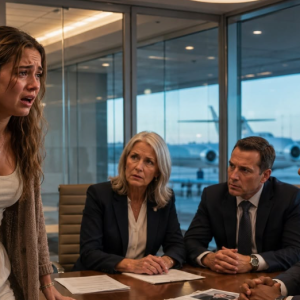
Margaret Shaw reached across the table, but stopped before touching my hand.
“There is more,” she said.
I laughed again, a broken sound that barely escaped my throat.
“How can there possibly be more?”
Investigator Ortega opened the folder and removed a photograph of an elderly woman with silver hair, thin shoulders, and bright blue eyes.
She was sitting in a wheelchair beneath a flowering cherry tree.
Something about her face pulled at me.
Not recognition exactly.
Something deeper.
Something my body understood before my mind did.
“Her name was Evelyn Pierce,” Ortega said.
“Your biological grandmother.”
Was.
The word landed first.
I stared at the photograph.
“When did she die?”
“This morning,” Margaret answered.
My breath stopped.
“She had been in hospice care for several weeks.
Her funeral is tomorrow.”
I looked from one face to another.
“Aunt Rebecca sent me home because of a funeral?”
Margaret’s eyes softened.
“She sent you because Evelyn left explicit instructions that you were to be told the truth immediately after her death.”
I pushed the photograph away.
“That doesn’t make sense.
How did she know I was alive?”
The room went silent again.
Then Daniel removed a stack of letters tied with a faded blue ribbon.
“Because your aunt told her.”
I stared at the letters.
The handwriting on the envelopes was shaky and uneven.
Each one carried a date.
The oldest was from eighteen years ago.
“She knew?” I whispered.
“Aunt Rebecca knew?”
“Not everything,” Margaret said.
“Not at first.”
Daniel leaned forward.
“Rebecca was sixteen when Martin brought you home.
He told the family that Elaine had secretly given birth after hiding the pregnancy because of her previous miscarriages.
Rebecca believed him for several years.”
He paused.
“When she was twenty-one, she found a box in the attic.”
“What was inside?”
“Your bloodstained baby blanket.
A hospital identification band belonging to Natalie Pierce.
The original accident report.
And a newspaper article about the missing infant.”
My stomach twisted.
“She confronted him?”
“Yes.”
“And then?”
“He threatened her.”
Daniel’s voice hardened.
“Martin told Rebecca that if she spoke, Elaine would go to prison as an accomplice.
He also claimed you would be placed into foster care, separated from everyone you knew, and psychologically destroyed.”
I shook my head.
“So she stayed silent.”
“She was terrified,” Margaret said.
“But she did not do nothing.”
Margaret untied the ribbon and opened the first letter.
“She secretly contacted Evelyn Pierce.”
My fingers curled against the edge of the table.
“My grandmother knew where I was for eighteen years?”
“She knew you were alive,” Margaret said.
“She knew the name Claire Ellison.
She knew Martin had taken you.
But she did not know where you lived.”
I looked at her sharply.
“My aunt could have told her.”
“Rebecca tried.”
Daniel pushed another document toward me.
It was a restraining order.
“Martin discovered their correspondence.
He convinced your mother that Rebecca was unstable and obsessed with taking you away.
He forced Rebecca out of the family and obtained a protective order based on fabricated claims.”
Memories returned in fragmenTS.
Aunt Rebecca missing from birthdays.
My mother refusing to discuss her.
My father changing the subject whenever I asked why we rarely saw her.
“She’s troubled,” he used to say.
“She makes things up.”
“She wants to hurt this family.”
My hands began to tremble again.
“He made me believe she was dangerous.”
“Yes,” Margaret said.
I looked at the letters.
“Why didn’t my grandmother go to the police?”
“She did.”
Ortega placed a second folder on the table.
“Four times.”
I stared at him.
“What happened?”
“Martin had been promoted by then.
He had friends in the department.
The evidence was dismissed as grief-driven accusations from an elderly woman who had never recovered from losing her son, daughter-in-law, and granddaughter.”
Daniel’s jaw tightened.
“Her complaints were buried.”
The phrase lodged inside me like glass.
Buried.
Just like my real name.
Just like my real parenTS.
Just like the truth.
I picked up the photograph of Evelyn.
“She spent all those years knowing I was somewhere.”
Margaret nodded.
“She hired private investigators whenever she could afford them.
She sold her house.
She sold your grandfather’s workshop.
She spent nearly everything searching for you.”
My eyes filled with tears.
“Did she ever see me?”
No one answered immediately.
That silence was answer enough.
Margaret opened another envelope and removed a photograph.
It showed me at seventeen, standing outside my high school in a graduation gown.
My father was beside me.
My mother was fixing my cap.
Across the street, barely visible behind the windshield of a parked car, sat Evelyn Pierce.
“She saw you from a distance,” Margaret said.
“Several times.”
I pressed my hand over my mouth.
“She never approached you because Martin had threatened to disappear with you if Evelyn came near.”
A sob escaped me.
“She was there?”
“At your high school graduation,” Margaret said.
“At one of your soccer games.
Outside the church on your eighteenth birthday.”
She handed me another photograph.
Evelyn stood across the street while I laughed with my cousins on the church steps.
She was holding a small wrapped box.
“She brought you a necklace that belonged to your biological mother,” Margaret said.
“She never got to give it to you.”
For the first time since entering the room, I broke completely.
I bent forward, pressing my forehead against the table while grief tore through me.
Not the clean grief of losing someone you had known.
This was grief for a woman who had loved me for twenty-three years from across streets, through photographs, behind legal barriers, and from the shadows of a life she was never allowed to enter.
A grandmother who had died the same morning I discovered she existed.
“I could have known her,” I cried.
Margaret’s voice trembled.
“Yes.”
“I could have called her.”
“Yes.”
“I could have told her I was alive.”
“She knew you were alive,” Margaret said gently.
“And according to her letters, that was the one thing that kept her going.”
I lifted my head.
“Can I read them?”
“They belong to you.”
I pulled the top letter from the stack.
My dear Natalie,
Today you turned five.
I do not know what name they have given you, what cake you ate, or whether you still laugh the way your mother did when she was little.
I bought you a red coat because Laura always said red would suit you.
I have nowhere to send it, so I placed it in the cedar chest with the other things waiting for you.
I hope the people raising you are kind.
I hate them for taking you, but I pray they are kind.
I had to stop reading.
The letters blurred beneath my tears.
I turned to Margaret.
“What happens now?”
“That depends partly on you,” she said.
“Martin is in custody.
Elaine has not been charged yet, but investigators are questioning her.”
My heart clenched.
“My mother.”
Nobody corrected me.
That somehow hurt more.
“Did she know?” I asked.
Daniel looked uncomfortable.
“We are still determining when she learned the truth.”
“When?”
“We believe Martin initially told her you had been legally surrendered by a young mother.
But there is evidence Elaine discovered the truth several years later.”
My stomach dropped.
“How much later?”
Ortega opened a transcript.
“When you were eight.”
A memory slammed into me.
I was eight years old, sitting on the kitchen floor while my parents argued behind a closed bedroom door.
My mother had been crying.
“You told me she needed us,” she shouted.
My father had answered too quietly for me to understand.
Then she screamed, “She belonged to someone!”
The next morning, they told me they had argued about money.
“She knew,” I whispered.
“From the evidence we have, yes,” Daniel said.
“She knew for at least fifteen years.”
I stood so quickly that the chair struck the wall.
“I need air.”
Margaret followed me into the hallway.
The airport moved around us with cruel normalcy.
People hugged beside baggage claim.
Children dragged stuffed animals across the floor.
A family laughed while waiting for a suitcase.
I watched a little girl run into her father’s arms.
For twenty-three years, I had believed I was that girl.
Loved.
Protected.
Chosen.
Now every memory felt like evidence.
“Rebecca is waiting outside,” Margaret said.
I turned.
“She came?”
“She has been here since before your flight landed.”
“Why didn’t she come into the room?”
“She thought you might hate her.”
“I do hate her.”
The words came out sharper than I expected.
Then I closed my eyes.
“No.
I don’t know.
I don’t know what I feel.”
“You do not have to decide today.”
But I needed to see her.
Rebecca stood near the terminal exit wearing jeans, a gray sweater, and the terrified expression of someone awaiting a verdict.
She looked older than I remembered.
Smaller.
When our eyes met, she began crying.
“Claire.”
I flinched.
Her face crumpled.
“Natalie,” she corrected.
That name felt foreign coming from her.
I walked toward her slowly.
“Why didn’t you tell me?”
“I tried.”
“When?”
“Hundreds of times.”
“You had my number.”
“Your father monitored your phone records.
Your email.
Your social media.
Every time I contacted you, he convinced you I was unstable.”
“That was when I was a child.
I’ve been an adult for five years.”
Rebecca wiped her face.
“I was afraid.”
“So was my grandmother.”
“I know.”
“She died without ever speaking to me.”
“I know.”
Her voice broke.
“And I will hate myself for that every day for the rest of my life.”
I wanted to scream at her.
Instead, I asked the one question that had been clawing at me since the conference room.
“Why today?”
Rebecca looked toward Margaret.
Then she reached into her bag and removed a small digital recorder.
“Because Evelyn recorded a final statement three weeks ago.
She named Martin, the officers who protected him, and the county clerk who forged your records.”
She held the recorder tightly.
“Yesterday, someone broke into the hospice facility and searched her room.”
My skin went cold.
 Friend Keeps “Joking” About Woman\'s Husband Having A Side Chick — So She Paid And Walked Out
“Martin?”
“We think he discovered she was dying and feared she had preserved evidence.”
“So you sent me away?”
Rebecca nodded.
“Your Florida trip wasn’t a coincidence.
I paid your cousin to invite you.
I needed you out of the house before the arrest.”
My breath caught.
“You planned this?”
“We were afraid Martin might run.
Or take you with him.”
I stared at her.
“He would never hurt me.”
Rebecca’s expression changed.
Not disbelief.
Pity.
“He already did.”
The truth of that sentence hollowed me out.
That evening, Margaret drove me to a hotel under another name.
I spent the night reading Evelyn’s letters.
One for every birthday.
One for every Christmas.
One for every milestone she imagined but never witnessed.
At eleven, she wondered whether I loved books.
At thirteen, she warned me that heartbreak would feel permanent but would not be.
At sixteen, she told me about my mother Laura learning to drive and nearly destroying a row of mailboxes.
At eighteen, she wrote:
You are an adult today.
I have spent years asking the law to return you to me, but perhaps the law has waited too long.
If you ever discover the truth, I do not want revenge to consume you.
Your life is not only the crime committed against you.
It is also every kind choice you made without knowing where you came from.
They may have stolen your name, but they did not create your heart.
I read that paragraph until dawn.
At eight in the morning, Margaret knocked on my door.
“The funeral begins at ten.”
I looked at the black dress she had brought me.
“Does anyone there know who I am?”
“Several people know.
Most do not.”
“Will Martin’s family be there?”
“No.”
“Will the press?”
“We have kept the location private.”
I dressed slowly.
Before leaving, I opened the cedar box Rebecca had delivered from Evelyn’s home.
Inside were twenty-three wrapped gifTS.
A red child’s coat.
A wooden music box.
Books.
Birthday cards.
A small silver necklace with a teardrop-shaped blue stone.
Taped beneath it was a note.
This belonged to your mother.
She wore it the night she met your father.
I fastened it around my neck.
The funeral was held in a small white church near the water.
Only thirty people attended.
Old neighbors.
Former coworkers.
A hospice nurse.
A retired detective who had once tried to reopen the case and lost his position for doing so.
At the front stood Evelyn’s closed casket beneath a spray of white roses.
My legs nearly gave out when I saw the framed photograph beside it.
The same bright blue eyes.
The same smile I saw in my own mirror.
Rebecca took my hand.
This time, I let her.
We sat in the front row.
The minister began speaking about persistence, love, and a woman who refused to stop believing that someone she loved would one day come home.
Halfway through the service, the church doors opened.
My mother entered.
Elaine.
She wore a dark coat and no makeup.
Two investigators followed several steps behind her.
A murmur spread through the pews.
I stood.
Rebecca gripped my arm.
Elaine looked at me as though she had crossed a desert to reach that doorway.
“Claire.”
My entire body tightened.
She took one step forward.
“Please.”
“You knew.”
Her face collapsed.
“I didn’t know at first.”
“But you knew when I was eight.”
She began sobbing.
“Yes.”
The sound echoed through the church.
“You knew my grandmother was alive.”
“Yes.”
“You knew she was looking for me.”
“Yes.”
Each answer struck like a hammer.
“And you still let me call you Mom.”
Elaine pressed both hands to her mouth.
“I loved you.”
A cold anger rose through my grief.
“You loved being my mother.”
She shook her head desperately.
“No.
I loved you.”
“Then why didn’t you return me?”
“Because I was afraid.”
“Everyone keeps saying that.”
“I thought they would take you away.
I thought you would hate me.
I thought I would lose the only child I had.”
“You were supposed to lose me.”
The words silenced the room.
I pointed toward Evelyn’s casket.
“She lost her son.
She lost her daughter-in-law.
Then you helped steal the only family she had left.”
Elaine looked at the floor.
“Martin said Evelyn was unstable.”
“And you believed him?”
“At first.”
“And later?”
She could not answer.
That was the moment I understood.
My father had committed the first crime.
My mother had committed the second.
His crime was taking me.
Hers was choosing, every day for fifteen years, not to give me back.
Elaine reached into her coat.
The investigators moved immediately.
But she only removed an envelope.
“I wrote this years ago,” she said.
“I never had the courage to give it to you.”
She placed it on a pew.
“I will cooperate.
I will tell them everything.
I know that does not repair what I did.”
“No,” I said.
“It doesn’t.”
She nodded.
Then she looked at the casket.
“May I stay?”
I wanted to tell her no.
I wanted to make her feel one fraction of what Evelyn had endured.
But my grandmother’s letter returned to me.
I do not want revenge to consume you.
I sat down.
“You may stand in the back.”
Elaine closed her eyes.
“Thank you.”
It was not forgiveness.
It was simply the first decision I made that belonged entirely to me.
After the service, Margaret read Evelyn’s will.
She had left me the cedar box, her remaining savings, and a small house overlooking Puget Sound.
But the final request mattered most.
She asked that I establish a foundation in Laura and David Pierce’s names to help families of missing children navigate corrupt or neglected investigations.
“I left you very little money,” Evelyn had written, “but I leave you a purpose, should you choose to accept it.”
I did.
Over the next year, the Ellison case became national news.
Martin pleaded not guilty until DNA evidence, recorded statements, falsified records, and testimony from Elaine and Rebecca destroyed his defense.
The retired county clerk confessed.
Two former officers admitted they had suppressed Evelyn’s complainTS.
Martin was convicted of kidnapping, evidence tampering, fraud, obstruction, and conspiracy.
At sentencing, he asked to speak.
I almost refused to attend.
Then I realized I wanted to see him without the uniform, without the family photographs behind him, without the authority he had carried through my childhood.
He stood in an orange jail uniform and looked smaller than the man in my memories.
“Natalie,” he said.
I hated hearing him use my real name.
“I know you believe everything was a lie.
But I loved you from the moment I found you.”
I stared at him through the courtroom silence.
“You did not find me.”
His lips parted.
“You stole me.”
“I gave you a good life.”
“You stole every life I might have had.”
His face trembled.
“I was your father.”
“No,” I said.
“You were the man who made sure I never met him.”
He lowered his head.
The judge sentenced him to thirty-two years.
Elaine accepted a plea agreement and served eighteen months for obstruction and fraud, followed by probation.
I visited her once.
Not because I had forgiven her.
Because I needed answers that no court could provide.
She gave me photographs, school projects, and boxes from my childhood.
Then she asked, “Was any of it real?”
I looked at the woman who had braided my hair, cared for me when I was sick, and also allowed another woman to die without knowing me.
“My love was real,” I said.
“That is what makes what you did so cruel.”
She cried.
I left without embracing her.
Perhaps one day that would change.
Perhaps it would not.
Two years after the airport meeting, I stood outside Evelyn’s house beside Rebecca.
A brass plaque had been installed near the entrance.
THE PIERCE FAMILY CENTER FOR MISSING CHILDREN.
Inside, investigators, attorneys, counselors, and volunteers worked with families who had been ignored, dismissed, or told to stop hoping.
On opening day, I placed Evelyn’s letters in a glass display case, along with the blue ribbon and a copy of the newspaper article that had once called me missing.
I kept the original article folded in my desk.
Not as proof of what had been stolen.
As proof that I had been searched for.
A little girl visiting the center with her mother looked at the display and then at me.
“Are you the missing baby?” she asked.
Her mother looked embarrassed.
But I smiled.
“I was.”
The girl frowned.
“You’re not missing now.”
My throat tightened.
“No,” I said.
I looked through the window at Rebecca planting white roses near the walkway.
At families walking through the doors carrying photographs and hope.
At the silver necklace resting against my chest.
“No,” I repeated softly.
“I’m finally home.”
For most of my life, I believed home was a house built by the people who raised me.
Then I discovered that a house could be filled with birthdays, laughter, and love, yet still rest on a stolen foundation.
I lost my parents twice.
First in a crash I could not remember.
Then in an airport room where I learned that the people I trusted most had taken their place.
But I also found a grandmother inside twenty-three years of letters.
I found an aunt who had failed me, fought for me, and finally risked everything to bring me the truth.
And I found the person I had been before anyone changed my name.
Claire Ellison was not entirely a lie.
She was the girl who survived.
Natalie Pierce was not merely a ghost.
She was the woman who chose what happened next.
The man who stole me believed that controlling my past would give him ownership of my future.
He was wrong.
My name is Natalie Claire Pierce.
I was taken from a wrecked car, hidden behind a forged certificate, and raised inside a secret powerful men thought they had buried forever.
But buried truth does not disappear.
Sometimes it grows rooTS.
Sometimes it breaks through concrete.
And sometimes, after twenty-three years in darkness, it finally finds its way home.