Calvin Rhodes did not ask me to explain.
He did not offer comfort.
He simply said, “Put me on speaker.”
I tapped the screen and held the phone between Derek and me.
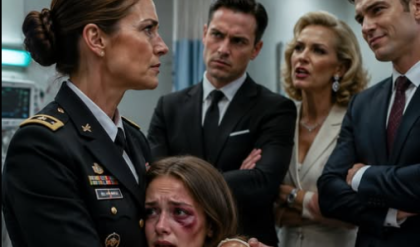
The hospital room seemed to shrink around his voice.
“Derek,” Calvin said.
My husband’s expression changed.
Only slightly.
But I saw it.
The smirk disappeared first.
Then his shoulders stiffened beneath his expensive charcoal jacket.
“Calvin,” he answered.
“This is a family matter.”
“No,” Calvin said.
“It became a fiduciary matter the moment you attempted to redirect money belonging to Holly.”
Vanessa glanced at Derek.
For the first time since I had discovered their affair, my sister looked uncertain.
Derek recovered quickly.
He always did.
He lowered his hand from his reddened cheek and smiled as though Calvin had misunderstood a harmless conversation.
“Nobody attempted to redirect anything.
Marissa is exhausted.
She’s emotional.”
I stared at him.
Our daughter was dying three feet away, and he was still performing.
Calvin’s voice remained calm.
“I have already received copies of the attempted transfers.”
The color drained from Derek’s face.
Vanessa’s hand slipped away from her stomach.
I felt the floor tilt beneath me.
“What attempted transfers?” I asked.
Calvin was silent for half a second.
That half second told me more than any answer could.
“Marissa,” he said carefully, “Derek submitted three requests over the past six weeks to release funds from Holly’s medical trust.”
My fingers tightened around the phone.
“I never authorized that.”
“I know.”
Derek stepped forward.
“This is absurd.”
Calvin continued as if Derek had not spoken.
“The requests included an electronic signature resembling yours, a physician authorization letter, and documentation claiming Holly’s treatment had been discontinued.”
The monitor beside Holly’s bed continued its slow rhythm.
Beep.
Beep.
Beep.
Each sound seemed to strike the center of my chest.
I looked at Derek.
“You told them her treatment had been discontinued?”
He lifted both hands.
“Marissa, listen to me.”
“You told the trust administrator my daughter was no longer receiving treatment?”
“Our daughter,” he corrected automatically.
The cruelty of that correction nearly made me laugh.
Vanessa moved toward the door.
Calvin’s voice cut through the room.
“Vanessa, I suggest you remain where you are.”
She froze.
“How do you know I’m here?”
“Because Derek’s third request identified an account jointly controlled by both of you.”
Derek lunged for my phone.
I stepped back.
A nurse appeared in the doorway almost immediately.
She had probably heard my slap, Derek’s raised voice, or both.
“Is everything all right?”
“No,” I said.
Derek forced a smile.
“My wife is having a difficult moment.”
The nurse looked at Holly, then at the five-fingered mark forming across Derek’s face.
Her gaze returned to me.
“Would you like security?”
“Yes.”
Derek’s smile vanished.
“Marissa.”
“Yes,” I repeated.
“I would like security.”
Vanessa started crying.
Not loudly.
Not sincerely.
She pressed one hand over her mouth and whispered, “I can’t handle this stress.
It’s bad for the baby.”
I looked at her swollen stomach.
For months, that stomach had been used as a shield.
Whenever I demanded answers, Vanessa clutched it.
Whenever Derek disappeared for hours, she claimed she needed help.
Whenever I reminded either of them that Holly was ill, they accused me of resenting an unborn child.
I did not resent the baby.
The baby was innocent.
But innocence did not spread backward into the people who created him.
“Calvin,” I said, “what happens now?”
“We begin the emergency protection protocol your mother established.”
Derek laughed again, but there was no confidence left in it.
“Her mother has been dead for ten years.”
“And she still planned further ahead than you ever did,” Calvin replied.
Two hospital security officers arrived.
The nurse stepped inside and quietly closed the door behind them, blocking Derek and Vanessa from Holly’s view.
One officer asked, “Ma’am, who needs to leave?”
“My husband and my sister.”
Derek pointed at Holly.
“That is my child.”
I looked at him across the bed.
“No.
She was your child when she needed someone to sit with her during chemotherapy.
She was your child when she was vomiting into a plastic basin at three in the morning.
She was your child when she asked why her father never came to the hospital anymore.”
His jaw tightened.
“You don’t get to keep me from her.”
“You kept yourself from her.”
He stepped toward me.
The officers moved between us.
Vanessa grabbed his sleeve.
“Derek, let’s just go.”
He shook her off.
His eyes remained fixed on me.
“You have no idea what you’re doing.”
For years, that sentence had worked.
When I questioned household expenses, I had no idea how investments worked.
When I confronted him about late nights, I had no idea how much pressure he was under.
When I noticed messages from Vanessa disappearing from his phone, I had no idea how paranoid illness had made me.
But now I understood something.
Derek had never needed me to be stupid.
He only needed me to doubt myself.
“I know exactly what I’m doing,” I said.
“I’m choosing Holly.”
The officers escorted them into the hallway.
Derek twisted around before the door closed.
“You’ll regret humiliating me.”
I looked at our daughter’s pale face.
“No,” I said.
“I’ll regret that I trusted you for this long.”
The door shut.
For several seconds, I could hear Derek arguing outside.
Then the voices faded.
The room became quiet again.
I walked to Holly’s bedside and sat down.
Her eyelashes fluttered, but she did not wake.
I placed the phone beside my ear.
“Calvin, tell me everything.”
He exhaled slowly.
“Not in front of Holly.”
“I’m not leaving her.”
“Then put in your earbuds.”
I did.
Calvin waited until I confirmed that the line was private.
Then he told me the truth.
My mother, Evelyn, had known Derek was dangerous long before I did.
Not physically dangerous.
Not at first.
He was charming, ambitious, attentive, and very interested in the successful medical supply company my mother had built with Calvin.
When Derek and I got engaged, Mom welcomed him.
But she never completely trusted the speed with which he became curious about family asseTS.
He asked about ownership percentages.
He asked whether I would inherit shares.
He asked whether Holly, who was two at the time, had a college account.
He always framed the questions as concern for our future.
My mother heard something else.
Before she died, she transferred most of what she intended for me into a protected trust.
A portion was for my personal security.
Another portion belonged solely to Holly.
Neither fund could legally become marital property.
The trust documents included a protection clause.
If any spouse, guardian, financial adviser, or relative attempted to gain unauthorized access, all discretionary authority would immediately transfer to Calvin and an independent trust company.
The suspected person would also lose access to any company benefits, loans, housing arrangements, or financial privileges connected to my mother’s estate.
I swallowed.
“What company benefits does Derek have?”
Calvin hesitated.
“More than you realize.”
The house where we lived was not actually owned by Derek and me.
It belonged to a holding company created by my mother.
Derek’s consulting firm rented two floors of office space from another family-owned property at a heavily discounted rate.
His largest client, MedCore Regional, had signed with him because Calvin recommended his company.
His luxury vehicle was leased through a corporate mobility program.
Even the investment capital Derek used to launch his firm came from a loan backed by my mother’s estate.
I closed my eyes.
“He told me he built everything himself.”
“He built a polished image around resources your mother quietly provided.”
“How much did he try to take from Holly?”
“Two million, four hundred thousand dollars.”
My eyes opened.
The amount was so large that it did not immediately make sense.
“Holly’s account doesn’t have that much.”
“The medical trust does.”
“What medical trust?”
There was another silence.
“Your mother established it after Holly was born.”
I looked at my daughter.
Her fingers were wrapped around Captain Bun’s worn ear.
“How much is in it?”
“After investment growth, just over eleven million dollars.”
The hospital seemed to move farther away.
My mother had died suddenly from an aneurysm.
I had known about the college fund and a smaller inheritance account, but she had never told me about eleven million dollars.
“Why didn’t anyone tell me?”
“Your mother ordered us not to reveal the full amount unless Holly faced a catastrophic medical need or someone attempted to exploit her.”
A bitter sound escaped me.
“Well, both happened.”
“Yes.”
“What was Derek planning to do with the money?”
“We do not yet know everything.
But the receiving account was opened by a corporation called VDM Future Holdings.”
“VDM?”
“Vanessa, Derek, and possibly the name they chose for the baby.”
My stomach turned.
They had not simply planned to deny Holly treatment.
They had created a company for the money they expected to take after abandoning her.
“When were the requests submitted?”
“The first was eight days after Holly’s relapse.”
I stared at the blanket.
Eight days.
Eight days after Dr. Patel told us the cancer had returned, Derek had kissed my forehead in the hospital parking lot and promised we would do whatever it took.
Then he had gone home and begun trying to steal from her.
“Why weren’t the requests rejected immediately?”
“They were.
But I wanted to determine how far he would go.
We flagged the account, preserved every document, and notified federal financial investigators after the forged medical letter was submitted.”
“Federal investigators?”
“Forging medical documentation to access protected funds creates several problems for him.”
I should have felt relieved.
Instead, I felt cold.
“What did the letter say?”
“Marissa.”
“Tell me.”
“It claimed Holly’s physicians had determined that further treatment would be futile and that the remaining funds should be released for the future support of another dependent child.”
I pressed my fist against my mouth.
The words blurred behind tears.
Another dependent child.
That was how Derek had described the baby he conceived with my sister while his daughter fought cancer.
Not as a child.
As a replacement.
A better investment.
A future without hospital bills, bald heads, or fear.
I looked at Holly’s face.
Her cheeks were hollow from treatment, but she was still beautiful.
She had lost three teeth that year and kept each one in a tiny purple box because she did not trust the tooth fairy’s filing system.
She loved astronomy, cinnamon pancakes, and making up dramatic voices for our elderly cat.
She once apologized to a nurse for crying during an injection.
She was eight years old.
She had not had a good run.
She had barely begun.
“Calvin,” I whispered, “can the trust pay for Boston?”
“It can pay for Boston, transportation, housing, private nursing care, experimental treatment, rehabilitation, and every medically reasonable expense required.”
My entire body sagged.
For the first time in months, I could breathe.
“We can take her?”
“I have already spoken with the treatment center.
Dr. Patel sent the files two hours ago.”
I frowned.
“How did you know?”
“Your mother required the trust administrator to receive notification of any serious diagnosis.
The hospital submitted the paperwork last week.”
“And nobody told Derek?”
“We suspected he was monitoring your communications.
We did not want him interfering.”
My husband had been planning to let Holly die.
Meanwhile, people I barely knew had been quietly building a road toward her survival.
“When can we leave?”
“If Holly remains stable, a medical aircraft will take you tomorrow afternoon.”
I touched my daughter’s hand.
“Tomorrow.”
“Yes.”
“What happens to Derek and Vanessa?”
“The trust protection will activate tonight.
But Marissa, you need to understand something.”
“What?”
“Once we begin, we cannot quietly reverse it.
Your mother designed the clause to operate like a fire door.
When someone attempts fraud, everything closes at once.”
I thought about Derek’s laugh.
Holly had a good run.
“Begin.”
Calvin did not ask whether I was certain.
“Consider it done.”
The line ended.
I sat beside Holly until midnight.
At twelve fifteen, my phone began vibrating.
The first message came from Derek.
WHAT DID YOU DO?
The second arrived seconds later.
MY COMPANY ACCOUNTS ARE FROZEN.
Then:
THE HOUSE ACCESS CODE DOESN’T WORK.
Then:
CALL ME NOW.
Vanessa sent one message.
You are punishing an innocent baby.
I read it twice.
Then I typed:
No.
I am protecting an innocent child.
I blocked her.
At twelve thirty-two, Derek called from another number.
I let it ring.
At twelve thirty-five, he called the hospital desk.
At twelve forty, security informed me he was downstairs demanding access.
Dr. Patel had already placed a restriction on Holly’s visitor list.
Derek was refused entry.
At one in the morning, a hospital administrator arrived with two security officers and a woman in a navy suit.
She introduced herself as Special Agent Naomi Price from the Federal Bureau of Investigation’s financial crimes division.
I looked at Holly.
Agent Price understood immediately.
“We can speak somewhere else.”
“No,” I said.
“I’m not leaving her.”
The agent pulled a chair to the far side of the room and lowered her voice.
She already knew about the trust requesTS.
She showed me copies of the forged forms on a tablet.
My name appeared at the bottom of each one.
The signature looked almost perfect.
Derek had seen me sign thousands of forms during Holly’s treatment.
He knew the angle of my letters.
The way I looped the M in Marissa.
The slight break in the final stroke.
The physician letter bore Dr. Patel’s name.
It stated that Holly had entered end-of-life care.
There was even a forged hospital seal.
I stared at it until the words became shapes.
“Did Vanessa know?”
Agent Price slid to another page.
An email.
From Vanessa to Derek.
The subject line read: TIMING.
The message was brief.
Once the hospital marks her terminal, the release should be easier.
Don’t push Marissa until the money is moved.
She’ll be unstable afterward, but by then it won’t matter.
I stopped breathing.
Agent Price reached for the tablet, but I held it.
“I want to read the rest.”
“There are hundreds of messages.”
“I want to know.”
She studied me for a moment.
Then she opened another file.
Derek and Vanessa had been communicating for almost two years.
Their affair began before Holly’s first diagnosis.
They joked about family dinners.
They complained about me.
They discussed my mother’s inheritance.
Vanessa told Derek that I was “too sentimental to manage real money.”
Derek replied that my emotions made me easy to control.
When Vanessa became pregnant, they began planning a new life.
A waterfront house.
A private school.
A consulting expansion.
A nursery designed by a decorator Vanessa followed online.
They called the baby their “fresh start.”
Then Holly relapsed.
Derek wrote:
The timing is terrible, but maybe the relapse solves the Marissa problem.
She’ll focus on the kid while we move everything.
Vanessa answered:
How long does the doctor think she has?
Derek replied:
Not sure.
Hopefully this doesn’t drag out.
I put down the tablet.
Agent Price spoke softly.
“You don’t need to read any more tonight.”
I looked at the man who had promised to love me in sickness and in health.
Not physically.
He was not in the room.
But he was everywhere.
In the forged signatures.
In the empty chair beside Holly’s bed.
In every time I had apologized for asking where he had been.
“What do you need from me?” I asked.
“A formal statement when you are ready.
Access to shared financial records.
Permission to examine devices registered in your name.
And honesty, even when the truth feels embarrassing.”
“Why would it be embarrassing?”
“Because victims of long-term financial manipulation often blame themselves for not seeing it sooner.”
I looked down at my stained sweatshirt.
“I did blame myself.”
“That shame belongs to the people who deceived you.”
Holly moved beneath the blanket.
Her eyes opened slightly.
“Mom?”
I was beside her before the agent could stand.
“I’m here, sweetheart.”
Her gaze drifted around the room.
“Was Dad yelling?”
My throat closed.
“He had to leave.”
“Is Aunt Vanessa still here?”
“No.”
Holly seemed relieved.
That hurt in a different way.
“Good,” she whispered.
I brushed the hair back from her forehead.
“Why good?”
She looked toward the window where Derek and Vanessa had been standing.
“She says things when you’re gone.”
Agent Price lowered her eyes.
I held Holly’s hand.
“What things?”
Holly’s lips trembled.
“She said I was making everybody tired.”
My vision blurred.
“She said babies need families that aren’t sad all the time.”
I felt the agent’s stillness behind me.
“What else did she say?”
Holly’s breathing quickened.
I stopped.
“You don’t have to tell me now.”
“She told Dad the new baby would be healthy.”
The monitor accelerated.
A nurse entered and checked Holly’s oxygen level.
I kept my voice gentle.
“Sweetheart, listen to me.
Nothing Vanessa said was your fault.
You do not make people tired.
You do not make our family sad.”
Holly’s eyes filled with tears.
“Am I ruining the baby?”
“No.”
“Dad said money can only save one future.”
The words entered the room like smoke.
Agent Price stood.
The nurse stopped adjusting the tubing.
I could not feel my hands.
“When did he say that?”
“Yesterday.”
“Was I here?”
“You were talking to the doctor.”
I leaned forward until my forehead touched hers.
“You are not taking anything from anyone.
Do you understand?”
She cried silently.
“We have enough money for your treatment.
We’re going to Boston tomorrow.”
Her eyes widened.
“The place with the robot machine?”
“Yes.”
“Can Captain Bun come?”
“Captain Bun is essential medical personnel.”
A weak smile touched her lips.
It was the first smile I had seen in days.
Agent Price excused herself soon after.
Before leaving, she handed me her card.
“We will make sure they cannot reach Holly.”
I looked at the card, then at her.
“I want them charged with everything they did.”
“That process has already begun.”
By sunrise, Derek’s world had started collapsing.
Calvin called at six thirty.
The holding company had terminated Derek’s right to occupy our house under the fraud provision.
Because the property was held in trust for me and Holly, I retained full access.
Derek did not.
His consulting firm’s lease had also been canceled after investigators discovered he used company resources to prepare fraudulent trust documenTS.
The vehicle he drove was repossessed from the hospital parking garage.
MedCore Regional suspended its contract pending the financial investigation.
The estate-backed business loan was recalled.
Derek had personally guaranteed a portion of it.
Without the company contract, he could not cover the payment.
“How quickly did all that happen?” I asked.
“Your mother was very specific.”
I almost smiled.
Mom had liked Derek at first.
But when she stopped liking someone, she documented everything.
“She really expected this?”
“She hoped she was wrong.”
“Did she leave anything for me?”
“A letter.
It can only be released after the protection clause is triggered.”
I looked at Holly.
“Bring it to Boston.”
“I will.”
At eight, Dr. Patel entered with a team of specialisTS.
Holly’s condition had stabilized enough for transport.
The Boston treatment was risky.
Her immune system was weak.
The cancer had spread faster than expected.
There were no promises.
But there was a chance.
That chance was enough.
While the hospital prepared the transfer, I went home for the first time in two days.
A private security officer met me in the driveway.
Derek sat on the front steps beside two suitcases.
He wore the same suit from the hospital.
His tie was gone.
His shirt was wrinkled.
The polished confidence had disappeared.
Vanessa sat inside a rideshare vehicle parked at the curb, watching us through the window.
Derek stood when I approached.
“We need to talk.”
“No.”
“You can’t throw me out of my own house.”
“It was never your house.”
His nostrils flared.
“So that’s it? You hide behind your dead mother’s money?”
I stopped several feet away.
“You tried to steal from a dying child.”
“I was trying to protect our future.”
“Holly is our future.”
“She might not survive!”
The words echoed across the driveway.
The security officer shifted closer.
Derek lowered his voice.
“I’m sorry.
I shouldn’t have said that.”
“You already did.”
“Marissa, I panicked.”
“You forged my signature three times.”
“I was desperate.”
“You forged a doctor’s letter saying Holly had entered end-of-life care.”
His expression changed.
He had not known how much I knew.
“Vanessa handled the paperwork.”
From the car, Vanessa opened the door.
“What?”
Derek glanced back.
I almost admired the speed of his betrayal.
He had spent two years promising Vanessa a new life.
Now, less than twelve hours after losing access to my mother’s money, he was handing her to federal investigators.
Vanessa climbed out of the car.
“You said your accountant prepared it.”
Derek turned toward her.
“Get back in the car.”
“You said Marissa had already agreed to stop treatment.”
“I said get back in the car.”
I looked between them.
Their great love lasted exactly as long as their shared plan.
Vanessa pointed at him.
“He told me the money was legally his.”
Derek laughed bitterly.
“Do you think that makes you innocent?”
“I never signed anything.”
“You opened the account.”
“Because you told me to!”
The security officer stepped between them when Derek moved closer.
I walked toward the front door.
Derek called after me.
“Marissa, please.”
I stopped.
In eleven years of marriage, I had heard him apologize many times.
He apologized for forgetting anniversaries.
For missing Holly’s school play.
For calling me controlling.
For lying about Vanessa.
Each apology had been a bridge back to the same behavior.
Now he said please because the consequences had finally found him.
“What do you want?” I asked.
“A chance to explain.”
“You explained everything in the hospital.”
“I didn’t mean it.”
“You laughed.”
His eyes shifted away.
“You laughed while Holly struggled to breathe.”
“I was nervous.”
“You smirked when you said you needed her money for your son.”
“I was under pressure.”
“You told her money could only save one future.”
His face went still.
Behind him, Vanessa covered her mouth.
She had not known.
“Did you say that to her?” she whispered.
Derek ignored her.
I stepped closer.
“She heard you.
She thought her illness was ruining your baby’s life.”
“I can fix that.”
“No, Derek.
You can’t.”
“She’s my daughter.”
“Then tell me the name of her favorite teacher.”
His mouth opened.
No answer came.
“What does she call the moon when it’s only half full?”
Silence.
“What song does she ask me to sing when the chemotherapy hurts?”
He stared at me.
“What is she afraid of at night?”
Still nothing.
I nodded slowly.
“You know the password to her trust.
You know the balance of her college fund.
You know how to copy my signature.
But you don’t know your daughter.”
Derek’s face twisted.
“I worked to provide for this family.”
“My mother provided for this family.”
His eyes flashed.
There it was.
Not shame.
Not grief.
Humiliation.
He could tolerate losing me.
He could tolerate abandoning Holly.
But he could not tolerate learning that the empire he bragged about had been supported by a woman he considered foolish.
“Take your suitcases,” I said.
“Do not come near Holly.”
“You can’t keep me from her forever.”
Agent Price’s unmarked sedan turned onto the street.
A second vehicle followed.
I looked past Derek at the approaching agenTS.
“No,” I said.
“But they might.”
Vanessa saw the vehicles and stepped backward.
Derek turned.
Three agents exited.
Agent Price approached with a folder in her hand.
“Derek Cole, Vanessa Shaw, we have warrants to seize your electronic devices and financial records.”
Vanessa began crying again.
Derek looked at me as though I had personally invented federal law.
“You did this.”
 Mom Changed Her Sister’s Birthday Restaurant, Then Couldn’t Understand Why Anyone Was Upset
“No,” I said.
“You did.”
I entered the house while the agents spoke to them.
Inside, our life remained arranged as if nothing had happened.
Family photos lined the hallway.
Holly’s rain boots sat beside the door.
A mug Derek gave me on our tenth anniversary remained near the sink.
It said FOREVER PARTNER.
I put it in the trash.
Then I packed for Boston.
At noon, I returned to the hospital with Holly’s clothes, my laptop, Captain Bun’s emergency repair kit, and every ounce of courage I could gather.
The medical aircraft left at three sixteen.
Holly watched the clouds through the small window.
“Are we above heaven?” she asked.
“Not quite.”
“Do you think Grandma can see us?”
“I think Grandma arranged the flight.”
Holly smiled faintly.
“Grandma always liked being in charge.”
“Yes, she did.”
The Boston hospital was larger than any medical center Holly had ever seen.
The treatment floor had murals of forests, oceans, planets, and castles.
Her room overlooked the river.
A nurse named Camille gave Captain Bun his own identification bracelet.
Holly took the responsibility very seriously.
The first week was tesTS.
The second was preparation.
The third began the experimental treatment.
It was worse before it was better.
Holly developed a fever so high that four doctors surrounded her bed.
Her blood pressure dropped.
Her lungs struggled.
For one night, I stood outside the intensive care room while a crash cart waited near the door.
I called Calvin because I could not call my mother.
“She’s so small,” I said.
“I know.”
“What if the money came too late?”
“It bought her the best chance available.”
“What if the chance isn’t enough?”
“Then she will still know you fought for her.”
I pressed my forehead against the glass.
“I’m afraid she doesn’t know.”
“She knows.”
“How?”
“Because you are there.”
Holly survived the night.
Then the next.
On the fifth morning, her fever broke.
One week later, her blood counts began moving in the right direction.
Dr. Leland, the lead specialist, entered her room with three other doctors and a smile he was trying not to reveal too quickly.
“The early response is stronger than we expected.”
I gripped the side of Holly’s bed.
“What does that mean?”
“It means the treatment is working.”
Holly looked up from a drawing of Captain Bun piloting the medical plane.
“Am I cured?”
Dr. Leland sat beside her.
“Not yet.
But your cancer is scared.”
She considered that.
“Good.”
The doctor nodded.
“Very good.”
While Holly fought, Derek and Vanessa turned on each other.
Agent Price kept me informed because their criminal case involved the trust.
Vanessa claimed Derek manipulated her.
Derek claimed Vanessa invented the plan.
Vanessa provided text messages.
Derek provided recordings.
Apparently, they had both secretly recorded each other for monThS.
Love had never lived between them.
Only leverage.
The investigators found more than the attempted trust theft.
Derek had inflated expenses through his consulting company.
He moved money between accounts to hide debt.
He used my identity to secure a business credit line.
He took out a loan against assets he did not own.
He had also been paying Vanessa’s apartment rent, prenatal expenses, jewelry bills, and luxury vacations from a company account.
The bracelet she wore beside Holly’s hospital bed had been purchased with money from a medical services contract my mother’s company helped him obtain.
When the story reached the local news, reporters waited outside our home.
Calvin hired a public relations attorney to protect Holly’s privacy.
The official statement said only that a financial investigation was underway and that a minor child’s medical trust had been secured.
No details about Holly’s diagnosis were released.
Derek, however, spoke publicly.
Against his lawyer’s advice, he stood outside the courthouse and told reporters he was the victim of a vindictive wife.
He said I was weaponizing our sick child.
He said the money was intended for all family members.
He said my grief had made me irrational.
That evening, Agent Price emailed me a video of the interview.
I watched thirty seconds.
Then I closed it.
Holly was sleeping beside me.
Her head was bald.
Her skin was pale.
A line ran into her chest.
She was alive.
Derek’s opinion no longer had the power to rearrange my reality.
Three weeks later, Calvin came to Boston.
He arrived wearing a navy overcoat and carrying a worn leather case.
Holly recognized him from old family photographs.
“Are you Grandma’s serious friend?”
Calvin raised an eyebrow.
“Was that how she described me?”
“No.
That’s how Mom describes you.”
I covered my face.
Calvin smiled.
It transformed him.
For a moment, I saw the younger man who must have stood beside my mother when they built their first warehouse.
“I brought something for you,” he told Holly.
From his case, he removed a small wooden box.
Inside was a silver compass.
Holly lifted it carefully.
“Was it Grandma’s?”
“Yes.
She carried it whenever she traveled.”
“Does it work?”
“Always.”
Holly turned it in her hand.
“What if you don’t know where you’re going?”
Calvin looked at me.
“Then it reminds you that being lost is not the same as having no direction.”
Holly placed the compass beside Captain Bun.
After she fell asleep, Calvin and I went to the family lounge.
He handed me an envelope.
My name was written across the front in my mother’s handwriting.
For several seconds, I could not open it.
Then I slid my finger beneath the seal.
My dearest Marissa,
If you are reading this, then someone you trusted has mistaken your kindness for weakness.
First, I am sorry.
I hoped the protections in the trust would never be necessary.
I hoped Derek would become the husband you believed he could be.
I also knew hope is not a financial strategy.
You have always loved with your entire heart.
This is your greatest strength, but people without integrity may try to use it against you.
Do not let their betrayal teach you to become cruel.
Let it teach you to become clear.
Money cannot create character.
It only gives character room to reveal itself.
The funds I left are not meant to control your life.
They are meant to give you choices when fear tries to take them away.
Choose Holly.
Choose yourself.
Choose the people who stay when there is nothing to gain.
And remember this: protecting your child will never make you selfish.
It will make you her mother.
I love you beyond every document, every account, and every year I did not get to see.
Mom
I read the letter twice.
Then I folded it against my chest and cried with a grief I had postponed for ten years.
Calvin sat quietly.
When I could speak, I asked, “Why didn’t she tell me she was worried about Derek?”
“She tried.”
I remembered.
Mom had once asked whether Derek respected the word no.
I accused her of being unfair.
Another time she suggested I maintain a separate bank account.
I told her marriage required trust.
She had not argued.
She had simply protected me without forcing me to admit I needed protection.
“I was so angry with her near the end,” I whispered.
“She knew you loved her.”
“I chose him in every argument.”
“She knew you were choosing the future you wanted.”
“And she knew I was wrong.”
“No,” Calvin said.
“She knew you might need time.”
I looked through the lounge window toward Holly’s room.
“Did my mother know about Vanessa?”
“No.
The affair started after Evelyn died.”
“At least she didn’t see that.”
Calvin’s expression softened.
“She would have frightened them both.”
I laughed through my tears.
“Yes, she would have.”
The custody hearing took place by video because Holly could not travel.
Derek requested immediate visitation.
His attorney argued that he had not been convicted and retained parental righTS.
My attorney presented Holly’s statement to a child psychologist.
The psychologist testified that Derek’s comments had caused severe emotional distress.
Agent Price confirmed that Derek was under investigation for attempting to misappropriate medical funds.
Dr. Patel testified that the forged letter falsely described Holly as terminal and could have delayed lifesaving treatment if accepted.
Then Derek testified.
He wore a dark suit and a pale blue tie.
His face looked thinner.
He spoke about loving Holly.
He described himself as a frightened father who had made administrative mistakes.
He blamed confusion.
He blamed stress.
He blamed Vanessa.
My attorney asked him a simple question.
“Mr. Cole, when was the last time you attended one of Holly’s medical appointments before the hospital incident?”
Derek looked at his attorney.
“Approximately two months earlier.”
The records showed nine monThS.
“When was the last time you spent a full night at the hospital with her?”
“I don’t recall.”
He never had.
“What medication causes Holly’s hands to become painfully dry?”
“I’m not a physician.”
“What is the name of her primary oncologist?”
“Dr. Patel.”
That answer seemed to strengthen him.
Then my attorney asked, “What is Dr. Patel’s first name?”
Derek said nothing.
“What city was Holly’s clinical treatment located in?”
“Boston.”
“What is the name of the hospital?”
Silence.
“What type of cancer does your daughter have?”
His attorney objected.
The judge overruled.
Derek swallowed.
He gave the wrong answer.
I closed my eyes.
Even then, even after everything, part of me had hoped he would know.
The judge suspended Derek’s visitation pending the criminal investigation and ordered all future contact to occur only through a court-appointed guardian.
Derek requested permission to send Holly a letter.
The judge allowed it.
The letter arrived two weeks later.
It was four pages long.
The first page blamed me.
The second explained Derek’s financial pressure.
The third asked Holly to tell the court she wanted to see him.
On the fourth page, he wrote that her new baby brother deserved a chance to know her.
He never apologized for saying she had a good run.
He never asked whether her treatment was working.
He never said he was glad she was alive.
I gave the letter to the child psychologist.
Holly never saw it.
Vanessa tried a different strategy.
She sent me an email titled FROM YOUR SISTER.
I almost deleted it.
Instead, I forwarded it to Agent Price and then read it.
Marissa,
I know you hate me, and maybe I deserve that.
But you need to understand that Derek lied to me too.
He said your marriage was over emotionally.
He said you had agreed to separate after Holly’s treatment.
He said the trust money was his because he had contributed to the family for years.
I never wanted Holly to die.
I only believed Derek when he said there was no hope.
I am about to become a mother, and I am terrified.
My accounts are frozen.
I lost my apartment.
Reporters are following me.
I have nowhere to go.
Whatever happened between us, I am still your sister.
Please help me for the baby’s sake.
Vanessa
I read the email slowly.
Then I responded.
You knew Holly was receiving treatment because you visited her hospital room.
You knew Derek and I were still married because you attended our anniversary dinner.
You knew the money belonged to Holly because your emails called it Holly’s trust.
You told an eight-year-old child that she made everyone tired.
You helped the man she called Dad make her feel replaceable.
Your baby is innocent, and I hope you protect him from the people you and Derek became.
But I will not rescue you from the consequences of hurting my daughter.
Do not contact me again.
I sent it.
Then I sat beside Holly and helped her build a cardboard model of Saturn.
Spring came slowly.
Holly’s scans improved.
The first showed a partial response.
The second showed no new growth.
The third made Dr. Leland ask another specialist to confirm what he was seeing.
The active cancer had become almost undetectable.
Not gone.
Not guaranteed.
But close enough for the medical team to use a word I had been afraid to imagine.
Remission.
Holly stared at the doctors.
“Does that mean I get to go home?”
Dr. Leland smiled.
“It means we start planning for it.”
She screamed so loudly that a nurse ran into the room.
Then Holly threw both arms around me.
Captain Bun fell to the floor.
Calvin, who had joined by video, removed his glasses and pretended to clean them.
We returned home four months after leaving.
The house no longer felt like Derek’s.
Calvin had arranged for every room to be cleaned and repainted.
I removed the photographs that included him.
Not because I wanted to erase the past.
Because Holly deserved to live somewhere that did not celebrate the person who told her she had no future.
She chose a new color for her bedroom.
Sunrise yellow.
“Because mornings mean you made it,” she explained.
We placed my mother’s compass on a shelf above her desk.
Captain Bun sat beside it wearing his hospital identification bracelet.
Neighbors decorated the street with paper stars.
Holly’s classmates stood in the driveway holding signs.
WELCOME HOME, HOLLY.
CAPTAIN BUN FOR PRESIDENT.
CANCER PICKED THE WRONG GIRL.
For the first time since her relapse, I let myself imagine a future longer than one week.
Holly returning to school.
Holly losing her last baby tooth.
Holly becoming a teenager and pretending I was embarrassing.
Holly learning to drive.
Holly opening the college account Derek tried to steal.
Holly having a good run someday, when she was ninety and surrounded by people who knew what those words were supposed to mean.
The criminal case took nearly a year.
Derek eventually pleaded guilty to conspiracy, attempted wire fraud, identity theft, falsification of medical documentation, and several financial crimes connected to his business.
He accepted the plea after Vanessa agreed to testify.
Vanessa pleaded guilty to conspiracy and attempted fraud.
Because she cooperated, had no prior record, and was pregnant during the offense, she received a shorter sentence than Derek.
Her son was born before sentencing.
She named him Julian.
For the baby’s sake, I hoped he would grow into someone kinder than his parenTS.
Derek received several years in federal prison and was ordered to pay restitution.
His consulting company collapsed.
His professional licenses were revoked.
The vehicles disappeared.
The luxury apartment disappeared.
The expensive suits no longer mattered.
At sentencing, Derek asked to address the court.
He turned toward me.
“I lost everything because of one mistake.”
I looked at him across the courtroom.
One mistake.
Not two years of lies.
Not hundreds of messages.
Not forged documenTS.
Not the sentence spoken beside Holly’s hospital bed.
The judge seemed to hear the same thing.
“One mistake?” she repeated.
Derek’s attorney touched his arm, but he kept talking.
“I panicked because I had another child coming.
I made a bad financial decision.”
The judge opened a folder.
“You submitted three fraudulent requesTS.”
Derek lowered his eyes.
“You forged your wife’s signature.”
Silence.
“You fabricated a physician’s statement declaring your living daughter to be beyond treatment.”
His face tightened.
“You attempted to take money intended to save that child and use it to finance a separate household with her aunt.”
Vanessa sat at the defense table several feet away.
She did not look at him.
The judge continued.
“What you call a financial decision was, in reality, a moral decision repeated over many weeks.”
Derek’s jaw clenched.
“You decided one child was worth less because caring for her became inconvenient.”
I felt Holly’s hand in mine.
She was not supposed to attend, but at ten years old, she asked to hear the judge’s decision.
Her therapist prepared her.
She wore a navy dress and carried Captain Bun inside a small backpack.
Derek saw her for the first time in more than a year.
He stared.
Holly’s hair had grown back in soft brown curls.
Her cheeks were round again.
She looked healthy.
Alive.
The shock on his face made me realize something.
Somewhere inside himself, Derek had already buried her.
Her survival was not simply a miracle to him.
It was evidence.
The judge sentenced him.
When the hearing ended, Derek called Holly’s name.
She stopped.
I let her decide whether to turn around.
She did.
He stepped as close as the court officer allowed.
“Holly, I’m sorry.”
She studied him.
“For what?”
His mouth opened.
“For everything.”
“That’s not an answer.”
The courtroom went quiet.
Derek looked at me, perhaps expecting help.
I gave him none.
Holly adjusted the strap of her backpack.
“Are you sorry you hurt me, or sorry you got caught?”
His eyes filled with tears.
I had once believed Derek’s tears meant he felt deeply.
Now I understood they often meant he had lost control of the room.
“I love you,” he said.
Holly’s expression did not change.
“You don’t know me.”
The words were not cruel.
They were true.
She turned away.
Outside the courthouse, reporters waited behind barriers.
My attorney guided us toward a side exit.
Before we reached the car, Holly looked up at me.
“Was that mean?”
“No.”
“I wanted him to be sorry.”
“So did I.”
“What if he becomes sorry later?”
“Then being sorry will help him become a better person.
It doesn’t mean you have to let him hurt you again.”
She thought about that.
“Can you forgive someone and still stay away?”
“Yes.”
“Have you forgiven him?”
I looked back at the courthouse.
“I’m learning how.”
That was the truth.
Forgiveness was not forgetting.
It was not reopening the door.
It was not pretending the betrayal had made me stronger and therefore somehow become acceptable.
Forgiveness was releasing my life from the expectation that Derek would one day understand the damage he caused.
Maybe he would.
Maybe he would not.
Either way, Holly and I were no longer required to wait.
Vanessa sent one final letter from the facility where she served her sentence.
She did not ask for money.
She did not blame Derek.
She wrote that becoming a mother had forced her to understand what she had done.
Her son developed pneumonia at six months old.
He recovered, but Vanessa spent three nights beside his hospital bed believing she might lose him.
During those nights, she remembered standing beside Holly’s window while Derek laughed.
She remembered the diamond bracelet on her wrist.
She remembered telling herself that Holly’s suffering was not her responsibility.
The letter ended:
I used to think the worst thing I did was sleep with your husband.
It wasn’t.
The worst thing I did was look at a sick child and treat her life as an obstacle.
I do not expect forgiveness.
I only want you to know that Holly deserved a better aunt, and you deserved a better sister.
I am sorry.
I folded the letter.
For several days, I did nothing.
Then I placed it in a locked box with the legal documenTS.
Someday, Holly could decide whether to read it.
I did not respond.
An apology could be sincere and still arrive too late to restore a relationship.
Two years after the night in the hospital, Holly stood on a stage at a childhood cancer foundation gala.
She was ten years old.
Her hair reached her shoulders.
She wore a yellow dress the color of her bedroom walls and carried a folded sheet of paper.
The foundation had invited her to speak because the medical trust, now under my direction with Calvin’s oversight, had created a new emergency fund.
We called it the Evelyn Hope Fund.
It helped families travel for experimental treatment when insurance refused coverage.
It also provided independent financial advocates for parents whose partners controlled or withheld medical money.
I had learned that Holly’s story was not unique.
Not every betrayal involved millions.
Sometimes a spouse hid a bank card.
Sometimes a parent canceled insurance.
Sometimes a caregiver refused transportation because treatment was inconvenient.
Sometimes frightened mothers sat in hospital rooms believing they had no choices.
My mother’s money gave us a choice.
I wanted it to create choices for others.
The ballroom quieted as Holly approached the microphone.
I stood near the stage with Calvin.
He wore the silver compass pin Holly had given him for his birthday.
Holly unfolded her paper.
“My name is Holly Cole,” she began.
“When I was eight, I got very sick again.”
Her voice trembled.
She looked at me.
I smiled.
She continued.
“I thought being sick made me a problem.
Someone told me there was only enough money to save one future.”
Several people in the audience lowered their heads.
“But that wasn’t true.
A future is not something another person gets to take away because helping you is hard.”
Calvin’s eyes shone.
Holly held the paper more steadily.
“My grandma died when I was little, but she saved money to help me.
My mom used it to take me to Boston.
The doctors helped my body, and my mom helped me stop believing I was a burden.”
I pressed my hand over my heart.
“So our fund is for kids whose families need another chance.
It is also for moms and dads who are scared that someone else controls the money.
We want them to know that being scared does not mean they are weak.”
Holly glanced down at Captain Bun, who sat on a chair beside the podium wearing a tiny yellow bow tie.
The audience laughed softly.
“And this is Captain Bun.
He is not officially on the board yet, but negotiations are ongoing.”
The laughter grew.
Holly smiled.
Then she finished.
“My grandma had a compass.
A compass doesn’t walk the road for you.
It just helps you remember which direction matters.”
She turned toward me.
“My mom chose me.”
My vision blurred.
“So now we choose other kids.”
The entire room rose.
The applause seemed endless.
Holly stood beneath the lights, small and strong, smiling through tears.
I remembered her in the hospital bed.
The plastic tube.
The yellow-duck blanket.
Derek’s laugh.
Holly had a good run.
He had intended those words as an ending.
But he had been wrong.
Holly’s life was not an account to be closed.
It was not a failed investment.
It was not a future that could be exchanged for an easier one.
Her life was mornings in a sunrise-yellow room.
It was science projects covering our kitchen table.
It was Captain Bun receiving unnecessary medical examinations.
It was arguments over bedtime and celebrations after clear scans.
It was fear, courage, anger, healing, and the right to grow.
A year after the gala, we received Holly’s five-year treatment plan.
Her prognosis continued to improve.
There would be regular scans.
There would always be moments when a headache, a bruise, or a fever brought the old terror rushing back.
But we stopped letting fear own every day.
On the anniversary of our return from Boston, Holly and I drove to the coast.
Calvin joined us.
We carried my mother’s compass to a cliff overlooking the ocean.
The wind pulled at our jackeTS.
Holly stood near the railing and watched the needle settle.
“Grandma’s still telling us where to go,” she said.
“Maybe,” I replied.
Calvin looked toward the horizon.
“Or perhaps she taught you how to choose for yourselves.”
Holly placed the compass in my hand.
“You keep it now.”
“I thought it was yours.”
“It is.
But you need it more.”
I laughed.
“Why?”
“Because I already know where I’m going.”
“Where?”
She pointed toward the parking lot.
“For ice cream.”
Calvin nodded gravely.
“A well-considered destination.”
We walked back together.
That evening, as the sun lowered over the water, Holly ordered strawberry ice cream with too many sprinkles.
I ordered coffee.
Calvin pretended not to want dessert, then ate half of mine.
For a while, nobody mentioned hospitals, courtrooms, trusts, betrayals, or cancer.
We were simply three people at a small outdoor table while the sky turned gold.
Holly told us she wanted to become a doctor.
Then she changed her mind and said she might become an astronaut.
Then a lawyer.
Then the owner of a rabbit hospital.
“You have time,” I told her.
She licked melting ice cream from her thumb.
“How much?”
I looked at her beneath the evening light.
No parent could promise forever.
No trust could purchase certainty.
No doctor could guarantee every tomorrow.
But I could give her the answer she deserved.
“As much as we can fill with living.”
She smiled.
And that was what we did.
We lived.
Not perfectly.
Not without scars.
But freely.
Derek had believed money determined which future deserved to survive.
My mother knew better.
Money created options.
Love created courage.
And character determined what a person did when someone vulnerable stood between them and the life they wanted.
Derek chose himself.
Vanessa chose convenience.
I chose Holly.
Years later, when people heard our story, they often said the phone call destroyed my husband and my sister.
But that was never quite true.
The call did not destroy them.
It merely removed the protection that had hidden what they had already become.
Their choices destroyed their lives.
My choice saved my daughter’s.
And every morning, when sunlight filled Holly’s yellow bedroom and I heard her moving around upstairs, I remembered the darkest night of my life.
The hospital monitor.
The strawberry lotion.
The stuffed rabbit.
The man who laughed.
Then I remembered the phone in my shaking hand.
One call.
One decision.
One door closing behind the people who wanted my child’s future.
Another opening toward Boston.
Toward treatment.
Toward justice.
Toward a crowded ballroom where my daughter stood beneath bright lights and told the world she was never a burden.
Derek had said Holly had a good run.
He was right about only one thing.
Her run was good.
But it was nowhere near finished.