PART ONE: THE DRAWER
The music from the club was still echoing in her voice when she shouted it.
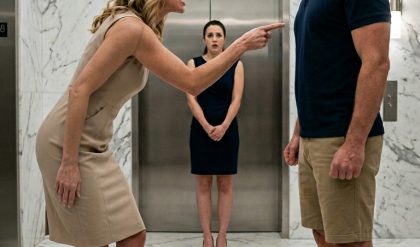
“If you don’t like it, Merryill, divorce me.”
She was standing outside the Uber, one heel already broken, her eyeliner smudged like war paint. Her hair smelled of vodka and someone else’s cologne. I stood in the doorway in socks, holding her wedding ring in my hand — not because she’d taken it off, but because I’d found it on the bathroom floor next to an unopened pregnancy test.
That part comes later.
Three minutes before she climbed out of that Uber and screamed her ultimatum into the night, she had texted me a photo of herself at Midnight Thirst, that ridiculous new rooftop nightclub where half the city’s divorces are conceived. She was wrapped around some guy with platinum hair and a tattoo of a crying baby on his neck. Her caption read, “Relax, babe. It’s just dancing.”

I had been sitting on the couch, still in my work clothes, the television humming some documentary I wasn’t watching. The photo burned into my retinas. Not because of jealousy — that had been beaten out of me long ago — but because I recognized the tattoo. The crying baby. The platinum hair. The same face I’d been staring at for eleven days on a cheap burner phone hidden in her drawer.
Kiara thought she knew me. She thought I was the same guy who once cried because she left me on read during a lunch break. The guy who said sorry for raising my voice when I found lipstick on her scarf. The guy who forgave her “accidental” hotel reservation on Valentine’s Day in another man’s name because she swore it was just a glitch in the booking system.
Yeah, that was me. Soft. Forgiving. Predictable.
But tonight wasn’t going to end like the others. Because what she didn’t know — what she couldn’t have possibly imagined — was that I’d already started preparing for this moment weeks ago. Quietly. Softly. The same way she had been lying.
I walked into our bedroom. The ring I’d found earlier sat cold on the bathroom tile, but I left it there. Instead, I opened her nightstand drawer — the one she thought I never touched. Old cards, receipts, little souvenirs she claimed were from girls’ trips. Behind a travel candle and an expired gym pass sat the burner phone. I pulled it out, turned it on, let the screen glow against my palm.
Dozens of messages. Photos. Voice notes. All from one number saved as X.
I didn’t scream. I didn’t throw anything. I just took another photo — not of me, not of another woman. Just the open drawer. The burner phone glowing inside. The truth spilling out of the shadows she’d built.
I sent it to Kiara with one caption.
“Oops.”
The typing bubble appeared immediately. Then vanished. Then appeared again. Then nothing.
Thirty seconds later, the shared Uber account pinged my phone. Drop off home. ETA 3 minutes.
She was coming. Not for me. Not to talk. She was coming to erase, to cover up, to beg.
And she had no idea what I’d already done with the contents of that phone.
I heard her car screech into the driveway, the sound of metal kissing the curb. The front door flung open so hard it dented the wall behind it. Kiara stood there, chest heaving, heels clutched in one hand, mascara streaking down both cheeks like black rain. Her eyes scanned the living room as if expecting flames.
I didn’t say a word. I just sat at the dining table, a cup of chamomile tea cooling between my palms, dressed in the same gray sweater she once said made me look like a depressed librarian. I looked up at her with the calm of a man who had already buried the marriage and was simply waiting for the funeral to end.
“What did you do, Merryill?” Her voice trembled between fury and fear, a tightrope neither of us believed she could walk.
I tilted my head. “You told me to divorce you.”
“That was a joke. I was drunk. I didn’t mean—” She stopped herself, swallowing the lie before it fully formed. Her eyes darted to the bedroom, to the drawer I’d left deliberately open. The burner phone sat right where I’d placed it, screen glowing with the last message thread still visible.
She lunged for it. Snatched it up like a lit stick of dynamite.
“Where’s the backup? Where’s the SIM card? Tell me you didn’t open it.”
I smiled. I don’t think I’d ever seen her afraid before. She always had the upper hand. Always controlled the tone, the timing, the truth. But not tonight.
“You think I just found it today?” I asked softly, taking a sip of tea. “Kiara, I’ve had that thing backed up for over a week. Cloud folder labeled Photoshop presets. You never check my desktop.”
Her face went pale. The kind of pale that has nothing to do with lighting and everything to do with a life collapsing in real time.
“You know what else I found?” I continued, standing slowly. The chair scraped against the hardwood floor. “Screenshots of your little getaway last month. The one you said was with Dalia. Guess who booked the hotel?”
Silence.
“It wasn’t Dalia.”
She opened her mouth, but nothing came out. Her lips moved like a fish drowning in air.
“And here’s the best part,” I added, placing the teacup down with deliberate softness. “I didn’t send anything to your mother. Not yet. Didn’t email your job either. But that cloud folder? It’s real, and it’s shared with a dead man’s switch. If I don’t log in every twenty-four hours, it auto-sends to everyone in your contact list.”
She rushed toward me, grabbing my arm, her nails digging into the wool of my sweater. “Please, Merryill. Please. You don’t understand. It wasn’t like that. He— he was just— Look, I made mistakes, okay? But if you love me, you won’t ruin my life over one—”
“One what?” I snapped, the calm finally cracking, a fissure of heat rushing through my voice. “One night? One year? One burner phone? One man? One baby?”
The word hit her like a physical blow. She stumbled back, her hand releasing my arm, her lips parting in raw disbelief. Her mascara-streaked eyes widened, not with anger now, but with the horror of someone who realizes the ground beneath them was never solid.
“How do you…”
“The pregnancy test,” I said. “I found it on the bathroom floor next to your ring. You weren’t hiding it very well. And no, I didn’t need to open it. I already knew from the voice notes. ‘I’m late, X. What do we do?’” I quoted it back to her, the exact words she’d whispered into that burner phone two weeks ago. Her voice had been trembling with a fear she never once showed me.
Kiara dropped the phone. It clattered against the floor, the screen cracking, a spiderweb spreading across the glass like a metaphor neither of us needed to acknowledge.
“Please,” she whispered. “We can fix this.”
I walked past her. Not toward the bedroom. Not toward the kitchen. Toward the front door, where my laptop case waited, already packed. I’d been preparing for this exact moment for eleven days. Eleven days of smiling, cooking dinner, folding laundry, pretending to be the clueless doormat she’d trained me to be, while quietly copying every file from that burner phone. She never once suspected. She barely looked at me anymore.
“Where are you going?” Her voice cracked.
I didn’t answer. I slipped on my shoes, picked up the case, and opened the door. The night air hit my face, cool and clean, nothing like the suffocating perfume of her lies.
“Merryill, please. I’ll change. I swear.”
I paused at the threshold. Didn’t turn around. “You won’t change, Kiara. You’ll just get better at hiding it. And I’m tired of living in the cracks of your performance.”
I stepped outside. The door clicked shut behind me.
I didn’t slam it. I didn’t shout. I just locked it quietly and walked out into the night like a ghost who’d finally decided to stop haunting his own home.
But inside my chest, something burned. Not sadness. Not grief. Something sharper. Something that had been dormant for years, buried under apologies I never should have made and forgiveness I never should have offered.
The car engine turned over with a quiet hum. I pulled out of the driveway, and in the rearview mirror, I saw her silhouette framed in the doorway, frozen, one hand pressed against the glass like a woman watching her entire life walk away.
She thought I was coming back. She thought I’d cool off, overthink, then apologize for making her feel guilty. That’s how our fights usually ended — with me folding and her rewriting the truth in real time.
But not tonight.
Tonight, I was driving straight to the only person who deserved to see what I’d uncovered.
Her sister, Janelle.
PART TWO: THE SISTER WHO KNEW
Janelle lived in a modest apartment on the south side, the kind of building where the elevator always smelled faintly of garlic and regret. I’d only been there twice before — once for a dinner party where Kiara spent the entire evening ignoring me, and once to pick up a birthday gift Janelle had forgotten to mail.
I knocked at 1:47 a.m.
The door opened a crack, then wider. Janelle stood there in an oversized hoodie, her hair pulled back in a messy bun, her eyes blinking against the hallway light. She didn’t look surprised to see me. She looked like someone who’d been expecting this knock for years.
“It’s her, isn’t it?” she said. Not a question.
I nodded. “Can I come in?”
She stepped aside. Her apartment was small but warm, filled with bookshelves and half-finished puzzles and a cat that regarded me with the suspicion of a tiny, furry judge. She gestured toward the couch, and I sat down, the laptop case still clutched in my hands like a life raft.
“What happened?”
I handed her the flash drive. “Open the folder called Oops.”
Janelle hesitated. For a moment, I saw the conflict on her face — the sister who wanted to protect, the woman who knew too much. But then something hardened in her expression, and she plugged the drive into her laptop.
I watched her face change in real time.
First, confusion. Her brow furrowed as she clicked through the screenshots. Then shock — her mouth falling slightly open as the photos loaded. Then horror. Real, visceral horror. She covered her mouth with one hand, scrolling through the messages, the voice note transcriptions, the video stills.
“Oh my God,” she whispered. “Merryill, how long have you had this?”
“Eleven days.”
She looked up at me, her eyes wet. “Why didn’t you tell anyone?”
“Because I needed to be sure. Because I needed to be smart. Because if I confronted her without proof, she’d twist it. She always twists it.”
Janelle didn’t argue. She knew. She’d watched Kiara do it for years — not just to me, but to friends, coworkers, their own mother. Kiara was a narrative architect, always building and rebuilding the story of her life to cast herself as the heroine.
“Is it real?” Janelle asked. “The messages, the photos — they’re not edited?”
“They’re real. I verified the timestamps. The location data. Everything.”
She asked again, her voice smaller. “Are you okay?”
I wasn’t. But I nodded anyway. “I will be.”
Janelle closed the laptop and pushed it away as if it were contaminated. She sat back in her chair, her arms crossed, her gaze distant. For a long moment, she said nothing. Then:
“You know she’s been lying about the baby, too, right?”
I froze. The pregnancy test flashed in my mind — the unopened box on the bathroom floor next to her wedding ring. I’d assumed she was pregnant and hiding it, maybe unsure of the father. But Janelle’s tone suggested something darker.
“What baby?”
Janelle leaned back slowly, exhaling through her nose. “She told me she had a miscarriage. A few weeks ago. She said it was yours. That she was devastated. That you didn’t even care.”
The room tilted.
“But I saw her at the clinic,” Janelle continued. “I was there for a routine appointment, and I saw her in the waiting room. She wasn’t alone. There was a man with platinum hair and a tattoo of a crying baby on his neck. She didn’t see me, but I saw them. He was holding her hand. When they called her name, she checked in under his last name.”
My throat closed. Not my baby. Not my name. Not my grief.
“She told me she lost the baby,” I said slowly, the words tasting like ash. “She cried in the bathroom for an hour. I sat outside the door begging her to let me in.”
Janelle’s expression softened, but only slightly. “She was never pregnant with your child, Merryill. Whatever happened at that clinic, it had nothing to do with you.”
I sat in stunned silence, my hands resting on my knees, my heart pounding so hard I could feel it in my temples. All those weird excuses over the past month. The stress headaches. The random mood swings. The night she locked herself in the bathroom and sobbed while I pressed my palm against the door, desperate to help.
It wasn’t grief. It was guilt.
“I didn’t want to believe it,” Janelle said quietly. “I kept hoping she’d change. That marriage would ground her. But she’s been doing this since we were teenagers. She doesn’t know how to stop.”
I looked at her. “Why are you telling me this? She’s your sister.”
Janelle’s jaw tightened. “Because you deserved the truth a long time ago. And because I’m tired of being part of her cleanup crew. Every time she breaks something, someone else has to glue it back together. I’m done.”
She stood up, walked to a small desk in the corner, and pulled out a manila envelope. “I’ve been keeping this for months. I wasn’t sure if I’d ever give it to you. But after tonight…”
She handed me the envelope. Inside were printed screenshots of text messages, emails, and a credit card statement with charges for hotels I’d never stayed in.
“I hired a private investigator six months ago,” Janelle admitted, not meeting my eyes. “When she started acting strange around the holidays. I thought maybe she was in trouble. Turns out she was the trouble.”
I stared at the papers. “You’ve had this the whole time?”
“I was waiting for the right moment. For you to be ready to hear it. I’m sorry it took this long.”
I didn’t feel betrayed by Janelle. If anything, I understood. Kiara’s web was sticky; anyone caught in it struggled to move. But now, with Janelle’s confirmation, with her evidence added to mine, I wasn’t just hurt anymore. I was armed.
“Does your mother know?” I asked.
“God, no. She still thinks Kiara walks on water.”
I thought about Kiara’s mother — a retired judge with a reputation for moral absolutism. The kind of woman who framed other people’s divorces as character failures. The kind of woman who once told me at Christmas dinner, “I’m so glad Kiara found someone like you. You calm her.”
That memory used to make me feel proud. Now it just made me feel like bait.
“Do you have a plan?” Janelle asked.
I stood up, tucking the manila envelope into my laptop case. “I have a hotel room waiting downtown. And I have drafts. A lot of drafts.”
“Drafts for what?”
“Everything.”
She didn’t ask for details. She just nodded, her face a complicated map of sadness and relief.
“Thank you,” I said, pausing at the door. “For telling me.”
Janelle hugged me — a brief, fierce squeeze that said more than any words could. “You deserve better. You always did.”
I left her apartment with something better than revenge. I left with confirmation, with witnesses, and with a very specific plan.
By the time Kiara started blowing up my phone with her frantic calls and crocodile texts, I was already sitting in a hotel room downtown, calmly rewriting the end of her story.
PART THREE: THE GHOST IN THE MACHINE
The Marwood Hotel sat on a quiet street lined with ancient oaks, its lobby smelling of cedar and old money. I’d chosen it deliberately — not for its charm, but for its secure business lounge, its printers that didn’t ask questions, and its front desk staff who valued discretion above all else.
My room was on the seventh floor. A single window overlooked the city skyline, glittering with indifferent lights. I ordered coffee from room service. Black. No sugar. I needed my hands steady.
The phone buzzed again.
Kiara: Please come home. We can fix this.
Then, five minutes later:
Kiara: You’re scaring me, Merryill. Please just talk to me. I’m worried about you.
Then, an hour after that:
Kiara: Do NOT go to HR. I swear to God, if you ruin my job—
And there it was. That little crack. Proof that she finally understood what I’d been holding all along. The mask had slipped, and beneath the desperate pleading was the real Kiara — calculating, self-preserving, furious that she might actually face consequences.
I didn’t respond to any of it.
Instead, I opened my laptop and pulled up the encrypted folder I’d been meticulously building for over a week. Inside were dozens of subfolders, each labeled with clinical precision: Messages, Photos, Voice Notes, Financial Records, Witness Statements.
The burner phone had been a goldmine of stupidity. Kiara and X — whose real name, I’d discovered through some light digital forensics, was Elias Vance — had been careless. They’d used the cheap phone like teenagers, never once considering that someone might find it. They’d sent photos of themselves together. Voice notes detailing their plans. Arguments about when she’d leave me. Celebrations when she lied her way out of another suspicion.
But the worst — the part that made my hands shake even now — was the folder labeled Elias_Vance_Employment.
Elias worked at the same company as Kiara. He wasn’t just her affair partner; he was her direct supervisor. Their relationship was a walking HR violation, a conflict of interest wrapped in hotel bedsheets and departmental budget approvals. I’d found emails between them discussing promotions she’d received, projects she’d been assigned, benefits she’d negotiated — all while they were sleeping together.
This wasn’t just a betrayal of our marriage. It was a betrayal of her entire professional ethics.
I opened my draft folder. The first email was addressed to the company’s anonymous ethics hotline. Subject line: Urgent Concern — Undisclosed Relationship with Direct Supervisor. Attached were seventeen screenshots: emails, calendar invites for “off-site meetings” that aligned with hotel charges, and a photo of Elias and Kiara at a company retreat, his wedding ring clearly visible, her hand resting on his thigh under the table.
The second draft was for Elias’s wife. I’d found her through a simple social media search — a kindergarten teacher named Lia with kind eyes and three children under ten. I’d debated this one for days. Involving her felt cruel. But then I remembered the video still of Elias laughing in bed with my wife, and the cruelty felt less like mine and more like his.
I didn’t send that one. Not yet. I needed to think. Not about revenge — that was already in motion — but about what kind of man I wanted to be on the other side of this.
The third draft was the one I’d been dreading and craving in equal measure. Addressed to Kiara’s mother, the honorable Judge Celeste Harmon.
I attached a single photo: a blurred still from the burner phone video of Kiara in bed with Elias. No nudity — just enough context to make the scene unmistakable.
My caption: I thought you deserved the truth.
I stared at the screen for a long time. The cursor blinked, patient and indifferent. Then I closed my eyes, thought about all the years I’d spent shrinking myself to fit into Kiara’s carefully curated life, and hit send.
The phone buzzed one last time before I turned it off completely.
Kiara: Where are you? Please. I’m begging you.
I didn’t turn it back on. I didn’t want to see the fallout in real time. I wanted to sleep — really sleep — for the first time in years.
Morning arrived gray and quiet. I woke to the sound of rain tapping against the window, the hotel sheets cool and unfamiliar against my skin. For a moment, I forgot where I was. Then the memory crashed back, and I felt something unexpected: relief.
I turned on my phone.
The world had not been quiet in my absence.
Thirty-seven missed calls. Fifty-two text messages. Eleven voicemails. Emails from unknown addresses, some pleading, some furious, one even threatening legal action if I didn’t “retract immediately.”
I scrolled through the chaos methodically. Kiara’s texts had evolved through stages of grief that had nothing to do with loss and everything to do with damage control. The last one, sent at 4:22 a.m., read: I didn’t think you had it in you.
I almost smiled.
Then I checked Janelle’s messages.
Janelle: She’s losing it. Mom called her at 3AM screaming. Elias is on leave pending an investigation. His wife found out somehow. It’s a mess.
Janelle: She keeps asking if you’ll undo it. Like it’s a button you can just press.
Janelle: You okay?
I typed back: I’m fine. Don’t tell her where I am.
Then I called my lawyer.
Trina Hol had been my attorney since before the marriage — a sharp-eyed woman in her fifties who wore power suits like armor and spoke in sentences that felt like closing arguments. When I’d first approached her two weeks ago, she hadn’t looked surprised. She’d looked like someone who’d seen a hundred men like me walk through her door: hollowed out, embarrassed, still hoping there was a way to fix it.
“There’s no fixing it,” she’d said then, sliding a retainer agreement across her desk. “But there’s surviving it. And from what you’ve shown me, you’re in a strong position.”
Now, on the phone, her voice was crisp and satisfied. “I received a call from Kiara’s attorney this morning. He was very eager to discuss a ‘mutual dissolution.’ I told him we’d be filing on grounds of infidelity with documented evidence and that any attempt to pursue a defamation claim would be met with a full discovery motion. He backed off within twenty minutes.”
“She tried to claim defamation?”
“She tried to claim a lot of things. None of them stick when you have timestamps and location data.” Trina paused. “I’ve already drafted the divorce papers. Say the word and I’ll have them served this afternoon.”
I looked out the window. The rain had stopped. The city below seemed cleaner somehow, washed of its usual grime.
“Serve them,” I said.
The divorce papers arrived at Kiara’s workplace — well, her former workplace, since she’d been placed on administrative leave pending the HR investigation — at 2:15 p.m. I didn’t deliver them in person. I didn’t leave a note. I didn’t need to.
The documents spoke for themselves. Irreconcilable differences based on documented infidelity and breach of trust. No alimony. No negotiation. Just an exit.
I expected her to fight. That was her nature. But something had shifted in the twenty-four hours since I’d walked out. Her mother’s public statement — a restrained but devastating blog post about being “blindsided by the deception of a loved one” — had gone viral in legal circles. Elias’s wife had filed for separation. The company investigation had expanded to include financial irregularities tied to Kiara’s promotions.
She was being erased from her own carefully curated narrative. And for once, there was no one left to rewrite it for her.
PART FOUR: THE FALL OF THE HOUSE OF KIARA
I stayed at the Marwood for another week. Not because I needed to hide, but because I needed space to remember who I was without her.
The mornings became a ritual. I’d wake early, drink coffee by the window, and write in a journal I’d bought from the hotel gift shop. At first, the pages were angry — rants about betrayal, lists of every lie I’d uncovered, fantasies of public humiliation I’d never actually execute. But slowly, the anger gave way to something quieter. Grief, maybe. Or clarity. It was hard to tell the difference.
Janelle visited twice. We talked about things that had nothing to do with Kiara — our childhoods, our favorite books, the strange relief of silence after years of noise. She told me she was thinking about moving to another city, starting fresh somewhere her sister’s shadow couldn’t reach.
“You should do it,” I said. “Before the roots get too deep.”
She smiled — a real smile, the kind that reached her eyes. “You first.”
Kiara, meanwhile, was doing what Kiara did best: performing.
Her social media became a theater of denial. Inspirational quotes layered over sunsets. Old vacation photos cropped to exclude me. A carefully angled selfie with a coffee cup, captioned “Healing, not hating.”
It was like watching someone redecorate a house while the foundation crumbled beneath it.
And then she tagged me.
The post was a quote, rendered in a looping cursive font against a blush-pink background: “Some men break under pressure. Others just weren’t strong enough to begin with.”
She’d added her own caption: “When you finally choose yourself over someone who couldn’t handle you. 
 ”
”
I stared at the screen, a strange heat rising in my chest. Not rage — something colder. Something that had been sharpening itself in the quiet hours of the past week.
I opened my laptop.
For the first time since this nightmare began, I decided to break my silence publicly. No rage. No threats. Just facts.
I spent three hours writing a blog post. Anonymous, of course. I blurred faces and removed names. But I told the story from start to finish — the burner phone, the hidden pregnancy, the professional misconduct, the years of gaslighting and manipulation. I included redacted screenshots, timelines, and a simple closing line: “Sometimes the quietest person in the room isn’t weak. He’s just waiting for the right moment to speak.”
I didn’t promote the post. I didn’t share it anywhere. I sent it to exactly one person: a former coworker of Kiara’s, a woman named Sasha who’d been fired after a department reshuffle that Kiara had orchestrated to cover her own tracks. Sasha had a massive LinkedIn following and a long memory.
Within hours, the post had been shared over two thousand times.
People talk. People connect dots. And it didn’t take long before someone cross-referenced the tattoo mentioned in the story — a crying baby on his neck — with a certain HR-suspended executive.
Elias deleted his social media accounts by noon.
His wife, Lia, posted a single story — a photo of her children, captioned “Trust is harder to rebuild than it is to destroy.” Someone sent me a screenshot of a family member commenting, “Disgusted. Don’t contact us again.”
And Kiara? She called me from a new number at 2:17 a.m.
I didn’t answer.
She texted: “What the hell did you do?”
I replied with one line: “Nothing you didn’t already do to yourself.”
The last email arrived three days later. No subject line. No greeting. Just a single sentence from an address I almost didn’t recognize.
I didn’t think you had it in you.
I read it three times. Then I archived it and never looked at it again.
She was right, in a way. Neither did I. But betrayal doesn’t just change the relationship. It changes the betrayed. It sharpens something dull. It turns a whimper into a weapon. And Kiara — she taught me that by trying to destroy me, she helped me rebuild myself without her.
PART FIVE: THE QUIET AFTER
I moved out of the Marwood on a Tuesday. The divorce had been finalized faster than I’d expected — Kiara, stripped of her job, her family’s support, and her carefully constructed reputation, hadn’t contested a single term. She’d taken the furniture, the paintings, the coffee machine she once swore she couldn’t live without. I let her have all of it.
What I took was smaller. Clothes. Books. My grandfather’s watch. A few photographs from before the marriage, back when I still recognized my own smile.
I found an apartment above a bookstore on the east side of the city. It was small — one bedroom, a kitchen that barely fit a table, windows that faced a courtyard where someone had planted sunflowers that grew taller than the fence. The owner of the bookstore, an older man named Wes, gave me free coffee in exchange for tech support. I spent my mornings fixing his ancient point-of-sale system and my afternoons working remotely — freelance graphic design, mostly. Less stress. More peace.
I started journaling again. Not the angry scrawl of those first hotel days, but something slower. Observations about the weather. Descriptions of customers who wandered into the bookstore. Fragments of a novel I’d been meaning to write since college but had abandoned somewhere between Kiara’s first lie and my thousandth apology.
My brother in Oregon called every Sunday. We’d barely spoken during the marriage — Kiara had always found reasons to dislike him, which I now understood was her strategy for isolating me from anyone who might see through her. But he never said I told you so. He just asked how I was doing and told me about his garden, his dog, the quiet rhythms of a life lived honestly.
One evening, about three months after the divorce, I met someone new.
Her name was Lina. She worked at the botanical gardens across town and came into the bookstore every Friday to browse the nature section. She had a habit of reading the last page of a book first — “to make sure the ending is worth the journey” — and she laughed at her own jokes before she finished telling them.
We started talking. Slowly at first, then more. Coffee turned into dinner. Dinner turned into walks through the gardens where she worked, her pointing out plants with names I couldn’t pronounce, me pretending to remember them.
She never asked to see my phone. She never made me feel small. And when I finally told her about Kiara — the full story, unvarnished and unedited — she didn’t flinch.
“You survived something terrible,” she said, her hand resting lightly on mine. “That doesn’t make you broken. It makes you someone who knows what he deserves.”
I nearly cried. Not because it was romantic, but because it was the first time in years that someone had looked at me and seen strength instead of softness.
It’s been almost a year now since that night Kiara screamed her ultimatum into the dark. I don’t think about her much anymore. When I do, it’s not with anger — it’s with the strange, distant ache of a wound that’s healed but left a scar.
She’s a chapter now. One that taught me a lesson I’ll never forget: that loving someone doesn’t mean tolerating their destruction of you. That being the nice guy doesn’t mean you have to be the quiet one. And that sometimes the strongest thing you can do is walk away with your dignity while they stand frozen in the ruins of what they thought they controlled.
Last month, I deleted the burner phone files. Every screenshot, every voice note, every timestamped piece of evidence. I didn’t need them anymore. The truth had done its work, and I was ready to stop carrying it.
I still have the ring, though. Not Kiara’s — mine. I found it in the bottom of a drawer while unpacking, tarnished and forgotten. I keep it in a small box on my desk, not as a reminder of what I lost, but as a promise to myself.
Next time, I’ll know the difference between love and performance.
Next time, I’ll trust my own voice.
And if there is no next time, that’s okay too. Because I’ve learned how to be whole on my own — and that, I think, is the ending worth the journey.
PART SIX: THE GHOST AT THE DOOR
It had been fourteen months since I’d last heard Kiara’s voice.
Fourteen months of quiet mornings. Of coffee that tasted like coffee, not anxiety. Of falling asleep without my phone clutched in my hand, waiting for the next crisis. Lina and I had grown close — not in the frantic, consuming way Kiara and I had collided, but slowly, like two trees whose roots found each other underground. She didn’t complete me. She didn’t need to. I was already whole.
But peace, I had learned, is not a permanent state. It’s a garden that requires tending. And sometimes, someone from your past shows up with a shovel.
It was a Thursday evening in late October when the knock came. The rain had been falling since noon, slicking the cobblestone courtyard below my apartment with a silver sheen. I was at my desk, halfway through a freelance project, Wes’s cat curled on the windowsill like a loaf of contentment.
The knock was firm. Unfamiliar.
I opened the door and felt the past crash into me like a wave.
Judge Celeste Harmon stood in the hallway, her umbrella dripping onto the worn carpet, her face a careful mask of composure that didn’t quite reach her eyes. She wore a dark trench coat and no jewelry except a single pearl brooch — the same one she’d worn to my wedding.
“Merryill,” she said. “May I come in?”
I hadn’t spoken to Celeste since the divorce. Her voicemail — “I am disgusted… Whatever you need, I will help” — had been the last communication between us. I’d never taken her up on the offer. I didn’t need her help, and I wasn’t sure I wanted her guilt.
But she was here now, standing in my doorway with rain dripping from her sleeves and something heavy behind her eyes.
I stepped aside.
The apartment felt smaller with her in it. She sat on my modest couch, back straight, hands folded on her knee, every inch the retired judge despite the humble surroundings. I offered her tea. She declined. I sat across from her and waited.
“I wouldn’t be here if it weren’t necessary,” she began. Her voice was controlled, but beneath it ran a current of something I’d never heard from her before — uncertainty. “I know I have no right to ask anything of you. After what she did. After what I… failed to see.”
“You didn’t fail to see,” I said. “She was good at hiding.”
Celeste’s jaw tightened. “A mother should know her own child.”
I didn’t argue. I’d spent enough time blaming myself for Kiara’s deceptions. I wasn’t going to shoulder Celeste’s guilt too.
“What is it?” I asked.
She reached into her bag and withdrew a slim envelope. Her hands trembled slightly — another thing I’d never seen from her. She placed it on the coffee table between us.
“Kiara is missing,” she said.
The words hung in the air like smoke. I didn’t react. I’d spent a year training myself not to react to her name.
“Missing how?”
“She hasn’t contacted anyone in three weeks. No calls. No texts. Her apartment is empty. Her landlord said she stopped paying rent two months ago.” Celeste paused, her composure cracking for just a moment. “The last email she sent was to me. She said she was sorry. That she’d ‘made it right.’ I didn’t understand what she meant until I found this.”
She gestured toward the envelope. I didn’t touch it.
“What’s inside?”
“A safety deposit key. And a letter addressed to you.”
My heart, which I’d trained to stay calm in the face of Kiara’s chaos, gave a single, heavy thud.
“I haven’t opened it,” Celeste continued. “It’s sealed. But I need to know if you know where she is. If she contacted you. If you’ve seen her.”
“I haven’t heard from her in over a year.”
Celeste studied my face. I let her. I had nothing to hide.
“I believe you,” she said finally. “But I’m asking you to read it. Whatever’s in that letter, I think she wanted you to know. And I think… I think it might explain why she’s gone.”
I looked at the envelope. Plain white. My name written across the front in Kiara’s handwriting — the same looping script that had once filled our wedding invitations. Seeing it now felt like touching a scar I’d almost forgotten I had.
“Why do you need me?” I asked. “You’re her mother. You have resources. The police—”
“I’ve tried the police. She’s an adult. She’s allowed to disappear.” Celeste’s voice hardened with frustration, then softened again. “But you knew her in ways I didn’t. You knew the parts she hid from everyone else. If anyone can understand what she’s done, it’s you.”
I didn’t want to be that person. I’d worked so hard to stop being that person. But Celeste was watching me with an expression I recognized — the desperate, hollow look of someone who’d spent weeks staring at a phone that wouldn’t ring.
I picked up the envelope.
Lina arrived an hour after Celeste left. She found me on the couch, the unopened letter on the table before me, a cold cup of tea forgotten at my elbow.
“Who was that woman I passed on the stairs?” she asked, shaking rain from her hair. “She looked like she’d seen a ghost.”
“That was Kiara’s mother.”
Lina stopped. Her hand stilled on her coat buttons. She looked at me, then at the envelope, then back at me.
“What does she want?”
I told her everything Celeste had said — the disappearance, the letter, the key. Lina listened without interrupting, her face calm but watchful. When I finished, she sat down beside me and took my hand.
“Are you going to open it?”
“I don’t know,” I admitted. “Part of me wants to burn it. I’ve already wasted so much of my life on her secrets.”
“And the other part?”
I looked at the envelope. “The other part remembers that she was a human being. A broken, manipulative one. But still human.”
Lina was quiet for a moment. Then she said, “You’re not the man who let her destroy him anymore. Whatever’s in that letter, it can’t change who you’ve become.”
She was right. I knew she was right. But the fear was still there — not of Kiara, but of the version of myself who might emerge if I let her back in, even for a moment.
“I’ll read it,” I said. “But not alone.”
Lina nodded and squeezed my hand. “I’m not going anywhere.”
The letter was three pages long, handwritten on expensive stationery that smelled faintly of jasmine — Kiara’s signature scent. I hadn’t smelled it in over a year, and the familiarity of it made my stomach clench.
Dear Merryill, it began. If you’re reading this, I’m already gone.
I read it aloud, Lina sitting beside me, her presence a steady anchor against the tide of memory.
I’ve spent months trying to figure out how to write this. I wrote a hundred drafts. I deleted every one. Apologies feel cheap when you’ve burned down someone’s life. Explanations feel like excuses. But you deserve something — not forgiveness, not closure, just the truth. The whole truth. For once in my life.
Kiara wrote about her childhood. About growing up in the shadow of a mother who demanded perfection, who taught her that mistakes were failures and failures were unforgivable. She wrote about learning to lie before she learned to tie her shoes — tiny deceptions at first, designed to avoid punishment, then larger ones, designed to create a self her mother could love.
By the time I met you, I didn’t know how to be real anymore. I only knew how to perform. And you — God, Merryill, you were so genuine. So open. I think I hated you for it, a little. Because you made me feel like a fraud.
I paused, my throat tight. Lina’s hand was warm on my back.
Elias wasn’t special. None of them were. They were just mirrors — people who reflected back the version of me I wanted to see. You reflected back the version I was afraid to see. Every time you looked at me with love, I saw who I really was, and I couldn’t stand it.
The letter went on. She described the pregnancy — not a miscarriage, but a termination. She’d gone to the clinic with Elias because she couldn’t bear to go alone, and she’d lied to Janelle because the truth was too ugly even for her to face.
I didn’t lose the baby. I chose not to have it. Because I knew it wasn’t yours. And I knew if I had it, the whole house of cards would collapse. I told myself I was protecting you. But I was protecting myself. I was always protecting myself.
Then came the part that made me stop breathing.
When you sent that photo of the drawer, I felt something I’d never felt before. Not just fear. Relief. Because for the first time in my entire life, I didn’t have to hide anymore. You had already seen everything. There was nothing left to protect. Nothing left to perform.
I know you won’t believe this, but I’m grateful. You did what no one else could do. You made me face myself. And I hated what I saw.
The final page described her plans. She’d sold most of her possessions. She’d checked into a treatment program — not the luxury kind she used to mock, but a residential facility in a remote part of Oregon that specialized in personality disorders and trauma.
I’m not writing this to ask you to wait for me. I’m not writing this to ask for your forgiveness. I’m writing this because I owe you the truth, and this is the only way I know how to give it. The key in this envelope opens a safety deposit box at First National Bank. Inside, you’ll find everything — the full financial records, the emails, the truth about every lie I ever told you. I’ve also left the deed to the house. It’s yours. I took enough to cover my treatment. The rest is for you to do with as you see fit.
I don’t know if I’ll ever be well. I don’t know if I’ll ever be someone capable of real love. But I’m trying. For the first time in my life, I’m trying.
The letter was signed simply: Kiara.
No declarations of love. No pleas for reconciliation. Just her name, plain and unadorned, as if she’d finally stripped away the performance and left only what was real.
I set the pages down. My hands were steady, but inside, something was shifting — not crumbling, just rearranging.
Lina spoke first. “That’s not what I expected.”
“Neither did I.”
“Do you believe her?”
I thought about it. The Kiara I knew would have used a letter like this to manipulate, to plant seeds of guilt, to draw me back into her orbit. But this letter didn’t feel like manipulation. It felt like a confession — the kind of confession that costs something to give.
“I don’t know,” I said honestly. “But I think I need to find out.”
PART SEVEN: THE SAFETY DEPOSIT
First National Bank was a stone building on the edge of downtown, all marble floors and hushed echoes. I’d walked past it a hundred times without ever going inside. Now I stood at the entrance with the key cold in my palm, Lina beside me, Celeste’s letter folded in my coat pocket.
“You don’t have to do this,” Lina said.
“I know.”
“But you’re going to anyway.”
I looked at her. “If I don’t, I’ll always wonder. And I’m tired of wondering about her.”
The bank manager, a thin man with wire-rimmed glasses, led us to a private room. He retrieved the box — a long metal drawer — and placed it on the table before retreating with a nod.
The key turned smoothly. The lid lifted.
Inside were documents. Stacks of them. Financial records, property deeds, tax returns. A flash drive with a label in Kiara’s handwriting: Everything. And beneath it all, a photograph.
I picked it up. It was a picture of us on our wedding day — the moment after the ceremony, when we’d stepped outside the church and the sun had broken through the clouds. I was laughing at something she’d said. She was looking at me, not at the camera, with an expression I’d never been able to name.
Until now.
It was fear. Not the fear of being caught. The fear of being seen. Of being loved by someone who didn’t know the truth and wouldn’t stay if he did.
I set the photograph down and started going through the documents. They were meticulous — far more organized than anything Kiara had ever produced during our marriage. Bank statements. Email printouts. A complete timeline of her affair with Elias, annotated with dates and locations. And at the bottom of the stack, a sealed envelope addressed to Janelle.
I didn’t open that one. It wasn’t mine to read.
“What are you going to do with all this?” Lina asked.
I stared at the pile of evidence. Evidence I’d already found. Evidence she was now handing over voluntarily.
“Nothing,” I said. “I don’t need it anymore.”
“Then why did she give it to you?”
“Because she needed to give it,” I said. “It wasn’t for me. It was for her. A final accounting.”
Lina nodded slowly. “So what now?”
I closed the box and locked it. The key I placed in my pocket, next to the letter.
“Now I go see Celeste.”
Judge Celeste Harmon lived in a restored Victorian on the north side of the city, a house I’d visited dozens of times during my marriage — always with Kiara, always performing the role of the dutiful son-in-law. Now I stood on the porch alone, the October wind biting through my coat, and knocked.
She opened the door quickly, as if she’d been waiting.
“You read it,” she said.
I nodded. “She’s in treatment. A residential facility in Oregon. She didn’t say which one, but she said she’s trying to get better.”
Celeste’s face crumpled — not dramatically, just a slight collapse of the carefully maintained facade. She pressed a hand to her mouth and stepped back, letting me in.
The house smelled like it always had — lemon polish and old books. But it felt emptier now, the silence heavier.
“I failed her,” Celeste said, sinking into a wingback chair. “I raised her to be perfect, and I raised her to be a liar. Those two things are the same, aren’t they?”
I didn’t answer. It wasn’t my job to absolve her.
“The letter she wrote you,” Celeste continued. “Was it… honest?”
“I think so. For the first time.”
She nodded, her eyes distant. “Will you tell me what it said?”
I considered it. Then I handed her the letter. She’d earned that much, I thought. Or maybe Kiara had.
Celeste read it in silence, her expression shifting through grief, guilt, and something that might have been hope. When she finished, she folded the pages carefully and handed them back.
“Thank you,” she whispered. “For reading it. For coming here. For…” She trailed off, unable to finish.
“She’s not who I thought she was,” I said. “But maybe she’s not who she was either. People can change. I have to believe that.”
Celeste looked at me with something I’d never seen from her before: respect.
“You were always too good for her,” she said. “I knew it then. I was just too proud to say it.”
I didn’t need her validation. But I accepted it anyway, a small piece of closure I hadn’t known I was missing.
PART EIGHT: THE UNEXPECTED ALLY
Two days later, I received a message from someone I never expected to hear from again.
Lia Vance.
Elias’s ex-wife — the kindergarten teacher with kind eyes and three children. The woman whose life had been shattered alongside mine when the burner phone’s contents spilled into the open. She’d messaged me on a social platform I barely used, her profile picture showing her with her kids at a pumpkin patch.
Mr. Merryill, her message read. I hope this isn’t inappropriate. I’ve been wanting to reach out for months, but I didn’t know how. I heard from mutual contacts that you’ve moved on. I have too. But I think we owe each other a conversation. If you’re open to it, I’d like to meet.
I stared at the screen for a long time. Lina leaned over my shoulder, reading.
“Are you going to respond?” she asked.
“I don’t know. What would we even talk about?”
“Maybe the things you couldn’t talk about with anyone else.”
She had a point. I’d spent the past year processing my pain with Janelle, with my brother, with a therapist I’d started seeing six months ago. But Lia was the only person who had experienced the exact same betrayal from the same two people. She was the only one who truly understood.
I typed back: I’m open. When and where?
We met at a park near her children’s school — a small playground with a duck pond and benches painted forest green. Lia arrived in a sweater the color of autumn leaves, her dark hair pulled back in a simple ponytail. She looked tired but steady, the way people look when they’ve rebuilt themselves from rubble.
“Thank you for coming,” she said, sitting on the bench beside me. “I know this is strange.”
“My whole life has been strange for a while. This is almost normal.”
She smiled — a small, sad smile that didn’t reach her eyes. “I used to think I was the only one. That Elias’s infidelity was my fault. That I wasn’t enough.”
“I know the feeling.”
“When your blog post went around, I read it three times. Cried each time. Not because of the details — I already knew most of them by then — but because someone else was telling the same story I’d been living. Someone else survived it.”
I hadn’t thought about the blog in months. I’d taken it down after the divorce, not wanting to be defined by it. But knowing it had reached someone who needed it made me glad I’d written it.
“How are your kids?” I asked.
Lia’s expression softened. “Better than I expected. They miss their father, but they don’t miss the tension. Kids feel things, even when you try to hide it.” She paused. “Elias hasn’t seen them in six months. He moved to another state after the investigation. Reached out once asking for visitation, but I told him he needed to get help first. He hasn’t tried since.”
“And Kiara?”
Lia’s jaw tightened. “I hated her for a long time. But then I realized — Elias made his choices. She didn’t force him. They were both adults who chose to destroy other people’s lives. The blame belongs to both of them.”
I nodded. That was a lesson I’d learned the hard way: forgiveness wasn’t about absolving the other person. It was about freeing yourself from the weight of anger.
“She’s in treatment,” I said. “Kiara. She wrote me a letter. She’s trying to get better.”
Lia was quiet for a moment. Then: “Do you believe people can change?”
I thought about the letter. The safety deposit box. The photograph of our wedding day, with Kiara’s fearful eyes staring at a future she was already sabotaging.
“I think people can try,” I said. “That’s all any of us can do.”
We talked for another hour — about our new lives, our hard-won peace, the strange freedom of starting over. Lia told me she’d gone back to school part-time, studying child psychology. She wanted to help kids who’d been through trauma. “The kind of help I wish I’d had when I was young,” she said.
Before we parted, she reached into her bag and pulled out a small, wrapped package.
“This is for you,” she said. “I didn’t know if I’d ever get the chance to give it to you. It’s not much.”
I opened it carefully. Inside was a framed photograph — not of Elias or Kiara, but of the sunrise over the city skyline, taken from a rooftop garden Lia had planted after the divorce.
“I started gardening as therapy,” she explained. “Something about watching things grow from nothing. It reminded me that even after everything burns down, new things can still take root.”
I looked at the photograph, at the golden light spilling over the buildings, and felt something loosen in my chest.
“Thank you,” I said. “I know exactly where I’ll put it.”
PART NINE: THE NAME ON THE DOOR
Winter passed quietly. Lina and I spent Christmas with her family — a loud, chaotic gathering of cousins and aunts and a grandfather who told the same jokes every year and laughed harder each time. I felt like an outsider at first, but not in a bad way. More like a traveler who’d stumbled into a warm inn after a long journey.
Janelle moved to Portland in February, just as she’d promised herself she would. She sent me a postcard of the coastline, her handwriting messy but jubilant. “Starting over is terrifying. But I think I’m going to be okay.”
My brother visited in March, the first time I’d seen him in person since the wedding. We didn’t talk about Kiara. We talked about his garden, his dog, the simple rhythms of a life lived without drama. When he left, he hugged me longer than usual.
“I’m proud of you,” he said. “You know that, right?”
I did. But it still felt good to hear.
And then, in April, Celeste called with news.
“She’s completed the program,” she said, her voice cautious. “Kiara. She’s moving into a halfway house. She asked about you. Not in a way that made me uncomfortable — just… she wanted to know if you were happy.”
I was standing in the bookstore, sorting through a box of new arrivals. Wes was humming behind the counter, and the cat was asleep in a patch of sunlight.
“I am,” I said. “I am happy.”
“She asked me to tell you something.” Celeste paused. “She said to tell you that she’s sorry. That she knows it doesn’t change anything. But she’s sorry.”
I closed my eyes. For a moment, I was back on the doorstep of our old house, holding her wedding ring, staring at an unopened pregnancy test. The man I’d been then felt like a stranger — someone I remembered but no longer inhabited.
“Tell her I hope she finds peace,” I said. “I really do.”
Celeste was quiet, and I realized she was crying. Not the theatrical tears Kiara used to weaponize, but something smaller and more genuine. The tears of a mother who’d spent years failing her daughter and was only now learning how to do better.
“Thank you, Merryill,” she said. “I don’t deserve your kindness.”
“It’s not about deserving,” I told her. “It’s about choosing not to carry the weight anymore.”
That evening, Lina and I walked through the botanical gardens where she worked. The cherry blossoms were in full bloom, their petals drifting down like snow. She held my hand and pointed out the plants she’d helped nurture — the rare orchids, the stubborn succulents, the climbing roses that had taken three years to bloom but were now spilling over the trellis in cascades of pink.
“I have a question,” she said, stopping beneath an archway of wisteria. “And I want you to answer honestly.”
I braced myself. “Okay.”
“Do you still think about her?”
The question hung between us. I could have lied. I could have softened it. But Lina deserved the same honesty I’d always wanted and never received.
“Sometimes,” I admitted. “Not the way I used to. Not with anger or longing. Just… sometimes I wonder if she’s okay. If she’s becoming someone better.”
Lina nodded, her expression unreadable. “And if she showed up tomorrow, fully changed, fully healed… would you want her back?”
I took her other hand, pulling her gently toward me. “No,” I said. “Because I’m not the person who loved her anymore. That version of me died the night I found the truth. The person I am now loves you. Only you.”
Lina’s eyes glistened. “I was so afraid to ask that question.”
“I know. But you never have to be afraid with me. I promise you that.”
She kissed me beneath the wisteria, and the world felt impossibly beautiful.
PART TEN: THE FINAL CHAPTER
One year later, almost to the day, I received a letter in the mail.
It wasn’t from Kiara. It was from a publisher.
I’d been writing — I’d never stopped writing. All those journal entries, those late-night reflections, those fragments of a novel I’d abandoned during the marriage, had grown into something larger. A memoir. Not just about the betrayal, but about the aftermath. About what it means to rebuild when everything you thought you knew has crumbled.
I’d sent the manuscript to a small independent press on a whim, expecting nothing. But they wanted to publish it.
I called Lina first. She screamed so loudly I had to hold the phone away from my ear.
I called Janelle second. She cried.
I called my brother third. He said, “I always knew you had a book in you.”
And then, sitting alone in my apartment above the bookstore, I allowed myself to feel it — not pride, exactly, but something quieter. Satisfaction. The knowledge that I’d taken the worst thing that had ever happened to me and turned it into something that might help someone else.
The book came out in the spring. I didn’t use my real name — a pseudonym that gave me enough distance to feel safe. But the story was mine, every word of it. The burner phone. The nightclub. The pregnancy test on the bathroom floor. The silent drive to Janelle’s apartment. The long, slow process of learning to trust my own voice again.
I dedicated it to three people: To Lina, who taught me that love doesn’t have to hurt. To Janelle, who proved that blood doesn’t have to be thicker than truth. And to anyone out there who’s forgotten how powerful they really are.
The launch party was small — a gathering at Wes’s bookstore, with fairy lights strung between the shelves and champagne that tasted like victory. Lina arranged flowers from the botanical gardens. Janelle flew in from Portland. My brother drove six hours just to be there for the evening.
And midway through the party, as I was signing a copy for a stranger who’d traveled all the way from Sacramento, my phone buzzed.
A notification. A message from a number I didn’t recognize.
I opened it.
“I read your book. I know it’s you. I just wanted to say I’m proud of you. The person you’ve become — it’s who I always hoped you’d be. I’m sorry I wasn’t the one to grow with you. But I’m glad you found someone who is.”
No name. No signature. But I knew.
I stared at the screen for a long moment. The party swirled around me — laughter, clinking glasses, the low hum of conversation. Lina caught my eye from across the room and smiled.
I typed back: “Thank you. I hope you’re finding your own peace.”
Then I deleted the thread, put my phone in my pocket, and walked across the room to kiss the woman I loved.
EPILOGUE: THE VIEW AHEAD
There’s a moment, somewhere in the middle of every storm, when you realize the rain isn’t going to stop. When you understand that the only way out is through. I spent years standing at the edge of my own life, waiting for someone to come rescue me from the wreckage.
No one came.
So I rescued myself.
And now, standing in the courtyard below my apartment, watching the sunflowers Wes planted grow taller than the fence, I understand something I couldn’t have articulated before: betrayal doesn’t have to be the end of your story. It can be the beginning. Not because the pain wasn’t real — it was, it still is in some small, scarred corner of my heart — but because pain, if you let it, can be a compass. It can point you toward the life you were always meant to live.
Kiara is a chapter now. One that taught me lessons I’ll carry forever. But she’s not the whole book. She never was.
I have Lina. I have my work. I have a community of people who see me — really see me — and don’t flinch at what they find.
The sun is setting over the city, painting the sky in shades of gold and rose. Lina is inside, reading on the couch, her feet tucked under a blanket. I can hear Wes downstairs, closing up the bookstore, whistling a tune I don’t recognize.
Life is quiet now. But it’s a full kind of quiet. The kind that fills you up instead of hollowing you out.
And if you’re out there — reading this, living your own quiet storm, wondering if you’ll ever feel whole again — I want you to know something.
You will.
Not because time heals. Time alone doesn’t do anything. But because you are stronger than you know. Because the part of you that’s been broken isn’t the part that defines you. Because someday, when you least expect it, you’ll look up and realize the view ahead is so much more beautiful than the one you left behind.
And you’ll be glad you kept walking.
THE END