
My father’s voice tore through the courtyard.
“Audrey! Get away from that microphone!”
I looked down from the stage.
Arthur Vance was no longer the powerful, polished man who had controlled every room he entered.
His face had turned pale.
His expensive tie hung crooked from the sudden movement, and one of his hands was still lifted as though he believed he could command me from a distance.
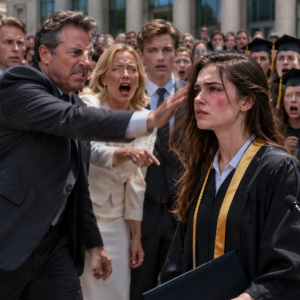
Beside him, my mother clutched Julian’s arm.
Julian tried to pull away.
That small movement told me everything.
He knew what was inside the envelope.
The university president stepped closer to me.
“Ms.
Vance, these are extremely serious allegations.”
“I know,” I replied.
“That is why I brought documentation.”
I broke the seal.
The sound of tearing paper seemed impossibly loud.
Inside were bank statements, copies of electronic transfers, scholarship records, tax documents, forged signatures, emails, and a notarized statement from a former employee of my father’s accounting firm.
I lifted the first document.
“When I was seventeen, my grandmother established an education trust in my name,” I said.
“It contained two hundred and eighty thousand dollars.
She intended it to pay for my college tuition, graduate school, housing, and any academic expenses I needed.”
Confusion moved through the crowd.
My mother shook her head violently.
“That is a lie!” she shouted.
“Her grandmother never gave her anything!”
I removed the original trust agreement.
The university president accepted it and examined the embossed seal.
“My grandmother’s attorney provided me with a certified copy three months ago,” I continued.
“The trust was real.
The money was real.
But shortly after my eighteenth birthday, nearly all of it disappeared.”
My father pushed through the people separating him from the stage.
“You have no idea what you’re talking about!”
“I know exactly where the money went.”
I held up a page showing a series of transfers.
“One hundred and twenty thousand dollars was moved into a company called Vance Future Holdings.”
Julian stopped pretending to be confused.
His mouth fell open.
I looked directly at him.
“That company was created for Julian’s first business.”
Everyone turned toward my brother.
He raised both hands defensively.
“I didn’t know where the money came from.”
“Maybe not at first,” I said.
“But you knew later.”
“That’s insane.”
I pulled out printed emails.
“One year after you launched the company, Dad wrote to you that the funding came from ‘Audrey’s useless little school account.’ You replied that I would probably drop out anyway.”
Julian’s face collapsed.
He glanced at our parents, silently begging them to rescue him.
They could not.
The truth had begun moving faster than their lies.
I read the next line.
“You also wrote, ‘She’ll never find out.
Mom already told everyone she couldn’t handle college.’”
A woman near the front gasped.
One of my aunts, who had traveled for the ceremony, covered her mouth with both hands.
For four years, she had sent me birthday messages saying she hoped I would eventually become responsible.
Now she knew why.
Julian’s voice rose.
“That email is out of context!”
“What context makes stealing from your sister acceptable?”
“I didn’t steal anything!”
My father finally reached the steps leading to the platform, but two campus security officers blocked him.
“Move,” he ordered.
Neither officer did.
I continued.
“Another sixty thousand dollars paid for Julian’s second company.
Thirty-eight thousand paid for his car.
Twenty-four thousand covered credit card debt.
Seventeen thousand paid for a luxury family vacation to Italy.”
I paused.
“I was not invited on that vacation.”
Several people in the crowd murmured angrily.
I remembered seeing the photographs online.
My mother had stood beneath the Tuscan sun wearing a white designer dress.
My father had raised a glass of wine.
Julian had posed beside a rented sports car.
The caption called it a celebration of family.
That same week, I had been sleeping in Paige’s dorm room because I could not afford my rent.
My mother pointed at me from below the stage.
“You ungrateful child! We raised you! We fed you! Everything we did was for this family!”
“No,” I said.
“Everything you did was for the image of this family.”
Her expression froze.
“You didn’t care whether Julian succeeded.
You only cared that people believed he had succeeded.
And you didn’t care whether I suffered.
You only cared that no one discovered I had achieved something without you.”
“That isn’t true,” she whispered.
“It is the only thing that has ever been true between us.”
For the first time, she looked smaller than I remembered.
But I was not finished.
“The theft was only the beginning.”
I lifted another document.
“When the trust company requested confirmation for the withdrawals, someone submitted forms containing my signature.”
I held the page toward the audience.
“I never signed them.”
My father’s anger shifted into something colder.
He stopped struggling against security.
That was the moment I knew he finally understood.
I had enough evidence.
Not just to humiliate him.
To prosecute him.
“My signature was forged,” I said.
“My Social Security information was used to approve transactions.
False tax statements were filed under my name.
When I later applied for financial assistance, I was told I did not qualify because the records showed I had already received money that I had never seen.”
Paige covered her mouth beside me.
“You told me the scholarship office made a mistake,” she whispered.
“I thought they had.”
The memory returned with painful clarity.
Freshman year.
A cramped financial-aid office.
A counselor telling me the system showed large educational distributions under my identity.
I had gone home that weekend and asked my parents for help.
My father called me irresponsible.
My mother said I was inventing problems for attention.
Julian sat at the kitchen island playing with the keys to his new car.
I had believed them.
For years, I had believed the confusion was somehow my fault.
“The false records nearly cost me my scholarship,” I said.
“They also created a tax debt in my name.
I discovered it when I tried to rent an apartment last year and failed the background check.”
The university president’s expression hardened.
“Ms.
Vance, have you reported this to the authorities?”
“Yes.”
My father closed his eyes.
The courtyard became completely still.
“I met with a federal investigator six weeks ago,” I said.
“I also submitted everything to the state financial crimes division.
They asked me not to confront my family until the records had been secured.”
My mother staggered backward.
Julian whispered, “Federal?”
I looked past them toward the entrance of the courtyard.
Two people in dark business suits were walking toward the stage.
A third person followed, carrying a leather folder.
My father recognized them immediately.
He had spent his career managing other people’s money.
He understood exactly what their presence meant.
“This was supposed to be a graduation,” he said weakly.
“It still is.”
The investigators reached the security officers and displayed identification.
One of them, a woman named Agent Morales, had met me three times in a quiet office across town.
She had listened without interrupting as I described the missing trust, the forged documents, the threats, and the years of manipulation.
She looked at my father.
“Arthur Vance, we need to speak with you regarding allegations of wire fraud, identity theft, tax fraud, forgery, and misappropriation of trust asseTS.”
My mother grabbed his sleeve.
“You can’t take him! This is a family misunderstanding!”
Agent Morales turned toward her.
“Victoria Vance, your name appears on several authorization forms.
We also need to speak with you.”
My mother released him as if his jacket had burned her hand.
“I only signed what Arthur gave me.”
My father stared at her.
It was the first crack in their alliance.
“You knew,” he said.
“I knew it was Audrey’s account, but you said parents were legally allowed to move the money!”
The crowd erupted.
My mother realized too late that she had confessed into the same live microphone she had tried to stop me from using.
Agent Morales glanced toward one of her colleagues.
He began writing.
My father’s face twisted.
“Victoria, be quiet.”
“You told me it was temporary!” she cried.
“You said Julian would repay it once his company became profitable!”
Julian backed away.
“Don’t bring me into this.”
My father turned on him.
“We did everything for you!”
“No, you didn’t,” Julian snapped.
“You did it because you wanted to brag about me!”
The words echoed through the courtyard.
I almost laughed at the cruel symmetry.
For years, they had united by making me the family failure.
Now, the moment consequences arrived, they tore one another apart.
Julian pointed at my father.
“He created the companies.
He controlled the accounTS. I just signed what he told me to sign.”
My father lunged toward him.
Security restrained him immediately.
“You spoiled, worthless coward!”
Julian’s expression changed.
Perhaps it was the first time our father had spoken to him the way he had always spoken to me.
Julian looked stunned.
Then wounded.
Then furious.
“I’m worthless?” he shouted.
“You spent my entire life telling me I was a genius! You paid people to fix everything I ruined! You blamed Audrey every time I failed because you couldn’t admit your perfect son was ordinary!”
My mother began crying.
Not quiet tears.
Loud, theatrical sobs that once would have made me rush to comfort her.
This time, I remained behind the microphone.
My father looked up at me.
There was no remorse in his eyes.
Only hatred.
“You think this makes you strong?” he said.
“Destroying your own family in public?”
I placed both hands on the podium.
“No, Dad.
Surviving you made me strong.”
A murmur of approval moved through the graduates.
 His Kids Boycott His Wedding After He Refuses To Invite Grandma, Family Drama Explodes
“You destroyed this family when you decided one child deserved everything and the other deserved nothing.
You destroyed it when you stole from me.
You destroyed it every time you lied about me to protect yourselves.”
I touched my aching cheek.
“And today, when you struck me because you could not control the truth, you destroyed the last excuse I ever had to protect you.”
The university president stepped toward the microphone.
“This institution does not tolerate violence on its campus.
Nor will we ignore credible evidence that one of our graduates was targeted through financial fraud.”
He turned toward the security officers.
“Please cooperate fully with the investigators.”
My father began shouting that he knew lawyers, judges, donors, and board members.
No one moved to help him.
Agent Morales asked him to place his hands behind his back.
My mother screamed when the restraints closed around his wrisTS.
Then an investigator approached her.
She looked at me desperately.
“Audrey, please.”
It was the softest she had spoken my name in years.
“You have to tell them this is a mistake.”
I studied her face.
Part of me still remembered the mother who brushed my hair when I was five.
The woman who once stayed beside my bed during a fever.
The person I had spent years hoping would return if I worked hard enough, behaved well enough, achieved enough.
But that mother had become a memory I used to excuse the woman standing before me.
“I already spent four years paying for your choices,” I said.
“I won’t pay for them anymore.”
Her face crumpled.
The investigators led my parents away through the crowd.
No one applauded.
It was not a victory that deserved celebration.
It was an ending.
And endings, even necessary ones, can still hurt.
Julian remained beneath the stage.
For the first time in his life, he stood completely alone.
He looked at me.
“I really didn’t know in the beginning.”
“But you knew eventually.”
He lowered his eyes.
“Yes.”
“Why didn’t you tell me?”
His answer came after a long silence.
“Because if you got the money back, I would lose everything.”
I nodded slowly.
There it was.
Not love.
Not confusion.
Not fear.
Convenience.
“You already lost everything,” I said.
“You just didn’t realize it because Dad kept buying replacemenTS.”
Julian’s eyes filled with tears.
“What happens to me now?”
“I don’t know.”
“You’re my sister.”
“I was your sister when I was working until two in the morning.
I was your sister when you laughed about me at family dinners.
I was your sister when you knew they were using my identity.”
He flinched.
“You don’t get to remember that we’re family only when you need mercy.”
I stepped away from the microphone.
My knees almost gave out.
Paige caught my arm.
The strength that had carried me through the speech disappeared all at once.
My entire body began shaking.
Paige wrapped her graduation gown around me and held me tightly.
“You did it,” she whispered.
“I don’t feel like I won.”
“Maybe winning doesn’t always feel good.”
The dean approached us.
He looked at the red mark on my cheek and then at the envelope of documenTS.
“Ms.
Vance, the ceremony is not finished.”
I stared at him.
“The valedictorian is still expected to deliver her address.”
A stunned laugh escaped me.
After everything that had happened, I had forgotten.
The speech.
The one I had rewritten six times.
The one I had planned to deliver before my father’s hand changed the day.
“I don’t think I can give the speech I prepared,” I admitted.
“Then give the one you need to give.”
The dean adjusted the microphone.
Paige squeezed my hand before stepping back.
I faced the graduating class.
Hundreds of people watched me.
Some looked horrified.
Some looked compassionate.
Some were crying.
I unfolded the original speech, stared at the first line, and then folded it again.
“When I arrived at this university,” I began, “I believed success meant proving people wrong.”
My voice trembled, but I continued.
“I believed that if I earned the best grades, worked the longest hours, and never asked for help, eventually the people who called me a failure would admit they were wrong.”
I looked toward the empty space where my family had stood.
“But today I learned something.”
The wind moved gently through the courtyard, rustling the sleeves of our graduation gowns.
“Success is not convincing cruel people to respect you.
It is learning that their disrespect does not define you.”
The courtyard remained silent.
“Some of us are graduating with families who supported us every step of the way.
Some of us are graduating despite the people who should have supported us.
Some are carrying debts, grief, fear, rejection, or secrets no one else can see.”
Paige wiped her eyes.
“We were taught that failure is falling behind.
Changing direction.
Asking for help.
Starting over.”
I shook my head.
“But failure is not struggling.
Failure is becoming so afraid of another person’s light that you try to extinguish it.”
A professor began applauding.
Then another.
Within seconds, the entire courtyard rose.
The sound washed over me.
Not because I had perfect grades.
Not because I had exposed my parenTS.
Because, for the first time, I was standing before the world without apologizing for surviving.
The months that followed were difficult.
My father was charged with multiple financial crimes.
The investigation uncovered that he had not only stolen from my trust but had also misused money from two clienTS.
My mother accepted a plea agreement after admitting she had signed fraudulent documents and lied to investigators.
Julian cooperated with prosecutors.
He sold his car, closed his remaining company, and surrendered assets purchased with the stolen funds.
Our relatives called me constantly.
Some apologized.
Others asked why I had not handled the matter privately.
I stopped explaining myself to people who cared more about the location of the truth than the crime itself.
The court ordered the return of what remained of my trust.
It was not the full amount.
Most of the money was gone.
But with recovered assets, damages, and the scholarship I had protected through sheer determination, I finally had enough to apply to graduate school without working three jobs.
I also filed to legally change my last name.
Not because I was ashamed of where I came from.
Because I wanted the name on my future accomplishments to belong to the person who had earned them.
I chose my grandmother’s name.
Audrey Bennett.
On the morning the change became official, I visited her grave.
I placed my graduation photograph beside the flowers.
In the picture, the mark on my cheek was faintly visible.
My cap sat slightly crooked.
Paige stood beside me, smiling proudly.
“I found the trust,” I told my grandmother.
“And I found myself too.”
A breeze moved through the trees.
For years, I had believed being rejected by my family meant I was unworthy of belonging anywhere.
But family was not merely blood.
Family was Paige bringing me food during finals.
It was the diner manager changing my shifts before exams.
It was the professor who wrote recommendation letters and never once treated my poverty as a lack of potential.
It was the dean who reminded me that my voice still mattered after someone tried to silence it.
One year later, I returned to the university courtyard.
Not as a frightened graduate.
As the founder of the Bennett Opportunity Fund, a small nonprofit created with part of the recovered money.
Its purpose was simple: to help students whose families used finances, manipulation, or abuse to control their education.
At the first scholarship ceremony, I stood before twelve studenTS.
Some had been disowned.
Some had escaped violent homes.
Some had worked in secret because their families believed education was wasted on them.
I handed the final scholarship to a young woman named Maya.
She stared at the envelope in disbelief.
“My father says I’ll never finish,” she whispered.
I remembered the cap rolling across the pavement.
The slap.
My mother’s pointing finger.
The microphone waiting for me.
I placed the envelope in Maya’s hands.
“Then don’t finish for him,” I said.
“Finish for yourself.”
She began to cry.
So did I.
That evening, after everyone left, I stood alone beside the same podium where my life had changed.
The courtyard was quiet.
Golden sunlight stretched across the stones.
For a moment, I could almost see the frightened young woman I had been—holding a sealed envelope, cheek burning, heart pounding, unsure whether telling the truth would destroy her.
I wished I could reach back through time and speak to her.
I would tell her that losing a family built on lies was not the same as losing love.
I would tell her that dignity sometimes arrives disguised as loneliness.
I would tell her that walking away does not make a daughter disloyal when staying requires her to disappear.
Most of all, I would tell her that the diploma lying on the pavement was never the greatest thing she earned that day.
The greatest thing she earned was her freedom.
My father had struck me because he believed fear would keep me silent.
My mother had called me a failure because she believed shame would make me small.
They were wrong.
I picked up my diploma.
I walked toward the microphone.
And when I finally told the truth, I did not destroy my family.
I simply stopped allowing them to destroy me.