Dad went colorless.
Not pale.
Not embarrassed.
Colorless.
The kind of gray that spread from his mouth to his temples when a man realized the lie he had controlled for years was no longer his to manage.
Ryan looked between him and Marisol.
“What does that mean?”
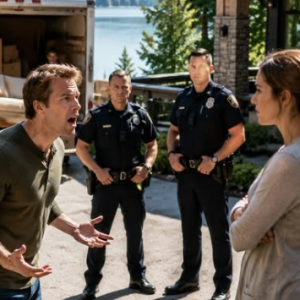
Marisol did not answer him immediately.
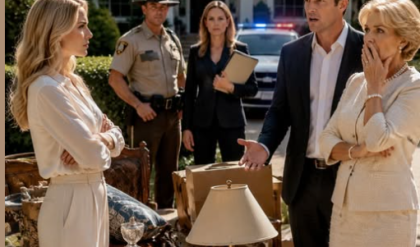
She turned toward the second sheriff’s cruiser parked near the cedar trees at the edge of my driveway.
The rear door opened.
A woman stepped out slowly.
She was in her late sixties, with silver hair pulled into a loose knot and a burgundy coat buttoned to her throat.
She held a worn leather folder against her chest as if it contained something fragile.
I recognized her before Dad said her name.
“Aunt Evelyn?”
My mother’s older sister stopped beside Marisol.
I had not seen her since Mom’s funeral.
Not because I had chosen distance.
Dad had told us Evelyn blamed the family for Mom’s death, wanted money, and had become “confused and vindictive.” Ryan had believed him because believing Dad had always been easier than questioning him.
I had believed him because grief had made me tired.
Evelyn looked at me with eyes so much like my mother’s that my breath caught.
“Hello, Claire.”
Dad stepped toward her.
One officer raised a hand, and he stopped.
“You have no business here,” Dad said.
Evelyn gave a small, exhausted laugh.
“That sentence has protected you for a long time, Thomas.”
Ryan slammed his coffee onto the hood of the moving truck.
“Can someone explain what’s happening?”
Marisol opened the folder she had shown Dad.
“Four years ago, shortly after your mother died, your father presented a lease claiming Evelyn rented him her cottage for one dollar per month for the remainder of her life.”
I stared at Dad.
Evelyn’s cottage stood forty miles north of my lake house.
It was the old family property where Mom and Evelyn had grown up.
I remembered summers there—blueberry pancakes, wet towels on the porch, Mom singing while she washed dishes.
Dad had told us Evelyn sold it to cover medical debTS.
Marisol continued.
“The document named Thomas as landlord, although Evelyn owned the property outright.
He then used the fraudulent lease to claim she had abandoned the home and violated the agreement.”
Megan covered her mouth.
“What happened to the cottage?” I asked, though suddenly I knew.
Evelyn looked directly at Dad.
“He sold it.”
The lake seemed to fall silent behind me.
Ryan shook his head.
“That’s impossible.”
“No,” Evelyn said.
“It was organized.”
Dad recovered enough to sneer.
“She signed the papers.”
“I signed a document allowing your mother to retrieve personal belongings after she entered hospice,” Evelyn said.
“Thomas replaced the signature page.”
I felt something cold move through my body.
Mom had spent her final months weak, medicated, and frightened.
Dad had managed the paperwork, the insurance, the accounTS. He had told Ryan and me that our mother did not want visitors because she was ashamed of how sick she looked.
Evelyn’s voice trembled.
“Your mother discovered what he had done three weeks before she died.”
Dad pointed at her.
“Stop.”
“She confronted him.”
“I said stop.”
The officers moved closer.
Evelyn’s eyes filled, but she kept speaking.
“Laura begged him to return the money.
She said she would tell both of you the truth.
The next morning, Thomas changed her phone number, dismissed her home nurse, and told everyone she wanted privacy.”
My grip tightened around the edge of the door.
For four years, I had lived with the guilt of believing my mother did not want to see me during her final week.
I had called every day.
Dad had always answered.
“She’s sleeping.”
“She’s confused.”
“She asked you not to come.”
The words returned with perfect cruelty.
“You told me Mom didn’t want me there,” I whispered.
Dad finally looked at me.
For half a second, I saw the old expression—the one that had once made me apologize before I knew what I had done wrong.
Then it disappeared.
“You were working,” he said.
“You had responsibilities.”
“I would have left.”
“You were always dramatic.”
The sentence broke something open inside me.
Not painfully.
Cleanly.
My father had spent my entire life calling my reactions excessive so no one would examine his actions.
Ryan stepped away from him.
“Dad, did Mom ask for us?”
Dad’s mouth hardened.
“She was dying.
She said many things.”
“Did she ask for us?” Ryan repeated.
Dad looked toward the lake.
Ryan’s face changed.
It was not redemption.
Not yet.
It was the first crack in a wall he had mistaken for truth.
Evelyn opened her leather folder and removed a small digital recorder sealed inside a plastic evidence bag.
“Laura knew he would lie,” she said.
“So she recorded their last argument.”
Dad lunged.
Both officers caught him before he crossed two steps.
The coffee cup rolled from the truck’s hood and burst across the gravel.
“Turn that off!” Dad shouted, though no one had turned it on.
His panic was confession enough.
But Marisol pressed play.
Static crackled.
Then my mother’s voice drifted across the porch.
Weak.
Breathless.
Alive.
“Thomas, give Evelyn back her house.”
Dad’s recorded voice answered, sharper and younger.
“You don’t understand the finances.”
“I understand theft.”
“I kept this family together.”
“You kept us dependent.”
My knees nearly failed.
Ryan gripped the side of the moving truck.
Mom continued.
“Claire will recognize the documents are false.”
A pause.
Then Dad laughed on the recording.
“Claire recognizes whatever I tell her to recognize.
She is exhausted, desperate for approval, and too afraid of conflict to challenge me.”
My vision blurred.
I waited for shame to arrive.
Instead, anger stood up inside me.
Not wild anger.
Not helpless anger.
The calm, permanent kind.
Mom’s voice returned.
“And Ryan?”
“Ryan wants what benefits him.
He’ll help me pressure her if I tell him it’s for the family.”
Ryan flinched as though Dad had struck him.
Megan turned away from him.
The recording continued for less than two minutes, but it dismantled thirty years.
Mom threatened to contact an attorney.
Dad threatened to declare her mentally incompetent.
She accused him of isolating her.
He told her no one would believe a dying woman over the husband caring for her.
Then Mom said the final words I would hear in her voice.
“You will lose both children, Thomas.
Maybe not today.
But one day they will see you clearly, and when they do, you will have no one left to blame.”
The recording ended.
No one spoke.
A bird landed on the porch railing, tilted its head, and flew away.
Dad stood between the officers, breathing hard.
He looked smaller than I remembered.
Not because age had diminished him.
Because truth had.
Marisol closed the recorder inside the folder.
“The evidence from Evelyn’s case matches the agreement created for Claire’s property,” she said.
“Same formatting errors.
Same false landlord designation.
Same witness address, which belongs to a mailbox rental store.”
One officer turned Dad around and placed handcuffs on him.
Ryan stared.
“You’re arresting him?”
“He is being detained while investigators review evidence related to forgery, fraud, unlawful property transfer, and financial exploitation,” the officer said.
“Your own involvement will also be reviewed.”
Ryan’s head snapped up.
“My involvement?”
“You submitted the false agreement to the moving company,” Marisol said.
“You represented yourself as a lawful tenant and attempted to enter the property with a key you knew Claire had not given you.”
“I didn’t know the lease was fake.”
Megan looked at him.
“You told me Claire signed it.”
“I thought Dad handled it.”
“You told the movers she was unstable.”
Ryan’s mouth opened.
Nothing came out.
Megan’s face tightened with a humiliation so raw that I almost looked away.
Almost.
She had helped plan my displacement.
She had measured rooms she had never entered.
She had told her children they were moving into my home before asking me a single question.
But she had also sold her lease based on Ryan’s lie.
Consequences rarely arrived in clean categories.
Megan lowered her clipboard.
“The kids are in the car.”
Ryan rubbed both hands over his face.
“Meg, I can explain.”
“No.
You can explain to them why we packed their rooms because you promised them a house that belonged to your sister.”
“It was supposed to become ours.”
The moment the words left his mouth, everyone heard them.
Ryan closed his eyes.
I stepped onto the porch.
The morning air smelled of wet stone and pine.
For the first time, I did not feel like a guest inside my own life.
“You never planned to stay temporarily,” I said.
Ryan looked at me.
“You planned to take it.”
His shoulders sagged.
“You don’t need this much space.”
“That is not an answer.”
“You’re alone.”
“That is not permission.”
“Dad said Mom wanted—”
“Do not use her again.”
My voice carried across the driveway with such force that even Dad stopped struggling.
I walked down the porch steps until I stood several feet from my brother.
“You do not get to turn my privacy into waste.
You do not get to call my recovery selfish because it cannot be used by you.
You do not get to decide that a woman living alone owns less than a man with a family.”
Ryan’s eyes grew wet, but I continued.
“For years, I gave you money because Dad said you were struggling.
I covered your car payment.
I paid the deposit on your first apartment.
I paid part of your wedding expenses after Dad said he was short.”
Megan looked sharply at Ryan.
“You said your father paid for the wedding.”
Ryan stared at the gravel.
I understood then.
Dad had not merely stolen property.
He had turned generosity into his own reputation.
“He took credit for my money,” I said.
Ryan’s silence answered.
Megan’s face collapsed.
“How much?” she whispered.
Ryan shook his head.
“Not now.”
“How much of our life was paid for by your sister while you let me thank your father?”
“Stop making this worse.”
“You made it worse.”
Their children watched through the truck window.
I saw the older boy lower his head.
That stopped me.
 Woman Backs Out Of House Deal Last Minute After Realizing Her “Room” Comes With Public Access
Not because Ryan deserved protection, but because the children deserved adults who did not use public destruction as entertainment.
I turned to Megan.
“There’s a motel in town with family suites.
Marisol can give you the address.
I’ll cover three nights directly with the front desk.”
Ryan looked at me with sudden hope.
I raised one hand.
“This is for the children.
It is not forgiveness, and it is not money handed to you.”
His hope disappeared.
Megan’s eyes filled.
“Thank you.”
“After three nights, you’ll need another arrangement.”
She nodded.
Ryan stepped toward me.
“Claire, we’re family.”
The officers were leading Dad toward the cruiser, but he heard the sentence and almost smiled.
It was his favorite weapon.
I looked at Ryan.
“Family is not a deed.
It is not a debt.
It is not access to whatever I own.”
“You’re really going to let them arrest Dad?”
“I did not forge the documenTS.”
“You called the police.”
“You came to take my house.”
His voice rose.
“Because he told me it was allowed!”
“And you believed him because the lie benefited you.”
Ryan stopped.
There it was.
The difference between being deceived and choosing deception because it offered a reward.
The officers placed Dad in the cruiser.
Before the door closed, he twisted toward me.
“You think you won?” he shouted.
“When this is over, everyone will know what kind of daughter you are!”
I walked closer to the vehicle.
The window was open enough for him to hear me.
“Yes,” I said.
“They will know I am the daughter who survived you.”
The cruiser door shut.
For several seconds, only the moving truck’s engine disturbed the morning.
Then the driver approached Ryan.
“Are we unloading or not?”
Ryan looked at my house, the officers, Megan, and finally me.
“No,” he said.
The truck left twenty minutes later.
Megan drove behind it with the children.
Ryan remained in the driveway after everyone else had gone, holding the useless spare key.
I waited inside the doorway.
He turned it over in his palm.
“I really thought he had the right,” he said.
“No, you thought he had the power.”
He looked up.
“There’s a difference.”
For once, he did not argue.
He placed the key on the porch railing.
“Did Mom really think I’d help him?”
“She knew who we were then.”
“And now?”
I looked at the man who had spent most of his life imitating our father and calling it strength.
“I don’t know who you are now.”
His face tightened.
“That depends on what you do next.”
He nodded slowly and walked away.
The legal case lasted eleven monThS.
Investigators found more than forged leases.
Dad had diverted money from Mom’s estate, sold Evelyn’s cottage through a shell company, and opened a line of credit using a signature Mom could not have written during the final month of her illness.
The cottage had been renovated and resold twice, which made returning it impossible.
But impossible was no longer the same as hopeless.
The court froze Dad’s remaining asseTS.
Evelyn received restitution from the sale of his house, his investment account, and a property he had secretly owned under another company’s name.
Ryan accepted a plea agreement for his role in submitting the false lease.
He avoided jail but completed community service, paid a fine, and signed a formal statement describing Dad’s instructions.
More importantly, he stopped lying.
Megan separated from him for six monThS.
I did not intervene.
I did not rescue.
I did not lend money.
The first time Ryan called asking for help, I told him to speak to a financial counselor.
The second time, he asked me to forgive him.
“I can’t forgive what you still don’t understand,” I said.
So he began therapy.
At first, I assumed it was another performance.
Then he sold his expensive truck, repaid part of what he owed me, and sent a spreadsheet listing every loan I had given him since college.
No excuses.
No request that I praise him.
Just numbers.
A year after the morning at the lake house, he came to visit alone.
He did not bring a key.
He knocked.
I opened the door but did not invite him in immediately.
He held a small cardboard box.
“I found these in Dad’s storage unit.”
Inside were letters.
Dozens of them.
All addressed to me and Ryan in Mom’s handwriting.
Dad had never mailed them.
Some were written before she became too weak to hold a pen.
Others were short, uneven pages composed during her final weeks.
My hands shook as I opened the last one.
Claire,
Your father mistakes your kindness for surrender because he does not understand that kindness is a choice.
One day, choose yourself without guilt.
I hope you find a place where the water is quiet and no one makes you earn the right to rest.
Love always,
Mom
I read it twice.
Then I walked through the house, opened the glass doors, and carried the letter down to the dock.
Ryan followed at a distance.
We sat without speaking.
The lake reflected a pale gold sunset.
The house behind us no longer smelled of fresh paint.
It smelled of coffee, cedar, books, and the rosemary bread Evelyn baked every Sunday.
She had moved into a guest cottage nearby using part of her restitution.
Not with me.
Near me.
That distinction mattered.
After a while, Ryan spoke.
“I’m sorry I became like him.”
I folded Mom’s letter carefully.
“You became useful to him.”
“That doesn’t excuse it.”
“No.”
“I thought if I kept him happy, he would finally respect me.”
I looked toward the water.
“He taught both of us to compete for something he never intended to give.”
Ryan nodded.
“Do you think Mom forgave him?”
“I don’t know.”
“Do you?”
I considered the question.
Dad had been sentenced to prison.
He sent letters blaming Evelyn, Marisol, Ryan, the court, and me.
He blamed everyone except the man whose signature appeared on the forged documenTS.
I stopped opening them after the third.
“I don’t need to forgive him to stop carrying him,” I said.
Ryan absorbed that.
Then he looked back at the house.
“Are you happy here?”
I smiled.
The answer surprised me with its simplicity.
“Yes.”
Not every day.
Not without grief.
But peace was not the absence of painful memories.
It was the absence of people demanding that pain make you easier to control.
Ryan stood to leave before dark.
At the end of the dock, he paused.
“Can I come back sometime?”
I looked at him.
He did not say because we are family.
He did not say Mom would want it.
He did not say I owed him.
He simply waited for an answer.
“Yes,” I said.
“But call first.”
A faint smile crossed his face.
“I will.”
Months later, Evelyn and I placed a bench near the shoreline with Mom’s name carved beneath the seat.
Not a monument to suffering.
A place to rest.
On the anniversary of her death, we sat there while the children skipped stones across the water.
Megan had returned to Ryan, but only after he signed a financial agreement, completed therapy, and told the children the truth in language they could understand.
He did not tell them Grandpa made a mistake.
He told them Grandpa stole from people who trusted him.
He told them he had helped because he wanted something that was not his.
And he told them being sorry mattered only when it changed what you did next.
As the sun lowered behind the trees, my nephew came and sat beside me.
“Dad says this is your house,” he said.
“It is.”
“And we have to ask before visiting.”
“That’s right.”
He considered this seriously.
“Even family?”
“Especially family.”
He nodded as if I had explained an important law of nature.
Then he handed me a smooth white stone he had found at the water’s edge.
“For your collection.”
I did not have a stone collection.
But I started one that day.
The first stone sat on my kitchen windowsill, glowing in the morning light.
For years, my father had taught us that love meant surrendering boundaries, money, privacy, and truth to whoever shouted “family” the loudest.
The lake house taught me something else.
A locked door was not cruelty.
A changed key was not betrayal.
And peace was not selfish merely because someone else wanted to occupy it.
The night Ryan called to evict me from my own home, he thought the house was the prize.
It was not.
The real victory was waking the next morning and understanding that no one—not my father, not my brother, not guilt, grief, or history—had the authority to remove me from the life I had finally chosen.
That evening, after everyone left, I stood alone on the dock.
The water moved gently beneath the fading sky.
Behind me, every window of my home glowed warmly.
I thought of Mom’s letter.
Choose yourself without guilt.
So I did.
Then I went inside, closed the door, and locked it—not because I was afraid of who might enter, but because I finally understood that protecting my peace was one of the ways I could honor the woman who had wanted me to be free.