Julián read the sentnce 4 times before the words settled inside him.
What your father buried under the kitchen.
For a moment, the whole house seemed to breathe around him.
The refrigerator hummed.
The hallway clock ticked.
A floorboard creaked somewhere upstairs, and Julián’s body turned cold.
He was not alone.
He closed the sewing box slowly, slipped the brass key into his pocket, and turned off the small lamp in his mother’s closet.
The room fell into darkness.
Through the half-open door, he could see the hallway stretching toward the stairs.
A shadow moved near the wall.
Julián did not call out.
He had spent 8 months in Abu Dhabi solving problems that could kill men if handled wrong.
Gas lines.
pressure chambers.
scaffolding hanging 40 stories above sand and steel.
He knew the difference between fear and warning.
This house was warning him.
He stepped behind the closet door just as the bedroom door opened wider.
Rebeca walked in.
She had changed clothes since the paramedics took Doña Estela away.
Her hair was tied back.
Her face was clean.
Too clean.
She looked less like a woman whose mother-in-law had been taken to the hospital and more like someone preparing for a meeting.
In her hand was a small flashlight.
She went straight to the closet.
Julián held his breath.
Rebeca pulled open drawers, lifted blankets, pushed aside shoeboxes, then froze when she saw the empty space where the blue sewing box had been.
Her whisper was ugly.
“No.”
She turned, and Julián stepped out of the darkness.
“Looking for this?”
Rebeca’s scream died before it became sound.
For one second, she looked like the woman he had married.
The woman who used to stand barefoot in the kitchen at midnight, eating mango with salt, laughing when he kissed her shoulder.
Then that woman disappeared, and the stranger returned.
“You scared me,” she said.
“Good.”
Her eyes dropped to the box in his hands.
“Julián, listen to me.
Whatever Marisol told you—”
“Marisol told me to look in a box.
The cameras told me the rest.”
The color left her face.
Not all at once.
Slowly.
Like someone watching fire move toward a locked door.
“What cameras?”
Julián smiled without warmth.
“The ones you didn’t find.”
Rebeca took a step back.
“You recorded me inside my own house?”
“My mother’s house,” he said.
“And I recorded you beating an old woman, forcing legal papers in front of her, hiding her medicine, and discussing a forged signature with Arturo.”
She stopped pretending.
Her mouth hardened.
“You don’t understand anything.”
“You’re right.
I don’t understand how you could do it.”
Rebeca laughed, but there was no confidence left in it.
“You think your mother is innocent? You think that sweet old lady in the hospital bed never lied to you?”
Julián’s hand tightened around the sewing box.
“Careful.”
“No, you be careful,” she snapped.
“That woman has controlled you your entire life.
She controlled your father.
She controlled the money.
She controlled everything.
And you left me here to rot with her while you played important man overseas.”
“I hired help.
I called every day.
I paid for nurses.
I trusted you.”
“You abandoned this house,” Rebeca said.
“You abandoned me.”
Julián stepped closer.
“And you punished my mother for it?”
For the first time, Rebeca had no answer.
A phone vibrated in her hand.
She looked down too quickly.
Julián saw Arturo’s name flash across the screen.
Before she could move, he took the phone from her.
Rebeca lunged, but he lifted it out of reach.
The message was already open.
“Did you get the key? He cannot find the kitchen safe before we do.
If he already has the box, leave the house now.”
Julián looked at her.
“The kitchen safe.”
Rebeca’s eyes filled with panic again.
“Give me my phone.”
“No.”
“Give it to me!”
He backed away, never turning his back to her.
“The police are coming.”
She froze.
“You called them?”
“I called them from the hospital parking lot.
I called my lawyer too.
And I sent the videos to 3 places you can’t touch.”
That was when the front door opened.
Arturo walked in with 2 men Julián had never seen before.
One wore a dark suit.
The other wore work boots and carried a crowbar.
Arturo stopped when he saw Julián at the top of the hallway.
Then he smiled.
“Cousin.”
Julián looked at the crowbar.
“You brought tools to visit my mother?”
Arturo sighed.
“Don’t make this dramatic.”
Rebeca ran past Julián and down the hallway.
“He has the box.”
Arturo’s smile vanished.
The man in work boots shifted the crowbar from one hand to the other.
Julián did not move.
“You have about 4 minutes before police arrive.”
Arturo laughed.
“Police in this neighborhood take 20 minutes, minimum.”
“Not when the call includes elder abuse, assault, forged documents, and 117 days of video evidence.”
The suited man looked at Arturo.
“Video evidence?”
Arturo’s jaw clenched.
Rebeca whispered, “He’s bluffing.”
Julián raised his phone and played the clip.
Arturo’s own voice filled the hallway.
“If she doesn’t sign, we use the old fingerprint.”
The suited man stepped back as if the sound itself had burned him.
Arturo’s face twisted.
“You always had to be the smart one.”
“No,” Julián said.
“I was the stupid one.
I trusted family.”
For a moment nobody spoke.
Then the man with the crowbar rushed him.
Julián swung the sewing box into the man’s wrist with all the force in his body.
The crowbar hit the floor.
Julián kicked it under the sideboard, grabbed the man by the collar, and shoved him into the wall.
Rebeca screamed.
Arturo ran toward the kitchen.
Not the door.
Not the street.
The kitchen.
And that told Julián everything.
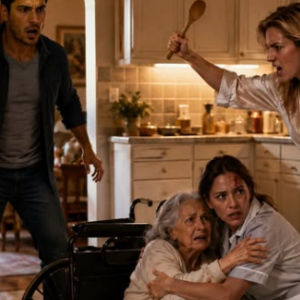
He chased him past the overturned wheelchair, past the place where his mother had lain on the floor, past the table where Rebeca had tried to turn cruelty into paperwork.
Arturo dropped to his knees beside the old pantry cabinet and pulled at one of the lower tiles.
Julián grabbed him by the back of his jacket.
Arturo spun and punched him in the jaw.
Pain exploded white behind Julián’s eyes.
He stumbled into the counter, caught himself, and saw Rebeca standing in the kitchen doorway with the crowbar.
She had picked it up.
Her hands were shaking.
But she was holding it like she meant to use it.
“Move,” she said.
Julián wiped blood from the corner of his mouth.
“Don’t do this.”
Her laugh broke.
“Do what? Lose? You think I’m going to lose everything because your mother hid papers like some saint in a novela?”
Arturo pulled the loose tile up.
Under it was a square metal plate with an old lock.
Julián heard sirens in the distance.
Rebeca heard them too.
Her eyes widened.
Arturo shouted, “The key!”
Rebeca raised the crowbar.
Julián looked at her and finally understood the most painful part.
She did not look guilty.
She looked cheated.
As if the real crime was being stopped.
“I gave you years of my life,” she said.
“You gave me a mask.”
“I was your wife.”
“My wife would have protected my mother.”
That sentence hit harder than any slap.
Rebeca lowered the crowbar an inch.
Then Marisol appeared behind her.
She had a white bandage above her eyebrow and hospital slippers on her feet.
In her hand was her phone, recording.
“Put it down, señora.”
Rebeca turned.
“You little rat.”
Marisol did not back away.
“You already hit me once.
This time everyone is watching.”
Behind Marisol, 2 officers entered the house with their hands on their holsters.
The kitchen filled with blue and red light from outside.
Arturo tried to run.
He made it 3 steps before an officer grabbed him and slammed him against the refrigerator.
Rebeca dropped the crowbar.
The sound echoed through the room like a judge’s hammer.
“No,” she whispered.
“No, no, no.
Julián, tell them.
Tell them it was a misunderstanding.”
Julián looked at the broken wheelchair.
He looked at the cabinet where his mother used to keep cinnamon cookies for him when he was a child.
Then he looked at Rebeca.
“The misunderstanding was mine.”
They arrested Arturo first.
Then the man with the crowbar.
Then Rebeca.
She screamed when the cuffs closed around her wrisTS.
Not because they hurt.
Because for the first time in months, she was the one who could not control the room.
“You’ll regret this!” she shouted as they pulled her toward the door.
“Your mother lied to you! Ask her why she kept that key! Ask her what your father really did!”
Julián said nothing.
But her words sank into him like a hook.
At 6:42 that morning, he stood alone in the kitchen with Marisol, 2 officers, and the metal plate beneath the loose tile.
One officer photographed everything.
The other asked for the key.
Julián reached into his pocket.
The brass key was warm from his hand.
It slid into the lock perfectly.
The plate opened with a dry metallic click.
Inside was not money.
Not jewelry.
Not gold.
Just a waterproof metal case wrapped in oilcloth.
Julián lifted it out with both hands.
It was heavier than it looked.
On top, written in his father’s handwriting, were 4 words:
FOR JULIÁN ONLY.
His knees almost weakened.
His father, Ernesto Vargas, had died 11 years earlier after a sudden fall at a construction site.
Everyone called it an accident.
A tragic slip.
A bad ladder.
A wrong step.
Julián had believed it because grief makes children believe whatever helps them survive the funeral.
But his mother had never spoken about that day without shaking.
She never wanted him near that old kitchen safe.
She never wanted Arturo around the house.
And 3 months before Julián went to Abu Dhabi, she had told him something strange while folding towels.
“If anything happens to me, don’t let Rebeca touch the blue box.”
He had laughed gently and kissed her forehead.
“Nothing will happen to you, Mamá.”
Now he wanted to go back in time and slap himself awake.
The officers took the case as evidence, but not before allowing Julián’s lawyer to arrive and witness the opening.
His lawyer, Camila Montes, came in a navy suit with wet hair and no makeup, looking like someone who had been dragged from sleep and was already furious.
She read the first folder from the case at the kitchen table.
Then the second.
Then the third.
By the time she reached the USB drive sealed in a plastic sleeve, her expression had changed completely.
“Julián,” she said quietly, “this is not just about your mother’s house.”
He sat across from her.
“What is it?”
Camila glanced at the officers, then at Marisol.
“It is land.”
“Land?”
“Four parcels outside Tuxpan.
Industrial access, water rights, and easement potential.
Your father bought them quietly in the 1990s through a family trust.
Your mother is the lifetime administrator.
You are the final beneficiary.”
Julián frowned.
“I don’t understand.
My father was a site engineer.
We were never rich.”
Camila placed a contract in front of him.
“You weren’t.
Not then.”
The top of the page carried the logo of a foreign energy consortium.
Camila tapped the number.
“This company wants a private storage route and service corridor through those parcels.
Forty-two million was only the first payment.
Long-term lease value could be 10 times that.”
Marisol covered her mouth.
Julián stared at the page.
“So Rebeca knew.”
“Arturo knew,” Camila said.
“And I think he told her.”
“Why wouldn’t my mother tell me?”
Camila’s face softened.
“Maybe she was protecting you.
Maybe your father asked her to wait.
Or maybe she suspected someone in the family had already killed once for those papers.”
The kitchen went silent.
Julián looked toward the doorway where Rebeca had stood.
“What did you just say?”
Camila opened the oldest envelope.
Inside was a photograph.
His father.
Younger.
Standing beside a pipeline survey marker.
Next to him stood Arturo’s father.
And behind them, half hidden, was Arturo at 19, wearing a red cap, staring at Ernesto with a look Julián recognized from the video.
Resentment.
Camila unfolded a handwritten statement.
“It’s from your father,” she said.
Julián reached for it, but his fingers trembled.
So Camila read aloud.
“If this letter is ever opened, it means Estela could no longer keep the truth hidden.
I believe my brother’s family knows about the land.
I believe Arturo has copied survey maps from my office.
If anything happens to me, protect Estela and Julián.
Do not allow any Salcedo to approach the trust.”
Julián closed his eyes.
His father had known.
His mother had known.
And Julián had left her alone with the enemy wearing his wedding ring.
At 9:15 that morning, Julián returned to the hospital.
Doña Estela was awake.
Her wrist was in a brace.
Her lips had color again.
But her eyes filled with fear the moment she saw him.
“Hijo,” she whispered.
“Did you go back?”
Julián sat beside her and took her hand carefully.
“I went back.”
Her face crumpled.
“No.
I told her.
I told Marisol to tell you no.”
“I wasn’t alone,” he said.
“The police were there.”
“Rebeca?”
“Arrested.”
A tear slid down Doña Estela’s cheek.
Not relief.
Something heavier.
“Arturo?”
“Arrested too.”
This time she broke.
Her small shoulders shook beneath the hospital blanket, and Julián leaned forward, holding her as gently as he could.
“I’m sorry,” she whispered.
“I’m sorry, my son.”
“You have nothing to be sorry for.”
“Yes,” she said.
“I do.
I should have told you years ago.”
Julián looked at her.
“Told me what?”
Doña Estela turned her face toward the window.
Outside, morning light spread over the city like nothing terrible had happened.
“Your father did not fall.”
Julián’s throat closed.
The words were quiet, but they split his life in two.
“He came home the week before he died,” she continued.
“He was nervous.
Not like Ernesto.
Your father was a brave man, but that night he locked every door twice.
He told me Arturo had been asking questions.
About the land.
About the trust.
About your name.”
Julián could barely speak.
“Why didn’t you go to the police?”
“I did.”
She swallowed.
“They said it was an accident.
Arturo’s uncle knew people.
Your father’s files disappeared.
The witness changed his statement.
And I had a 22-year-old son who had already lost his father.
I was afraid if I pushed, they would come for you next.”
Julián stood and walked to the window.
For 11 years, he had mourned an accident.
For 11 years, Arturo had eaten at his table.
For 11 years, Rebeca had smiled beside him at family gatherings.
And his mother had carried the truth alone.
“Why the sewing box?” he asked.
Doña Estela wiped her face.
“Your father gave me that box on our first anniversary.
He said nobody searches an old woman’s sewing things.”
Despite everything, Julián almost smiled.
Then his mother’s face changed.
“There is one more thing.”
He turned back.
“What?”
“Rebeca was not the first woman Arturo sent near this family.”
Julián went still.
Doña Estela looked ashamed.
“Years ago, before you met her, there was another.
She worked with Arturo.
She tried to get close to you after your father died, but you were too broken to notice.
Then Rebeca appeared.
Sweet.
patient.
helpful.
She knew when to call me Mamá.
She knew what food you liked.
She knew your grief.”
Julián’s stomach twisted.
“You’re saying my marriage was arranged?”
“I am saying Arturo chose her before you did.”
The room tilted.
Julián remembered the coffee shop where he first met Rebeca.
He remembered her dropping a folder near his table.
He remembered helping her pick up papers.
He remembered her laughing and saying, “Maybe fate wanted me to meet a gentleman today.”
Fate.
No.
Arturo.
His phone rang.
Camila.
He answered without greeting.
“We found the notary,” she said.
Julián gripped the phone.
“What notary?”
“The one tied to the forged medical authorization and property transfer.
He just gave a statement.
Rebeca and Arturo had a final appointment scheduled for tomorrow morning.”
“For what?”
Camila paused.
“To declare your mother mentally incompetent, transfer her administrative control to Rebeca as household spouse, and begin sale authorization on the trust asseTS.”
Julián looked at his mother.
She was watching him, already reading the horror on his face.
Camila continued.
“And Julián… they had a second document.”
“What document?”
“A spousal separation agreement.
Backdated.
It claims you abandoned Rebeca financially while overseas.
It would give her access to marital assets and strengthen her claim that she was the only caregiver in the house.”
Julián almost laughed.
Caregiver.
The word was obscene.
“There’s more,” Camila said.
“Marisol saved messages.”
He turned toward the hallway.
Marisol sat outside the hospital room, still in the slippers, holding a paper cup of coffee with both hands.
“She saved everything,” Camila said.
“Threats, payment offers, recordings.
Rebeca tried to bribe her.
Then she threatened to accuse her of stealing jewelry.
Yesterday, Marisol found Doña Estela locked in the pantry.”
Julián closed his eyes.
His mother squeezed his hand.
“I didn’t want you to leave your job,” she whispered.
“You were so proud.”
“No job is worth this.”
“I know.”
He knelt beside her bed.
“Mamá, look at me.”
She did.
“I failed you once.
Never again.”
By noon, the story began to spread.
Not because Julián posted it.
Not because Marisol posted it.
Because Rebeca had built her life on appearances, and appearances always collapse loudly.
Her friends heard first.
Then the neighbors.
Then the wives from the private club where Rebeca had spent months telling people she was “exhausted from caring for a difficult old woman.”
A woman from that club called Julián at 1:08 p.m.
“I just want you to know,” she said, voice trembling, “Rebeca brought your mother once.
She left her in the sun near the parking lot for almost an hour.
We thought… we thought she had permission.
I’m sorry.”
Another neighbor sent footage from a doorbell camera.
Rebeca pushing Doña Estela’s wheelchair too fast over uneven pavement.
Rebeca leaving grocery bags just out of reach while the old woman struggled.
Rebeca laughing on the phone while Doña Estela called her name from inside the house.
Every clip was another blade.
Every witness was another stone on Rebeca’s grave.
But the worst evidence came at 4:31 p.m.
Marisol entered Doña Estela’s hospital room carrying her cracked phone.
“I didn’t know if I should show you,” she said.
Julián stood.
 Woman Backs Out Of House Deal Last Minute After Realizing Her “Room” Comes With Public Access
“Show me.”
The video was shaky.
Marisol had recorded it secretly from the laundry room.
Rebeca stood in the kitchen with Arturo.
Doña Estela was not in frame, but her voice could be heard from the hallway.
“Please.
Don’t make him come home.
Leave Julián alone.”
Arturo replied, calm as smoke.
“If Julián comes home early, he disappears from this too.”
Rebeca said, “Don’t be stupid.
He’s my husband.”
Arturo laughed.
“He is your assignment.”
The room went silent.
Julián felt every part of him go numb.
Marisol lowered the phone.
“I’m sorry.”
He took one step back.
His mother began crying again.
Not because she was shocked.
Because she had known.
Julián looked at her.
“You heard that?”
Doña Estela nodded.
“That was the day I screamed.
The day I told Marisol, ‘No vuelvas a esa casa.’ I meant you.
I didn’t want you coming back into their trap.”
Julián sat down slowly.
Everything Rebeca had ever done rearranged itself in his mind.
The first meeting.
The fast affection.
The way she insisted on handling family papers.
The way she hated his mother’s old stories.
The way she celebrated when he accepted the Abu Dhabi contract.
Eight months away.
Eight months for Rebeca and Arturo to break Doña Estela.
Eight months to force signatures, steal keys, erase witnesses, and rewrite the truth before Julián came home.
But they made one mistake.
They thought distance made a son weak.
They forgot guilt can become fire.
Three days later, the first hearing took place.
Rebeca arrived in court wearing white.
Of course she did.
Her hair was soft around her face.
Her makeup was pale.
She walked carefully, like a wounded wife from a television tragedy.
Her attorney kept a hand near her elbow, guiding her as if she might collapse from sorrow at any second.
Julián sat across the room beside Marisol and Camila.
Doña Estela could not attend, but her recorded testimony had been submitted that morning.
Rebeca glanced at him once.
Then looked away.
A performance.
The judge entered.
The room rose.
Rebeca’s attorney began with a speech about stress, caregiver exhaustion, emotional pressure, and a “misunderstood domestic incident.”
Julián listened without blinking.
Then Camila stood.
She did not raise her voice.
She did not need to.
“Your Honor, this is not caregiver exhaustion.
This is a coordinated attempt to abuse, isolate, medically neglect, and financially exploit a 78-year-old woman for control of a trust connected to industrial land asseTS. We have video, audio, medical records, forged documents, witness testimony, digital messages, and attempted unauthorized access to a hidden family safe.”
Rebeca’s attorney stopped writing.
The judge looked over his glasses.
“Proceed.”
The first video played.
Rebeca lifting the spoon.
Marisol covering Doña Estela.
The courtroom changed.
Not loudly.
Worse.
Quietly.
People stopped shifting in their seaTS.
Rebeca stared at the table.
The second video played.
Arturo with the folder.
The forged power of attorney.
The line: “If she doesn’t sign, we use the old fingerprint.”
The judge’s face hardened.
The third video played.
“He is your assignment.”
For the first time, Rebeca looked at Julián.
Not with love.
Not even with hate.
With accusation.
As if he had betrayed her by surviving her.
When the judge denied bail restrictions and ordered expanded investigation, Rebeca’s mask cracked completely.
She stood.
“Julián, tell them!”
Her attorney grabbed her sleeve.
“Sit down.”
“No!” she shouted.
“Tell them your mother hated me! Tell them she turned you against me!”
Julián stood slowly.
The judge warned him to remain silent unless addressed.
But Rebeca kept screaming.
“I loved you!”
That was when Julián finally looked at her.
“No,” he said quietly.
“You studied me.”
The courtroom fell still.
Rebeca’s mouth trembled.
For a second, he thought she might cry.
Then she smiled.
A small, poisonous smile.
“You still don’t know everything.”
Camila touched Julián’s arm, warning him not to answer.
But Rebeca leaned forward as officers came toward her.
“Ask your mother about the night your father signed the second trust.”
Julián’s breath caught.
“What second trust?”
Rebeca laughed as they pulled her back.
“Oh, she didn’t tell you that part?”
The judge ordered her removed.
Her voice echoed as the doors closed.
“She kept one secret even Arturo never found!”
That night, Julián went back to his mother’s hospital room.
Doña Estela was awake, staring at the TV without watching it.
He closed the door.
“Mamá.”
She turned.
And before he said anything else, she started crying.
That was the answer.
“There’s a second trust,” he said.
Her hands twisted in the blanket.
“Yes.”
Julián sat beside her, exhausted beyond anger.
“What is it?”
Doña Estela looked at the window.
“Not money.”
“Then what?”
“A name.”
He frowned.
“What name?”
She reached for the cup of water, but her hand shook too badly.
Julián helped her drink.
When she finished, she whispered, “Marisol.”
Julián turned toward the door.
Marisol had gone to the cafeteria.
“What does Marisol have to do with this?”
Doña Estela closed her eyes.
“Her mother was named Clara.”
“I know.
Marisol told me she died when Marisol was young.”
Doña Estela nodded.
“Clara worked for your father.”
Julián waited.
“She was the only witness to what happened at the site the day Ernesto died.
She saw Arturo argue with him.
She saw Arturo leave the upper platform.
She saw your father fall minutes later.”
Julián’s pulse hammered.
“Why didn’t she testify?”
“She tried.” Doña Estela’s voice broke.
“They threatened her.
Then they took her little girl for one afternoon from school.
Just long enough to prove they could.”
“Marisol.”
“Yes.”
Julián felt sick.
“So my father created a second trust for Clara?”
“For Marisol,” Doña Estela said.
“Education.
protection.
A safe apartment.
Enough money so Clara could disappear if she needed to.
But Clara refused to leave.
She said if she ran, Arturo won.”
“What happened to her?”
Doña Estela looked at him.
“She died in a car accident 2 years later.”
Julián stood.
The room seemed too small for the truth.
“And Marisol never knew?”
“No.”
“Why did you hire her?”
“I didn’t,” Doña Estela whispered.
“Rebeca did.”
Julián froze.
“What?”
“Rebeca found her.
I don’t know how.
Maybe Arturo told her.
Maybe they thought keeping Marisol close would help them find out what Clara had left behind.
But when Marisol came into this house, I recognized her eyes.”
Julián’s voice dropped.
“And you didn’t tell her.”
“I was afraid.
If she knew, she would run.
If she ran, Arturo would know I remembered.”
Julián pressed both hands to his face.
The story had roots under rooTS.
Every time he thought he had reached the bottom, there was another locked door.
“Where is the second trust?”
Doña Estela pointed weakly toward the chair where Marisol’s sweater rested.
“In the hem.”
Julián stared at the sweater.
Doña Estela swallowed.
“The first week she worked at the house, I sewed a copy of the key into her sweater lining.
I told her it was a blessing stitch.
She laughed at me.”
Despite everything, Julián let out a broken breath.
“Mamá…”
“I was old,” she said.
“Not helpless.”
For the first time since his return, Julián saw her clearly.
Not as the fragile woman on the kitchen floor.
Not as the victim in the hospital bed.
But as the woman who had survived 11 years surrounded by wolves, hiding keys in sewing boxes and sweater hems, waiting for the one day when somebody would finally listen.
Marisol returned with coffee and stopped when she saw them staring at her sweater.
“What happened?”
Doña Estela held out her hand.
“Come here, niña.”
Marisol walked closer.
Doña Estela touched the sleeve.
“Your mother saved my husband’s truth.
I tried to save her daughter.”
Marisol went pale.
“What?”
Julián helped remove the stitch from the hem.
Inside was a tiny flat key sealed in plastic.
Marisol began to shake.
“No.
No, I don’t understand.”
Camila arrived 20 minutes later.
They opened the second safety deposit box the next morning under legal supervision.
Inside were Clara’s testimony, photographs, old police complaints, copies of threats, and a trust document naming Marisol Clara Reyes as beneficiary.
There was also a video.
Old.
Grainy.
Recorded on a construction camera from 11 years earlier.
It showed Ernesto Vargas arguing with Arturo near the platform.
No sound.
But the image was enough.
Arturo pointing.
Ernesto stepping back.
Arturo grabbing his sleeve.
A struggle.
A fall.
The official accident died right there on the screen.
Marisol collapsed into a chair.
Julián stood behind her, one hand on the back of the seat, unable to speak.
His father had not slipped.
Clara had not lied.
His mother had not imagined enemies.
And Marisol had not been a maid who accidentally stepped into a family war.
She had been part of the truth from the beginning.
Two weeks later, Arturo was charged again.
Not just for fraud.
Not just for elder abuse conspiracy.
For the death of Ernesto Vargas.
The news hit the family like a bomb.
Relatives who had ignored Doña Estela for years suddenly called Julián crying.
“I always suspected Arturo.”
“Your mother should have told us.”
“We’re family.
We want to help.”
Julián blocked most of them.
Family, he had learned, was not blood that arrived after evidence.
Family was a 26-year-old woman throwing herself over an old lady on a kitchen floor.
Family was a mother hiding the last truth in thread and cloth.
Family was not the people who shared your last name.
It was the people who stood between you and the blow.
Rebeca tried once to contact him from jail.
He refused.
Then she wrote a letter.
Camila advised him not to open it.
He opened it anyway.
Not because he missed her.
Because sometimes the last poison has to be seen to be thrown away.
The letter began with lies.
“I was scared.”
“I was manipulated.”
“Arturo used me.”
Then came excuses.
“You were gone.”
“Your mother hated me.”
“I only wanted security.”
And finally, buried near the bottom, the truth.
“You would never have chosen me if I came to you honestly.”
Julián folded the letter.
That sentence was the only honest thing Rebeca had ever given him.
He burned it in the metal sink of the empty house.
Then he called a contractor.
“I want the kitchen rebuilt,” he said.
“All of it.”
The contractor asked what style.
Julián looked at the tile where his mother had fallen.
“Bright,” he said.
“Open.
Nothing hidden.”
Three months later, Doña Estela came home.
Not to the old house.
Julián sold nothing.
Signed nothing.
Transferred nothing.
But he moved his mother into a smaller home with ramps, sunlight, a garden, and a room for her sewing machine by the window.
Marisol came too.
Not as a servant.
As family.
The second trust paid for her nursing degree, because after everything, she said she wanted to care for people who had no one strong enough to speak for them.
Doña Estela cried when she heard that.
“You already did,” she told her.
The court cases took time.
Real justice always does.
But the first conviction came sooner than anyone expected.
Not from the old murder.
Not from the land scheme.
From the video in the kitchen.
Rebeca stood before the judge without white clothes this time.
No soft makeup.
No wounded wife performance.
Just a woman with nowhere left to hide.
Doña Estela attended by video from her new home.
Her voice was weak but steady.
“For months, I believed maybe I deserved it because I was old.
Because I needed help.
Because my son was away and I did not want to ruin his life.
But I know now that needing help does not make a person worthless.”
The courtroom was silent.
Then Marisol spoke.
“She told me if I said anything, no one would believe a house worker over a wife.
She was wrong.”
Julián testified last.
He looked at Rebeca only once.
“I left my mother in the care of my wife.
I came home and found out my wife had become the danger.
That is something I will live with.
But what she did was not a bad day.
It was not stress.
It was not exhaustion.
It was a choice she made again and again because she thought an old woman’s voice did not matter.”
Rebeca stared at the table.
This time, she did not smile.
When sentencing came, she cried.
Maybe for herself.
Only for herself.
Arturo’s trial lasted longer.
The old video had to be authenticated.
Witnesses had to be found.
Dead files had to be reopened.
Men who had lied 11 years earlier suddenly forgot their lies when prosecutors showed them emails, payments, and phone records.
By the end, Arturo looked smaller than Julián remembered.
Not weaker.
Just exposed.
Without money, threats, and family silence around him, he was only a bitter man who had wanted what Ernesto built.
On the final day, Arturo turned toward Julián.
“You think your father was a saint?”
Julián stood from the bench.
“No,” he said.
“I think he was my father.
And you didn’t have the right to take him.”
Arturo looked away first.
That was the victory Julián had not known he needed.
One year after the night he opened the blue sewing box, Julián returned to the rebuilt kitchen.
Sunlight covered the new floor.
No hidden plate.
No broken wheelchair.
No blood.
No fear.
Doña Estela sat by the window, threading a needle with stubborn concentration.
Marisol, now in nursing school, stood at the stove pretending not to burn rice.
Julián leaned against the counter and watched them.
For the first time in a year, the house felt like a place people could breathe.
His mother looked up.
“You’re quiet.”
“I’m listening.”
“To what?”
Julián smiled.
“To the house.”
Marisol laughed.
“Houses don’t talk.”
Doña Estela tied a knot in the thread.
“This one does.”
Julián looked around.
Maybe she was right.
For months, that house had screamed through hidden cameras, loose tiles, old keys, and a blue sewing box nobody was supposed to open.
Now it spoke differently.
Through boiling coffee.
Through Marisol’s laughter.
Through his mother humming an old song while she sewed a crooked patch onto a kitchen towel.
Later that evening, Julián found the blue sewing box on the table.
Inside were normal things now.
Needles.
Thread.
Buttons.
A small pair of scissors.
But beneath them was a note from Doña Estela.
He unfolded it.
“My son, secrets protected us once, but they also cost us too much.
From now on, this family survives in the light.”
Julián pressed the note to his lips.
Then he placed it back inside the box.
Not as evidence.
Not as a warning.
As a promise.
That night, before turning off the lights, he checked on his mother.
She was asleep, one hand resting over the blanket.
Peaceful.
Safe.
He stood there for a long moment, letting the sight heal something in him that no court could reach.
Behind him, Marisol whispered from the hallway.
“She’s okay now.”
Julián nodded.
“Yes.”
But he knew the truth was bigger than that.
His mother was not okay because Rebeca was gone.
She was okay because someone had finally believed her.
And sometimes, that is where justice begins.
Not in a courtroom.
Not with a signature.
Not with revenge.
But with one person hearing a frightened voice from the kitchen and deciding never to ignore it again.