The sirens reached the uniform shop before Daniel found his voice.
Red and blue light flashed across the front windows, reflecting off polished brass buttons and glass display cases.
For one surreal second, the entire shop looked decorated for a military parade.
Then Daniel broke formation.
He lunged toward the envelope in my hand.
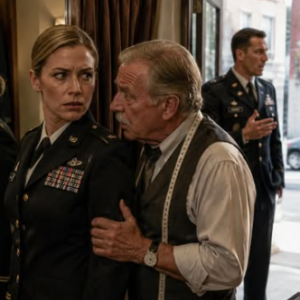
I moved before he reached me.
My left arm blocked his wrist.
I pivoted, used his momentum, and drove him against the glass counter hard enough to rattle every medal tray beneath it.
Frank seized Daniel’s other arm and twisted it behind his back.
Lieutenant Evan Price did not move.
He stood near the door, staring at us with the stunned expression of a man who had spent too long believing consequences were something that happened to other people.
“Get off me!” Daniel shouted.
“Emily, you’re making a mistake!”
I pressed his shoulder down.
“No, Captain,” I said.
“Marrying you would have been the mistake.”
Two military investigators entered first, followed by local police officers.
Frank had activated the silent alarm after pulling me into the fitting room.
One investigator was a broad-shouldered major named Lila Grant, whom I knew by reputation from the Criminal Investigation Division.
Her eyes took in the scene quickly: Daniel pinned to the counter, Evan frozen by the entrance, the envelope in my fingers, and Frank’s phone still recording.
“Colonel Mercer?” Major Grant asked.
“Yes.”
“Are you injured?”
“No.”
She looked at Daniel.
“Release him.
We have him now.”
Frank and I stepped back.
The officers placed Daniel in handcuffs.
The sound of metal closing around his wrists was quiet, but it cut through me more deeply than his confession had.
Daniel looked at me as if I had betrayed him.
That was the most astonishing part.
He truly believed I had done something to him.
“Emily,” he said, lowering his voice.
“You don’t understand what you heard.”
Major Grant took the envelope from me and opened it carefully.
Inside was the false ribbon rack Daniel had described, along with a folded note containing placement instructions and a cash payment receipt.
Frank gave a bitter laugh.
“Looks understandable to me.”
Daniel’s face changed.
The fear vanished behind a familiar expression of wounded sincerity.
It was the face he had used after missing dinners, canceling plans, and dismissing every concern I raised as stress.
“Emily, this was never supposed to hurt you,” he said.
I looked directly at him.
“You planned to destroy my career, steal classified procurement records, frame me for misconduct, question my mental stability, and accept money from a defense contractor.”
His jaw tightened.
“That sounds like harm.”
“It was leverage,” he insisted.
“That’s all.
You were never going to prison.”
Major Grant turned toward him.
“Captain Whitaker, you should stop talking.”
But Daniel had always mistaken charm for control.
He ignored her.
“The system is corrupt,” he said to me.
“You know that better than anyone.
Contractors make billions.
Senior officers retire into consulting jobs.
Everyone takes something.”
“Not everyone.”
“Don’t be naïve.”
The words struck me because he had said them before.
When we first met, he admired my principles.
He called my discipline inspiring.
He said honor was not an old-fashioned word when I used it.
Now he looked at the same principles and called them naïveté.
Perhaps that was what betrayal really was—not discovering that someone had changed, but realizing they had been studying your values only to learn how to weaponize them.
Major Grant read Daniel his righTS.
Evan finally spoke.
“I didn’t take any money.”
Everyone turned toward him.
He raised both hands.
“I knew Daniel was trying to discredit her, but I didn’t know about classified files.
I thought it was a promotion fight.
He said Colonel Mercer was blocking a contract and needed to be transferred.”
Daniel stared at him.
“Shut up.”
Evan stepped backward.
“You told me nobody would get hurt.”
“You coward.”
“No,” Evan said, his voice trembling.
“You’re not putting this on me.”
Major Grant gestured to another investigator.
“Lieutenant Price, you’re coming with us.”
Evan did not resist when they cuffed him.
Daniel did.
He twisted toward me as the officers led him away.
“You think they’ll protect you?” he shouted.
“You think command won’t bury this to avoid embarrassment? Tomorrow was supposed to make you useful.
Without me, you’re just a forty-two-year-old colonel who chose her career over having a family!”
The shop went silent.
His last weapon was not classified access, forged medals, or bribery.
It was cruelty.
He reached for the deepest insecurity he knew I carried and fired it like a final bullet.
I felt the impact.
But I did not fall.
I straightened my half-fitted jacket.
“You’re wrong,” I said.
“Tomorrow was supposed to make us a family.
You were the one who chose ambition instead.”
Daniel opened his mouth again, but the officers pushed him through the door.
The bell chimed above his head.
Then he was gone.
For several seconds, nobody spoke.
Frank slowly sat on the edge of the counter and rubbed his bad knee.
“Well,” he said, “I suppose the cuff links are staying here.”
A laugh escaped me.
It was small, broken, and completely inappropriate.
Then it became a sob.
I pressed one hand to my mouth.
Frank stood immediately, but he did not try to embrace me.
He understood soldiers.
Sometimes touching a person held together by discipline was the fastest way to make them collapse.
He simply stood beside me.
“I was going to marry him tomorrow,” I whispered.
“I know.”
“My father’s dress saber is already at the chapel.”
“I know.”
“Two hundred people are coming.”
“Then two hundred people are about to learn the ceremony has changed.”
I looked at him.
Frank nodded toward the mirror.
“You’re still standing, Colonel.”
In the reflection, I saw a decorated officer with swollen eyes, an unfinished hem, and a wedding jacket that suddenly felt like evidence from another life.
But Frank was right.
I was still standing.
The investigation began immediately.
For the next fourteen hours, I sat beneath white lights in a secure interview room while Major Grant and her team reconstructed the conspiracy.
Daniel’s phone revealed encrypted messages with a procurement executive named Calvin Rourke, regional vice president of Helix Defense Systems.
The messages went back eleven monThS.
Eleven monThS.
Daniel had proposed to me eight months earlier.
The engagement had not been the beginning of his plan.
It had been one of its operational phases.
He had targeted me after learning I was assigned to oversee a procurement review involving defective vehicle armor supplied by Helix.
My team had discovered cost manipulation, falsified durability tests, and maintenance failures that could have placed soldiers at risk.
I had recommended suspending the contract.
Daniel had recommended marrying me.
The investigators found payments disguised through consulting firms, photographs of documents taken inside my home office, and drafts of anonymous complaints describing me as emotionally unstable, obsessed with rank, and prone to wearing unauthorized decorations.
They also found recordings of our private conversations.
Daniel had recorded me discussing nightmares after my father’s death, fatigue after an overseas deployment, and frustration with senior command.
Ordinary moments of vulnerability.
He had labeled each audio file by category.
ANGER.
GRIEF.
PARANOIA.
BREAKDOWN MATERIAL.
I stared at the list on Major Grant’s screen until the words blurred.
“Turn it off,” I said.
She closed the file immediately.
“I’m sorry,” she said.
I looked down at my hands.
During combat deployments, I had seen maps marked with enemy positions.
I had watched analysts identify vulnerabilities in roads, communications systems, and defensive lines.
Daniel had mapped me the same way.
Not as a person.
As terrain.
At three in the morning, Major Grant placed a cup of coffee in front of me.
“There is something else,” she said.
I was afraid to ask.
“Rourke’s messages reference a second officer.
Someone senior enough to delay internal audits and redirect investigators.”
“Name?”
“We don’t have one yet.”
“Codename?”
“Chaplain.”
I leaned back.
The room suddenly felt colder.
“The wedding is in nine hours,” I said.
Major Grant nodded.
“We recommend canceling it quietly.
Make a statement later.
Let us continue without alerting possible accomplices.”
I understood her reasoning.
But Daniel had spent months building a narrative that I was unstable.
If I canceled the ceremony without explanation, rumors would spread before the truth did.
Photographs of the false medal might already exist.
Anonymous complaints could already be scheduled for release.
And two hundred guests—including senior officers, procurement officials, contractors, and command staff—would be gathered in one room.
I looked at the dark window beyond Major Grant’s shoulder.
“What if we don’t cancel?”
She studied me.
“Colonel?”
“The guest list includes Brigadier General Nathan Cole, deputy commander for acquisition oversight.
He personally approved Daniel’s transfer last year.”
“That does not make him involved.”
“No.
But it makes him relevant.”
“Attending the ceremony could expose you to unnecessary pressure.”
“The conspiracy was designed to activate after the wedding.
Someone expected the ceremony to happen.”
Major Grant’s eyes sharpened.
“You want to use the wedding.”
“I want to see who still expects the plan to succeed.”
She was quiet for a long moment.
Then she said, “You understand that this will not be a normal ceremony.”
I almost smiled.
“Major, nothing about tomorrow is normal anymore.”
At eight forty-five the next morning, sunlight poured through the stained-glass windows of Saint Michael’s Military Chapel.
The front steps were lined with white roses and crossed sabers.
Officers in dress uniforms filled the pews beside family members, civilian officials, and old friends.
A string quartet played softly near the altar.
The guests knew only that the ceremony had been delayed.
They did not know the groom was in custody.
My mother stood in the bridal preparation room, holding the veil she had carried from home.
She had flown from Colorado to watch me marry Daniel.
Instead, she found two CID investigators guarding the hallway and her daughter buttoning a colonel’s dress uniform instead of a wedding gown.
 School Counselor Locks Her Office After Repeated Boundary Violations, Staff Call It ‘Uncollaborative’
“You don’t have to do this,” she said.
“I know.”
“You can leave through the side entrance.”
“I know.”
“You’ve spent your entire life walking into rooms because other people needed you to be strong.”
Her voice shook.
“You are allowed to walk away today.”
I turned toward her.
My mother was seventy years old and still wore my father’s wedding ring on a chain around her neck.
She had buried a husband after thirty-eight years of marriage and never once pretended grief had made her weak.
“I’m not doing this because they need me to be strong,” I said.
“I’m doing it because Daniel counted on my silence.”
She searched my face.
Then she set the veil aside.
“What do you need from me?”
I held out my hand.
“Walk with me.”
At nine seventeen, the chapel doors opened.
The quartet stopped.
Every guest rose.
A murmur moved through the room when they saw me.
I was not wearing white.
I wore my dress uniform, fully corrected and inspected by Frank Dobbins.
My legitimate ribbons sat precisely above my heart.
My silver eagles gleamed at my shoulders.
At my side hung my father’s ceremonial saber.
My mother walked beside me.
There was no groom waiting at the altar.
Only Major Grant, two investigators, and the base chaplain.
I reached the front and turned to face the guesTS.
Confusion filled the chapel.
Daniel’s parents sat in the first row.
His mother looked terrified.
His father’s face had become rigid with disbelief.
Brigadier General Nathan Cole sat three pews back.
Beside him was Calvin Rourke of Helix Defense Systems.
Rourke had come to my wedding.
That was his mistake.
“Please be seated,” I said.
Nobody moved at first.
Then chairs creaked and uniforms shifted as two hundred people obeyed.
I looked across the room.
“Yesterday, I intended to stand here and take a vow of marriage.
That ceremony will not occur.”
A gasp came from the right side of the chapel.
I continued.
“Captain Daniel Whitaker was arrested yesterday afternoon as part of an investigation involving bribery, attempted theft of protected defense information, conspiracy to obstruct military procurement oversight, and a coordinated effort to falsely discredit a commanding officer.”
Rourke stood.
“This is outrageous,” he said.
“I will not sit here and listen to—”
The chapel doors closed behind him.
Two federal agents stepped into the aisle.
Major Grant said, “Mr. Rourke, please remain where you are.”
His face drained of color.
Then Brigadier General Cole rose.
“This is not the place for an arrest spectacle,” he said sharply.
“Colonel Mercer, whatever happened personally between you and Captain Whitaker should be handled through proper channels.”
The entire room went still.
I looked at him.
“Personally?”
Cole’s expression did not change.
“I am advising caution.”
“No, General.
You are repeating language from an anonymous complaint that was never officially filed.”
Major Grant stepped forward.
Cole’s eyes moved toward her.
That small movement told me everything.
I drew a folded document from inside my jacket.
“Investigators recovered a draft memorandum describing my objections to the Helix contract as emotionally motivated,” I said.
“The memorandum recommended removing me from procurement oversight after my marriage.
It was written three months ago.”
Cole said nothing.
“It contained a phrase Captain Whitaker used yesterday: command-pressure instability.”
A tremor ran through the guesTS.
I continued.
“That phrase appears in only one other document.
A private evaluation prepared by Brigadier General Nathan Cole.”
Cole stepped into the aisle.
“You are dangerously close to insubordination.”
“No, sir,” I said.
“I am dangerously close to the truth.”
He stared at me.
The authority in his face had intimidated hundreds of officers over the course of his career.
But authority without integrity was merely costume.
Major Grant approached him.
“General Cole, we need you to surrender your phone and accompany us.”
“You do not have the authority.”
The federal agent behind Rourke raised a warrant.
“We do.”
Cole looked around the chapel, perhaps expecting someone to defend him.
Nobody did.
His shoulders lowered by less than an inch.
It was enough.
As agents escorted Cole and Rourke away, whispers exploded across the pews.
Some guests stood.
Others reached for phones.
Daniel’s mother began to cry.
I waited until the doors closed again.
Then I faced everyone who remained.
“I apologize for bringing you here under false expectations,” I said.
“But I will not apologize for exposing people who believed a marriage ceremony could be used as cover for corruption.”
The chaplain moved closer.
“Colonel Mercer,” he said gently, “what would you like to do now?”
I looked at the flowers, the crossed sabers, and the empty place where Daniel had planned to stand.
The chapel had been prepared for a promise.
Perhaps it still could hold one.
I turned toward Frank Dobbins, who stood near the back in his old Army dress uniform.
He looked surprised when I called his name.
“Sergeant Dobbins, will you come forward?”
He limped down the aisle.
When he reached me, I removed my father’s saber and placed it across both palms.
“My father taught me that a uniform does not make a person honorable,” I said.
“It only makes dishonor easier to see.”
Frank’s eyes became wet.
I looked at the soldiers, officers, families, and civilians before me.
“Yesterday, a retired sergeant risked his business and his safety because he refused to let someone corrupt this uniform.
Today, instead of taking a marriage vow, I would like to renew a different one.”
The chaplain nodded.
Every service member in the room seemed to understand.
I raised my right hand.
“I, Emily Mercer, do solemnly reaffirm that I will support and defend the Constitution of the United States against all enemies, foreign and domestic…”
Across the chapel, officers slowly stood.
One by one, right hands rose.
Frank stood beside me.
My mother stood behind me.
Even Daniel’s father, trembling and ashamed, rose from the front pew.
The words filled the chapel—not as performance, but as a reminder.
An oath was not a sentence spoken once.
It was a choice repeated whenever keeping it became costly.
Six months later, Daniel Whitaker pleaded guilty to conspiracy, bribery, attempted theft of protected information, evidence fabrication, and conduct unbecoming an officer.
Evan Price accepted a lesser sentence in exchange for cooperation.
Calvin Rourke and General Cole were convicted after a federal trial exposed years of contract manipulation.
Helix Defense lost its contract.
The procurement review I had begun resulted in redesigned armor standards and criminal referrals across three states.
Frank’s tax liens were investigated too.
Daniel had exaggerated them, but the threat had not been entirely invented.
Frank’s shop was struggling under his son’s medical debt.
When word spread about what he had done, veterans from across the country began mailing uniforms to him for restoration.
Officers drove hours for fittings.
A military charity paid his son’s remaining treatment cosTS.
Frank changed the name above the door.
DOBBINS HONOR UNIFORMS.
He protested when I told him the name was dramatic.
Then he ordered a larger sign.
As for me, the board never removed me from command.
They offered me a promotion.
I declined the first offer.
Not because I was afraid of responsibility, but because I had finally learned that rank could become another hiding place.
I took three months of leave, visited my mother, slept without setting an alarm, and began speaking to a counselor about the grief and exhaustion Daniel had tried to use against me.
Seeking help did not prove I was unstable.
It proved I intended to remain whole.
One year after the canceled wedding, I returned to Saint Michael’s Chapel alone.
The roses were gone.
The pews were empty.
Afternoon sunlight rested softly across the floor.
I stood before the altar in civilian clothes.
No medals.
No insignia.
No saber.
Just Emily.
Frank had asked me once whether I regretted stepping out of the fitting room.
I had told him no.
That was not entirely true.
I regretted many things.
I regretted trusting Daniel.
I regretted the years I had mistaken emotional distance for independence.
I regretted every moment I had made myself smaller so a dishonest man could feel larger.
But I did not regret hearing the truth.
The chapel doors opened behind me.
My mother entered carrying two cups of coffee.
“You planning another ceremony?” she asked.
I smiled.
“No.”
She handed me a cup and stood beside me.
After a while, I said, “I thought that wedding was supposed to prove I hadn’t missed my chance at a family.”
My mother looked toward the empty altar.
“A family is not proof of anything.”
“I know that now.”
She linked her arm through mine.
Outside, bells rang across the base as the flag was lowered for the evening.
We walked toward the doors together.
I had entered that chapel a year earlier believing my life had been destroyed before it could begin.
But a ruined plan was not a ruined life.
Sometimes the door that closed was not keeping happiness from you.
Sometimes it was keeping you from marching willingly into your own destruction.
And sometimes the most meaningful vow a person could make was not to remain beside someone else forever.
It was to never again abandon herself.