I didn’t offer a single word of protest.
For two years, I had protested quietly.
I had defended Dominic when my father questioned his judgment.
I had explained away Victoria’s insults as concern.
I had laughed weakly when Natalie mocked my clothes, my cooking, and my supposedly modest upbringing.
I had convinced myself that marriage required patience, forgiveness, and sacrifice.
But sacrifice was not supposed to mean surrendering your dignity.
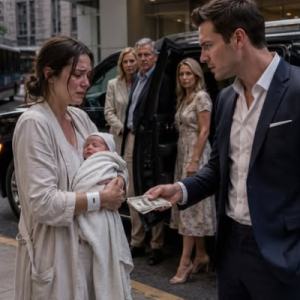
Mr. Vance guided me into the waiting vehicle while the neonatal nurse secured Leo beside me in a specially prepared infant seat.
The medical officer examined my incision before we left the curb.
“You should never have been placed on public transportation in this condition,” she said, struggling to hide her anger.
“Your blood pressure is elevated, and the swelling around the incision needs immediate attention.”
Mr. Vance’s jaw tightened.
He made one phone call.
“Inform Mr. Brooks that Ms.
Brooks and the baby are safe.
Also tell legal counsel to begin Phase One.”
I looked at him.
“What is Phase One?”
He met my eyes through the rearview mirror.
“Your father has been preparing for this possibility since the day Dominic asked for your hand.”
I should have been surprised.
Instead, I felt strangely relieved.
My father had never trusted Dominic completely.
He had respected my decision, but he had quietly protected me in the only way he knew how—with contracts, contingency plans, and people who noticed what I was too determined to ignore.
The vehicle did not take me to the apartment.
It carried me across Manhattan to Brooks House, the limestone mansion where I had grown up.
I had avoided returning there for years because I wanted to prove I could build a life without my father’s name.
As the iron gates opened, I realized how foolish that pride had become.
Home was not the place I had failed to escape.
Home was the place where no one would ask me to bleed quietly so they could make a lunch reservation.
My father stood at the top of the front steps before the vehicle had fully stopped.
Charles Brooks was known in business circles as a man who could silence an entire boardroom by removing his glasses.
Yet when the nurse placed Leo in his arms, his expression broke.
He stared at his grandson’s tiny face.
Then he looked at me.
“Did he touch you?”
“No.”
“Threaten you?”
“Not directly.”
“Prevent you from receiving medical care?”
I hesitated.
“He knew I was in pain.
He simply didn’t care.”
My father closed his eyes for one second.
When he opened them, the tenderness had vanished.
“Then he has made his decision.”
He handed Leo back to the nurse and wrapped his coat around my shoulders.
“Now we make ours.”
Inside, an entire suite had been prepared for us.
There was a bassinet beside the bed, a medical recliner, bottles, diapers, blankets, and every postpartum supply imaginable.
My father had arranged everything during the short time I was on the bus.
But waiting in the adjoining library were three attorneys, the chief financial officer of Brooks Global, and a woman I recognized immediately.
Marianne Cole.
She was the lead partner of the investment firm that had saved Dominic’s technology company eighteen months earlier.
Dominic believed Marianne admired his intelligence.
In truth, she had taken his meetings because my father had asked her to evaluate whether the company was worth protecting for my sake.
Marianne stood as I entered.
“Audrey, I’m sorry.”
“For what?”
“For confusing your loyalty to your husband with confidence in his leadership.”
She placed a thick folder on the table.
“Dominic’s company has been surviving on funding connected to Brooks Global.
Directly and indirectly, your family controls forty-one percent of the voting interest.”
I stared at her.
“Forty-one?”
“Through several independent funds,” my father said.
“Your marriage agreement prevented Dominic from claiming any ownership in your family assets, but it did not prevent me from protecting an enterprise tied to your financial future.”
One attorney slid another document toward me.
“More importantly, Mrs. Hale, you personally own fifteen percent.”
I looked down at the signature.
Mine.
Years earlier, before Dominic’s first investor presentation, I had used money from a trust account to keep his company alive.
Dominic had described it as a temporary personal loan.
My father’s attorneys had structured it as convertible equity.
Dominic had never bothered to read the full agreement.
He had been too busy congratulating himself.
“If the Brooks-affiliated investors vote together,” Marianne continued, “we can suspend Dominic as chief executive pending a formal review.”
“On what grounds?”
She opened the folder.
“Misuse of company property.
Undisclosed personal expenses.
Manipulation of financial projections.
Retaliation against employees.
And possibly an inappropriate relationship with a senior executive.”
My stomach tightened.
“Which executive?”
Marianne hesitated.
“Natalie.”
The room seemed to tilt.
“Natalie is his sister.”
“No,” my father said quietly.
“She is Victoria’s daughter from a previous marriage.
Dominic and Natalie were raised together, but they are not related by blood.”
My mind returned to the SUV.
Dominic laughing beside her.
The months of private dinners he called strategy meetings.
The hotel charges he claimed were investor expenses.
The way Natalie looked at Leo without warmth, almost as if my son’s existence inconvenienced her.
“Are you saying they’re having an affair?”
“We are saying,” the attorney replied carefully, “that company security recovered messages suggesting an intimate relationship.
The investigation is ongoing.”
I pressed my hand over my incision as a deeper pain moved through my body.
For two years, Dominic had accused me of being suspicious whenever I asked why Natalie accompanied him on business trips.
He had called me insecure.
Emotional.
Unstable.
All while telling me I should be grateful to belong to his family.
My father came around the table.
“You don’t need to deal with this tonight.”
“Yes,” I said.
My voice was weak, but it did not shake.
“I do.”
I looked at the documents again.
“Remove him.”
The vote took place at four o’clock that afternoon.
Dominic was still seated at an exclusive restaurant with his mother, Arthur, and Natalie when his corporate access was terminated.
His company credit cards stopped working first.
Then his phone lost access to internal email.
Then the chief operating officer called to inform him that an emergency board meeting had suspended him as chief executive.
According to Marianne, Dominic laughed.
He told them they could not remove the founder from his own company.
Then legal counsel read the voting totals.
The laughter stopped.
At 4:17 p.m., my phone began ringing.
I watched Dominic’s name flash across the screen from my bed while Leo slept beside me.
I did not answer.
He called again.
And again.
By the ninth call, the messages started.
AUDREY, WHAT DID YOU DO?
CALL ME NOW.
THIS IS MY COMPANY.
TELL YOUR FATHER TO STAY OUT OF OUR MARRIAGE.
Then:
I KNOW YOU’RE UPSET ABOUT THE BUS, BUT YOU’RE OVERREACTING.
Finally:
MY MOTHER IS CRYING.
YOU’RE DESTROYING THIS FAMILY.
I read that message twice.
Five days after I had been cut open to deliver his son, Dominic had left me outside a hospital with bus fare.
Yet somehow his mother’s tears were the emergency.
I turned the phone face down.
At six that evening, security informed us that Dominic’s SUV had arrived at the front gate.
My SUV.
The vehicle my father had given me before the wedding.
Dominic stood outside the gates, pounding the intercom button while Victoria shouted at the cameras mounted above the entrance.
Arthur remained near the vehicle, pale and silent.
Natalie paced behind them, staring at her phone.
“Let us in!” Victoria demanded.
“Audrey belongs with her husband!”
My father looked toward me.
“You don’t have to see them.”
“I know.”
I rose slowly from the bed.
The medical officer objected, but I promised I would remain seated.
Mr. Vance arranged a chair inside the entrance hall, beyond the locked glass doors.
The outer gates opened just far enough to allow Dominic through on foot.
He entered alone.
The moment he saw me, he rushed forward.
Two security officers stepped between us.
“Audrey, tell them to move.”
I looked at him carefully.
His expensive tie was loosened.
His hair was disordered.
The confidence he wore like armor had cracked around the edges.
“Where is Leo?” he asked.
“Safe.”
“He’s my son.”
“He was also your son when you left him at the hospital.”
Dominic flinched.
“I made a mistake.”
“No.
You made a choice.”
“My mother needed the car.”
“The car belongs to me.”
“We’re married.
That means it belongs to both of us.”
One of the attorneys stepped forward.
“That is incorrect.
The vehicle was acquired before the marriage and remained registered solely to Mrs. Hale.”

Dominic’s face hardened.
“This is between me and my wife.”
I almost laughed.
He had remembered I was his wife only after the board removed him.
“Did you sleep with Natalie?” I asked.
The color drained from his face.
For several seconds, he said nothing.
That silence answered me more clearly than any confession.
Then he tried to recover.
“You’ve just had a baby.
You’re emotional.”
The old words.
The old trick.
Make me doubt myself.
Make me feel ashamed for noticing the truth.
This time, the words had no power.
“Answer the question.”
“It was complicated.”
“No.
It was betrayal.”
“She understood the pressure I was under.”
“And I didn’t?”
“You were always tired.
Always complaining about the pregnancy.
Everything became about doctors, appointments, and the baby.”
I stared at him in disbelief.
“My pregnancy was about the baby, Dominic.”
“You stopped supporting me.”
“I used my trust to save your company.”
“You never told me your family controlled the investors!”
“Because I wanted to know what kind of man you would become if you thought no one powerful was watching.”
His mouth opened.
Nothing came out.
I continued.
“And now I know.”
Victoria’s voice echoed from beyond the gate.
“Dominic, don’t apologize to her! She trapped you!”
My father stepped into the hall.
He had remained silent until that moment.
“Your son pursued my daughter for nearly a year,” he said.
“He accepted her money.
He drove her vehicle.
He lived in a residence purchased through her trust.
He built his company with capital obtained because investors believed Audrey’s judgment carried weight.”
Dominic turned toward him.
“You hid all of this from me.”
“No,” my father replied.
“Audrey gave you the opportunity to reveal who you were without being influenced by her wealth.”
He paused.
“You revealed yourself perfectly.”
Dominic looked back at me.
“Please.
Let me see Leo.”
For one painful second, I remembered the man he had been when we met.
The man who brought me coffee during early meetings.
The man who once sat on the kitchen floor assembling a crib, laughing because the instructions made no sense.
Perhaps some part of that man had been real.
But real love was not measured by who someone was when life was easy.
It was measured by who they became when you were weak enough to need them.
“You will see Leo through arrangements approved by the court,” I said.
“Until then, all communication goes through my attorney.”
“Audrey, don’t do this.”
“I didn’t.”
I held his gaze.
“You did.”
The attorney handed him a sealed envelope.
Divorce papers.
A temporary custody petition.
A demand that he vacate the apartment within forty-eight hours.
And formal notice that Brooks Global was initiating a forensic audit of his company’s finances.
Dominic stared down at the envelope.
“What am I supposed to do now?”
It was almost the same question I had wanted to ask outside the hospital.
What was I supposed to do with a newborn, a fresh incision, a diaper bag, and a handful of bus fare?
No one in his family had cared.
So I gave him the same amount of compassion he had given me.
“I’m sure there’s a bus nearby.”
My father did not smile.
Neither did I.
Some moments were too serious for triumph.
Dominic left the mansion on foot.
The SUV remained behind.
The next three months changed everything.
The financial audit uncovered more than arrogance.
Dominic had used company funds to pay for luxury vacations, gifts for Natalie, private dining, and a secret apartment in Tribeca.
He had also inflated projected revenue to secure another round of investment.
The board terminated him permanently.
Federal regulators opened an investigation into the financial statemenTS.
Natalie disappeared from social media and retained her own attorney.
When investigators offered reduced consequences in exchange for cooperation, she provided years of messages, receipts, and recordings.
Victoria called me cruel.
Arthur called me vindictive.
Dominic called me nearly every day until the court ordered him to communicate only through a parenting application.
Yet none of them ever apologized for leaving Leo and me outside the hospital.
They apologized only for what happened afterward.
That taught me something I would never forget.
Some people do not regret hurting you.
They regret discovering that hurting you has consequences.
The divorce was finalized eleven months later.
Dominic received supervised visitation until he completed parenting classes, therapy, and a court-approved family responsibility program.
I did not try to erase him from Leo’s life.
A child should not be used as a weapon.
But I would never again confuse access with entitlement.
Being a father was not a title Dominic could demand.
It was a responsibility he had to earn.
I returned to Brooks Global gradually.
Not as Charles Brooks’s hidden daughter.
Not as Dominic Hale’s quiet wife.
As Audrey Brooks.
I created a foundation that provided safe transportation, temporary housing, medical support, and legal assistance to women recovering from childbirth without reliable family care.
We called it the Homeward Project.
Our first program partnered with hospitals across New York to ensure no recovering mother carrying a newborn would ever be discharged without a safe way home.
The bus driver who had lowered the steps for me became one of our first transportation supervisors.
His name was Samuel Ortiz.
When I offered him the position, he looked stunned.
“I only did what anyone should have done,” he said.
“That day,” I told him, “you did more for my son and me than the people who called themselves our family.”
On the first anniversary of Leo’s birth, my father stood beside me at a small garden party behind Brooks House.
Leo had begun taking uncertain steps between us, laughing every time he fell onto the grass.
My father watched him with tears in his eyes.
“Do you regret calling me?” he asked.
I knew what he truly meant.
Did I regret revealing the truth?
Ending my marriage?
Taking away Leo’s chance to grow up in one home with both parents?
I looked at my son.
“No.”
The answer came easily.
“I regret waiting so long to believe I deserved help.”
My father nodded.
Then Leo pushed himself upright again and reached for me.
I lifted him carefully, though my scar still ached during cold weather.
That scar no longer reminded me of the day Dominic abandoned us.
It reminded me that I had survived bringing a life into the world.
It reminded me that weakness and helplessness were not the same thing.
And it reminded me that the few crumpled bills Dominic pressed into my hand had purchased something he never intended to give me.
A journey away from him.
Years later, when Leo was old enough to ask why his parents did not live together, I told him the truth without hatred.
I said that sometimes people make choices that break trust.
I said forgiveness does not always mean returning.
And I said love should never demand that someone suffer in silence to keep a family looking whole.
Then I showed him a framed set of bus tickets displayed in my office.
The original fare Dominic had given me.
Beside it was a photograph of the first Homeward Project vehicle carrying a mother and her newborn safely home.
Leo pointed at the money.
“Why did you keep it?”
I kissed the top of his head.
“Because that was the day I learned something important.”
“What?”
I looked through the office window at the city below.
At buses moving through crowded streeTS.
At mothers carrying children.
At millions of people traveling toward lives no one else could see.
“Sometimes,” I said, “the smallest amount someone gives you is enough to show exactly how little they value you.”
Leo frowned, trying to understand.
I smiled and pulled him closer.
“But it can also be enough to take you somewhere better.”
And that was how the worst journey of my life became the first step toward freedom—not because my father was powerful, not because Dominic lost his company, and not because the people who humiliated me finally faced consequences.
I became free because, for the first time, I stopped waiting for the people who wounded me to decide that I was worthy of kindness.
I chose it for myself.
And I chose it for my son.