
Thomas slowly set his car keys into his pocket.
Not because he had calmed down.
Because he knew that if he spoke while anger controlled him, his children would remember his rage instead of his love.
He walked straight toward Jacob first.
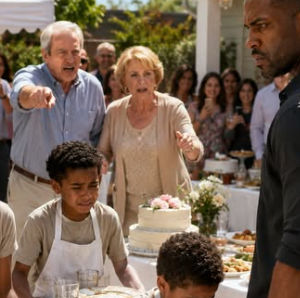
The little boy immediately dropped the rag.
“Daddy…”
His tiny voice cracked.
Thomas knelt beside him.
“Who told you to clean the tables?”
Jacob looked over his shoulder before answering.
“Grandma said… she said good boys help.
But then Aunt Melissa said I wasn’t doing it right.”
Thomas gently wiped Jacob’s dirty hands with his own handkerchief.
“You’ve done nothing wrong.”
Then he stood.
“Rebecca.”
His daughter looked as though she wanted to run into his arms but was afraid she would get in trouble.
“Dad… Grandma said we had to earn our lunch.”
Those words struck him harder than any insult ever had.
“You had to what?”
Rebecca lowered her eyes.
“She said because we’re… different.”
Samuel quietly added, “Grandpa said we’re not a real family.”
Silence.
Not in the yard.
Inside Thomas.
Something that had survived years of criticism finally stopped fighting to survive.
He turned.
Robert was standing beside the barbecue with a plate piled high.
Helen stood proudly beside the birthday cake, greeting guests as if nothing unusual had happened.
Thomas walked toward them.
Every conversation slowly faded.
“What exactly is happening here?”
Helen laughed softly.
“Oh, don’t be dramatic.”
Robert shrugged.
“They’re learning responsibility.”
Thomas nodded once.
“Responsibility?”
“Yes.”
“My six-year-old is scrubbing tables.”
“They’re children.”
“My eight-year-old is carrying heavy trays.”
“They need discipline.”
“My daughter was told she has to earn food.”
Helen folded her arms.
“If Thomas couldn’t build a proper family the way God intended, then at least his children can learn to serve people from a young age.”
Several relatives nodded.
Someone even muttered, “She’s right.”
Thomas looked around the garden.
Faces.
So many familiar faces.
People who had watched his children work while they sat eating meals he had paid for.
He took a slow breath.
Then another.
“Everybody.”
His voice wasn’t loud.
Yet every head turned.
“I’d like everyone’s attention for just a minute.”
The music stopped.
Even the teenagers lowered their phones.
Thomas walked to the microphone beside the birthday cake.
“I planned today’s celebration because I wanted to honor my mother.”
Helen smiled proudly.
“I rented this venue.”
People nodded.
“I paid for every chair.”
More silence.
“The food.”
“The flowers.”
“The decorations.”
“The music.”
“The cake.”
“I paid every single invoice.”
Robert frowned.
“What are you doing?”
Thomas ignored him.
“For years my parents have introduced me as the son who disappointed them.”
A few relatives shifted uncomfortably.
“They tell everyone I have three children with three different women.”
He looked toward Rebecca.
“That part is true.”
Then toward Samuel.
“I made mistakes.”
Toward Jacob.
“I’ve apologized for those mistakes.”
“But these three children…”
His voice softened.
“…have never been mistakes.”
Rebecca began crying openly.
Thomas continued.
“I’ve worked eighteen-hour days so none of them would ever wonder whether they were loved.”
“I missed birthdays because I was building businesses.”
“I slept in restaurant offices.”
“I sold my truck.”
“I refinanced everything I owned.”
“So these kids could have stable homes.”
He looked directly at Robert.
“And while I was doing that…”
“…I was also paying my parents’ mortgage.”
Gasps rippled across the yard.
Robert’s face turned pale.
Helen immediately interrupted.
“That’s private!”
Thomas nodded.
“It was.”
He reached into his jacket.
“I brought copies.”
Everyone stared.
He unfolded several documenTS.
“The mortgage paymenTS.”
“The utility bills.”
“The insurance.”
“The pharmacy receipTS.”
“The grocery account.”
He handed them to Uncle David.
“Please read them.”
David adjusted his glasses.
His eyebrows rose.
“These…”
He looked up.
“They’re all paid by Thomas.”
Someone whispered,
“Every month?”
David nodded slowly.
“For almost nine years.”
A stunned silence followed.
Thomas looked at the crowd.
“So today…”
“My children were forced to serve meals…”
“…to people eating food purchased by the father they call a failure.”
 Mom Changed Her Sister’s Birthday Restaurant, Then Couldn’t Understand Why Anyone Was Upset
Nobody spoke.
Not one person.
Helen stepped forward.
“You embarrassed us!”
Thomas laughed quietly.
“No.”
“I simply stopped protecting you.”
Robert slammed his plate onto the table.
“After everything we’ve done for you!”
Thomas looked at him sadly.
“What exactly have you done?”
Robert opened his mouth.
Nothing came out.
Thomas continued.
“When Rebecca had pneumonia…”
“You weren’t there.”
“When Samuel spent three nights in the hospital…”
“You never visited.”
“When Jacob learned to ride a bicycle…”
“You said you were too busy.”
“But today…”
“You had plenty of time to humiliate them.”
Helen’s voice trembled.
“We were trying to teach them humility.”
Thomas answered immediately.
“Humility is something you choose.”
“Humiliation is something done to you.”
“They’re not the same.”
The words settled over the crowd like heavy rain.
One of the teenage cousins slowly deleted the video from his phone.
Another quietly apologized to Jacob.
Then something unexpected happened.
Great-Aunt Margaret, ninety-one years old and respected by everyone in the family, slowly rose from her chair using her cane.
“I have something to say.”
Nobody interrupted her.
She looked first at Robert.
“When your father was alive…”
“…he cleaned tables.”
Robert blinked.
“He washed dishes.”
“He worked nighTS.”
“And he told me every day that honest work builds character…”
She pointed toward Jacob.
“…when it’s your own choice.”
Then she turned toward Helen.
“And when Thomas’s father lost his first business…”
“It was Thomas.”
“He was sixteen.”
“He left school every afternoon to help.”
“He never complained.”
She looked around at everyone.
“You all enjoyed judging him.”
“But I watched him become the man keeping this family alive.”
Tears rolled down her weathered face.
“The shame today…”
“…doesn’t belong to those children.”
She slowly walked toward Rebecca.
Then hugged her.
One by one, relatives stood.
Uncle David.
Aunt Lisa.
Cousin Brian.
Even neighbors who had been invited.
Several quietly apologized to the children.
Not everyone.
But enough.
Enough for Rebecca to finally smile.
Enough for Samuel to stop hiding behind his inhaler.
Enough for Jacob to stop believing he had done something wrong.
Thomas walked to the birthday cake.
He picked up the receipt still attached beneath the bakery box.
Then he looked at Helen.
“Happy birthday.”
He slid the receipt onto the table.
“The balance is paid.”
“My obligation ends today.”
“What does that mean?” Helen whispered.
Thomas reached into his wallet.
He removed a small envelope.
Inside was a single house key.
He placed it gently beside the receipt.
“The house has been transferred back into your names.”
Robert looked confused.
“You can’t—”
“I already did.”
“I’ll continue paying for your prescriptions for the next three monThS.”
“After that…”
“…you’re responsible for yourselves.”
Helen’s eyes widened.
“You wouldn’t abandon your parenTS.”
Thomas looked at his children.
Then back at them.
“I learned today that protecting my children isn’t abandoning anyone.”
“It’s finally becoming the father they deserve.”
He held out his hands.
Three little hands immediately reached for his.
Rebecca.
Samuel.
Jacob.
Together they walked toward the gate.
Halfway there, Jacob tugged on Thomas’s sleeve.
“Dad?”
“Yes, buddy?”
“Are we still a broken family?”
Thomas stopped walking.
He knelt until they were eye level.
“No.”
He smiled through tears.
“We’re an unusual family.”
“We’re a complicated family.”
“We’re a family that made mistakes.”
“But broken?”
He gently touched each of their foreheads.
“Broken families don’t stand together.”
“We do.”
Years later, people in the family would remember that birthday differently.
Some remembered the argumenTS.
Some remembered the silence.
Some remembered the receipts spread across the table.
But Rebecca remembered the moment her father took off her apron and folded it neatly before throwing it into the trash.
Samuel remembered hearing, for the first time, that none of them were mistakes.
Jacob remembered holding his father’s hand so tightly that afternoon his fingers hurt—and discovering that love could feel stronger than fear.
As for Thomas, he never attended another family gathering where respect had to be purchased with obedience.
Instead, every July, he held a different celebration.
No speeches.
No judgmenTS.
No comparisons.
Only laughter around a backyard table where everyone served themselves, children ran barefoot through the grass, and nobody had to earn a meal before receiving it.
Because he finally understood a lesson his parents never had.
The strongest families are not built by demanding that children know their place.
They are built by making sure every child knows they already have one.