I stared at the message until the letters blurred.
Ask your wife what really happened to your father.
For six years, Renata had known exactly which wound not to touch.
My father.
Don Armando Robles.
The man who taught me to shake hands firmly, pay workers before myself, and never let money make me smaller.
He died five years before I married Renata.
Everyone said stress killed him.
Everyone said debt crushed him.
Everyone said our little logistics company survived only because I had “rescued” it after my father’s bad decisions.
But the message on my phone did not ask about debt.
It asked about Renata.
Renata, who had not even been in my life when my father died.
Renata, who was now sitting across from me in a notary’s office, white as paper.
She saw my face.
Then she saw the screen.
And before I said one word, she whispered:
“No.”
That was how I knew.
People deny accusations.
They do not deny questions that have not been asked.
Diana stepped closer to me.
“Alejandro,” she said quietly, “do not speak to her without me present.”
Renata shot out of her chair.
“That message is fake.”
I smiled slowly.
“You haven’t read it.”
Her lips parted.
Ernesto grabbed her wrist.
“Sit down.”
She turned on him like a trapped animal.
“You told me there were no copies.”
There it was.
The second crack.
The notary’s office went so silent I heard the air conditioner hum.
Diana looked at the court clerk.
“Please note that statement.”
The clerk was already writing.
The doctor who had come to declare my mother unstable suddenly pushed his chair back.
“I have patients,” he muttered.
One of the officers moved in front of the door.
“Stay seated, doctor.”
Renata’s fake witnesses looked at each other like they had been invited to a business meeting and accidentally walked into a crime.
I looked at my wife.
Not the beautiful woman I married.
Not the elegant partner who stood beside me at dinners.
Not the person who had held my hand at my mother’s birthday and called her “mamá” in front of everyone.
I saw the truth standing there in heels.
A woman who had spent years learning where every bone in my life was soft.
“What copies?” I asked.
Renata did not answer.
Ernesto did.
“Family matters are not your concern, Alejandro.”
That almost made me laugh.
“My father is my concern.”
“He was a weak man,” Ernesto snapped.
“Weak men lose companies.”
My chest tightened.
“My father died with three drivers still on payroll because he refused to leave them without food.”
“And that,” Ernesto said coldly, “is why men like him get buried by men like me.”
Renata closed her eyes.
Diana’s voice cut through the room.
“Mr. Valdés, I strongly recommend you stop talking.”
But Ernesto had lived too long believing money was armor.
He pointed at me.
“You think a few recordings of my daughter yelling at an old woman make you powerful? You are still the same frightened boy who inherited a sinking company.”
“No,” I said.
“I’m the boy who brought that company back.”
His smile returned.
“With loans you never understood.”
That sentence hit harder than it should have.
Because for years, I had wondered.
After my father died, the bank called in debts I had never seen.
Suppliers demanded payments early.
Contracts disappeared.
I was twenty-seven, grieving, sleeping on the office floor, begging clients for one more chance.
Then Ernesto Valdés entered my life through a business dinner.
He introduced me to investors.
He recommended an accountant.
He said his daughter Renata admired hardworking men.
A year later, I married her.
And little by little, all roads led back to him.
The accountant.
The bank officer.
The legal consultant.
The fake medical witnesses.
The notary appointment.
Even the doctor beside Renata now sweating through his collar.
Diana looked at me.
“Alejandro, who sent the message?”
“I don’t know.”
Another message arrived.
This time, there was a photo.
A faded warehouse door.
Blue paint.
A number: 3.
Under it, one line:
Your father kept the original ledger behind the Guadalupe painting.
I stopped breathing.
Warehouse 3.
We still owned it.
It sat near Tlalnepantla, half-abandoned, used mostly for old equipment and files nobody had opened in years.
But the Guadalupe painting?
That had hung in my father’s office.
After he died, my mother took it home.
Then Renata said it was “too old and sad” and sent it to storage.
Three weeks ago.
The same week the hidden camera started recording.
I looked at Renata.
“You moved my father’s painting.”
Her face hardened.
“Old junk takes space.”
“You touched his office.”
“It’s my house too.”
“No,” I said.
“It never was.”
Her eyes flashed.
For one second, I saw the real Renata fully awake.
Not polished.
Not controlled.
Hungry.
“You would have lost everything without us,” she spat.
“Without who?”
She glanced at her father.
Too fast.
But enough.
Diana turned to the officers.
“We are leaving.
My client will not sign anything.
This meeting is over.”
Ernesto slammed his palm on the table.
“You walk out that door and I will bury your company by Monday.”
I looked back at him.
“You already tried that once with my father.”
His face changed.
Not fear.
Rage.
That was worse.
Diana touched my arm.
“Now, Alejandro.”
We walked out with the court clerk behind us.
Renata shouted my name in the hallway.
Not with love.
With ownership.
“Alejandro! You don’t get to leave me!”
I turned.
For six years, I had mistaken exhaustion for marriage.
I had called silence patience.
I had called humiliation peace.
I had called fear loyalty.
But my mother’s shaking hands had burned the last lie out of me.
“I already did,” I said.
Then I walked away.
Outside, Diana’s driver was waiting.
My mother was not in the car.
She was safe at the clinic.
But when I got inside, there was someone else in the back seat.
A thin old man with silver hair, a cane across his knees, and eyes full of guilt.
I recognized him immediately.
Manuel Ortega.
My father’s former accountant.
The man who vanished two months after the funeral.
The man everyone said had retired to Mérida.
The man my mother had cursed only once in my life.
When he saw me, he lowered his head.
“Forgive me, Alejandro.”
I did not move.
Diana closed the door and sat in front.
“Mr. Ortega contacted my office this morning,” she said.
“He is the unknown number.”
My phone felt heavy in my hand.
Manuel looked older than I remembered.
Sick, maybe.
Or haunted.
“I should have come sooner,” he said.
“My father trusted you.”
His eyes filled.
“I know.”
“You watched us lose everything.”
“No,” he whispered.
“I helped them make you believe you had.”
The car seemed to tilt.
Diana turned slightly.
“Tell him.”
Manuel swallowed.
“Your father did not leave the company in debt.
Not the way they told you.
There were loans, yes, but manageable.
He had two major contracts ready, one with a government supplier and one with a private hospital network.
Those contracts would have tripled the company.”
My hands curled.
“What happened?”
“Ernesto Valdés happened.”
The name landed between us like a dirty coin.
Manuel continued.
“Ernesto wanted your father’s routes, warehouses, and client list.
Don Armando refused to sell.
He said he would rather die poor than watch his workers become numbers on a spreadsheet.”
That sounded like my father.
Pain rose in my throat.
“So Ernesto destroyed him?”
“With help,” Manuel said.
“Whose?”
He closed his eyes.
“Mine.”
I almost opened the door while the car was moving.
Diana said, “Let him finish.”
Manuel’s voice broke.
“My wife needed surgery.
Ernesto paid the hospital bill.
Then he asked for small favors.
Delayed filings.
Misplaced copies.
Altered projections.
I told myself I was only buying time.
But then suppliers panicked.
Banks changed terms.
Your father looked guilty because we made him look guilty.”
I stared at him.
“My father died thinking he failed us.”
Manuel covered his face.
“No.
He died knowing someone betrayed him.”
The words cut me open.
“He knew?”
“He suspected.
That is why he created the original ledger.
Handwritten.
With copies of the real balances, contracts, payments, and letters.
He hid it because he no longer trusted me.”
I looked out the window as Mexico City blurred past.
My father had not been weak.
He had been surrounded.
Just like my mother.
Just like me.
“And Renata?” I asked.
Manuel hesitated.
“She was young then.
Twenty-two.
Already working for her father.
She delivered documenTS. She charmed bank officers.
She sat in meetings pretending to be an assistant.”
My stomach turned.
“She knew my father?”
“Yes.”
I thought of the first time Renata asked me about him.
She had tilted her head, touched my arm, and said, “I wish I could have met him.”
I shut my eyes.
That lie had slept beside me for six years.
“She didn’t marry me by accident,” I said.
Manuel shook his head.
“No.”
Diana’s jaw tightened.
“Ernesto placed her in Alejandro’s life to gain control when the direct takeover failed.”
I laughed once.
It came out empty.
“So I was the easier route.”
“You were grieving,” Manuel said.
“And kind.
That made you vulnerable.”
“No,” I said.
“It made them criminals.”
We reached the clinic first.
I needed to see my mother before going to Warehouse 3.
Doña Carmen was sitting up in bed, wrapped in a clean shawl, drinking tea with both hands.
When she saw Manuel, the cup trembled.
“You,” she whispered.
He lowered his head.
“Carmen.”
For a moment, I thought she might throw the tea at him.
She did something worse.
She looked at him like he was already dead.
“You came late.”
“I know.”
“My husband cried in the bathroom so his son wouldn’t hear him.”
Manuel’s shoulders collapsed.
“He thought he had ruined us,” she said.
“He apologized to me the night before he passed.
Apologized for debts that weren’t his.
Apologized for shame that wasn’t his.”
Her voice shook, but she did not cry.
My mother had cried enough in rooms where nobody protected her.
Not anymore.
Manuel whispered, “I brought the key.”
He reached into his coat and pulled out a small brass key on a faded red string.
My father’s handwriting was on the tag.
W3.
Warehouse 3.
My mother stared at it.
Then she looked at me.
“Go,” she said.
“Mamá—”
“Go, Alejandro.
Bring your father back clean.”
That was all I needed.
Diana, Manuel, two officers from the protection order team, and I drove to Tlalnepantla under a sky that looked ready to break.
Warehouse 3 smelled like dust, oil, and old rain.
The lock resisted at first.
Then the brass key turned.
Inside, everything sat under gray sheeTS.
Broken shelves.
Old tires.
Boxes with faded labels.
And against the far wall, wrapped in brown paper, was the painting.
La Virgen de Guadalupe.
My father had bought it from a street vendor after his first profitable year.
He said she watched the warehouse better than any guard.
My hands shook as I lifted it.
Behind the wooden backing was a narrow cut.
Inside, wrapped in plastic, was a black ledger.
Thick.
Handwritten.
My father’s name on the first page.
Diana put on gloves before touching it.
Manuel began to cry.
I did not.
Not yet.
Because inside that ledger were dates, names, payments, contracts, and copies of letters.
Ernesto Valdés.
Bank manager.
Legal consultant.
Manuel Ortega.
And a young assistant named Renata Valdés.
There were notes in my father’s handwriting.
Renata V.
brought revised file.
Renata V.
present during pressure call.
Renata V.
asked about Alejandro’s role in succession.
I felt cold all over.
My father had seen her before I ever did.
The last page almost dropped me to my knees.
It was a letter.
Not to my mother.
To me.
My son,
If you are reading this, then I failed to protect you from the kind of people who smile while measuring your house.
I am not ashamed of losing money.
Money returns.
I am ashamed that I trusted men who saw loyalty as weakness.
Do not let them teach you that kindness is foolish.
Kindness is not the problem.
Being kind without witnesses is.
Keep records.
Protect your mother.
And never sign anything because someone threatens what you love.
Your father,
Armando
The warehouse disappeared.
For a second, I was eleven again, watching my father grease a truck engine, hearing him say, “A man’s hands should know how to fix what his mouth promises.”
I pressed the letter to my chest.
Diana touched my shoulder.
“We have enough.”
But the story was not finished.
Because as we stepped out of Warehouse 3, three black SUVs pulled into the lot.
Ernesto got out first.
Renata followed.
She had changed clothes.
Dark sunglasses.
No white blazer.
No smile.
Behind them were six men I did not recognize.
Diana immediately stepped in front of me.
One of the officers put his hand near his radio.
Ernesto looked at the ledger in Diana’s arms.
“That belongs to my company.”
I almost laughed.
“My father wrote it.”
“Your father was a thief.”
Renata flinched.
Even she knew that was too far.
 Remote Worker Refuses To Keep Her Camera On, Now Her Boss Says She’s The Office Problem
I walked toward him until Diana caught my sleeve.
“No,” she warned.
I stopped.
But I looked Ernesto in the eye.
“You stole his peace.
You stole his name.
You stole years from my mother.
You put your daughter in my bed so you could finish what you started.”
Renata ripped off her sunglasses.
“Don’t act like I didn’t suffer too.”
That stunned me.
“Suffer?”
“You think I wanted this?” she said, voice rising.
“You think I wanted to marry a man who still asked his mother how much salt belonged in soup?”
One of Ernesto’s men looked away.
Renata was unraveling.
Good.
“Then why did you?” I asked.
She pointed at her father.
“Because he said you were the key.
Because he said after two years you would sign anything.
Because he said men like you are easy if you make them feel loved first.”
The words should have destroyed me.
Instead, they freed me.
Because the woman I had mourned inside my marriage had never existed.
She was a role.
A strategy.
A knife wearing perfume.
Ernesto barked, “Enough!”
Renata turned on him.
“No! I lost six years too.”
“You were paid,” he said.
The silence after that was beautiful.
Even Renata froze.
Diana’s eyes sharpened.
“Paid how?”
Ernesto realized his mistake.
But Renata laughed.
A broken, ugly sound.
“Tell him, Papá.
Tell Alejandro about the account in Houston.
Tell him how every anniversary, while he bought me earrings, you deposited another bonus because I had kept him obedient.”
Diana looked at the officer.
“Are you recording?”
The officer lifted his phone slightly.
“Since they arrived.”
Ernesto lunged toward Renata.
The second officer stepped between them.
“Back up.”
For the first time, Ernesto Valdés obeyed someone without choosing to.
Renata’s face crumpled.
But not from regret.
From losing.
That was an important difference.
She looked at me.
“You made me look like a monster.”
I shook my head.
“No.
I finally stopped editing the footage.”
Within forty-eight hours, the story was no longer hidden inside my phone.
Diana filed everything.
The protection order became permanent.
The forged medical statement triggered a criminal investigation.
The doctor lost his hospital privileges before the week ended.
The two fake witnesses admitted they had been promised money to say my mother was confused and aggressive.
Manuel Ortega signed a full confession.
He did not ask for mercy.
My mother gave him none.
But she did say one thing when he apologized again.
“Do one honest thing before you die.”
So he did.
The ledger reopened my father’s case.
Contracts were traced.
Bank communications were subpoenaed.
Payments from Valdés companies appeared in places they should never have been.
Renata tried to run damage control.
She posted a photo of herself crying, claiming she had endured “emotional manipulation” in our marriage.
Then Diana released one legal statement.
Not the videos.
Not yet.
Just a statement confirming court-protected evidence of elder abuse, coercive threats, fraudulent medical claims, and corporate manipulation.
The internet did what it does.
It smelled blood.
But I did not celebrate.
Not then.
I was too busy taking my mother home.
The house felt different when we entered.
Same walls.
Same patio.
Same lavadero.
But the air had changed.
Renata’s things were gone by court order.
The white dresses.
The expensive creams.
The framed wedding photo where she looked at the camera instead of at me.
All boxed.
All removed.
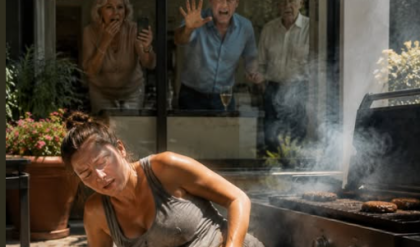
My mother stood at the patio entrance and stared at the floor where she had been kneeling two days earlier.
I hated that floor.
I wanted to tear it out with my hands.
“I’ll renovate it,” I said.
She shook her head.
“No.”
“Mamá—”
“No,” she repeated.
“We don’t erase where they hurt us.
We change what it means.”
The next morning, she asked me to buy flowers.
Yellow marigolds.
She placed them in a clay pot beside the lavadero.
Then she brought out my father’s Guadalupe painting and hung it facing the patio.
“There,” she said.
“Now your father watches this house again.”
I cried then.
Not loudly.
Not dramatically.
Just enough for my mother to pull me into her arms like I was still the boy who came home with scraped knees.
“You protected me,” she whispered.
“No,” I said.
“Too late.”
She held my face.
“Still counTS.”
Three weeks later, Renata asked to meet.
Diana said no.
Renata asked again through her lawyer.
No.
Then she sent a letter.
Not an apology.
A negotiation.
She offered to “settle privately” if I gave her access to one investment account and agreed not to testify against Ernesto.
I read the letter in Diana’s office.
Then I laughed.
It shocked both of us.
“What?” Diana asked.
“For six years, I thought she knew me better than anyone.”
“And?”
“She still thinks I can be bought.”
Diana smiled.
“Then let’s disappoint her.”
The hearing took place on a Thursday morning.
My mother wore a navy dress and my father’s watch.
She walked slowly, but she walked in on her own feet.
Renata arrived with three lawyers.
Ernesto arrived with five.
They did not look at each other.
That told me everything.
People who scheme together rarely fall together gracefully.
The courtroom was small, bright, and cold.
The judge, Mariana Cárdenas, reviewed the evidence without expression.
Renata’s lawyer spoke first.
He painted her as a stressed wife overwhelmed by caregiving responsibilities.
He said families sometimes used harsh language.
He said no one had been physically harmed.
My mother’s hand tightened around mine.
Diana stood.
“Your Honor, we will play only ninety seconds.”
Only ninety seconds.
Out of three weeks.
That was all it took.
Renata’s voice filled the courtroom.
“Your son will sign.
And when he does, I will put you somewhere clean enough for visitors and far enough that he stops remembering you.”
Then another clip.
“Fall again and I’ll tell him you’re doing it for attention.”
Then the final clip.
“Firma o la saco de esta casa.”
Sign, or I throw her out of this house.
The judge removed her glasses.
Renata stared at the table.
Her lawyer stopped taking notes.
Diana then presented the notary documents, the fake competency evaluation, the ledger, and Manuel’s signed statement.
Ernesto’s lawyer objected so many times the judge finally said, “Counsel, if you interrupt again without legal basis, I will treat it as strategy, not advocacy.”
That shut him up.
Then my mother testified.
Her voice was soft.
At first.
She talked about the small things.
How Renata corrected the way she ate.
How Renata told guests Carmen was “forgetful” before Carmen had forgotten anything.
How Renata moved her medication and then accused her of losing it.
How Renata made her ask permission to use the washing machine in the house my father helped buy.
Then Diana asked, “Doña Carmen, why didn’t you tell your son?”
My mother looked at me.
“Because she convinced me I would cost him everything.”
The judge’s face changed.
Just a little.
But I saw it.
“And did you believe her?”
My mother nodded.
“For a while.”
“What changed?”
She lifted her chin.
“My son came home before I broke.”
I could not breathe.
Renata cried then.
Beautiful tears.
Perfect timing.
She turned toward me.
“Alejandro, I loved you in my way.”
For the first time, my mother answered before I did.
“No, mija.
You loved winning.”
The courtroom went silent.
Even the judge looked down for half a second, maybe to hide something close to a smile.
Renata’s tears stopped.
There she was again.
The real one.
The orders came down hard.
Permanent no-contact order for my mother.
Temporary freeze of marital assets pending investigation.
Immediate suspension of any documents Renata had pressured me to prepare.
Referral to prosecutors for elder abuse, fraud, coercion, and corporate conspiracy.
And then the judge addressed me directly.
“Mr. Robles, the court recognizes your prompt action in preserving evidence.
Your mother remains under your chosen protective care.
No third party may remove her, evaluate her, or make decisions for her without court approval.”
My mother squeezed my hand.
Renata stood so fast her chair scraped.
“This is ridiculous.
He recorded me illegally.”
Diana did not blink.
“You were recorded in his home, threatening his mother, under circumstances already reviewed by the court.”
Renata looked at me with pure hatred.
“You will regret this.”
The judge’s voice cut in.
“Mrs. Valdés, threats in my courtroom are not recommended.”
Renata sat.
Ernesto did not speak.
He was too busy watching his empire crack through the floor.
The corporate case took longer.
Money always fights harder than people.
But the ledger gave us a map.
One by one, Ernesto’s allies began protecting themselves.
The bank officer claimed he had been pressured.
The legal consultant produced emails.
The hospital executive confirmed the old contracts had been redirected to a Valdés shell company.
And then came the recording that ended Ernesto.
It came from Renata.
Not because she grew a conscience.
Because she wanted a deal.
She sent Diana a file through her attorney.
Audio from three years earlier.
Ernesto’s voice.
“Once Alejandro signs the full power, we merge the company, sell the warehouses, and place the mother somewhere he can’t keep running back to.
Without Carmen, he folds.”
Then Renata’s voice, bored and sharp:
“And if he refuses?”
Ernesto laughed.
“Then you make him choose between being a husband and being a son.
Men hate that choice.
They always punish the mother first.”
I listened to it once.
Only once.
Then I walked into the kitchen and found my mother making coffee.
I told her.
She closed her eyes.
For a moment, she looked very tired.
Then she said, “Your father would have hated that man.”
“He did,” I said.
“He just didn’t know how right he was.”
Ernesto Valdés was arrested on a rainy morning outside his own office tower.
Cameras caught him covering his face with a folder.
Not dignified.
Not powerful.
Just small.
Renata was charged separately.
She avoided prison at first with lawyers and delays, but she lost the house, her access to my accounts, her position in every company document, and the one thing she loved most:
Control.
The divorce was not dramatic.
No screaming.
No final kiss.
No closure.
Just signatures.
This time, mine meant freedom.
Afterward, Diana handed me the stamped papers.
“Congratulations,” she said.
I looked at the document.
Divorced.
It should have felt like failure.
It felt like oxygen.
That afternoon, I took my mother to the old office.
Not the polished headquarters Renata liked.
The original one.
Two rooms above a tire shop.
The paint was peeling.
The stairs complained.
The sign outside still said ROBLES TRANSPORTES in faded blue letters.
My father’s first desk was there, covered in dust.
My mother ran her fingers over it.
“He used to eat tortas here,” she said.
“I remember.”
“He said one day you’d have a bigger office.”
“I do.”
She smiled.
“But this one made you.”
So we kept it.
I turned it into the Armando Robles Training Center for workers’ children.
Scholarships.
Accounting classes.
Driver safety courses.
Legal aid for employees with elder parents, because I had learned something terrible:
Abuse often begins with paperwork.
A signature.
A doctor’s letter.
A family meeting where one person’s voice slowly disappears.
My mother insisted on attending the opening.
She wore yellow.
At the end of the ceremony, she stood in front of everyone, small but unshaken.
“My husband built this company with honest hands,” she said.
“My son almost lost it because honest people sometimes think evil announces itself.
It doesn’t.
It comes well dressed.
It brings flowers.
It calls you family.”
No one moved.
She looked at me.
“But truth also waiTS. In ledgers.
In letters.
In cameras.
In sons who come home early.”
People applauded.
I looked away because I was crying again.
Months later, the patio was full of marigolds.
The lavadero was still there.
So was the Guadalupe painting.
Every Sunday, my mother cooked too much food and complained that I worked too hard.
Sometimes I still woke up angry.
Sometimes I remembered Renata’s voice and felt stupid for not seeing it sooner.
But then my mother would call from the kitchen:
“Alejandro, taste the salsa.”
And I would go.
Because that was the life Renata tried to take from me.
Not money.
Not property.
Not a company.
She tried to take the simple blessing of hearing my mother’s voice in my own home.
One evening, a final envelope arrived.
No return address.
Inside was my father’s original company seal.
Manuel Ortega had kept it all these years.
There was a note.
Your father said this seal should never touch a dishonest contract again.
I placed it beside his letter.
Then I called my mother.
She held the seal in both hands and kissed it.
“Now he rests,” she whispered.
I looked at the patio.
At the flowers.
At the floor that no longer looked like a place of humiliation.
At the home that had survived a woman who thought cruelty was power.
My phone buzzed.
Diana.
The message was short.
Valdés accepted full liability in the civil case.
Restitution approved.
I showed my mother.
She read it twice.
Then she handed the phone back and said the most Carmen Robles thing possible.
“Good.
Now tell them to pay the workers first.”
I laughed.
For the first time in years, the sound filled the whole house.
And somewhere, beneath the marigolds, the old floor dried clean.