
Aunt Martha opened the door before I could knock a second time.
She stood there wearing a faded green cardigan, her silver-streaked hair loosely tied behind her head.
The moment she saw my face, the color drained from hers.
“You heard us,” she whispered.
It was not a question.
I stepped inside without answering.
Her cottage smelled like cinnamon tea and old paper.
Sunlight spilled through the windows, falling across rows of carefully labeled folders stacked beside her desk.
Martha had spent thirty-four years working as an accountant.
Numbers were her language.
Records were her memory.
And now I needed her to tell me exactly how much of my life had been stolen.
“I need the truth,” I said.
“All of it.”
Martha closed the door behind me.
For several seconds, she simply stood there, one hand gripping the doorknob as though she needed it to remain upright.
Then she led me to the kitchen table.
“I told your mother this would happen,” she said quietly.
“I told her lies involving money always leave a trail.”
“How much did they take?”
Her eyes filled with shame.
“Cheryl—”
“How much?”
Martha sat down.
I remained standing.
She opened a drawer beside the table and removed a thick brown envelope.
My name was written across the front in her handwriting.
“I started keeping copies after Caleb bought the house,” she said.
“Your mother asked me to help organize their tax records.
That was when I discovered where the down payment came from.”
My fingers trembled as I opened the envelope.
Inside were bank statements, transfer receipts, loan documents, copies of canceled checks, and handwritten notes showing dates and amounTS.
My paymenTS.
Every month.
Twenty-five hundred dollars.
The transfers began six years earlier, exactly when my parents had promised to create my future fund.
But the money had never gone into an account for me.
The first eighteen months of payments had gone toward Caleb’s wedding, his car loan, and the down payment on his house.
The next two years had been used to rescue my father’s failing auto-parts business.
After that, my money paid off my parents’ credit cards, funded renovations to their kitchen, and covered several vacations they had told me were “anniversary gifts” from my brother.
There was no savings account.
There had never been one.
The screenshots showing thirty thousand dollars and ninety thousand dollars had been created using a basic editing program on my mother’s laptop.
I lowered myself into the chair across from Martha.
“How much should I have had by now?”
She slid a calculator toward herself even though I suspected she already knew the answer.
“Before interest, one hundred eighty thousand dollars.”
The number seemed unreal.
One hundred eighty thousand dollars.
Six years of waking before sunrise.
Six years of missing birthdays, trips, weddings, dinners, and opportunities because I believed every sacrifice was bringing me closer to independence.
Six years of wearing the same winter coat while Caleb posted photographs from luxury resorTS.
“Your father also listed some of the payments as business investments,” Martha continued.
“He created documents suggesting you willingly invested in his company.”
“I never signed anything.”
“I know.”
She pulled another paper from the envelope.
My name appeared at the bottom.
The signature looked almost like mine.
Almost.
My father had forged it.
For the first time since entering the cottage, I felt tears burn behind my eyes.
They had not merely spent my money.
They had prepared a defense.
If I ever discovered the truth, they intended to say I had agreed.
“I should have told you sooner,” Martha said, her voice breaking.
“Your mother begged me not to destroy the family.
She said Frank would pay you back once the business recovered.”
“Did the business recover?”
“Yes.”
“And did they pay me back?”
Martha looked down.
“No.”
“What did they do with the profits?”
“Frank bought a warehouse last year.
Caleb became a partner.”
A sound escaped me, somewhere between a laugh and a sob.
My father had used my money to save his business, then rewarded my brother with ownership.
“What else?” I asked.
Martha hesitated.
“There’s another reason they kept you in that house.”
She reached into the envelope and removed a property document.
My parents’ mortgage had been refinanced three years earlier.
According to the paperwork, they needed consistent household income to qualify.
My monthly payments had been recorded as rental income.
“That’s why they never wanted you to move,” Martha explained.
“Your money helped them qualify for the loan.”
I stared at the page until the words blurred.
Every time my mother told me I was close to my goal, she had been making sure I remained useful.
Every time my father praised my discipline, he had been protecting his income.
Every time they said they were doing it for my own good, they were securing theirs.
I carefully placed every document back into the envelope.
“Will you testify?”
Martha’s face tightened.
“If this goes to court?”
“Yes.”
She looked toward the photographs on her mantel.
My mother stood beside her in several of them, smiling at weddings, birthdays, and Christmas dinners.
“I love my sister,” Martha whispered.
“So did I.”
That answer seemed to settle something inside her.
She nodded.
“Yes.
I’ll testify.”
Over the next three weeks, I became the calmest version of myself I had ever been.
I woke up, went to work, came home, and smiled through dinner.
I continued sending the monthly payment, but this time I transferred it electronically rather than handing over cash.
In the payment description, I wrote: Deposit for Cheryl’s promised home savings account.
My mother sent me a heart emoji.
My father replied: Proud of you.
Keep building your future.
I saved both messages.
Martha introduced me to an attorney named Elena Park, a sharp, patient woman who listened without interrupting as I explained everything.
When I finished, Elena folded her hands on the desk.
“This is not a family misunderstanding,” she said.
“This is fraud, conversion of funds, forgery, and possibly tax fraud.”
Hearing the legal words made the betrayal feel heavier, but also clearer.
My parents had spent years wrapping theft in the language of love.
Elena helped me prepare a formal demand for repayment.
She also advised me to move my important possessions out of the house before confronting them.
So I quietly rented a small apartment near work.
It was only one bedroom, with scratched floors and a narrow balcony overlooking a parking lot.
But the first time I unlocked the door, I stood in the empty living room and cried.
Not because it was beautiful.
Because it was mine.
I moved small things first.
My birth certificate.
My college diploma.
My grandmother’s necklace.
Clothes my parents would not notice.
Then Elena told me to wait for the right moment.
That moment arrived at Caleb and Heidi’s sixth wedding anniversary dinner.
My parents hosted it at their house.
The dining table was covered with expensive food, crystal glasses, and flowers my mother had ordered that morning.
Caleb sat beside Heidi, talking proudly about expanding the family business.
“We’re opening a second location,” he announced.
“Dad says I’ll manage the whole operation.”
My father lifted his glass.
“To my son, the future of the company.”
Everyone raised their drinks.
I did too.
Then Heidi smiled at me.
“And what about you, Cheryl? Are you finally close to buying your apartment?”
The room shifted.
My mother’s hand paused above her plate.
My father gave a short laugh.
“She still has a lot to learn about the real world.”
I looked at him.
“Really?”
“You’ve been living comfortably under our roof for six years,” he said.
“You should be grateful.”
“I thought I was saving money.”
My mother quickly forced a smile.
“You are, sweetheart.”
But my father had already consumed several glasses of wine, and arrogance had loosened his judgment.
He leaned back in his chair.
“Oh, stop pretending, Dorothy.
She’s old enough to hear the truth.”
My brother frowned.
“What truth?”
My father looked directly at me.
“That money wasn’t savings.
It was rent.”
The words hung over the table.
He laughed.
Caleb gave an uncomfortable chuckle, as though he was waiting to see whether it was a joke.
My mother whispered, “Frank, not tonight.”
But he continued.
“What did you expect, Cheryl? Free housing forever? Food, electricity, water, a bedroom? Twenty-five hundred a month was fair.”
I stared at him silently.
For six years, I had imagined discovering the truth would destroy me.
Instead, I felt strangely peaceful.
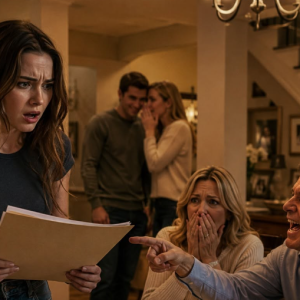
I reached beneath my chair and lifted the black folder I had placed there before dinner.
My father’s smile disappeared.
“What’s that?”
I set the folder on the table.
“The future you promised me.”
My mother’s face turned pale.
I opened it.
First, I placed the screenshots in front of them.
Thirty thousand dollars.
Ninety thousand dollars.
One hundred fifty thousand dollars.
All fake.
 Pregnant Women Chooses Her Mother And Husband For The Delivery Room, But Her MIL’s Overreaction Causes Family Drama
Then I placed the bank transfers beside them.
Payments to Caleb’s mortgage lender.
Payments to my father’s business.
Payments toward my parents’ debTS.
Finally, I placed the forged investment agreement in front of my father.
His expression changed from confusion to fear.
Caleb picked it up.
“What is this?”
“Ask Dad,” I said.
“He forged my signature to make it look like I invested in the company.”
“That’s ridiculous,” my father snapped.
I removed my phone and pressed play.
My mother’s recorded voice filled the dining room.
“That covered almost all of Caleb’s expenses.
She still has no idea.”
No one moved.
The recording continued.
“Frank says if she keeps this up for another two years, we’ll finish paying off the business too.”
Heidi slowly turned toward Caleb.
“You told me your parents gave us the down payment.”
Caleb’s face had gone white.
“They did.”
“With Cheryl’s money,” Heidi said.
“I didn’t know.”
I studied my brother carefully.
Perhaps he was telling the truth.
Perhaps he had simply never asked because accepting money was easier than questioning where it came from.
My mother began to cry.
“Cheryl, please.
We always intended to replace it.”
“When?”
“As soon as the business was stable.”
“The business has been profitable for three years.”
My father slammed his palm against the table.
“Enough! This is our house.
We fed you.
We raised you.
Everything you have is because of us.”
“No,” I said calmly.
“Everything you have is because of me.”
He stood so quickly that his chair struck the wall.
“You ungrateful little—”
The doorbell rang.
My father froze.
I closed the folder.
“That will be my attorney.”
Elena entered with Aunt Martha beside her.
The moment my mother saw her sister, she began shaking her head.
“Martha, how could you?”
Martha’s eyes filled with tears, but her voice remained steady.
“How could I? Dorothy, she trusted you.”
Elena placed a formal notice on the table.
“My client is demanding repayment of one hundred eighty thousand dollars, plus the value of funds obtained through misrepresentation, legal fees, and applicable interest.”
My father laughed bitterly.
“You think you can threaten me in my own home?”
“This is not a threat,” Elena replied.
“It is an opportunity to resolve the matter before we file a civil claim and refer the forged documents to the appropriate authorities.”
My mother covered her mouth.
Caleb stared at the papers.
“What happens to the business?”
“If the business benefited from stolen funds, its assets may become relevant,” Elena said.
My father turned toward me.
For the first time in my life, I saw him look afraid.
“You would destroy your brother’s future?”
I stood.
“No.
You used my future to build his.
I’m only asking for mine back.”
My mother rushed around the table and grabbed my arm.
“Please don’t leave like this.”
I gently removed her hand.
“I moved out yesterday.”
Her face collapsed.
“Where?”
“Somewhere you don’t have a key.”
“You’re our daughter.”
“I was your daughter when I asked for statemenTS. I was your daughter when you forged those screenshoTS. I was your daughter every month you watched me hand over half my salary.”
She began sobbing.
I wanted to feel victorious.
Instead, I felt tired.
Caleb stood and looked at our parenTS.
“Did you really use her money for my house?”
My father remained silent.
Caleb’s voice rose.
“Answer me!”
“Yes,” my mother whispered.
He sat down as if someone had struck him.
Heidi removed her wedding ring, placed it beside her plate, and looked at him.
“You may not have known at first,” she said, “but you know now.
What you do next will tell me who you are.”
That night, I left the house with Elena and Martha.
My father did not apologize.
My mother called seventeen times before midnight.
I answered none of them.
Two days later, Caleb came to my apartment.
He stood in the hallway holding a cashier’s check for forty thousand dollars.
“It’s everything we have left from our emergency savings,” he said.
“We’re selling the house.”
I stared at him.
“You don’t have to leave yourself homeless.”
“I lived in a home you paid for while you were sleeping in your childhood bedroom and being told to be patient.”
His eyes were red.
“I should have asked questions.
Dad always treated me like I deserved more.
I let him.”
That was not a full apology.
But it was an honest one.
I accepted the check.
Not because it fixed everything.
Because accountability had to begin somewhere.
The legal battle lasted eleven monThS.
My parents sold the warehouse.
My father surrendered his ownership in the business.
The forged investment agreement became the strongest evidence against him, and facing the possibility of criminal charges, he agreed to a settlement.
I recovered the full principal, a significant portion of the interest, and my legal fees.
My mother sent letters every week.
Some blamed my father.
Some blamed stress.
Some reminded me of childhood birthdays, family vacations, and all the meals she had cooked.
The final letter was different.
It contained only four sentences.
We stole from you.
We lied because admitting the truth would have cost us the life we wanted.
You did not destroy this family.
We did.
I kept that letter.
Not as forgiveness.
As proof that the truth had finally been spoken without excuses.
A year after the dinner, I signed the papers for a small townhouse with white walls, a bright kitchen, and a maple tree outside the front window.
I did not use all the settlement money for the down payment.
I created an emergency fund.
I invested part of it.
And I opened a separate savings account that no one else could access.
On the day I received the keys, Martha brought a potted lavender plant.
Caleb and Heidi arrived with Joy, carrying pizza and folding chairs.
Their marriage had survived, but only after counseling, hard conversations, and Caleb stepping away from my father’s business to build something of his own.
My parents were not invited.
Maybe one day they would be.
Maybe they never would.
Forgiveness, I had learned, was not a door someone else could demand I open.
It was a decision that belonged to me, and it did not require me to surrender the locks.
As evening settled over my new home, Joy ran through the empty rooms, laughing at the echo of her own voice.
“Is this really all yours, Aunt Cheryl?” she asked.
I looked around.
At the bare floors.
At the unopened boxes.
At the keys resting in my palm.
“Yes,” I said.
“It really is.”
She wrapped her arms around my waist.
“I’m going to save money for a house too.”
I knelt beside her.
“Then make sure you know where your money is.”
Everyone laughed, but I held her gaze.
“Always ask questions,” I told her.
“People who truly love you will never punish you for protecting yourself.”
Later, after everyone left, I stood alone on the small balcony.
For years, I believed my future existed inside an account controlled by my parenTS.
I thought security meant obeying them.
I thought gratitude meant silence.
I thought being a good daughter required trusting people who repeatedly refused to be trustworthy.
But my future had never been inside their bank.
It had been inside every difficult choice I was finally brave enough to make.
The choice to listen when something felt wrong.
The choice to document the truth.
The choice to walk away.
The choice to refuse shame for a betrayal that was never mine.
I opened my phone and checked my savings account.
The numbers were real.
The bank name was visible.
The account was in my name.
And for the first time, the balance did not represent six years of sacrifice.
It represented freedom.
My father once told me I would thank him one day.
He was wrong.
I did not thank him for stealing from me.
I thanked the woman I became when I stopped waiting for my family to save my future and finally chose to save it myself.