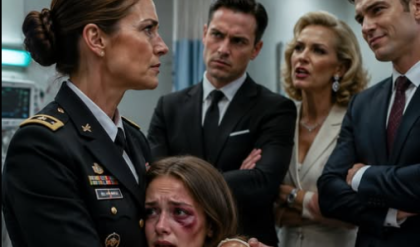
The first truth I told Angela Moore was the smallest one.
“Brittany pushed me down the basement stairs when I was twelve.”
My voice sounded distant, as if another girl were speaking through me.
Angela sat beside the hospital bed with a notebook resting unopened on her lap.
She did not interrupt.
She did not rush me.
She simply waited.
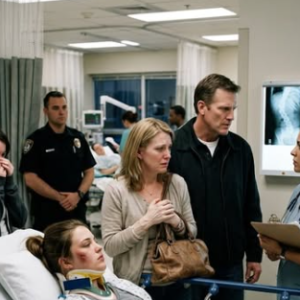
So I told her another truth.
“She broke my wrist when I was thirteen.”
Then another.
“She hit me with a lamp last winter.”
The words came faster after that.
Every bruise my parents had covered with long sleeves.
Every school absence explained by fake illnesses.
Every time my mother had placed an ice pack against my skin and whispered, “Don’t make this worse for your sister.”
Every time Dad had warned me that telling anyone would destroy the family.
Angela’s expression remained gentle, but her eyes changed as I spoke.
The softness stayed, yet something stronger appeared behind it.
Anger.
Not at me.
For me.
When I finally stopped, the room felt too quiet.
Angela glanced toward the curtain, where my father’s voice could still be heard arguing with Detective Nolan.
“Has Brittany always hurt you?” she asked.
I stared at the white blanket over my legs.
“No.”
Angela waited.
“She started after the accident.”
Her pen paused.
“What accident?”
My stomach tightened.
It had happened six years earlier, but my parents had trained me never to speak about it.
Even mentioning that night could turn Dad’s face cold and make Mom begin crying.
I looked toward the curtain.
“They told everyone I fell from the treehouse,” I whispered.
Angela leaned closer.
“But you didn’t?”
I shook my head.
“The treehouse was already gone.”
Angela’s expression sharpened.
“Emily, what happened that night?”
Before I could answer, someone shouted outside.
“You have no right to separate us from our child!”
Dad’s voice echoed through the emergency department.
Detective Nolan replied calmly, “Your daughter is sixteen and receiving treatment for multiple injuries.
At this moment, you do not control who speaks with her.”
A crash followed.
It sounded like a chair striking the wall.
The security officer called for assistance, and footsteps rushed past the room.
Angela stood and moved toward the curtain, but I grabbed her sleeve.
“Please don’t leave.”
She turned back immediately.
“I’m not going anywhere.”
My fingers released the fabric.
I had spent my whole life being told that adults would leave if I caused trouble.
Angela sat again.
“Tell me about the accident,” she said.
I closed my eyes.
I could still see the summer storm outside our old house.
Brittany had been thirteen.
I had been ten.
Rain hammered the windows while our parents argued downstairs.
Brittany had come into my room shaking.
Not angry.
Terrified.
“She told me we had to leave,” I said.
“She packed some clothes in my backpack and told me not to make noise.”
“Why did she want to leave?”
“Because of Dad.”
Angela’s face became still.
I forced myself to continue.
“He had been drinking.
Mom wanted to take us to our aunt’s house.
Dad found the suitcase.”
The memories returned in broken flashes.
Dad blocking the front door.
Mom screaming.
Brittany pulling me toward the garage.
A car engine starting.
My father grabbing the driver’s door.
Then the vehicle rolling backward.
“I was in the back seat,” I whispered.
“Brittany was driving.”
Angela drew in a slow breath.
“At thirteen?”
“She didn’t know how.
She was just trying to get us away.”
The car had rolled down the sloped driveway, crossed the road and struck a concrete drainage wall.
I remembered glass breaking.
Brittany screaming my name.
My mother dragging me out before the neighbors arrived.
Dad had invented the treehouse story that same night.
But that was not the secret that had destroyed us.
“After the crash, Brittany changed,” I said.
“She would wake up screaming.
She stopped going to school for a while.
Sometimes she didn’t remember things.”
“Was she treated by a doctor?”
I laughed once, but there was no humor in it.
“Dad said therapists asked too many questions.”
Angela looked toward the curtain again.
“Did Brittany ever receive medical care after the collision?”
“Only at a clinic Dad’s friend owned.
They said she had a concussion.”
“And you?”
“I had stitches.
Mom said not to mention the car.”
Angela’s hand tightened around her pen.
The curtain suddenly opened.
Detective Nolan stepped inside, followed by Dr. Grant.
Two more security officers stood behind them.
My father was no longer in the hallway.
My mother was crying into both hands.
Brittany sat in a chair with her shoulders folded inward, looking younger than nineteen.
Detective Nolan approached my bed.
“Emily, your father has been escorted from the treatment area.
He attempted to force his way past security.”
A tremor ran through me.
“Is he coming back?”
“No.”
The certainty in her voice made me believe her.
Dr. Grant moved to the scans.
“Emily, there is something else we need to discuss,” she said.
Angela stood beside her.
Dr. Grant pointed to a pale mark near the base of my skull.
“When we examined today’s injuries, we also found evidence of an older untreated fracture.”
I stared at the image.
“It likely occurred years ago,” she continued.
“Based on the healing pattern, it may match the time of the car accident you described.”
My mother made a broken sound outside the curtain.
Dr. Grant turned toward her.
“You knew there had been a collision.”
Mom slowly lowered her hands.
“I didn’t know Emily remembered.”
Those words changed the room.
Detective Nolan stepped closer.
“You did not say you believed she was mistaken,” she said.
“You said you didn’t know she remembered.”
Mom’s face collapsed.
Brittany looked at her.
“What is she talking about?”
Mom began shaking her head.
“Linda,” Detective Nolan said, “this is the moment to tell the truth.”
For several seconds, my mother could not speak.
Then she whispered, “Richard caused the crash.”
Dad’s name sounded unfamiliar in her mouth.
Brittany stood so quickly the chair scraped backward.
“No.
I was driving.”
“You were a child,” Mom cried.
“You were trying to escape him.”
Brittany’s eyes filled with confusion.
“You told me it was my fault.”
Mom covered her mouth.
The silence that followed was more painful than shouting.
Brittany stared at her as if she had never seen her before.
“You told me I almost killed Emily.”
“I was scared,” Mom said.
“Your father said if the police found out you had been driving, you would be taken away.
He said we would lose everything.”
“So you let me believe it?”
“Brittany—”
“For six years?”
My sister’s voice cracked.
Suddenly, I understood something I had never allowed myself to consider.
Brittany had not only become violent after the crash because of the injury.
She had grown up believing she had nearly killed me.
Dad had used her guilt like a chain.
Whenever she lost control, he reminded her that she was dangerous.
Whenever she regretted hurting me, he told her it was simply who she had always been.
And Mom had helped him.
Brittany turned toward me.
Her face was wet with tears.
“I thought you hated me.”
I could barely breathe.
“I was afraid of you.”
The words wounded her, but I did not take them back.
Fear had protected their lies for too long.
“I know,” she whispered.
Detective Nolan asked my mother to sit down.
“Start from the beginning.”
Mom looked at me, but I turned away.
She did not deserve permission from my eyes.
“The night of the crash,” she began, “Richard had been drinking.
He had hit Brittany earlier.
I told the girls to pack because I planned to leave.”
Brittany’s hand went to her cheek as if she could still feel the old blow.
“Richard found the suitcase,” Mom continued.
“He blocked the door.
Brittany grabbed the keys from the counter and ran to the garage with Emily.”
“You allowed a thirteen-year-old child to drive?” Detective Nolan asked.
“I was trying to stop Richard from reaching them.
But he broke away from me and grabbed the car door while it was moving.
Brittany panicked.
She pressed the wrong pedal.”
Mom’s voice dissolved into sobbing.
“After the crash, Richard said he would tell the police Brittany stole the car.
He said she would be sent away and I would lose custody of both girls.
So we lied.”
“And the old injuries?” Angela asked.
Mom looked at the floor.
“At first, Brittany only had outbursTS. She would throw things.
Then she started hitting Emily.”
“You witnessed it?” Detective Nolan asked.
“Yes.”
“How many times?”
Mom did not answer.
Detective Nolan repeated the question.
“I don’t know.”
 His Kids Boycott His Wedding After He Refuses To Invite Grandma, Family Drama Explodes
“You don’t know, or you don’t want to count?”
Mom began crying harder.
“I thought I could keep everyone together.”
That was the sentence that finally made something inside me break open.
“Together?”
Everyone turned toward me.
I pushed myself upright despite the pain in my ribs.
“You didn’t keep us together.”
My voice shook, but it did not disappear.
“You trapped us.”
Mom stared at me.
“You made Brittany believe she was a monster.
You made me believe I deserved to be hurt.
You protected Dad every time he threatened us, and then you protected Brittany every time she copied him.”
“I never wanted this,” she whispered.
“But you chose it.”
Mom flinched.
For once, I did not apologize for hurting her feelings.
The detective closed her notebook.
“Mrs. Whitaker, you are being detained while we investigate child endangerment, obstruction and possible evidence tampering connected to the earlier collision.”
Mom looked toward Brittany.
“Please tell them I’m not a bad mother.”
Brittany stepped backward.
“I don’t know what you are.”
A female officer arrived and escorted Mom away.
She called our names as she left.
Neither of us answered.
By sunrise, the hospital had become strangely calm.
Dad was arrested for assaulting the security officer and interfering with an investigation.
A search warrant was issued for our house.
Officers found old medical supplies, photographs of my injuries on Mom’s phone and a locked box containing documents from the private clinic that treated us after the crash.
The records had been altered.
The doctor who signed them had died two years earlier, but his notes showed that both Brittany and I had suffered injuries consistent with a vehicle collision.
They also contained a warning that Brittany needed neurological and psychological treatment.
Dad had refused.
That refusal had shaped the next six years of both our lives.
Angela arranged temporary placement for me with my aunt Rebecca, my mother’s older sister.
I had met her only twice because Dad claimed she was unstable and bitter.
The truth was simpler.
She had begged Mom to leave him for years.
When Aunt Rebecca arrived at the hospital, she did not rush to hug me.
She stopped a few feet away and asked, “May I come closer?”
That question almost made me cry.
No one in my family had ever asked permission before entering my space.
I nodded.
She sat beside me and held my hand carefully, avoiding the IV line.
“You will never have to return to that house,” she said.
I wanted to believe her, but safety felt like a language I had never learned.
“What about Brittany?”
Across the hall, my sister was being evaluated by another doctor.
Angela answered gently.
“She is an adult, Emily.
She will be questioned, and she may face charges for hurting you.
But her medical history and what happened when she was a child will also be considered.”
“Will she go to jail?”
“I can’t promise what the prosecutor will decide.”
I looked toward the doorway.
Part of me wanted Brittany punished.
Another part remembered the terrified thirteen-year-old girl who had packed my clothes and tried to save us.
Both truths could exist.
She had been abused.
She had also abused me.
Understanding her did not erase what she had done.
Two days later, Brittany asked to speak with me.
A detective, Angela and my aunt remained nearby.
Brittany entered wearing hospital clothes and no makeup.
Without her usual angry expression, she looked exhausted.
She stopped several feet from the bed.
“I’m not asking you to forgive me,” she said.
I said nothing.
“I kept telling myself you caused my anger because that was easier than admitting I had become like Dad.”
Her hands trembled.
“I remembered parts of the crash.
Mostly you crying in the back seat.
Dad kept saying I nearly killed you.
Every time I looked at you, I felt guilty.
Then I hated you for making me feel guilty.”
“You hurt me because you thought you had already hurt me?”
She nodded, ashamed.
“It doesn’t make sense.”
“No,” I said.
“It doesn’t.”
Tears filled her eyes.
“I’m going into treatment.
The doctors think the head injury affected my impulse control, but they said that doesn’t excuse my choices.”
For the first time, Brittany was speaking without defending herself.
“I told Detective Nolan everything,” she continued.
“Every time I hit you.
Every time Mom covered it up.
I told them where Dad kept the old camera.”
“What camera?”
She looked down.
“The garage security camera from the night of the crash.”
My breath stopped.
“Dad told Mom he destroyed it.
He didn’t.
He kept the hard drive because he used the footage to scare her whenever she talked about leaving.”
The recording showed everything.
Dad striking Brittany.
Mom telling us to run.
Brittany pulling me into the car.
Dad chasing us and grabbing the door.
The vehicle rolling backward.
The lie that controlled our family had been preserved by the man who created it.
He had kept evidence of his own cruelty because he was certain no one would ever challenge him.
He was wrong.
Six months later, Dad pleaded guilty to child abuse, obstruction, evidence tampering and several related charges.
The assault at the hospital added to the case.
Mom accepted a separate plea agreement for child endangerment and failure to report abuse.
She was required to complete counseling, but the court also prohibited her from contacting me without my consent.
Brittany’s case was more complicated.
Because she admitted what she had done, cooperated fully and entered long-term neurological and psychiatric treatment, she received a suspended sentence with strict conditions.
She moved into a supervised treatment residence.
For almost a year, I did not speak to her.
Healing did not arrive dramatically.
There was no moment when every nightmare disappeared.
It came in smaller ways.
The first night at Aunt Rebecca’s house, I locked my bedroom door and stayed awake until morning, waiting for someone to punish me.
No one did.
The first time I dropped a glass in the kitchen, I froze and covered my face.
Aunt Rebecca simply brought a broom.
“Are you cut?” she asked.
When I shook my head, she said, “Then it’s just a broken glass.”
Just a broken glass.
Not a reason to be hit.
Not evidence that I was careless.
Not proof that I ruined everything.
At school, I began meeting with a counselor.
I learned that surviving danger can make peace feel suspicious.
I learned that guilt often belongs to the people who caused the harm, even when they teach the victim to carry it.
Most importantly, I learned that telling the truth did not destroy my family.
The abuse had done that years earlier.
The truth simply opened the locked doors.
On my eighteenth birthday, I received a letter from Brittany.
I almost threw it away.
Instead, I opened it with Aunt Rebecca sitting nearby.
Emily,
I used to think saying I was sorry should be enough.
Now I understand that an apology is not a key that gives me access to your life.
I hurt you.
Whatever happened to me does not change what I did to you.
Treatment has helped me remember more about the sister I was before Dad taught me to hate myself.
I remember holding your hand during thunderstorms.
I remember packing your favorite sweater before we tried to leave.
I remember promising I would always protect you.
Then I became someone you needed protection from.
I will regret that for the rest of my life.
You do not owe me forgiveness, contact or another chance.
I only want you to know that the truth you told in the hospital saved both of us.
You saved yourself first, and you had every right to.
Brittany
I read the letter twice.
Then I folded it and placed it in a drawer.
I did not call her that day.
Forgiveness was not a debt.
But three months later, I agreed to meet her in a therapist’s office.
She looked different.
Healthier.
Quieter.
We did not hug.
We sat across from each other, and for the first time, no one told me what I was allowed to say.
“I’m still angry,” I told her.
“You should be.”
“I don’t trust you.”
“I understand.”
“I may never want you in my life the way you want.”
She swallowed and nodded.
“I know.”
Then I asked the question I had carried for years.
“Why didn’t you tell anyone Dad hit you?”
Her eyes filled with tears.
“For the same reason you didn’t tell anyone I hit you.”
Fear.
Shame.
Loyalty to people who had taught us that silence was love.
We did not become sisters again that afternoon.
But we became honest.
Sometimes that is where healing begins.
Years later, I returned to the same hospital where Dr. Marisol Grant had looked at my scans and recognized the pattern everyone else had ignored.
I was no longer a frightened sixteen-year-old beneath a thin white blanket.
I was a college graduate beginning my first day as a child advocacy caseworker.
Dr. Grant met me near the emergency department.
“You look different,” she said.
“I feel different.”
She smiled.
“Good.”
Before she walked away, I asked her something.
“Did you know that night? When you called security before speaking to my parents—did you know my father would react that way?”
She considered the question.
“I didn’t know what he would do,” she said.
“But I knew you deserved to be protected while we found out.”
That answer stayed with me.
Protection should never depend on proving exactly how dangerous someone is.
Sometimes it begins when one person notices the old fractures beneath the new ones.
Sometimes it begins when a doctor refuses to accept, “We’ll handle this at home.”
Sometimes it begins when hospital doors lock behind the people who have spent years controlling every exit.
And sometimes it begins when a terrified girl finally tells the truth and discovers that the world does not end.
Only the lie does.